
 Tiếng Việt
 한국어
한국어 日本語
日本語Article· Updated October 15, 2026
Choosing the Right POSM Storage Space? Storage Solutions for Marketing Agencies
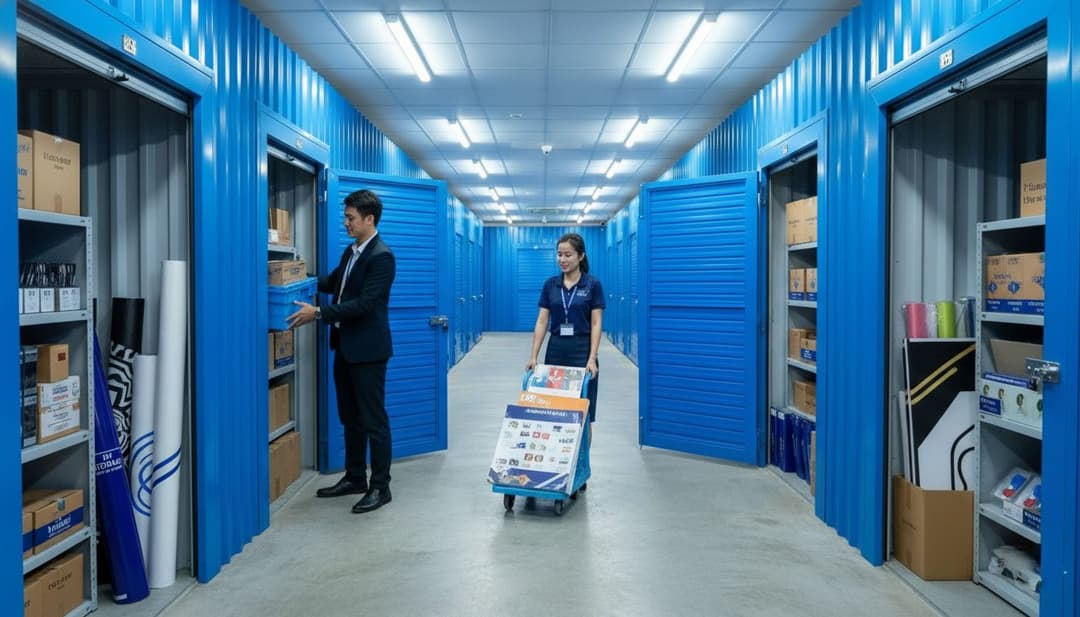
POSM storage for agencies is a specialized warehousing solution designed to preserve, manage, and distribute marketing materials such as standees, booths, banners, and activation props. Utilizing a dedicated warehouse helps agencies optimize costs, control inventory, reduce loss, and deploy campaigns more swiftly.
What is POSM and Why Do You Need Dedicated Storage?
POSM (Point of Sale Materials) are marketing items deployed at sales points or events to attract attention, convey brand messages, and drive immediate purchasing decisions. POSM needs to be stored correctly to prevent damage before use and ensure reusability, a task most businesses perform inefficiently, leading to significant waste of marketing budgets.
Unlike regular goods, POSM combines two of the most challenging storage characteristics: bulky dimensions (2-meter standees, modular booths, large-format printed backdrops) and fragile materials (printed paper, fabric, acrylic plastic, PVC foam). A warped standee or a stained banner cannot be used at an event, meaning the entire production cost is lost, and the business has to reprint from scratch.
Common Types of POSM and Specific Storage Requirements
POSM is not a homogeneous group; each type has different sizes, materials, and sensitivities, requiring specific storage conditions.
- Standees & Display Stands Standees are the most common type of POSM in retail and events, featuring metal or plastic frames combined with PP or PVC printed panels. Vulnerable points: The standee base is easily deformed under pressure, and printed panels can warp when exposed to heat or humidity. Storage requirements: Store upright or flat without stacking, in a well-ventilated area away from direct sunlight.
- Booths & Kiosks Exhibition and event booths are often designed as modular systems made from aluminum frames, printed panels, display shelves, and backdrops. They are large (typically 3x3m to 6x3m when assembled) but can be disassembled into smaller parts for storage. Challenges: Components are easily lost without a proper numbering and packaging system; aluminum frames can scratch if not stacked correctly.
- Banners, Backdrops & Large-Format Printed Items This group is the most sensitive regarding storage conditions. Fabric banners and sublimation-printed backdrops can be rolled to save space, but if rolled incorrectly or left tightly rolled for too long, the fabric will develop permanent creases that cannot be removed before deployment. PP plastic banners, when exposed to prolonged humidity, will peel off the print layer and fade unevenly. Requirements: Temperature below 28°C, humidity below 65% RH, gently rolled onto a core tube with a minimum diameter of 10 cm.
- Leaflets, Brochures & Paper Publications Seemingly simple, but leaflets and brochures are the most frequently damaged in practice because they are often stored most casually. High-quality coated paper (coated paper, art paper) will warp and pages will stick together when damp; printing ink oxidizes over time, causing colors to fade; and ants and termites attack paper very quickly in Vietnam’s tropical conditions. Requirements: Store in sealed cardboard boxes, placed on shelves at least 15 cm from the floor, away from moisture sources or air conditioner drainage.
- Wobblers, Shelf Talkers & Small Items This group includes small items such as hang tags, shelf labels, stickers, tent cards, and hangers, often produced in large quantities (thousands to tens of thousands per batch). The challenge is not storage conditions but inventory management: not knowing how many are left, which type, or for which campaign — leading to wasteful overprinting or stock shortages right before deployment day.
According to an internal survey of marketing agencies in Vietnam, 25–40% of POSM is damaged before its second deployment due to poor storage conditions, equivalent to wasting 25–40% of the production budget for each re-deployment campaign.
Why Can’t POSM Be Stored Casually?
Most businesses store POSM in the most convenient way: a corner of the warehouse, an unused meeting room, office corridors, or even under the stairs. Each of these choices leads to losses in its own way.
- Shared space with other goods causes mechanical damage: POSM crushed by heavy boxes will suffer structural deformation and leave irreversible wrinkles on printed panels. Stacking standees horizontally – the most common storage method – warps the bases and breaks connectors after 2–3 stacking instances. This is why many businesses have to order new standees for each campaign, even if the design isn’t outdated.
- Temperature and humidity conditions in Vietnam are particularly unfavorable: Uncontrolled warehouses in Ho Chi Minh City can reach 38–42°C during the day and experience humidity fluctuations of 70–90% RH during the rainy season. For printed materials, these are ideal conditions for: PVC plastic to become brittle and crack; ink on fabric banners to fade and yellow; adhesive on booth components to soften and loosen; and brochure paper to warp and become damp.
- Lack of a management system causes loss and confusion: Nothing is more frustrating than having to search for 30 minutes before an event day only to discover that the backdrop set for one campaign is mistakenly mixed with items from another, or worse, cannot be found at all, even though you’re sure it hasn’t been discarded. No labels, no catalog, no fixed location – this is a common situation when POSM is stored mixed with office supplies and other goods.
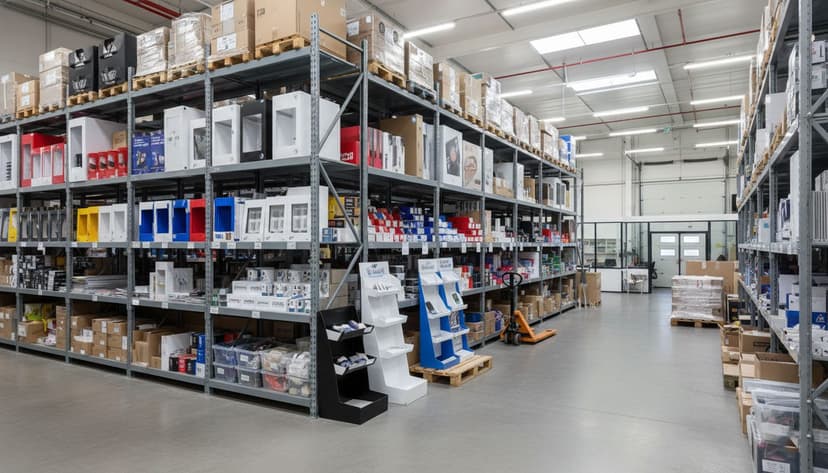
Dedicated POSM Storage — Minimum Requirements
A standard POSM storage space doesn’t need to be complex or expensive, but it must meet certain basic conditions that regular warehouses and office spaces cannot provide:
- Stable temperature below 28°C: More importantly, the daily temperature fluctuation range should not exceed 5–8°C. Repeated temperature changes are the primary cause of plastic material shrinkage and print layer peeling.
- Humidity controlled below 65% RH: Given the climate conditions in Southern Vietnam, a warehouse needs a dehumidifier or air conditioning to actively maintain humidity, rather than relying solely on natural ventilation.
- Specialized shelves and racks: Standees should have dedicated hanging racks or standing compartments. Banners and backdrops should be rolled and stored horizontally on core tubes, not stacked. Small POSM boxes should be placed on clearly labeled shelves, at least 15 cm off the floor to prevent moisture from the ground.
- Basic inventory management system: A list of items by campaign, date of entry, quantity, condition, and storage location – even a regularly updated Excel file – is better than nothing.
Businesses running 4–6 POSM campaigns annually with an average production budget of 50–200 million VND per campaign can save 20–40% on reproduction costs by investing in proper storage. This translates to 40–120 million VND saved annually just from better POSM preservation.
What is a POSM Storage for Agencies?
A POSM storage facility is a specialized space designed to systematically and professionally preserve, categorize, and manage marketing materials, from standees, booths, and banners to leaflets and event giveaways. Unlike a typical warehouse, a POSM storage is organized around the marketing campaign lifecycle: items are received after production, stored between deployments, dispatched on time before events, and re-inventoried upon return.
For a marketing agency running 10–30 campaigns annually for multiple clients, a POSM warehouse is not just an operational detail but a competitive advantage. Agencies that manage POSM well can reuse items more efficiently, respond faster when clients need urgent deployments, and significantly reduce recurring production costs for themselves and their clients.
POSM Warehouse Models Agencies Can Choose From
Not every agency needs the same warehouse solution. The choice depends on the volume of POSM being managed, the number of clients, and the frequency of campaign deployments.
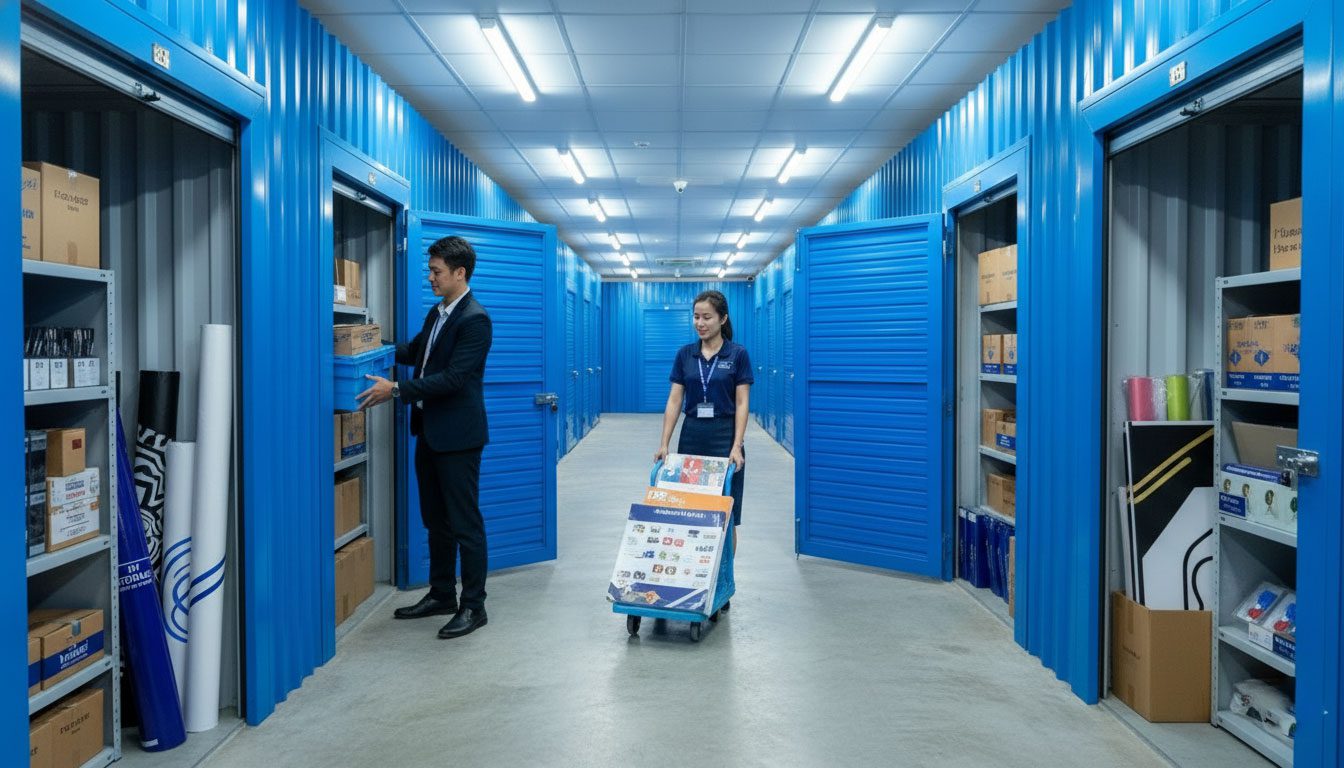
Self-managed mini warehouse: Suitable for small to medium-sized agencies running under 20 campaigns annually, primarily dealing with standees, roll-up banners, and small item boxes. Storage units from 1–20 m3 can be rented monthly from professional storage providers, offering private locks, 24/7 cameras, humidity control, and flexible access. Mini warehouse rental costs range from 0.5 – 4 million VND/month, with no long-term commitment required.
- Biggest advantage: No need for dedicated warehouse staff and flexible space adjustment during peak campaign seasons (typically Q4 and before Tet). Ideal for starting out before an agency grows large enough to require more complex solutions.
Dedicated warehouse within the agency office or workshop: Some larger agencies allocate a separate area within their office or rent additional space specifically for POSM storage. This model allows for the most comprehensive control, enabling agencies to design shelf layouts, define inbound/outbound processes, and integrate directly with their internal workflow.
- Main challenge: High fixed costs (premises, air conditioning, warehouse staff), and space is often haphazardly utilized without strict supervision, leading to the “warehouse becoming a dumping ground” after 6–12 months.
Logistics warehouse with integrated services: An option for large agencies or those with many FMCG/retail clients, requiring high volumes of POSM and frequent transportation. Professional warehouse providers handle everything: receiving goods from printers, counting, sorting, storing, packing for each deployment, and direct delivery to event venues or showrooms according to schedule.
- This model is popular with agencies serving retail chains with hundreds of outlets, where each outlet needs a specific POSM set, delivered on opening day or for brand identity changes. This cannot be achieved with a self-managed warehouse.
What Can a Professional POSM Warehouse Do?
The difference between a “storage space” and a “professional POSM warehouse” lies in three capabilities: systematic categorization, item tracking, and accurate inventory.
Systematic vertical and horizontal POSM categorization:
- By campaign and client: Each campaign has a dedicated area or shelf, marked with the client’s name, campaign name, and dates. When re-deployment is needed, staff know exactly where to retrieve items without rummaging through the entire warehouse.
- By item type: Standees are stored in specialized compartments. Rolled banners are hung or placed horizontally on tube racks. Leaflet boxes are stacked on shelves by height. Disassembled booths have each module numbered. This categorization helps quickly check item condition without opening every box.
- By status: “Ready for redeployment,” “needs repair,” “expired/needs disposal” – these three statuses must be clearly maintained so the agency knows the exact readiness capacity of the warehouse at any given time.
Item tagging and tracking:
- Each item or set of items is assigned an internal SKU code, which can be a QR code directly affixed to the item or its storage box. Scanning the code with a phone immediately reveals: campaign name, production date, number of deployments, current condition, and warehouse location.
- This system doesn’t require expensive software to start; a Google Sheets spreadsheet with freely generated QR codes is sufficient for professionally managing a POSM warehouse with under 500 SKUs. Larger agencies can integrate with simple Warehouse Management Systems (WMS) or specialized marketing asset management platforms.
Regular and pre-campaign inventory checks:
- Inventory checks are not a one-time activity but a recurring process, ideally twice a month for frequently active warehouses. Each check confirms: actual quantity versus the system, item condition (any new damage), and alerts for POSM nearing expiration or scheduled for dismantling according to the campaign calendar.
- More importantly: mandatory inventory checks before each deployment, not the day before the event, but 5–7 days prior. This timeframe is sufficient to repair small items, reorder damaged ones, and ensure timely delivery to the venue.
Agencies with systematically managed POSM warehouses typically achieve a 60–75% item reuse rate across campaigns, compared to 20–35% for agencies without a warehouse system. With an annual POSM production budget of 500 million VND, this difference equates to 200–300 million VND in unnecessary production costs if items are properly stored and managed.
Who Needs a Dedicated POSM Warehouse?
Not every agency needs to invest in a dedicated warehouse immediately, but here are signs that it’s time:
- When the agency frequently can’t find previously produced POSM: This is the clearest sign that the current storage system is overloaded or too chaotic.
- When the cost of reprinting and reproducing POSM starts to become a regular occurrence due to items being damaged during storage: At this point, the cost of a specialized warehouse is often lower than the cost of reproduction.
- When the agency serves 5 or more regular clients with distinct POSM: The risk of mixing up items between clients becomes severe without a clear categorization system.
- When a campaign’s scale exceeds 50 SKUs: This is the threshold where management by memory and email is no longer reliable enough to ensure nothing is missing during deployment.
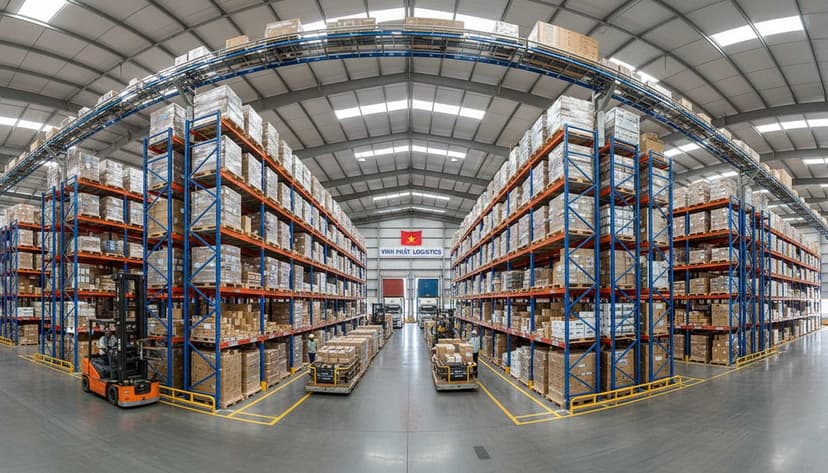
Key Criteria for Agencies Choosing a POSM Storage Warehouse
When selecting a POSM warehouse, agencies should prioritize a location close to deployment sites, flexible access hours, controlled humidity and temperature conditions, infrastructure for truck access, and a reliable security system to protect clients’ marketing assets. The most common mistake agencies make is choosing a warehouse based solely on the lowest rental price, only to discover real issues when standees are moldy or banners are wrinkled just before an event.
The checklist below is divided into 5 groups of criteria, from most important to supplementary, helping agencies compare options structurally rather than making emotional decisions.
Criterion 1 — Location: Close to City Center & Deployment Sites
Location is the only criterion that cannot be changed after signing a contract, and it’s also the criterion many agencies compromise on by choosing a cheaper but overly distant warehouse.
Why location is particularly crucial for POSM warehouses: POSM are not passively stored goods; they are frequently moved in and out of the warehouse, sometimes urgently on the day before an event. A warehouse an extra 30 minutes away from the event venue will accumulate into significant transportation and labor costs over 20–30 deployments each year.
Reference thresholds:
- Within ≤ 15 minutes of the agency’s office so staff can access the warehouse when needed without losing half a day.
- Radius ≤ 20 km from the city center, covering 80% of typical event locations.
- Near main roads, avoiding areas with truck restrictions during peak hours.
- Has parking or a loading/unloading area for delivery vehicles in front of the warehouse.
Before signing a contract, conduct a trial run from the warehouse to the agency’s three most frequent event locations on a weekday morning. Actual travel time during peak hours is often 40–80% higher than Google Maps’ off-peak estimates.
Criterion 2 — Flexible Access: Agency Hours, Not Warehouse Hours
Agencies work to deadlines, not administrative schedules. Morning events often require POSM to be loaded from 6–7 AM. Retrieving POSM after an evening event might mean returning to the warehouse at 11 PM – midnight. A warehouse that only opens from 8 AM – 5 PM and closes on weekends is unsuitable for agencies, no matter how good other criteria are.
Access checklist:
- Open 24/7 or at least from 6 AM to 10 PM daily.
- Fully operational on weekends and holidays – these are the days agencies need it most.
- Keycard or personal PIN system, not dependent on on-duty warehouse staff.
- No need to book in advance to retrieve items; free access based on actual needs.
- Can issue access cards to multiple staff members under the same account.
A direct question to ask when viewing a warehouse: “If I need to access the warehouse at 5:30 AM on a Saturday to prepare for an 8 AM event, can I get in?” The answer and the staff’s reaction will reveal the actual policy, not just the written one.
Criterion 3 — Vehicle Access Infrastructure: Suitable for Trucks Carrying Booths and Standees
Bulky POSM requires trucks for transportation, and not all warehouses can conveniently accommodate trucks. A warehouse perfect in every other aspect but with a narrow entrance insufficient for a 1.5-ton truck to turn around will become a logistics nightmare during peak season.
Transportation infrastructure checklist:
- Entrance wide enough for 1.5–2.5 ton trucks (minimum width 3.5m, clear height ≥ 3.5m).
- Yard or parking area within the premises (not requiring street parking and carrying items in).
- No steps or steep ramps at the entrance (hand trucks and dollies must enter easily).
- Freight elevator if the warehouse is on the 2nd floor or higher (minimum capacity 300kg and fits 2m long standees).
- Covered loading/unloading area (protected from rain when moving POSM in and out).
- No restrictions on vehicle access hours (or automatic gate outside business hours).
A 3x3m exhibition booth, once disassembled, consists of about 15–20 packages with a total weight of 80–120kg. It requires pallet jacks, turning space, and at least 2 people for efficient loading and unloading. A warehouse lacking these conditions will turn each inbound/outbound operation into a 2–3 hour task instead of 30–45 minutes.
Criterion 4 — Humidity & Temperature Control: Protecting Clients’ Marketing Assets
This is the most crucial technical criterion and often the most overlooked when choosing a warehouse because it’s not immediately visible during the initial viewing. The consequences of an uncontrolled environment only become apparent after 2–3 months when opening boxes to find yellowed banners or moldy standees.
Minimum environmental thresholds for POSM warehouses:
| Parameter | Minimum Threshold | Ideal Threshold | Consequences if Exceeded |
|---|---|---|---|
| Humidity (RH) | ≤ 70% | 50–65% | Mold, warped paper, faded ink |
| Temperature | ≤ 32°C | 22–28°C | Brittle PVC, peeling glue, discolored prints |
| Daily Temp. Fluctuation | ≤ 10°C | ≤ 5°C | Material shrinkage, cracked prints |
How to conduct a real-world check when viewing a warehouse:
- Bring a portable hygrometer (priced from 100,000 VND), and measure directly in the warehouse.
- Ask about the air conditioning or dehumidification system: what is its capacity, and does it operate continuously or only during the day?
- Observe walls and ceiling: are there signs of dampness, mold, or leaks?
- Ask about the rainy season: does the warehouse flood or become significantly more humid from June–November?
- Check the floor: is there standing water or dampness from the concrete slab?
Criterion 5 — Security: Protecting Client Assets is the Agency’s Responsibility
POSM not only have financial value (production cost) but also brand value; a client’s exclusive brand identity being lost or copied is a much more serious issue than purely material damage.
Minimum security checklist:
- CCTV cameras covering 100% of the area, storing footage for at least 30 days.
- Individual locker/storage unit locks, with only the agency holding the key, not warehouse staff.
- Controlled access list with time-stamped logs for all entries and exits.
- Security guard or alarm system connected to a central monitoring station 24/7.
- Clear compensation policy in case of loss within the warehouse premises.
Contractual requirements: The POSM warehouse rental agreement should include clauses clearly defining compensation responsibility if items are lost or damaged due to warehouse fault – specifying minimum compensation levels and the claims process. This is a clause many agencies overlook and only remember when an incident has already occurred.
Comprehensive Checklist — Bring This When Viewing Warehouses
| # | Criterion | Key Question | Acceptable Threshold |
|---|---|---|---|
| 1 | Location | How long does it take from the warehouse to the main event venue during peak hours? | ≤ 20 minutes |
| 2 | Access Hours | Can I access it at 6 AM on a Saturday? | Yes — 24/7 or from 6 AM |
| 3 | Vehicle Access | Can a 1.5-ton truck enter and turn around? | Yes — clear height ≥ 3.5m |
| 4 | Humidity | Hygrometer reading at the warehouse: What is the RH? | ≤ 70% RH |
| 5 | Temperature | Does the warehouse have AC or forced ventilation? | ≤ 32°C, fluctuation ≤ 10°C/day |
| 6 | Cameras | Full coverage? How many days of storage? | 100% coverage, ≥ 30 days |
| 7 | Private Lock | Does the agency have its own lock, with the warehouse not holding a key? | Yes |
| 8 | Compensation | What is the compensation policy if goods are lost? | Clearly documented |
| 9 | Actual Rent | Total cost including electricity, management fees, overtime fees? | All-in quote in writing |
| 10 | Flexibility | Can I increase/decrease space according to campaign seasons? | Yes — priority for existing tenants |
The golden rule when viewing a POSM warehouse: Bring a used fabric banner and leave it in the warehouse for 15 minutes with a hygrometer placed next to it to observe if the actual conditions match what the sales representative describes. A good warehouse has nothing to hide.
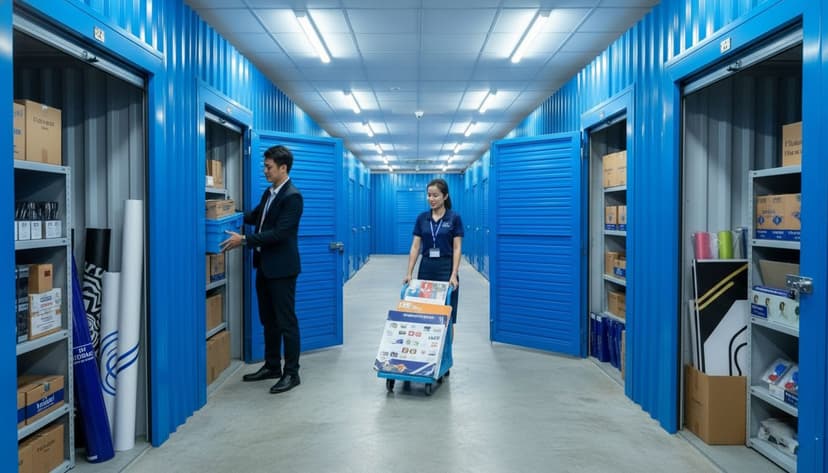
Mini Storage vs. Large Warehouse – Which Should Your Agency Choose?
Mini storage is ideal for smaller agencies or those needing flexible storage for specific campaigns, whereas a large warehouse suits agencies running multiple large-scale campaigns simultaneously for various clients. The right answer isn’t about “which is better,” but rather “which aligns with your agency’s current scale and operational frequency,” and crucially, which can adapt as your needs evolve.
A common mistake is for agencies to opt for a large warehouse from the outset due to “future-proofing,” only to pay for 60–70% of unused space during the first 6–12 months. Conversely, choosing a mini storage unit that’s too cramped can lead to improper POSM (Point of Sale Materials) stacking, resulting in damage that outweighs the savings from lower rent.
- Actual costs for mini storage: A 10 m² unit in Ho Chi Minh City or Hanoi ranges from 1.2–2.5 million VND/month. For agencies renting 2–3 units, the total cost is approximately 3–7 million VND/month, comparable to hiring a part-time warehouse manager, but without the need for additional staff or social insurance contributions.
- Total actual costs for a large warehouse: An 80–100 m² warehouse in a logistics area of Ho Chi Minh City or Hanoi costs 8–15 million VND/month, including electricity and management fees. Add to this the cost of one warehouse manager (part-time or full-time): 5–12 million VND/month. Total: 13–27 million VND/month. This is only justifiable if the agency saves more than this amount through better POSM reuse and reduced re-production costs.
Comprehensive Comparison Table: Mini Storage vs. Large Warehouse
| Criteria | Mini Storage (Self-storage) | Large Warehouse (Managed/Private) |
|---|---|---|
| Area | 2–30 m² per unit | 50–500 m²+ flexible layout |
| Rental Cost | 500K–3 million VND/month | 5–30 million VND/month or more |
| Contract | Monthly, no long-term commitment | 6 months–2 years |
| Flexibility | High — increase/decrease units monthly | Low — fixed area |
| Humidity Control | Varies by provider — needs checking | More proactive if private warehouse |
| Loading/Unloading Infrastructure | Often limited — small elevators | Comprehensive — loading dock, forklifts |
| Inventory Management | Fully self-managed | Can include outsourced services |
| Client Segmentation | Difficult if many separate units | Easy — layout designed as needed |
| Suitable for | Agencies ≤ 10 campaigns/year | Agencies ≥ 15 campaigns/year |
| Main Risk | Sudden lack of space during peak season | Paying for excess space during low campaign periods |
Many mid-sized agencies are adopting the most effective hybrid model: mini storage for frequently deployed POSM + seasonal large warehouses for booths and bulky items.
Specifically: maintaining 1–2 self-storage units year-round for standees, roll-up banners, and small item boxes – things that need frequent and easy access. Concurrently, they rent additional large warehouse space on a 3–6 month contract during Q3–Q4 when festival booths and year-end items surge, returning it after Tet (Lunar New Year).
This model optimizes both: the low cost of mini storage for regular needs, and the comprehensive infrastructure of a large warehouse for peak seasons, without incurring year-round large warehouse expenses.
FAQ
Start with 3 steps: (1) inventory all existing POSM and categorize by campaign; (2) rent a 10–20 m² self-storage unit with humidity control; (3) attach QR codes to each item and maintain a Google Sheets tracking list. No expensive software needed to get started.
Organize along two axes: by client/campaign (dedicated area per client) and by status (“ready to reuse”, “needs repair”, “dispose”). Tag each item or box with a QR code storing: campaign name, production date, usage count, and storage location. Scan with a phone for instant lookup.
Self-storage units of 5–15 m² in Ho Chi Minh City and Hanoi range from VND 500,000 – 2,500,000 per month depending on location and size. No long-term deposit required — units can be added during peak campaign seasons and returned afterward, offering far more flexibility than renting a dedicated space.
Yes. Agencies with proper storage achieve 60–75% POSM reuse rates, versus 20–35% with casual storage. For an agency spending VND 500 million per year on POSM production, this difference saves VND 200–300 million in reprinting costs — far exceeding the cost of renting dedicated storage.
Three leading causes: (1) high humidity above 70% RH causes mold on printed materials and banner fading — most common in Vietnam’s climate; (2) improper stacking warps standee bases and breaks booth joints; (3) excessive heat above 35°C makes PVC brittle and loosens adhesives. Total impact: 25–40% of POSM is damaged before its first redeployment when stored incorrectly.
It depends entirely on the storage contract. Many self-storage providers include liability limitation clauses — these must be read carefully and negotiated before signing. Agencies should request clear terms on maximum compensation amount, claims process, and resolution timeline. For high-value POSM, purchasing separate cargo storage insurance is worth considering.
In Ho Chi Minh City, self-storage facilities are concentrated in District 7, Binh Thanh, Go Vap, and Binh Duong — close to major event venues. In Hanoi, options cluster in Cau Giay, Hoang Mai, and Long Bien. Prioritize facilities within 15–20 minutes of the agency office and not on routes with peak-hour truck restrictions to keep POSM logistics uninterrupted.
Three key points: (1) use covered or enclosed trucks — POSM must not be exposed to rain or direct sunlight during transport; (2) pack correctly — standees upright or flat in cardboard boxes, banners rolled and shrink-wrapped; (3) run a pre-event inventory check 5–7 days before the event to allow time to replace any damaged items — not the night before.
Not yet. Agencies running fewer than 10 campaigns per year should start with 1–2 self-storage units (10–20 m² total) — costing VND 2–4 million per month with no long-term commitment. Only upgrade to a dedicated warehouse when POSM reprint costs exceed 6 months of larger warehouse rent, or when simultaneously managing POSM for 5 or more clients.
A hybrid model works best: mini storage year-round for standees, banners, and small items in regular use + large warehouse seasonally (Q3–Q4) for bulky booths and oversized materials. This approach optimizes both cost and logistics capacity without paying for a large warehouse year-round before demand justifies it.
Related articles
Article
Onshore vs Offshore: Which Manufacturing Model Should Businesses Choose?
Onshore manufacturing refers to production within a company’s home country, helping to control quality, shorten delivery times, and ensure easier regulatory compliance. Offshore…
Read article
Article
How To Organize Your Home Storage Room | 10 Space-Saving Tips
Organize household storage with ten practical tips, an inventory template, safety checks and guidance on when external storage is worth considering.
Read article

Article
Secrets to Profitable Online Selling: 10 Ways to Save Costs
To sell online profitably, you not only need to increase sales but also maintain good control over operating costs. Items such as inventory, premises, packaging, shipping, and order…
Read article
