
 Tiếng Việt
 한국어
한국어 日本語
日本語Article· Updated October 15, 2026
Guide to Designing Efficient Business Warehouses in 2026
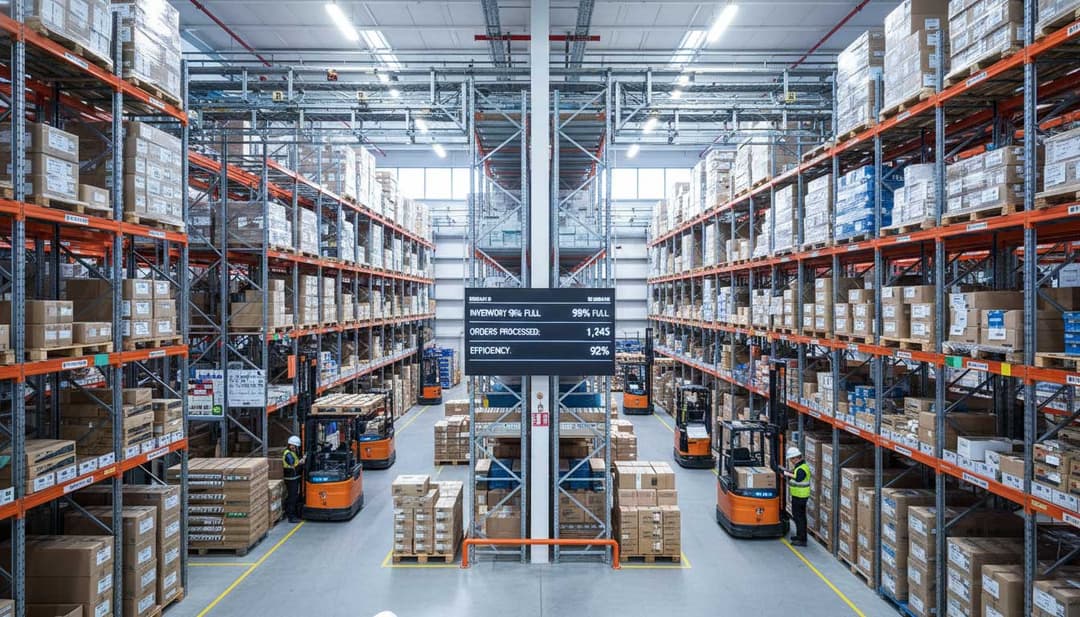
Effective enterprise warehouse design in 2026 demands a combination of optimized layout, standardized operational flow, management technology (WMS), environmental control, and smart storage classification to reduce operating costs and accelerate inbound and outbound operations.
Why Effective Warehouse Design is a Vital Element for Businesses?
A well-designed warehouse can reduce order processing time by 30–50%, lower labor costs, and optimize inventory storage, especially amidst the growth of e-commerce and complex supply chains in 2026.
In the economic landscape of 2026, where e-commerce has become the market’s “lifeblood” and user expectations for delivery speed have reached record levels, a warehouse is no longer merely a storage facility. It has transformed into a “power station” that dictates a business’s speed and profitability.
Here’s why an effective warehouse design is ‘vital’ for success:
1. Speed: The Competitive “Weapon”
In the era of express delivery, every wasted minute in the warehouse means a customer losing patience.
- Optimizing Picking & Packing: Statistics show that picking accounts for 50-55% of total warehouse operating costs. A smart layout design can help reduce order processing time by 30–50%.
- Real-world Data: A Statista 2025 report indicates that warehouses adopting a one-way flow design reduce average employee travel distance by 3km per shift.
2. The Challenge of Hidden Costs and Efficiency
Many businesses fail not due to a lack of orders, but because of excessively high operating costs.
- Space Optimization (m³): Instead of focusing solely on floor area (m²), modern design emphasizes storage volume (m³). Utilizing high-rise shelving and narrow aisles can increase storage density by up to 40% without requiring additional floor space.
- Reducing Errors: A disorganized warehouse leads to incorrect shipments and lost inventory. A Gartner 2025 report indicates that a lack of layout optimization can reduce overall efficiency by 20–40%, leading to skyrocketing return processing costs.
3. Scalability and Adaptability
The market in 2026 is highly volatile. A good warehouse must be able to expand or reconfigure its structure quickly.
- Modularity: Design allows for repositioning shelves or integrating autonomous mobile robots (AMRs) without dismantling existing infrastructure.
- Workplace Safety: A scientific layout minimizes collisions between forklifts and personnel, thereby reducing accident risks and legal compensation claims.
Traditional Warehouse vs. Optimized Warehouse 2026 Comparison
| Criterion | Traditional Warehouse (Old) | Optimized & Efficient Warehouse (Modern) |
|---|---|---|
| Space Utilization | Primarily utilizes floor area | Maximizes vertical space (m³) |
| Goods Flow | Intertwined, prone to congestion | One-way flow (U-shape/I-shape) |
| Data Management | Manual or fragmented Excel | Integrated WMS, AI for inventory forecasting |
| Labor Costs | High (due to extensive movement) | Low (thanks to optimized routes) |
| Order Processing Speed | Slow, prone to errors | 2-3 times faster |
Consider your warehouse a living entity. If its “bloodstream” (goods flow) becomes clogged, the entire business will stagnate. Investing in warehouse design isn’t an expense; it’s an investment in time and customer satisfaction.
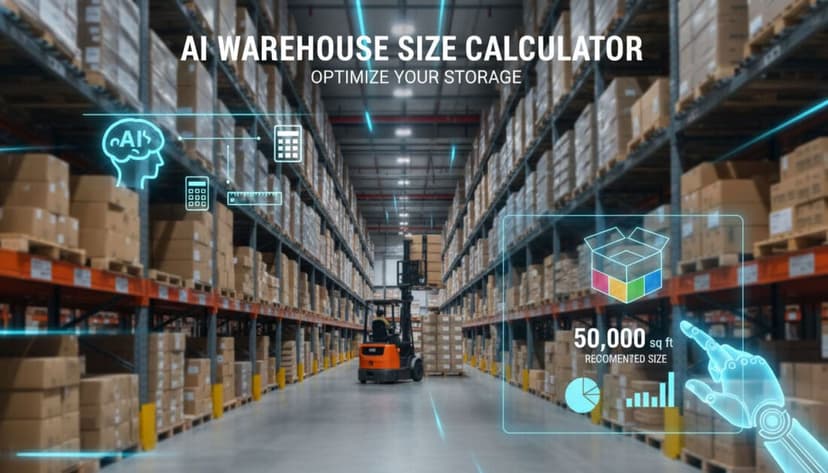
Effective Warehouse Design Principles
An effective warehouse needs to be designed according to principles that optimize flow (inbound → storage → picking → outbound), ensure scientific zoning, fire safety, and easy scalability as needs change.
1. Flow Principle – “One-Way Journey”
This is the most crucial principle. The flow of goods from inbound to outbound must follow a consistent direction, preventing staff or forklifts from moving against the flow, which causes congestion.
- U-shape layout: Inbound and outbound are on the same side. Suitable for smaller warehouses, it optimizes labor as staff can flexibly support both processes.
- I-shape layout (Straight flow): Inbound at one end, outbound at the other. Often used for large warehouses with extremely high throughput to completely separate the two traffic flows.
- L-shape layout: Suitable for warehouses with unique floor plans or for utilizing building corners.
2. Accessibility & ABC Classification Principle
Not all items are equally important. Effective design prioritizes “hot” items.
- ABC Classification: * Group A (Fast-moving): Placed in low positions, near the packing area for the quickest retrieval.
- Group C (Slow-moving): Placed in the highest or furthest positions.
- 100% Accessibility: Ensure that every pallet or carton can be retrieved without needing to move other items around it.
3. Space Optimization Principle
Don’t just look at floor area; look at volume (m³).
- Utilize height: Use high-bay racking systems. However, balance the rack height with forklift capabilities.
- Aisle width: Aisles must be wide enough for forklifts to turn but not so wide as to waste space.
- Tip: Using Very Narrow Aisle (VNA) forklifts can help you increase storage space by 20-30%.
- Space utilization index: Fill rate = (Actual goods volume / Total usable warehouse volume) x 100%
An ideal warehouse typically maintains this ratio at 80-85% to allow for operational space.
4. Safety & Standards Principle
No matter how good a design is, it’s meaningless if it poses hidden dangers.
- Warehouse Fire Safety: Emergency exits must be clear of obstructions. Sprinkler heads must not be blocked by goods on top of racks.
- Lighting and Ventilation: Ensure picking areas are well-lit to prevent SKU errors. Ventilation systems help preserve goods and protect employee health.
- Traffic Lanes: Clearly marked lines for pedestrians and forklift operating areas to prevent collisions.
5. Flexibility Principle
Your warehouse in 2026 might be completely different in 2028.
- Modular Design: Use racking systems where shelf heights can be adjusted or easily disassembled.
- Automation Readiness: Even if you’re not using Robots (AMR) yet, the floor should be flat and well-finished to facilitate future technology upgrades.
| Principle | Main Goal | Mistakes to Avoid |
|---|---|---|
| Flow | Reduce travel time | Cross-cutting flows causing collisions |
| Accessibility | Fast Picking | Placing fast-moving items at the back of the warehouse |
| Space | Optimize warehouse rental costs | Only storing goods on the floor, not using high racks |
| Safety | Protect people & goods | Blocking emergency exits with pallets |
| Flexibility | Easy expansion/change | Installing fixed racks, welded to the warehouse floor |
Before installing racks, use tape to mark out the flow paths on the warehouse floor and have staff simulate picking. You’ll discover countless “bottlenecks” that are never visible on a CAD drawing!
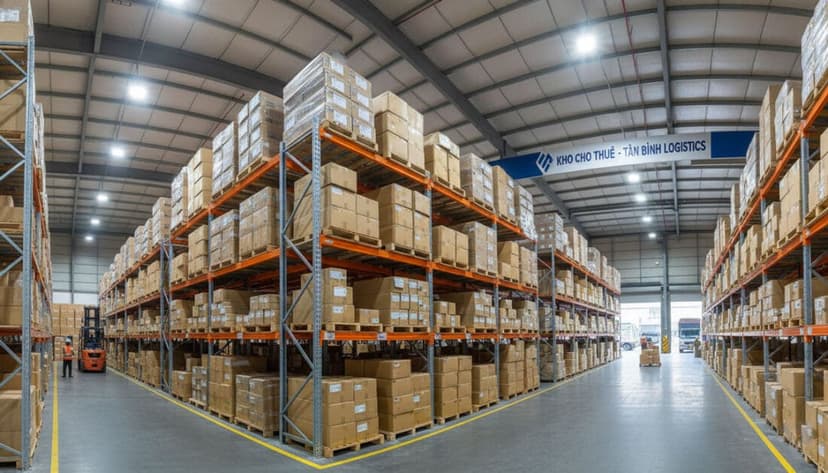
Choosing the Right Area & Layout for Your Business Scale
Warehouse space should be designed based on average inventory volume, number of SKUs, turnover rate, and storage cycle, typically calculated as TL* months of inventory × average orders/day.
1. Choosing a Layout Based on Business Scale
In modern logistics management, there’s no “one-size-fits-all” formula for every warehouse. An effective warehouse layout must strike a delicate balance between financial capability (CAPEX) – warehouse rental costs, product characteristics, and the business’s short-term growth objectives. Forcing a small business into an overly massive structure will lead to capital waste, but maintaining a rudimentary “storage shed” mindset when the business has grown will create “bottlenecks” that hinder delivery speed.
To optimize every square meter of space and every second of picking, businesses need to choose a warehouse structure based on specific scale milestones and operational characteristics, as follows:
A. Small Scale / Startup (Under 500 m²)
- Characteristics: Limited budget, few SKUs but rapid fluctuations.
- Preferred Layout: Selective Racking or medium-duty shelving.
- Advantages: Low investment cost, 100% accessibility to goods. You can pick any carton without moving other items.
B. Medium Scale / Growing (500 – 2,000 m²)
- Characteristics: Rapid increase in SKUs, starting to experience space shortages.
- Preferred Layout: Mezzanine (Mezzanine flooring).
- Advantages: This is a “lifesaver” for warehouses with high ceilings. You can double the usable area by building additional mezzanine levels above to store light goods or create a packing area.
C. Large Scale / Enterprise (Over 2,000 m²)
- Characteristics: Extremely high goods throughput, prioritizing speed and density.
- Preferred Layout: Drive-in Racking (for low SKU count but high volume goods) or VNA (Very Narrow Aisle).
- Advantages: Maximizes space optimization (extremely narrow aisles). At this scale, integrating autonomous mobile robots (AMRs) for picking is a worthwhile investment.
2. Comparison of Popular Storage Racks
| Rack Type | Storage Density | Accessibility | Investment Cost | Suitable for |
|---|---|---|---|---|
| Selective | Low | 100% | Low | High SKU count, continuous inbound/outbound |
| Double Deep | Medium | 50% | Medium | Space-saving aisles, standard goods |
| Drive-in | Very High | Low | High | Homogeneous goods, long-term storage |
| Mezzanine | Extremely High | Customizable | High | Height optimization, component warehouse |
3. The “85% Threshold” Principle
Never design a warehouse to be 100% full. In warehouse management, the 85% threshold is known as the “productivity bottleneck.”
If the warehouse is over 85% full, staff will spend too much time moving items to retrieve the necessary goods (the “traffic jam” effect in the warehouse).
The remaining 15% space is “breathing room” to handle newly arrived shipments or unexpected returns.
Always reserve space for the next two years of growth. If you plan to grow by 20% annually, don’t rent a warehouse that’s just enough for the present; you’ll incur relocation costs after just one year of operation.
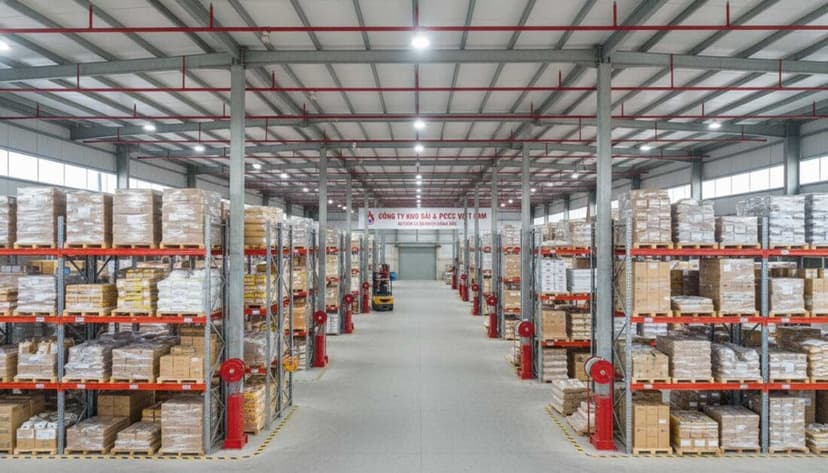
Goods Classification & Modern Storage Methods
Classifying goods (FIFO, LIFO, FEFO) and selecting the right racking system helps optimize space and processing time, especially for spare parts warehouses, FMCG, and pharmaceuticals.
In the warehouse logistics 4.0 era of 2026, merely “having space” is no longer enough. A modern storage system must be a perfect blend of inventory rotation strategies and smart technical infrastructure.
If you misclassify goods or choose the wrong racking system, operating costs can “devour” your profits. Here’s how the “big players” are running efficient warehouses:
1. Classifying Inventory Flow
Depending on product specifics (expiry date, physical properties), you must choose one of three “philosophies”:
FIFO (First-In, First-Out):
- Application: FMCG (Fast-Moving Consumer Goods) industry, food.
- Benefit: Ensures older stock doesn’t remain stagnant for too long, reducing the risk of expiry.
LIFO (Last-In, First-Out):
- Application: Construction materials (bricks, stones, sand), items without expiry dates and with significant weight.
- Benefit: Optimizes stacking, requiring fewer aisles between pallets.
FEFO (First-Expired, First-Out):
- Application: Pharmaceuticals, cosmetics, fresh food.
- Benefit: This is the strictest standard to protect consumer safety and prevent losses due to spoiled goods.
2. Modern Racking Systems: Choosing the Right “Backbone” for Your Warehouse
In 2026, racks are no longer static metal frames; they are designed to optimize every second of picking:
A. Selective Racking
- Mechanism: Each pallet has its own dedicated location, with 100% direct forklift access.
- Suitable for: Warehouses with many different SKUs (stock-keeping units), each with small quantities.
B. Semi-Automated Racking
- Mechanism: Uses a small robot (shuttle) running on rails to move pallets deep into the rack.
- Suitable for: Warehouses with extremely high density, few SKUs but very large quantities of each. This is a booming trend this year due to minimizing forklift travel inside the racks.
C. Gravity Flow Racking
- Mechanism: Racks are designed with an incline, allowing pallets to slide automatically from the loading end to the unloading end by gravity.
- Suitable for: Excellent for FIFO strategies. Staff only need to stand at one end to pick goods.
3. Multi-Tier Warehouse Solutions – “Duplicating” Space
If your warehouse ceiling is over 6m high, don’t let that overhead space go to waste.
Mezzanine Flooring: Helps create new working levels without needing to build additional factory space.
- Application: The lower level stores heavy goods on pallets, while the upper level is divided into smaller picking zones for e-commerce individual orders.
| Industry | Preferred Method | Recommended Racking Type |
|---|---|---|
| Automotive Parts | FIFO / ABC | Selective + Longspan Shelving |
| Food / FMCG | FIFO | Pallet Flow Rack / Radio Shuttle |
| Pharmaceuticals | FEFO | Enclosed, Temperature-Controlled Racks (Cold Storage) |
| E-commerce | ABC (Fast-moving) | Mezzanine + Automated Conveyor System |
Goods classification isn’t just about what’s on the shelves; it must be synchronized with a Warehouse Management System (WMS). If your racks are modern but your software is outdated, you’ll still spend hours searching for a “lost” pallet.
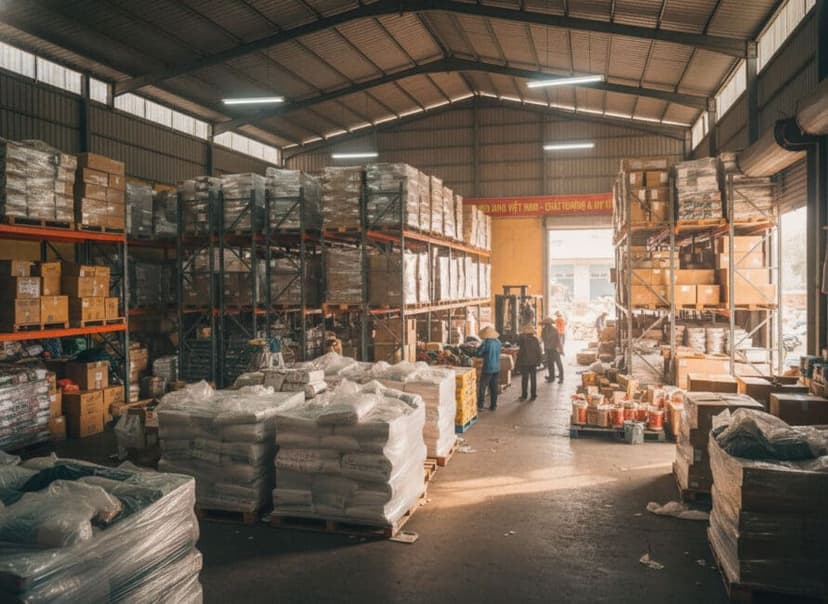
Leveraging Technology in Warehouse Design 2026
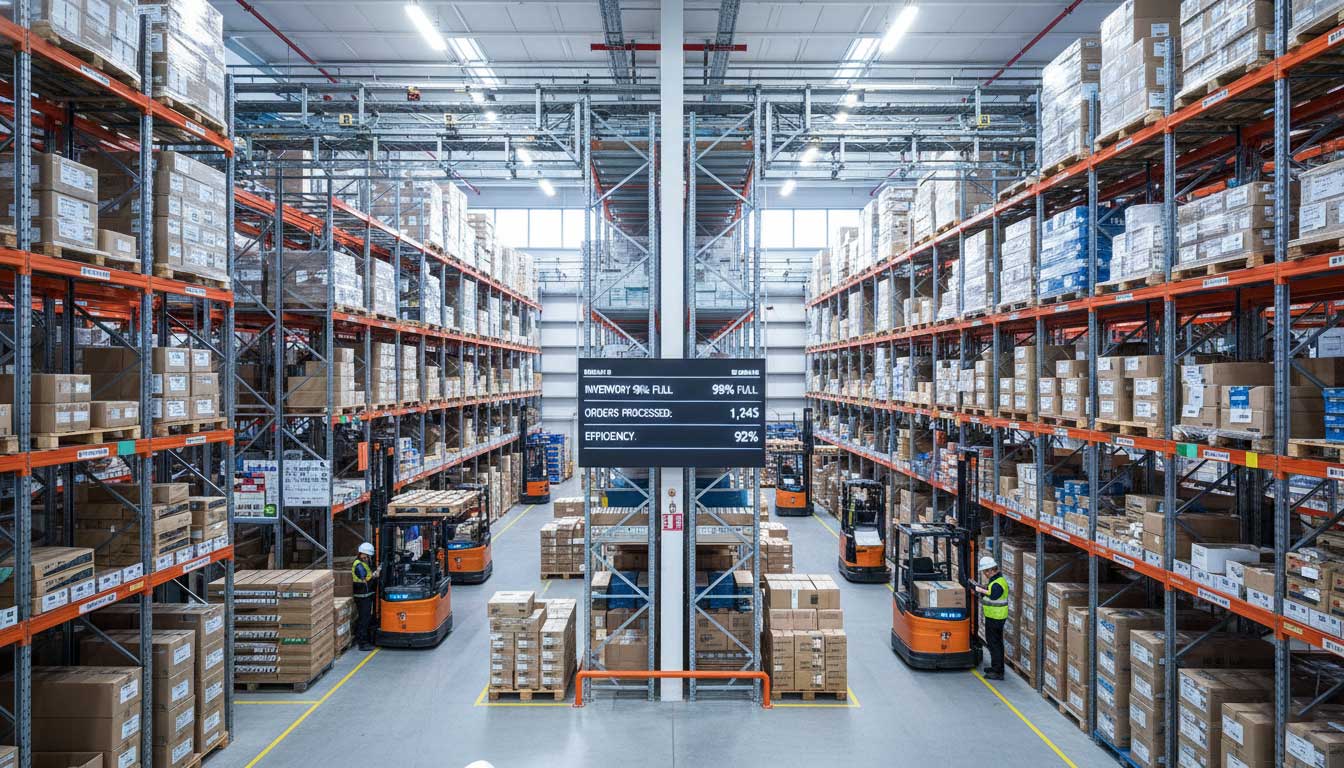
Technologies like WMS, barcode/RFID, automation, and analytics enable real-time inventory tracking, minimize picking errors, and optimize warehouse operational costs.
By 2026, the line between a warehouse and a data center is increasingly blurring. Adopting technology is no longer an “optional extra” but has become a prerequisite for businesses to thrive in a volatile global supply chain.
Here are the technological pillars reshaping modern warehouse design and operations:
1. WMS (Warehouse Management System) – The Central “Brain”
By 2026, a warehouse management system is more than just a record-keeper for inbound and outbound goods. It’s a connected ecosystem:
- Cloud & Real-time Integration: All data regarding pallet locations and order statuses are instantly updated across all devices (smartphones, tablets, AR glasses).
- Route Optimization: AI within WMS automatically calculates the shortest picking route for staff, reducing unnecessary travel distances by 30-40%.
2. Identification & Sensor Technology (The Senses)
Forget manual notepads; 2026 is the era of “No-touch” operations:
- RFID & Smart Identification Tags: Instead of manually scanning individual barcodes, RFID gates allow hundreds of products to be scanned in mere seconds as a forklift passes through.
- IoT Sensors (Internet of Things): Sensors are deployed throughout the warehouse to monitor temperature and humidity (crucial for parts and pharmaceuticals), automatically adjusting ventilation systems or sending mobile alerts in case of anomalies.
3. Autonomous Mobile Robots (AMR) & Automation (The Muscle)
Manual labor is being replaced by powerful assistants:
- AMR (Autonomous Mobile Robots): Unlike AGVs (which follow fixed paths), AMRs use laser sensors and AI to navigate independently, avoid obstacles, and transport goods to the correct packing areas.
- Cobots (Collaborative Robots): Robots work alongside humans to assist with strenuous or repetitive tasks, such as stocking high shelves.
4. Digital Twin – The “Digital Replica” and AI Analytics
This represents the pinnacle of modern warehouse design:
- Digital Twin: Businesses create an accurate 1:1 3D simulation of their warehouse on a computer. Before changing the layout or adding shelves, you can run simulations to predict efficiency without incurring any real-world costs.
- Predictive AI: AI analyzes historical data to forecast order “waves” (e.g., promotional seasons), suggesting which SKUs should be moved from group C to group A before peak periods commence.
KPIs & How to Measure Warehouse Design Effectiveness
Measure effectiveness using KPIs such as: order processing time, picking accuracy, space utilization percentage, cost per order, and inventory accuracy.
Designing an aesthetically pleasing warehouse on paper is just the first step. To determine if it truly “generates profit,” you need concrete figures. In 2026 logistics management, we don’t say “my warehouse runs pretty well”; we talk about Key Performance Indicators (KPIs) measured in real-time.
Here are the vital KPI groups for evaluating your warehouse design effectiveness:
1. Speed-related KPIs
An effective warehouse design must shorten travel distances and eliminate “bottlenecks.”
- Order Cycle Time: The total time from order receipt until goods are ready for dispatch.
- Goal: For modern e-commerce warehouses, this figure should be under 30-60 minutes.
- Picking Productivity: The number of lines or items an employee picks per hour.
- Design Impact: If Group A items are stored too far away, this metric will plummet.
2. Accuracy-related KPIs
Smart warehouse design (with clear signage and location coding) will minimize human errors.
- Picking Accuracy: Calculated using the formula:
- A = (Number of Correctly Picked Orders / Total Number of Orders) x 100%
- 2026 Benchmark: A standard warehouse should achieve > 99.8%.
- Inventory Accuracy: The congruence between software data (WMS) and physical inventory counts.
3. Space Utilization KPIs
This is a direct measure of whether you are wasting rental space.
- Space Utilization Rate:
- U = (Actual Volume of Goods Stored / Maximum Storage Volume) x 100%
- Note: If this metric is > 85%, your warehouse is experiencing congestion, leading to reduced picking speed. If < 70%, you are wasting space.
4. Cost-related KPIs
The ultimate goal of design optimization is to reduce costs per product.
- Cost Per Order: Total warehouse operating costs (personnel, electricity, shelf depreciation, technology) divided by the total number of orders.
- Warehouse Cost-to-Revenue Ratio: Helps businesses assess whether the warehousing department is consuming too much budget relative to business performance.
| KPI Metric | Average Level | Best-in-class Level |
|---|---|---|
| Picking Accuracy | 98.5% | > 99.9% |
| Inventory Accuracy | 97.0% | > 99.5% |
| Space Utilization | 75% | 80% – 85% |
| Dock-to-Stock Time | 24 Hours | < 4 Hours |
| Picking Time/Order | 5 – 10 Minutes | < 2 Minutes |
Effective warehouse design in 2026 is not just about optimizing space; it’s about building an intelligent, flexible, and scalable operational system that helps businesses reduce costs by 15–30% and accelerate order processing amidst increasingly complex e-commerce and supply chains.
In an era where logistics is rapidly shifting towards automation and data-driven processes, a well-designed warehouse from the outset will help businesses:
- Increase picking and packing efficiency
- Reduce outbound shipping errors
- Optimize storage space
- Enhance customer experience
According to global logistics reports for 2024–2025 (Gartner, Deloitte Supply Chain Insights), businesses investing in standardized warehouse design combined with WMS can improve inventory accuracy by up to 99% and reduce order processing time by 20–40%. Therefore, warehouse design is no longer an expense – but a long-term strategic investment.
FAQ
It is the “Flow” principle. A good design ensures a one-way, continuous movement of goods from Inbound (receiving) to Storage, then to Picking/Packing, and finally Outbound (shipping), minimizing backtracking and congestion.
Think vertically m3 instead of horizontally m2. Use High-bay racking systems, Mezzanine floors, or Very Narrow Aisle (VNA) racking to utilize the full clear height of your warehouse.
ABC Analysis categorizes items by frequency. Group A (fast-moving) items should be placed at the most accessible locations near the shipping area to reduce travel time, which can account for up to 50% of total picking costs.
In 2026, WMS acts as the “brain.” It maps the warehouse layout digitally to guide workers through the shortest picking routes and manages Bin Locations via Barcode/RFID to ensure 99.9% inventory accuracy.
Essential standards include fire safety (sprinklers, smoke detectors), clear emergency exit paths, adequate lighting (minimum 200 lux for picking zones), and designated pedestrian lanes to separate people from forklifts.
When your labor costs rise and order volume becomes high and complex. AMRs are ideal for repetitive transport tasks, allowing human workers to focus on high-value activities like quality control.
Use the formula:
ROI = ((Annual Operation Saving – Investment Cost)/Investment Cost) x 100%
Savings usually come from reduced labor hours, lower error rates, and optimized space.
Incorporate Solar panels on the roof, use LED lighting with motion sensors, and implement paperless operations through digital tablets and WMS to minimize environmental impact.
It states that once a warehouse exceeds 85% occupancy, operational efficiency drops significantly due to congestion. You should always aim for a 15% “buffer space” to maintain smooth flow.
Focus on Modularity. Use adjustable racking systems and leave space for future automation integration. Designing with scalability in mind ensures you won’t have to relocate when your SKU count grows.
Related articles
Article
Onshore vs Offshore: Which Manufacturing Model Should Businesses Choose?
Onshore manufacturing refers to production within a company’s home country, helping to control quality, shorten delivery times, and ensure easier regulatory compliance. Offshore…
Read article

Article
How To Organize Your Home Storage Room | 10 Space-Saving Tips
Organize household storage with ten practical tips, an inventory template, safety checks and guidance on when external storage is worth considering.
Read article

Article
Secrets to Profitable Online Selling: 10 Ways to Save Costs
To sell online profitably, you not only need to increase sales but also maintain good control over operating costs. Items such as inventory, premises, packaging, shipping, and order…
Read article
