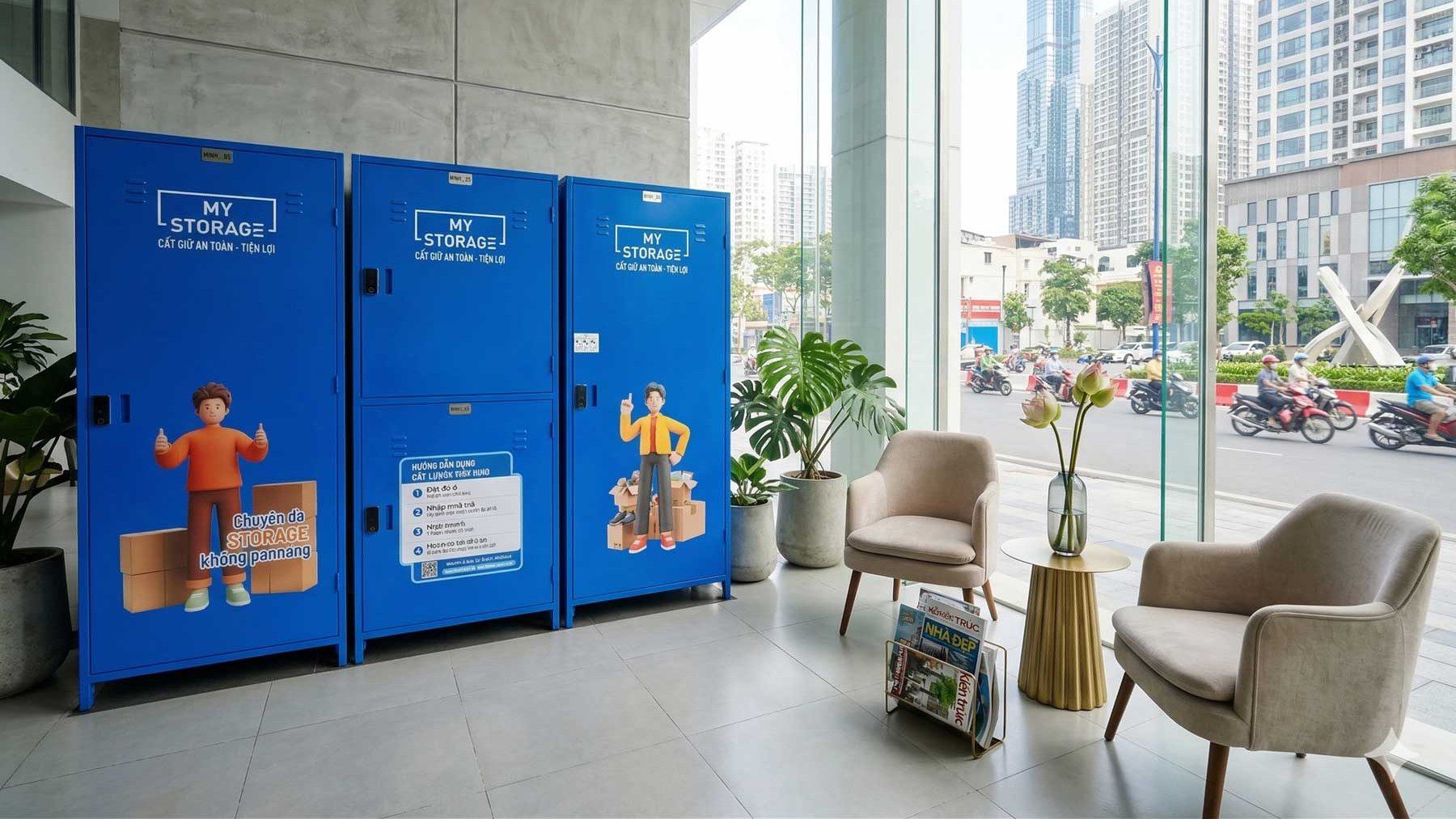

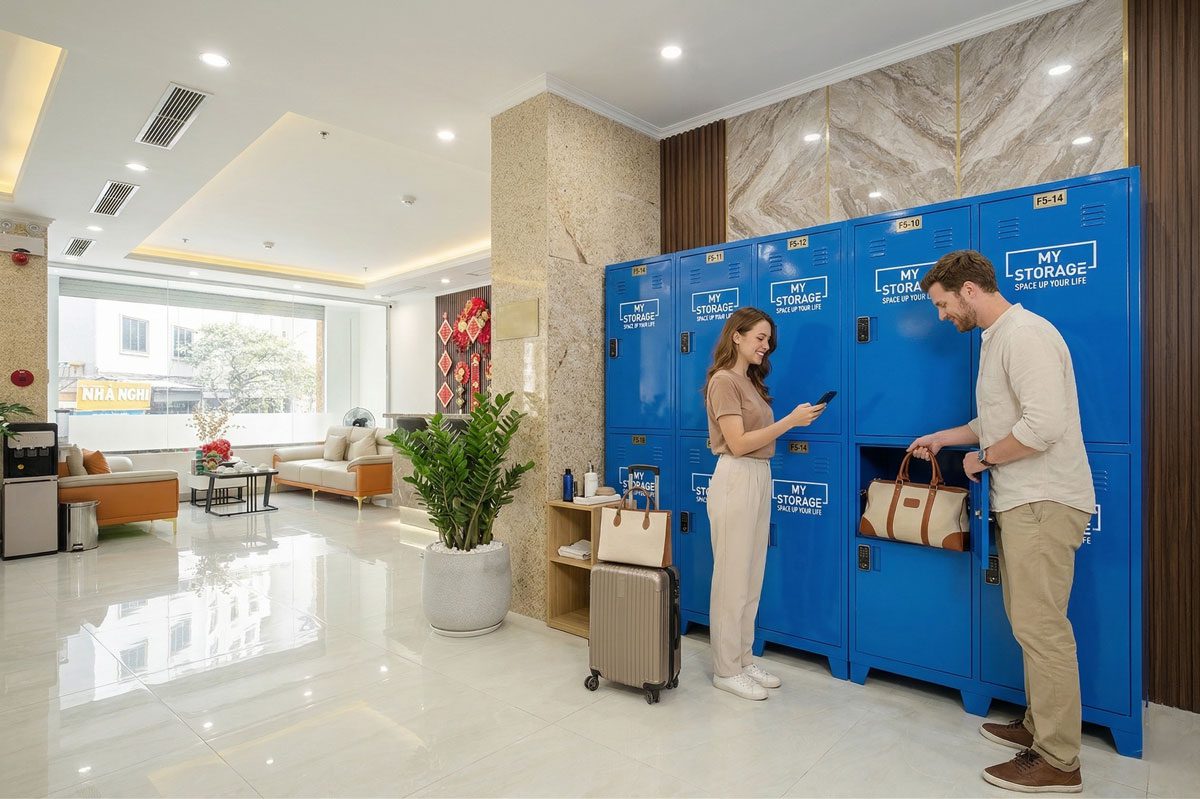
Parcel locker systems in apartments are becoming the new standard for luxury apartment amenities, helping to manage parcels efficiently, reduce courier congestion, and keep lobbies tidy. This solution not only enhances the resident experience but also helps building management optimize operations and the building’s image.
How Are Luxury Apartment Amenities Evolving?
Amenities in luxury apartments are undergoing a significant shift from traditional display-focused elements to smart, convenient, and operationally optimized living experiences. A decade ago, a swimming pool and a gym were sufficient criteria for a property to be considered “luxury.” Today, apartment buyers are asking different questions: Does this amenity truly solve a problem in my daily life?
This change is not merely an aesthetic trend but also reflects the maturity of luxury real estate buyers in Vietnam — high-income millennials and Gen Z, who are tech-savvy and prioritize substantive experiences over superficial appearances.
Previously: Display Amenities — Beautiful for Sale, Less for Living
Between 2010–2018, the “luxury apartment” standard in Vietnam was primarily defined by a long and impressive list of amenities: rooftop infinity pools, fully equipped gyms, spas, 5-star reception lobbies, outdoor BBQ areas, and community rooms. These amenities played a crucial role in sales marketing — creating a strong visual impression in showrooms and brochures.
The problem with the display amenity model: The actual utilization rate of most of these amenities was very low. A JLL Vietnam (2022) study showed that the average apartment swimming pool was used by only 15–25% of residents at least once a month. Gyms had a higher utilization rate but were often overcrowded during peak hours and empty for the rest of the day. The operating and maintenance costs of these amenities were equally distributed into the monthly management fees of all residents, even those who never used them.
Result: buyers paid high fees for amenities they didn’t use, while real daily life problems like parcel reception, parking, and small asset management lacked well-invested solutions.
Currently: Smart Living and Automation — Technology Serving Real Needs
From 2019 to the present, the definition of “luxury amenities” is being rewritten by technology and real operational data. Market-leading developers are investing in technological infrastructure rather than just physical amenity spaces.
- Smart home integration: Systems controlling lighting, air conditioning, security, and home appliances via smartphone apps are becoming the minimum standard in the luxury segment. Not because the technology is novel, but because users are accustomed to this level of control via smartphones and expect their living spaces to offer a similar experience.
- Digital building management systems: Apartment management apps (super apps) allow residents to book amenities, report issues, pay management fees, track maintenance, and communicate with building management on a single platform, instead of having to call or visit the management office directly. The utilization rate of apartment management apps in luxury projects in HCMC reached 60–75% within the first 6 months after implementation (according to a Savills Vietnam survey, 2023).
- Parcel locker systems: For frequent online shoppers, the average e-commerce purchase frequency for urban users in Vietnam is 4.5 times/week (VECOM, 2024) not receiving deliveries when not at home is a real problem affecting quality of life. Smart parcel lockers within the building completely solve this issue and have become one of the most highly rated amenities in recent luxury apartment resident satisfaction surveys.
- Electric vehicles and energy management: With the growth rate of EVs in Vietnam, EV charging infrastructure in apartment parking lots is transitioning from a “future amenity” to a “minimum standard” for projects launched from 2024 onwards.
According to JLL Vietnam (2023), 68% of luxury apartment buyers in HCMC and Hanoi ranked “technology and smart home systems” among the top 3 most important criteria when choosing a project, surpassing “swimming pools” (42%) and “gyms” (38%).
Next Trend: “Problem-Solving” Amenities for Real-Life Needs
The next generation of apartment amenities is defined by a single question: “What specific daily life problem of residents does this amenity solve?” If that question cannot be answered, the amenity is merely an operational cost that creates no value.
- Amenities solving storage challenges: Apartment sizes are shrinking while the need to own belongings remains constant. Personal lockers within the building, monthly mini-storage units directly on the apartment premises, and smart bicycle storage systems are being integrated into new project designs as solutions for shrinking living spaces.
- Amenities addressing mobility challenges: Internal shuttle services to metro stations and public transport hubs, personal EV charging stations, smart parking with app-based reservations, and on-site bike-sharing systems.
- Amenities solving health and wellbeing challenges: Not just adding more gym equipment or pools, but integrating health data: air quality monitoring systems in apartments and common areas, meditation and mindfulness zones with flexible booking, and organic rooftop garden plots for rent.
- Amenities addressing security and privacy challenges: Facial recognition systems replacing key cards at all access points, AI cameras analyzing unusual behavior instead of just passive recording, and guest access control via temporary QR codes issued by residents through an app.
| Amenity Generation | Typical Examples | Value Created | Actual Utilization Rate |
|---|---|---|---|
| Traditional (pre-2018) | Pools, gyms, BBQs | Marketing image | 15–30% residents/month |
| Transitional (2018–2022) | Basic smart home, management app | Operational convenience | 45–60% residents/month |
| Modern (2022–present) | Parcel lockers, EV charging, flexible storage | Solves real-world problems | 65–80% residents/month |
| Future (2025–2030) | AI wellbeing, internal marketplace, smart shared spaces | Creates community value | Forecasted 80%+ residents/month |
The new generation of luxury amenities doesn’t necessarily require large spaces or high construction costs. A 2 m² smart parcel locker used weekly by 80% of residents creates far more real experiential value than a 200 m² BBQ area used only 10 times a year. The metric has shifted from “what’s available” to “is it usable?”, and this represents the most fundamental change in luxury apartment standards this decade.
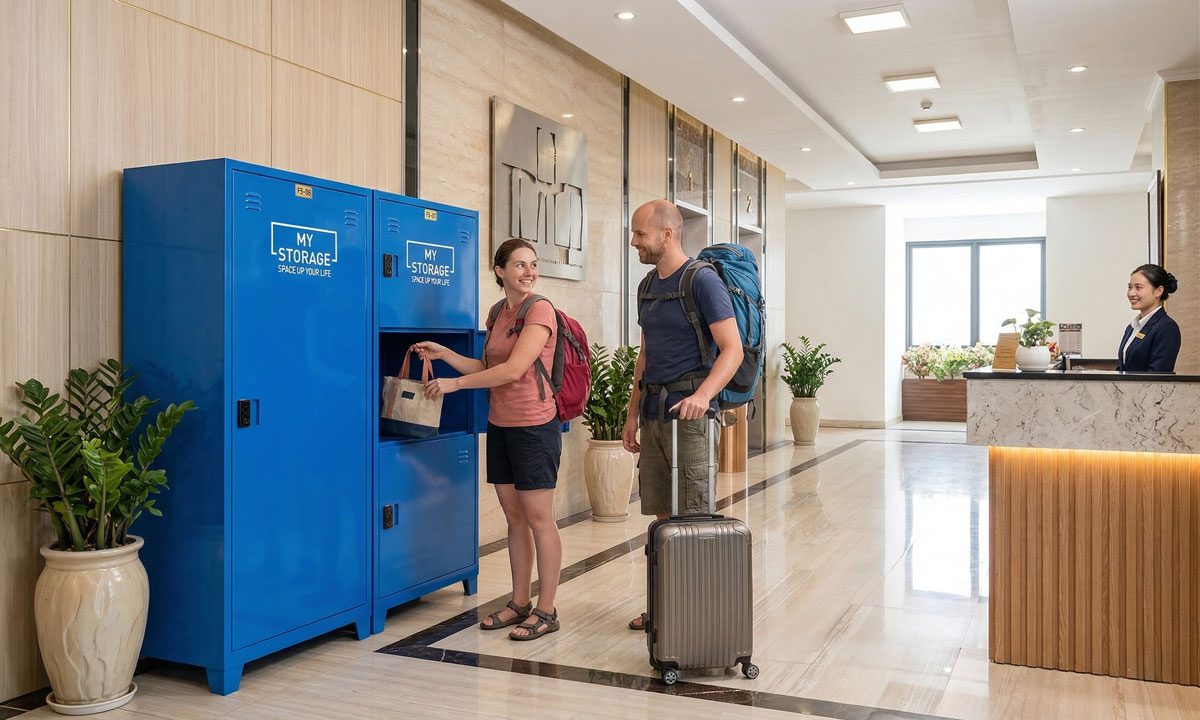
Apartment Lobbies “Overrun” by Parcels
The e-commerce boom is creating a very real physical problem in apartment lobbies across Vietnam: parcels piling up, delivery drivers waiting, receptionists overwhelmed, and the building’s image deteriorating daily. This isn’t a minor or temporary issue; it’s a direct consequence of the 25% annual e-commerce growth rate (VECOM, 2024) impacting a parcel reception infrastructure never designed to handle such volumes.
And while residents endure the inconvenience, building management faces endless operational pressure a daily loop of receiving goods, making notification calls, waiting for residents to pick up, handling disputes, and tidying up. No system, no tracking, no way out.
The Reality in Vietnamese Apartment Lobbies in 2024
Let’s look at what’s actually happening in the lobby of a 500-unit apartment building in Ho Chi Minh City on a peak e-commerce delivery Friday afternoon:
- The average Vietnamese user orders online 4.5 times/week (VECOM, 2024). For 500 households, an average of 100–150 parcels are delivered daily, concentrated between 2 PM and 7 PM. Most residents are not home during office hours. The result: couriers constantly arrive at the lobby, receptionists must sign for each package, parcels pile up on a “first-come, first-served” basis, residents spend 5–10 minutes searching for their items due to a lack of sorting systems, and the next courier has to wait for the receptionist to complete the previous transaction.
- On major sales days (11/11, Black Friday, holidays), volumes increase 3–5 times. The building lobby transforms into an uncontrolled temporary storage area.
- An average apartment receptionist spends 2–3 hours daily just processing parcels received from couriers, calling residents to notify them, supervising pickups, and tidying the area. This accounts for 25–37% of their total working time, consumed by a task not in the receptionist’s original job description and generating no operational value for the building.
4 Real Problems Residents and Building Management Are Both Enduring
- Couriers Waiting — Lobby Congestion During Peak Hours: Couriers cannot drop off packages and leave because delivery regulations require confirmation. If the receptionist is busy with other tasks or serving other residents, couriers must wait. With multiple couriers waiting simultaneously, the lobby becomes a bottleneck, not just in terms of space but also for the flow of residents and visitors. The image of a high-end building is directly eroded every time this occurs.
- Parcels Piling Up — Loss of Visual Control: Without a sorting system, parcels are arranged in order of arrival, not by name or apartment number. Residents searching for their items have to sift through each package. Parcels left waiting for hours or days further clog up space. Buildings design beautiful lobbies to create a strong first impression for guests, but dozens of packages stacked in a corner completely negate that design investment.
- Confusion and Loss — Dispute Risks: There’s no tracking system once packages enter the building. Receptionists sign manually or take unstandardized manual photos. When residents report missing items, there’s no clear evidence of who received it, when, where, or who took it. Each dispute consumes time for both building management and residents, leaving unresolved dissatisfaction.
- Overwhelmed Receptionists — Decreased Operational Efficiency: Receptionists are hired to support residents, coordinate operations, and handle incidents. When 25–37% of their working time is consumed by manual parcel processing, truly important tasks are delayed, poorly handled, or overlooked. Building management cannot continuously hire more staff to compensate; that’s not a sustainable solution for a problem stemming from a lack of system.
Why Manual Parcel Management Cannot Continue
The issue isn’t just today’s inconvenience—it’s a trend that will continue to worsen without a systemic solution.
- Parcel Volumes Will Continue to Rise, Not Decline: Vietnam’s e-commerce market reached $20.5 billion in 2023 and is projected to grow 20–25% annually until 2030. Each year, the number of parcels delivered to apartments increases proportionally. Today’s manual solutions are already operating at their limit; an additional 25% volume will be a breaking point.
- Rising Resident Expectations: Residents of high-end apartments are accustomed to real-time tracking from Shopee, Lazada, and GHN. They know exactly where their package is in the delivery chain until it enters the building, at which point everything becomes an information black hole. This broken experience creates dissatisfaction even when items aren’t lost.
- Growing Hidden Operational Costs: Staff dedicated to manual parcel handling, disputes requiring resolution, damage to the building’s image, and resident dissatisfaction leading to difficulty in lease renewals—all are real costs that never appear in “parcel cost” reports. They are hidden within personnel costs, dispute resolution costs, and lost revenue when residents don’t renew their leases due to poor service quality.
And the solution is readily available it just hasn’t been widely adopted: Smart parcel lockers within buildings are neither new nor expensive technology. This solution has been successfully implemented in thousands of apartments in Singapore, Japan, and South Korea, and is rapidly expanding in Vietnam. Couriers deliver items into the locker, the system automatically sends notifications to residents, and residents pick up their packages at their convenience, no receptionist needed, no waiting, no disputes.
| Metric | Manual Management | Smart Parcel Locker |
|---|---|---|
| Receptionist time for parcel handling | 2–3 hours/day | Under 15 minutes/day |
| Error/Loss rate | 1–3%/month | Near 0% (with full logs) |
| Resident experience | Pickup during receptionist hours | 24/7 pickup at convenience |
| Lobby image | Parcels piling up | Spacious, tidy lobby |
| Scalability with e-commerce growth | Requires increased staff | Only requires adding locker compartments |
| Additional operational costs | Proportional to volume | Virtually unchanged |
Why Do Luxury Apartments Choose Parcel Lockers?
Luxury developments opt for parcel lockers not just to solve the package delivery challenge, but to elevate the overall living standards, optimize operations, and safeguard the sophisticated image that developers have invested hundreds of billions of VND to build. In the high-end segment, a cluttered lobby with piled-up packages negates the entire brand value of a project, regardless of how beautiful the architecture or how premium the materials.
This is precisely why projects with the highest standards are often the first to implement parcel locker solutions – not because they have more problems, but because they refuse to compromise on the resident experience.
Why Luxury Apartments Prioritize Parcel Lockers Over Other Solutions
- Aligns with Brand Positioning: Smart, self-service lockers convey the same message as other premium amenities in the building: technology, convenience, and respect for residents’ time. Residents don’t need to speak with reception, wait, or adjust their schedules to the management office’s opening hours. This experience perfectly matches the mindset of those living in the luxury segment.
- Frees Up Staff for Real Service: When parcels are handled automatically by the locker system, receptionists and management staff are freed up to focus on what truly creates value: assisting residents, resolving issues, and maintaining service standards. This is a substantive operational upgrade, not just an added amenity.
- Clear and Measurable ROI: Unlike many other luxury amenities where value is hard to quantify, parcel lockers generate concrete figures: how much % reception time is reduced for parcel handling, how much % resident satisfaction with services increases, how many package disputes decrease each month. Property management can report efficiency to developers with real data.
- Unlimited Scalability: As parcel volumes increase with the pace of e-commerce, the only sustainable solution is to add locker compartments, not more staff. The locker system can scale linearly with demand without proportionally increasing operational costs.
Case Study 1 — The Nassim: When 5-Star Standards Accept No Compromise
About the Project: The Nassim is a luxury apartment project located in Thao Dien, District 2 (now Thu Duc City), Ho Chi Minh City – one of the city’s most upscale real estate addresses with a large international resident community and service standards equivalent to a 5-star hotel. With apartment prices among the market’s highest, residents’ expectations for every aspect of operations are extremely high.
The Problem to Solve: The international resident community at The Nassim has a higher-than-average online shopping habit, combining the convenience needs of busy individuals with consumer habits from developed countries. Large parcel volumes, diverse communication languages, and high privacy expectations created unique pressures that the traditional receptionist-sign-off model could not adequately meet.
Solution and Results: The Nassim implemented MyStorage’s smart locker system in the building’s parcel reception area. The system integrates multi-language automatic notifications, allowing residents to retrieve packages anytime without interacting with staff. Shippers deliver directly into the locker, scan a confirmation code, and the system immediately sends a notification to the resident’s phone with a personal unlock code.
Operational Results Recorded: The building lobby maintained consistent order and aesthetics, staff time spent on parcel handling significantly decreased, and resident satisfaction with package reception services markedly increased in the management board’s periodic surveys.
In the luxury segment, the value of parcel lockers lies not just in convenience but in the consistency of the experience. The Nassim residents do not accept “the receptionist is busy today, so you have to wait” or “the package is here, but I don’t know which compartment.” The locker system ensures every transaction occurs in precisely the same way, regardless of the shift or staff workload.
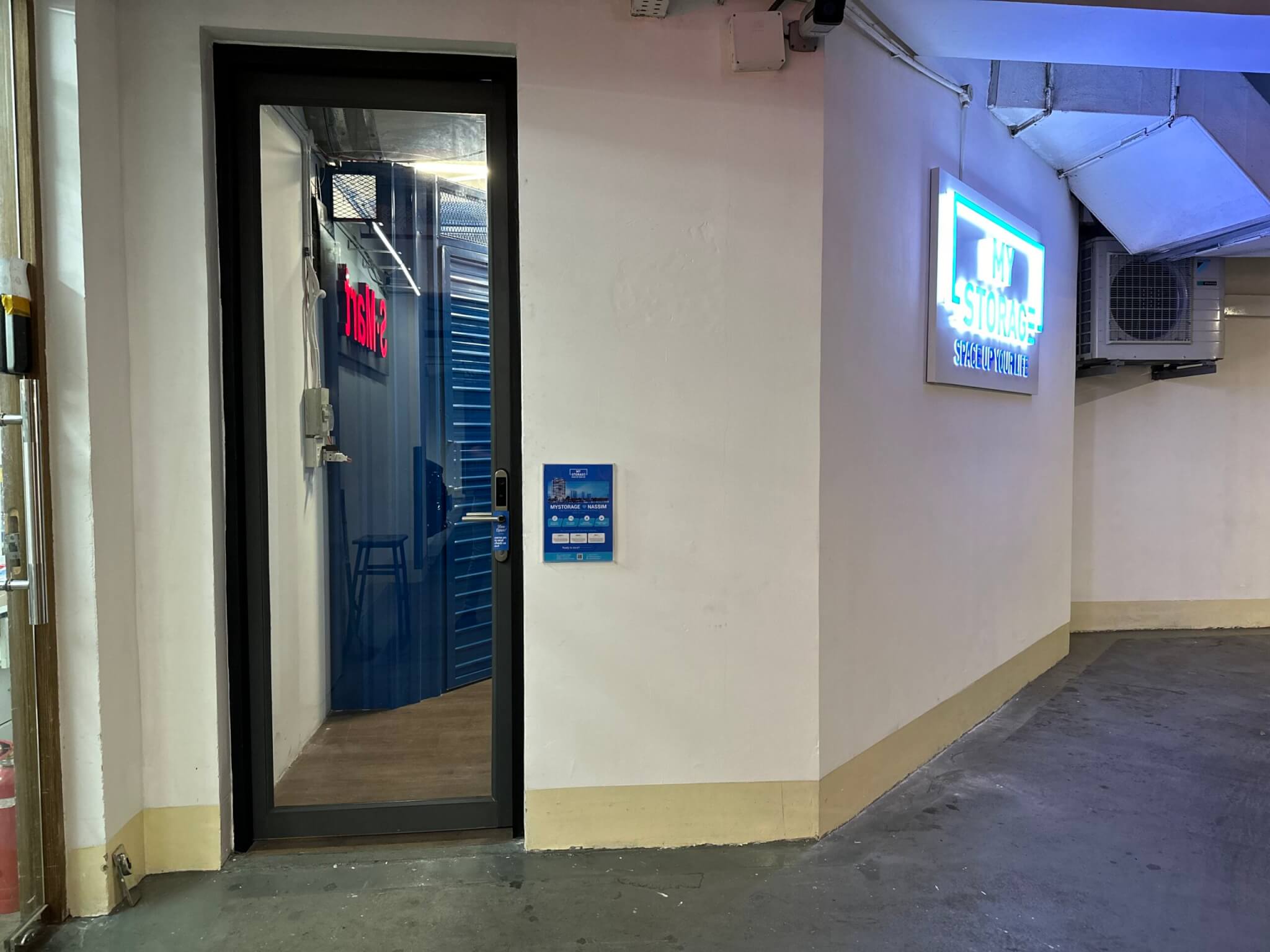
Case Study 2 — Q2 Thao Dien: Optimizing Operations in a Dynamic Urban Community
- About the project: Q2 Thao Dien is a high-end apartment project in the Thao Dien area, Thu Duc City, serving a young, dynamic resident community with a high proportion of professionals and expats working for multinational companies. This demographic has the highest frequency of online shopping, the most flexible work schedules, and simultaneously the least time to wait for package collection during office hours.
- The problem to be solved: Q2 Thao Dien residents are often not home during regular delivery hours. Packages accumulate at the reception desk, creating clutter in the lobby in the afternoon and evening, precisely when residents return home and when the lobby needs to make the best impression. The management board received feedback from residents regarding the unsightly situation and some cases of mistaken or delayed package notifications.
- Solution and results: Q2 Thao Dien implemented MyStorage’s parcel locker system, designed to integrate seamlessly into the building’s lobby space, avoiding the feeling of an “added-on” feature. The system connects with the existing apartment management application, allowing residents to receive notifications and track their package history within the same app.
- Outstanding results after implementation: The problem of packages piling up in the lobby was completely resolved, receptionists no longer have to spend time notifying and supervising package collection, and residents can retrieve their packages at any time that suits their schedule, even outside of management’s working hours.
For a dynamic resident community, time flexibility is a more crucial value than any other feature. A 24/7 parcel locker system, independent of staff schedules, perfectly aligns with the lifestyle of this resident group, which is why the locker utilization rate at Q2 Thao Dien reached high levels from the very first weeks of deployment.
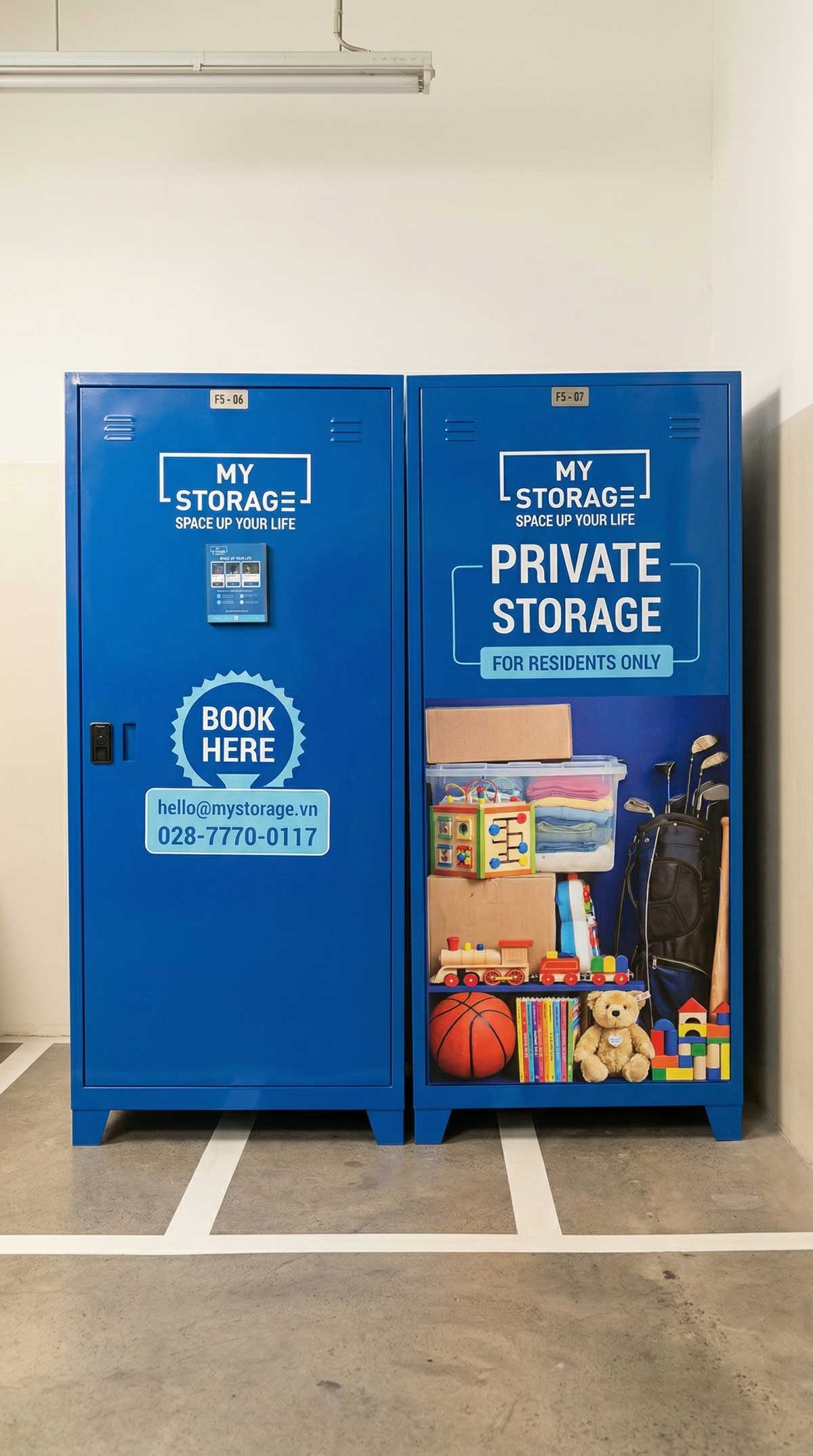
Common Lessons from Two Case Studies
Two projects in Thao Dien represent two distinct challenges: The Nassim prioritizes consistent brand experience and image, while Q2 Thao Dien focuses on flexibility and operational optimization. However, both led to the same solution and the same outcome: building lobbies freed from parcels, staff freed from manual tasks, and residents freed from dependence on others’ working hours.
| Criteria | The Nassim | Q2 Thao Dien |
|---|---|---|
| Resident Profile | International expats, 5-star standards | Young, dynamic professionals |
| Key Pain Point | Brand image and privacy | Flexible working hours, unable to receive deliveries |
| Prioritized Value | Consistent experience, multilingual | 24/7 flexibility, app integration |
| Notable Outcome | Maintained 5-star service standards | Completely resolved lobby clutter |
| Common Lesson | Parcel lockers are a minimum standard for luxury | Parcel lockers are an operational tool, not just an amenity |
Key Factors to Consider When Deploying Parcel Lockers
It’s crucial to choose a location with suitable foot traffic, determine the correct number of locker compartments, ensure stable system operation, and design a truly user-friendly experience. These four factors are not independent but interact with each other: a good location with insufficient compartments will frequently run out of space, causing dissatisfaction; a good system with complex UX will deter residents from using it; and a good UX in the wrong location will go unnoticed.
Successful parcel locker deployment isn’t about placing a locker in a corner and waiting for results; it’s about designing a small system that operates synchronously from physical hardware to technology to user experience.
Factor 1 — Lobby Location: The Right Spot Determines 70% of Success
The location of parcel lockers is the only factor that cannot be easily adjusted after deployment. Lockers placed in the wrong location will have a low utilization rate even if all other factors are excellent — and the common misconception is often “lockers aren’t suitable for this building,” when in reality, it’s simply a location issue.
Ideal location criteria for parcel lockers:
- Within direct sight from the main entrance or elevators
- Within a 10m radius from where shippers typically stop to deliver packages
- Does not obstruct the main flow of resident and guest traffic
- Has enough space in front of the lockers for 2–3 people to stand simultaneously without hindrance
- Close to a stable power source, not dependent on auxiliary or temporary power lines
- Has stable WiFi or 4G connectivity — smart lockers require continuous connection
- Sufficient lighting for users to read the screen and operate comfortably
- Not located in a hidden corner, narrow hallway, or an area that feels unsafe
Best locations in order of priority:
The ground floor elevator waiting area is ideal; users naturally stop here and have 30–90 seconds to operate while waiting for the elevator. Next is the reception area near the entrance, where both shippers and residents have a natural reason to stop. A wide corridor between the gate and the elevator ranks third high traffic but people move faster than in the elevator waiting area.
Practical check before deciding: Stand at the proposed locker location during peak evening hours (5–7 PM) and count the number of people passing by in 15 minutes. If fewer than 20 people, reconsider the location. If over 50 people, this location has good potential.
Factor 2 — Number of Lockers: Not Too Few to Avoid Running Out, Not Too Many to Avoid Waste
Determining the correct number of locker compartments is a balancing act between actual demand and deployment costs. Mistakes in both directions cause problems: too few compartments lead to constant unavailability, resident dissatisfaction, and shippers unable to deliver; too many compartments result in low occupancy rates, wasted space, and operational costs disproportionate to the benefits.
Formula for calculating minimum locker compartments:
Required compartments = (Number of households × average daily parcel reception frequency) ÷ average daily turnover per compartment
For a 300-household apartment building, with an average parcel reception frequency of 0.3 parcels/household/day = 90 parcels/day, and each compartment turning over 3 times/day: Minimum compartments = 90 ÷ 3 = 30 compartments.
Recommendation: Deploy 110–120% of the calculated demand to provide a buffer for peak days and growth phases. For the example above: 33–36 compartments is a suitable range for initial deployment.
Optimal compartment size distribution:
| Compartment Size | Recommended Ratio | Suitable For |
|---|---|---|
| Small (under 30cm high) | 35% | Envelopes, small boxes, food delivery bags |
| Medium (30–50cm high) | 45% | Clothing boxes, books, household items |
| Large (50–80cm high) | 20% | Large boxes, small home appliances |
Signals for adjusting the number of compartments: A “locker full” rate (users unable to find an empty compartment) exceeding 15% of access attempts is a clear signal to increase the number of compartments. An average utilization rate below 35% after 60 days of operation indicates a need to review the location or internal communication strategy, not to add more compartments.
Factor 3 — Operational System: Technology Must Work All the Time
Smart parcel lockers rely on three layers of technological infrastructure: hardware (lockers, electronic locks, screen), software (management system, app, notifications), and connectivity (power, internet). Any layer experiencing issues will affect the entire user experience. A single locker malfunction when a resident needs to retrieve an important package can negate weeks of positive experience.
Technical infrastructure checklist to ensure:
- Power source: Connected to the building’s main power supply, not a temporary outlet.
- UPS/power backup: Lockers have a backup battery or UPS connection to operate during short power outages.
- Internet connectivity: Stable WiFi or integrated 4G SIM in the locker as a backup.
- Remote monitoring system: Provider can detect and resolve issues remotely 24/7.
- Clear incident response procedure: Who to contact when a locker malfunctions, what is the committed response time?
- Manual backup: Contingency procedures when the system loses connection (master key code, support contact).
- Regular maintenance: Schedule for locker inspection and maintenance at least once every 3 months.
Questions to ask the provider before signing a contract: “Over the past 12 months, what was the system’s uptime percentage? What is the average response time for technical issues?” A committed uptime of at least 99% and a technical issue response time under 4 hours are acceptable thresholds for residential buildings.
Factor 4 — Resident Experience: If It’s Hard to Use, Residents Won’t Use It
The UX (User Experience) of the locker system determines the adoption rate — meaning what percentage of residents actually use the system compared to continuing to rely on reception staff for package signing. A system can be technically perfect but still fail if residents find it complicated or untrustworthy.
Most important UX points:
- Clear and timely notifications: Residents receive notifications immediately when a package is placed in the locker. The notification must include: the specific locker compartment number (not just “package has arrived”), an unlock code or authentication link, and a clear pickup deadline. Notifications via app + SMS in parallel ensure no one misses them.
- Pickup process under 60 seconds: From arriving at the locker to retrieving the package should not exceed 60 seconds. If more steps are required (app login, long code entry, additional authentication), the abandonment rate and return to reception will be high. The locker screen interface needs to be large enough, clear, and functional even if users don’t have the app installed.
- Multilingual support for buildings with international residents: Projects like The Nassim with expat residents require an English interface and notifications — this is not an optional feature but a mandatory condition to ensure high utilization rates among this resident demographic.
- First-time user guide: The first month after deployment is the critical period for adoption. Building management needs to proactively guide residents: introductory emails, posters in the lobby, notifications via the general apartment management app, and even direct guidance at the reception desk. Residents who have successfully tried it once often return with a very high frequency.
Signals for UX improvement: If after 30 days of operation, the rate of “overdue” packages (remaining in the locker beyond the allowed time without being picked up) is higher than 10%, the cause is usually notifications not arriving or arriving late — the notification flow needs to be re-checked. If many residents report “not knowing how to use it,” the onboarding process needs to be reviewed.
Comprehensive Parcel Locker Deployment Checklist
| # | Factor | Key Question | Signal to Review |
|---|---|---|---|
| 1 | Lobby Location | Is the traffic at the proposed spot over 50 people/day? | Under 20 people/day, hidden corner |
| 2 | Visibility | Can residents see the locker immediately upon entering the lobby? | Obscured by a pillar, plant |
| 3 | Power Source | Connected to main power or temporary outlet? Does it have UPS? | Temporary outlet, no backup |
| 4 | Internet Connectivity | Stable WiFi or 4G SIM backup? | Frequent disconnections |
| 5 | Number of Compartments | Calculated using the formula: households × reception frequency? | Frequently runs out of compartments during peak hours |
| 6 | Size Distribution | Enough large compartments for bulky items? | Shippers often can’t find suitable compartments |
| 7 | Notifications | Do residents receive notifications immediately when a package enters the locker? | Overdue packages exceed 10% |
| 8 | Pickup Speed | Is the process from arriving at the locker to retrieving the package under 60 seconds? | Residents give up and ask reception for help |
| 9 | Uptime Commitment | What uptime percentage does the provider commit to? | Commitment below 99% or no commitment |
| 10 | Onboarding | Is there a plan to guide residents in the first month? | Adoption rate below 40% after 60 days |