
 Tiếng Việt
 한국어
한국어 日本語
日本語Article· Updated October 15, 2026
Phone Accessory Warehousing Solutions for Online Shops
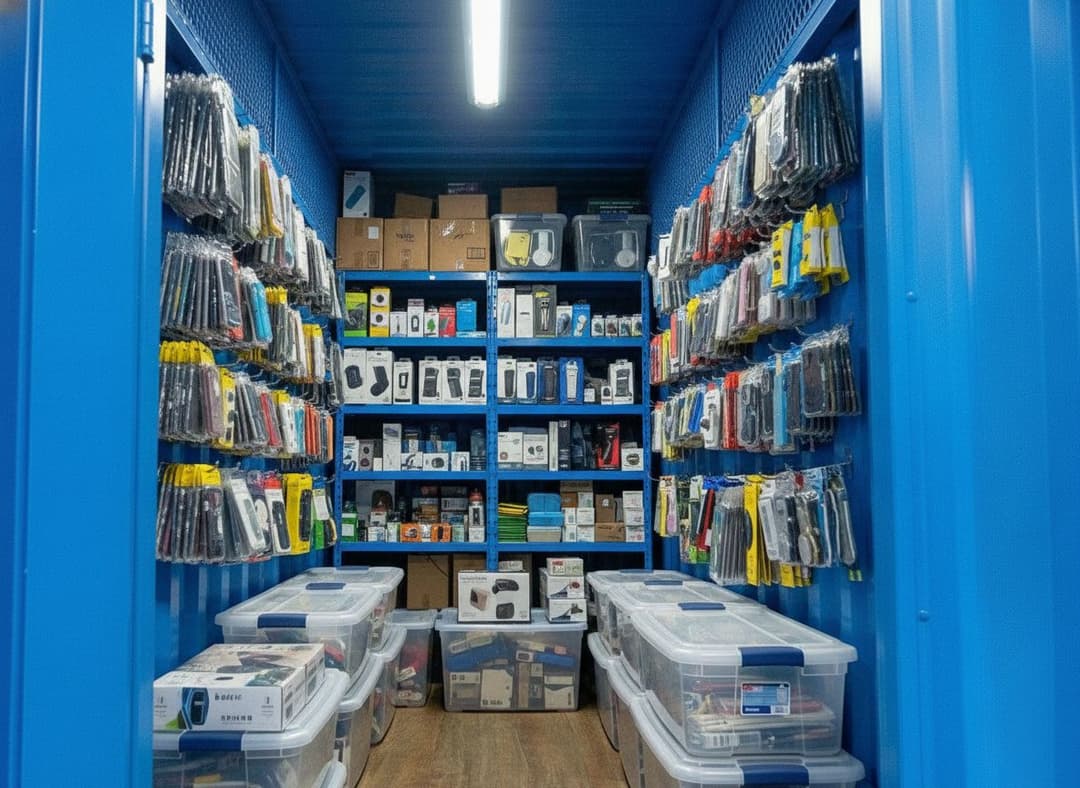
Phone accessory warehouse is a solution that helps online shops, sellers on Shopee, TikTok Shop, and distribution businesses store goods more safely, neatly, and easily. Instead of stuffing products at home or in the office, businesses can use storage units to preserve cases, charging cables, headphones, and other tech accessories, while flexibly scaling as sales grow.
Why Do Phone Accessory Shops Often Face Warehousing Issues?
Phone accessories look compact but create the most complex warehousing puzzle in the e-commerce category. Large SKU counts, rapid model changes following new device releases, and inventory that is difficult to control manually are the three main reasons why phone accessory shops quickly exceed the storage capacity of homes or small offices.
Numerous designs and colors create a massive number of SKUs
A simple phone case can have 20–30 designs, each with 5–8 different colors and compatibility with 10–15 popular phone models. A single case category alone can generate 1,000–3,600 different SKUs. When a shop expands into screen protectors, charging cables, headphones, stands, and photography accessories, the total SKU count can easily exceed 5,000–10,000 product codes.
Each SKU requires at least one distinct storage location to avoid confusion during packing, creating space and classification requirements far beyond what a room in a house can provide.
Diverse inventory and constant fluctuations
Unlike apparel or cosmetics, phone accessories have product lifecycles closely tied to the release cycles of major manufacturers. When Apple releases a new iPhone or Samsung launches a Galaxy S series, the entire inventory of cases and screen protectors for older models immediately loses value and sales speed slows down significantly.
Shops need to restock new items quickly while still processing old inventory, creating a situation where goods accumulate with each new device launch from manufacturers. After 2–3 years of operation, an active phone accessory shop can have inventory from 5–7 different device generations simultaneously.
SKUs increase rapidly according to market trends
Market trends for phone accessories change very quickly, and any shop that reacts slowly will miss out on revenue opportunities. When a case model goes viral on social media, dozens of shops immediately import it to catch up, but just a few weeks later, the trend may have shifted to another model.
As a result, shops continuously import new items based on trends while old items from previous trends haven’t sold out yet. This rate of inventory accumulation is particularly fast for shops that follow multiple trends at once without a clear inventory management strategy.
Small homes and offices quickly run out of space
Although phone accessories are small, with a large number of SKUs, the total volume of accumulated inventory grows much faster than regular goods. A 50x40x30cm box holds about 200–300 thin cases, but when needing to store 5,000 SKUs with 20–50 units each, the total inventory volume has exceeded 10–20 large cardboard boxes.
This space cannot be squeezed into a bedroom or office without seriously affecting daily life. Additionally, small items left cluttered in a living space create a much higher risk of loss and confusion compared to large-sized goods that are easy to distinguish.
Difficult to control inventory manually when there are too many SKUs
Controlling inventory manually with spreadsheets or hand-written notes is already difficult with 100 SKUs and nearly impossible with 1,000 or more without making mistakes. Phone accessory shops frequently encounter overselling because recording systems are not updated in time when selling simultaneously on multiple channels like Shopee, TikTok Shop, and direct sales.
Conversely, some SKUs are forgotten in the warehouse because there is no reminder system, leading to items expiring their sales window or becoming obsolete without being handled in time. Both situations cause direct financial damage and affect the shop’s rating on platforms.
A shop might only sell phone accessories but own hundreds to thousands of different product codes. Managing this number of SKUs well requires systematic storage space and cannot rely forever on a corner of a bedroom or under a desk.
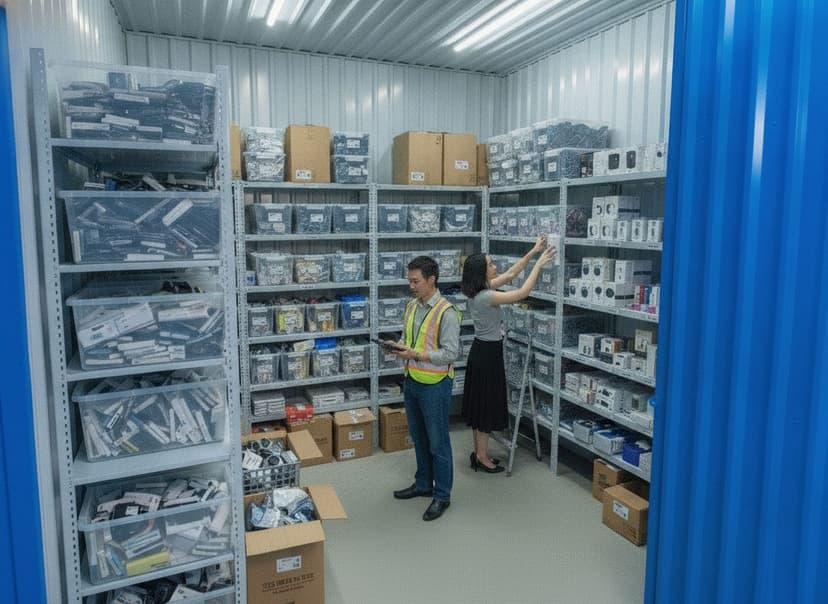
Common Types of Phone Accessories Requiring Warehousing
A suitable storage warehouse accommodates the entire catalog of phone accessories and consumer tech devices. Each product group has different storage characteristics, ranging from moisture-proof storage for electronic components to impact protection for fragile items.
| H3 | Description | Product Characteristics | Storage Requirements | Risks of Improper Storage |
|---|---|---|---|---|
| Phone Cases | Cases have the largest number of SKUs in the accessory category because each phone model needs its own case, and each design comes in many colors and materials. | Lightweight but the number of SKUs can easily exceed 1,000–3,000 codes; requires detailed zoning by phone model and color. | Tiered shelving by phone model, partitioned boxes by color, and clear labeling for each position to ensure correct SKU fulfillment. | Shipping the wrong model or color is the most common cause of returns, directly affecting the shop’s rating. |
| Charging Cables & Adapters | Cables and adapters are easily tangled and confused between connection standards if there is no clear classification system from the moment of stock entry. | Multiple connection standards like Type-C, Lightning, Micro USB, and various power outputs; easily mixed up without labels. | Classify by connection standard and power output; tie or coil cables neatly before storing; avoid stacking in heaps. | Shipping the wrong charging standard can damage the customer’s device, leading to difficult-to-resolve complaints and refunds. |
| Bluetooth Headphones | Headphones and small audio devices have high value relative to their size and are sensitive to humidity and impact during storage and transport. | Product boxes are easily dented; audio chips and lithium batteries are sensitive to moisture and high temperatures. | Maintain warehouse humidity below 65% RH; stack vertically or in rows to avoid heavy pressure; keep boxes sealed until shipping. | Moisture penetration can damage audio drivers; batteries may swell due to high heat; dented boxes affect the customer’s unboxing experience. |
| Screen Protectors | Screen protectors are the most fragile items in the phone accessory category, requiring special attention during both storage and internal warehouse handling. | Thin and easily broken under uneven pressure; each phone model needs a specific protector; difficult to distinguish by eye without labels. | Stack vertically instead of horizontally; do not stack more than 10–15 boxes; use padding between rows of protectors. | Cracked protectors in the warehouse may go undetected; shipping broken goods leads to mass returns and significant financial loss. |
| Power Banks & Tech Accessories | Lithium batteries in power banks and tech devices have the strictest storage requirements due to the risk of swelling and fire if kept in the wrong conditions. | Lithium batteries must never be kept at temperatures above 40°C or in damp places; high-value products require better security. | Warehouse temperature below 30°C; avoid direct sunlight and heat sources; do not stack in many layers; 24/7 camera security. | Swollen batteries can ruin the entire shipment; risk of fire or explosion in the warehouse if batteries are compressed or kept in excessive heat. |
When Should Online Shops Rent a Warehouse for Phone Accessories?
Renting a warehouse is a natural transition when a phone accessory shop surpasses the threshold where home space can no longer meet efficient operational needs. The five signs below, combined with corresponding solutions, help sellers determine the right time to take action.
| Identification Signs | Practical Issues | Solutions with a Private Warehouse |
|---|---|---|
| Stock occupies the entire bedroom or living room | Living space is narrowed to the point of affecting the whole family’s daily life. Cases stacked up to the bed, cables scattered on the floor, and cartons blocking walkways become familiar daily sights. Psychological stress from living amidst inventory accumulates, affecting both work quality and personal life. | Self-managed warehouses completely separate business space from living space. The home returns to its proper living function, and sellers work more effectively with clear boundaries between work and life. |
| Orders consistently exceed 30–50 per day | Order processing speed cannot keep up without a fixed packing area. Sellers spend an extra 5–10 minutes per order just finding items and clearing space to pack; multiplied by 50 orders a day, this is 4–8 hours wasted that could be used for business growth. Late delivery rates rise, dragging down shop ratings. | Warehouses provide fixed packing areas with wide tables, shelving within reach, and packing materials ready to go. Order processing speed increases by 40–60%, errors decrease, and on-time delivery rates significantly improve. |
| Having several hundred SKUs or more | Manual management loses control when SKUs exceed 300–500 codes. Cases for different phone models look nearly identical, cables with different standards can only be distinguished by small labels, and screen protectors are almost impossible to tell apart by eye. The rate of shipping the wrong SKU increases proportionally with the number of product codes without a professional zoning system. | A private warehouse allows for the setup of shelving systems zoned by phone model, connection standard, and product category. Each SKU has a fixed location with clear labels; the mis-shipment rate drops significantly, and picking time per order is reduced to under 1 minute. |
| Importing in bulk to optimize cost of goods | Bulk importing saves 15–25% on cost of goods but creates immediate space issues. A shipment of 2,000 cases occupies 3–5 large cartons; adding cables, protectors, and headphones from the same batch can total 10–15 boxes. Home space cannot accommodate large shipments without disrupting existing stock, forcing sellers to import in small trickles and miss out on cost advantages. | Flexible warehouses can increase space for each large shipment and shrink back down when inventory decreases. Sellers proactively import optimal quantities for the best cost of goods without being limited by home area. |
| Starting multi-channel selling | Selling simultaneously on Shopee, TikTok Shop, Lazada, and direct channels creates pressure to synchronize inventory and process orders from multiple sources. Unsynchronized inventory leads to overselling on one channel while another still shows stock, causing mass order cancellations and severely affecting reputation scores across all platforms at once. | Centralizing all goods in one location makes synchronizing physical inventory much easier. Sellers gain control over actual quantities and update all sales channels more accurately, minimizing overselling and unnecessary cancellations. |
You don’t need to wait until all five signs appear simultaneously. Just two of them occurring consistently for a month is enough to seriously consider renting a warehouse. The cost of a 2–5 m² self-storage unit in HCMC, price ranging from 500,000 to 1,200,000 VND per month, is often lower than the losses from a single batch of wrong deliveries or mass order cancellations due to poor inventory management.
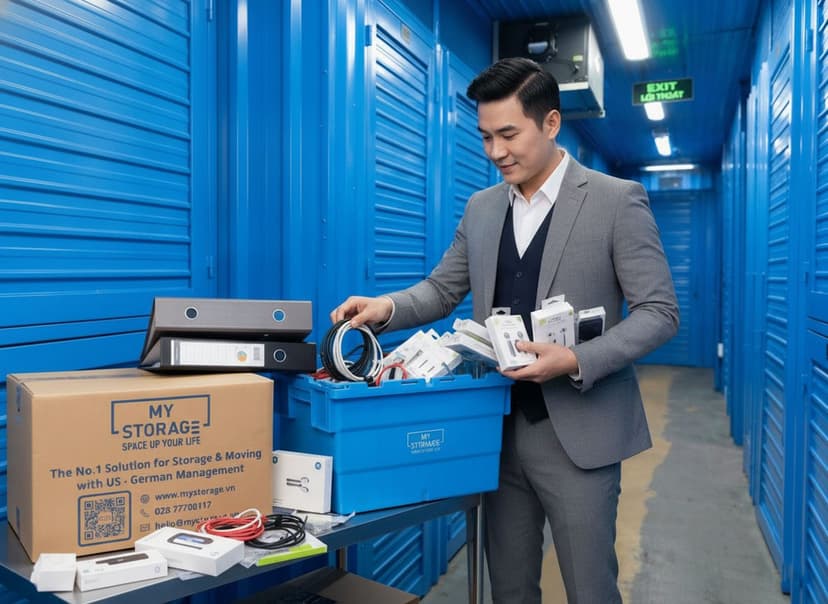
Benefits of Renting a Phone Accessory Warehouse
A private warehouse doesn’t just solve space issues; it creates a more professional operational foundation for growing phone accessory shops. Four core benefits directly impact business efficiency from the very first month.
Freeing Up Living and Working Space
Separating inventory from living space improves both quality of life and work efficiency simultaneously.
Moving stock to a private warehouse returns bedrooms, living rooms, and desks to their intended functions. Sellers no longer live among thousands of phone case boxes and cable rolls, making the home work environment airier and more focused. Families no longer complain about cardboard boxes blocking walkways or goods taking up common areas. The clear boundary between work and personal life is a less-mentioned benefit, but in reality, it is the one sellers value most after moving to a private warehouse.
Easier SKU Management
A system of zoned shelving and clear labeling in a private warehouse helps find the right SKU in under 1 minute, instead of the 5–15 minutes it takes when goods are cluttered at home.
| Operational Metrics | Home Storage | With Private Warehouse |
|---|---|---|
| Time to find one SKU | 5–15 minutes | Under 1 minute |
| Wrong delivery rate | High, especially with similar-looking SKUs | Significantly lower due to clear zoning |
| Inventory time | Several days per month | A few hours with standard labeling |
| Inventory accuracy | Low, prone to overselling | Higher, better multi-channel synchronization |
Easy Business Scaling
Monthly self-storage allows shops to increase space when importing large shipments and shrink when inventory decreases, without being limited by home size or long-term commitments.
Importing in bulk to optimize cost prices is no longer hindered by a lack of storage space. Shops can stock up before major sales like 9.9, 11.11, and Tet with 3–5 times the normal volume without affecting living space. When new trends emerge, shops react quickly by importing new SKUs without disrupting existing stock. Flexible monthly warehouse space ensures storage costs always align with the shop’s actual scale.
Better Product Protection
Environmentally controlled warehouses with 24/7 security protect phone accessories significantly better than home storage, especially for lithium batteries and electronic components sensitive to humidity and temperature.
| Risk Type | Home Storage | MyStorage Self-Storage |
|---|---|---|
| High humidity damaging components | Difficult to control, especially in rainy season | 50–65% RH maintained continuously |
| High temperature causing battery swelling | Up to 35–40°C during the day | Stable at 20–26°C |
| Theft of high-value goods | General apartment security | 24/7 cameras, individual PIN locks for each unit |
| Goods crushed due to poor stacking | Cramped space, arbitrary stacking | Tiered shelving, properly organized by category |
What Standards Should a Phone Accessory Warehouse Meet?
Phone accessories and electronic components have stricter storage requirements than general goods. A suitable warehouse must meet five core standards: a dry environment, surveillance cameras, access control, flexible space, and convenient loading and unloading.
Dry Environment
High humidity is the leading cause of electronic component failure in warehouses. Swollen lithium batteries, oxidized circuits, and peeling tempered glass films are all directly related to substandard storage environments.
| Parameter | Requirements for Phone Accessories | Risks if not met |
|---|---|---|
| Humidity | Below 65% RH, ideally 50–60% | Circuit oxidation, battery swelling, film peeling |
| Temperature | 20–26°C, not exceeding 30°C | Rapid battery capacity loss, plastic deformation |
| Ventilation | Continuous air circulation | Localized humidity buildup damaging long-term stock |
| Lighting | No direct sunlight exposure | Packaging fading, plastic becoming brittle and deformed |
Surveillance Camera System
Phone accessories are high-value, compact, and portable items, belonging to the group of goods at the highest risk of loss if the surveillance system is not strong enough.
Cameras at MyStorage cover all hallways, entrances, and areas adjacent to each storage unit, operating 24/7 and storing footage for 90 days. This system not only prevents loss but also provides verification evidence when shops need to check the timing of a specific shipment’s entry or exit, which is particularly useful during disputes with shipping units regarding the condition of goods upon dispatch.
Access Control
Phone accessory warehouses need strict access control because of the high value and small size of the goods, which can easily go missing without immediate detection.
| Criteria | Required Standards | MyStorage Compliance |
|---|---|---|
| Access Lock | Individual PIN code for each unit, no sharing | Each customer has an independent PIN |
| Staff Access Rights | Warehouse staff cannot open customer units | Only the owner has access to their unit |
| Access Logs | Record time and person for each access | Automatic log system that can be retrieved |
| After-hours Access | Need early morning or late night pickup | 24/7 access via individual PIN code |
Multiple Flexible Warehouse Sizes
The storage needs of phone accessory shops fluctuate greatly month by month, especially before and after major sales or when new phone models are released.
| Business Stage | Space Requirements | Estimated Cost |
|---|---|---|
| Starting out, under 500 SKUs | 2–3 m² | 400,000–700,000 VND per month |
| Growing, 500–2,000 SKUs | 4–6 m² | 800,000–1,400,000 VND per month |
| Before major sales, restocking | Temporary increase of 2–4 m² | Adjusted from the following month |
| After sales, inventory decreases | Shrink back to base level | No penalty fees for reducing space |
Easy Loading and Unloading
The speed of loading and unloading directly affects the ability to process orders quickly and maintain on-time delivery rates, which is especially important during peak sale periods.
| Logistics Criteria | Why it matters for accessory shops |
|---|---|
| 24/7 Access | Shipping pickup schedules are often 7–9 AM; early access is needed to prepare orders before pickup |
| Parking near warehouse entrance | Accessories are imported in large boxes; motorcycles or small trucks need to park close for fast unloading |
| On-site trolleys | 20–30 kg boxes require equipment for movement within the warehouse |
| Receiving goods on behalf | Suppliers deliver directly to the warehouse when the owner is absent, ensuring no missed orders |
| Wide aisles in the warehouse | Space is needed to open boxes and inspect goods on-site before organizing them onto shelves |
Which Warehouse Model Suits Shopee, TikTok Shop, and Facebook Stores?
The ideal warehouse model depends on order volume, SKU count, and sales channels. New shops require flexible small warehouses, growing shops need systematic self-storage, and distributors require large spaces with professional warehouse operation processes.
| Scale & Sales Channels | Operational Characteristics | Warehousing Challenges | Suitable Solutions | Area & Cost |
|---|---|---|---|---|
| New shops starting with under 20 orders per day | 1–2 sales channels, under 200 SKUs, small-scale inventory imports, operated solo or with one assistant | Stock stored at home begins to impact living space, lacking a clear SKU management system | Mini warehouse 1–3 m² at a self-storage facility, monthly rental without long-term commitment, enough space for 200–500 SKUs with simple tiered shelving | 1–3 m², 300,000–700,000 VND per month |
| Growing Shopee shops with 20–80 orders per day | Focused on one main channel, 200–1,000 SKUs, periodic batch imports, starting to need packing staff | High SKU inventory is hard to manage manually, lack of packing space, mis-delivery rates increase with order volume | 3–6 m² self-storage with a shelving system zoned by product line and category, fixed packing area inside the storage unit | 3–6 m², 700,000–1,400,000 VND per month |
| Trend-based TikTok Shop stores | Orders concentrated after each livestream, SKUs change rapidly with trends, need to process 100–500 orders within a few hours | Fast-moving trend inventory needs immediate storage, packing speed must be very high during short post-live windows | Flexible warehouses that expand area before major live seasons, prioritizing locations near shipping routes for quick pickup, large packing area | 4–8 m², 800,000–1,800,000 VND per month |
| Facebook shops selling diverse products | Orders spread across messages and comments, many different accessory categories, customers often buy combos | Diverse SKUs are hard to zone, combo items need a separate assembly area, difficult to sync inventory with other channels | Warehouse with dedicated areas for combo items and special request packing, detailed labeling system by product group | 3–7 m², 700,000–1,500,000 VND per month |
| Simultaneous multi-channel selling | Parallel operations on Shopee, TikTok Shop, and Facebook, over 1,000 SKUs, periodic bulk inventory imports | Unsynchronized inventory across channels leads to overselling, requires a central warehouse as a single control point | 6–15 m² centralized warehouse as the sole hub for all channels, clear zoning system, and real-time inventory updates from a single source | 6–15 m², 1,200,000–3,000,000 VND per month |
| Tier 1 Distributors | Supplying many small shops and retail stores, large SKU volume, periodic container or bulk shipment imports | Requires large areas with professional inbound/outbound management systems, frequent truck access, specialized warehouse staff | 15–30 m² warehouse with industrial shelving, pallets, and handling equipment, spacious truck parking, and fully documented inbound/outbound processes | 15–30 m², 3,000,000–6,000,000 VND per month |
Principles for choosing a warehouse by sales channel: Shopee shops prioritize accurate SKU zoning to reduce mis-deliveries. TikTok shops prioritize packing speed and proximity to shipping routes. Multi-channel shops prioritize a centralized warehouse for accurate inventory synchronization. Warehouse scale should start smaller than maximum demand and expand gradually based on actual data rather than initial estimates.
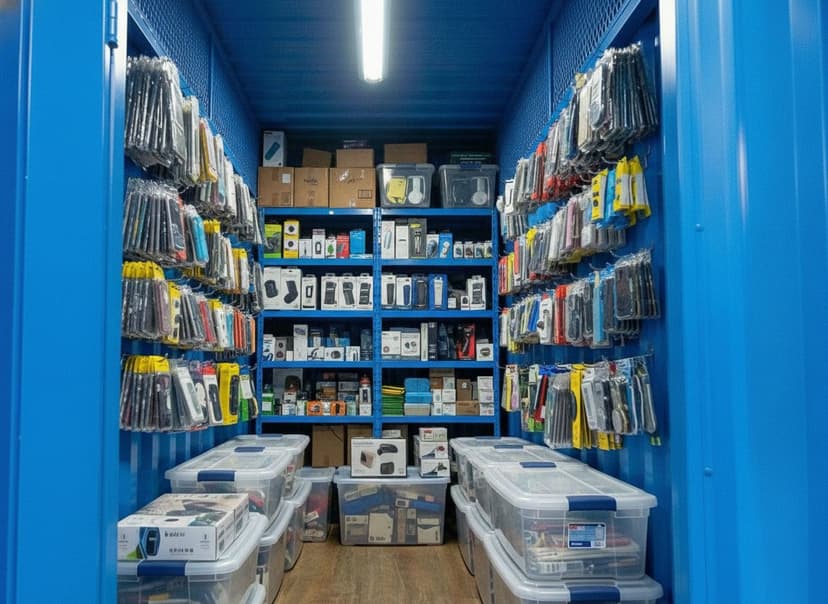
MyStorage – Phone Accessory Storage Solutions for Online Shops
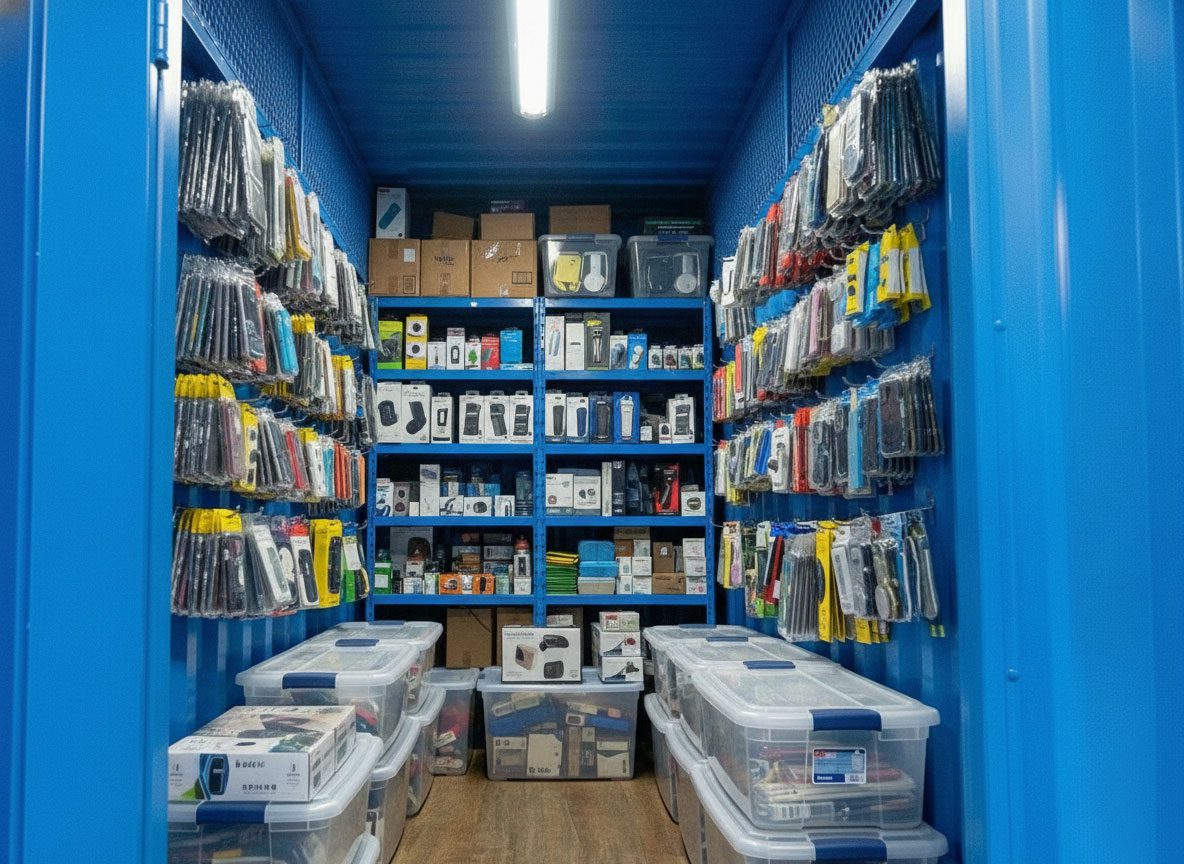
MyStorage provides flexible self-storage for phone accessory shops in HCMC, with monthly rentals and no long-term commitment, offering sizes from 1–20 m² suitable for all scales from new shops to distributors.
MyStorage facilities are designed to solve three core issues for phone accessory shops: a standard storage environment for electronic components, a security system to protect high-value goods, and flexible space adjustments according to each business stage.
| Criteria | MyStorage Solution |
|---|---|
| Size | 1–20 m², monthly adjustments with no penalty fees |
| Environment | 50–65% RH humidity, 20–26°C temperature maintained continuously |
| Security | 24/7 HD cameras, individual PIN locks for each unit, access logs |
| Access | 24/7 via personal code, no scheduling required |
| Cost | From 500,000 VND per month, no large deposits |
| Suitability | Shopee, TikTok Shop, Facebook Shop, distributors |
Small or large shops can all start immediately. Contact MyStorage to choose the right storage unit and begin storing on the same day the contract is signed.
FAQ
When stock starts occupying living space, SKU count exceeds 300, or incorrect delivery rates increase. These three signals appearing together indicate that home-based operations have reached their limit and a more systematic storage solution is needed.
Yes, if the facility maintains temperatures below 30°C and humidity below 65% RH. Lithium batteries must never be stored where temperatures exceed 40°C or where they are subject to compression, conditions that commonly occur in vehicles or uncontrolled storage spaces.
Zone across three levels: group major categories by area within the unit, separate device models by shelf, and differentiate colours or versions by compartment. Label clearly at each level and create a simple storage map so anyone can locate the correct SKU in under one minute.
Very much so, as orders concentrate within a few hours after each live session, demanding packing speeds that home environments cannot support. Storage with a fixed packing area and properly organized inventory allows 100–500 orders to be processed significantly faster than searching through a cluttered room.
Store vertically rather than horizontally, stack no more than 10–15 boxes per column, and pad between rows. Avoid placing glass boxes where they may be knocked when retrieving surrounding items. Breakage inside storage often goes undetected immediately, causing batch returns when customers receive damaged products.
Centralise all stock in one location rather than splitting across multiple places. Update actual inventory from a single source after every dispatch across all channels. One controlled central warehouse is the simplest and most effective way to prevent simultaneous overselling across multiple platforms.
Yes, if the unit is large enough to set up a folding table and packing materials. Many sellers choose 4–6 m² units for combined storage and on-site packing, particularly effective during peak sale seasons when fast order processing is needed without transporting goods home first.
Zone by brand first, then by device generation, and finally by colour or material. For example: the iPhone section has separate shelves for iPhone 13, 14, and 15, with each shelf divided into compartments by colour. This system allows new staff to find the right item without asking for guidance.
Yes, when combined with a clear zoning and labeling system established from the start. Incorrect delivery rates for phone accessories shops are typically high because many SKUs look similar, and an organized storage environment reduces these errors significantly compared to searching through cluttered home spaces.
List current SKUs and estimate total stock volume to select the right unit size. Prepare tiered shelving and category labels before moving stock in so the zoning system is established from day one. Contact MyStorage for size consultation and storage can begin on the same day the agreement is signed.
Related articles
Article
Onshore vs Offshore: Which Manufacturing Model Should Businesses Choose?
Onshore manufacturing refers to production within a company’s home country, helping to control quality, shorten delivery times, and ensure easier regulatory compliance. Offshore…
Read article
Article
How To Organize Your Home Storage Room | 10 Space-Saving Tips
Organize household storage with ten practical tips, an inventory template, safety checks and guidance on when external storage is worth considering.
Read article

Article
Secrets to Profitable Online Selling: 10 Ways to Save Costs
To sell online profitably, you not only need to increase sales but also maintain good control over operating costs. Items such as inventory, premises, packaging, shipping, and order…
Read article
