
 Tiếng Việt
 한국어
한국어 日本語
日本語Article· Updated October 16, 2026
Differences Between CSR and ESG: Meaning, Roles & Application Methods
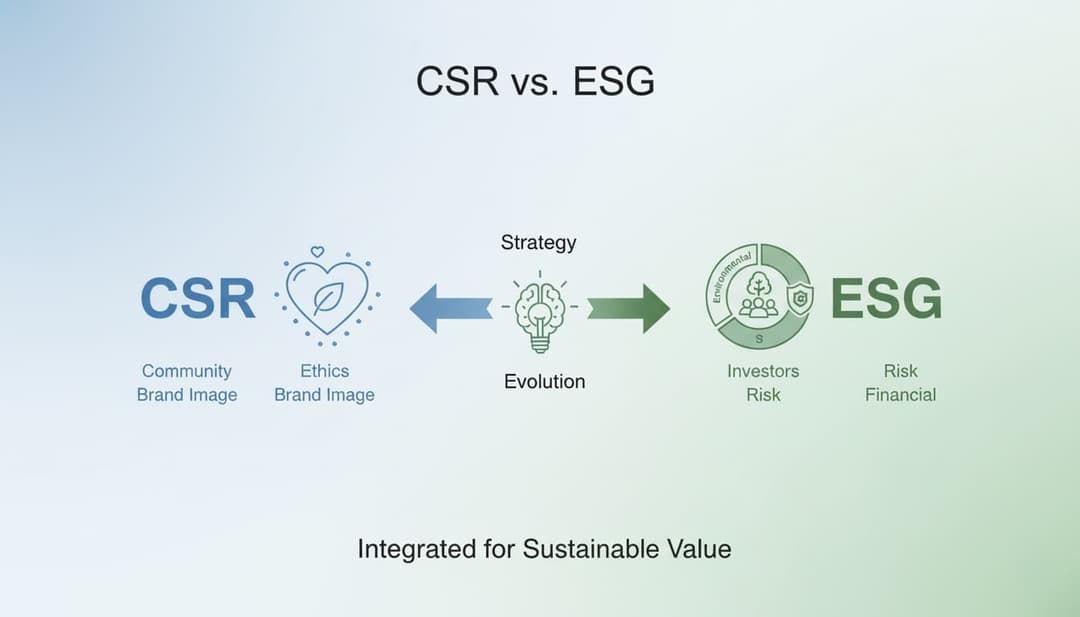
The comparisons in the original content are explanatory summaries, not absolute distinctions. CSR can also be measured, and ESG is not automatically mandatory for every business. Figures or examples without a source should be verified before being used in reports or business decisions.
Join Mystorage to explore the differences between CSR and ESG, the meaning of each concept, and how businesses apply them to enhance reputation, ensure compliance, and achieve sustainable development.
What are CSR and ESG?
CSR (Corporate Social Responsibility)
CSR is a business’s commitment to operating ethically and responsibly towards society and the environment. It goes beyond legal obligations, demonstrating a company’s contribution to sustainable development, improving the quality of life for communities and employees, while also protecting the environment.
Role in Modern Management: CSR helps businesses build a positive image, strengthen customer trust, attract and retain talent, and manage risks more effectively. It is often considered a part of marketing and branding strategies, being voluntary and stemming from a company’s core values.
ESG – A set of Environmental, Social, and Governance criteria
ESG is a framework of criteria used to evaluate a company’s performance based on three key factors:
- Environmental: Relates to a company’s impact on the natural environment (e.g., greenhouse gas emissions, waste management, use of renewable energy, resource conservation).
- Social: Relates to a company’s relationships with its employees, suppliers, customers, and communities (e.g., labor conditions, diversity and inclusion, data privacy, product responsibility).
- Governance: Relates to how a company is managed and operated (e.g., board structure, executive compensation, business ethics, financial transparency, shareholder rights).
Role in Modern Management: ESG is increasingly becoming a quantitative tool used by investors to assess a company’s sustainability risks and opportunities. It’s not just about “doing the right thing” but also about “doing good business” by mitigating risks, improving operational efficiency, and creating long-term value for shareholders.
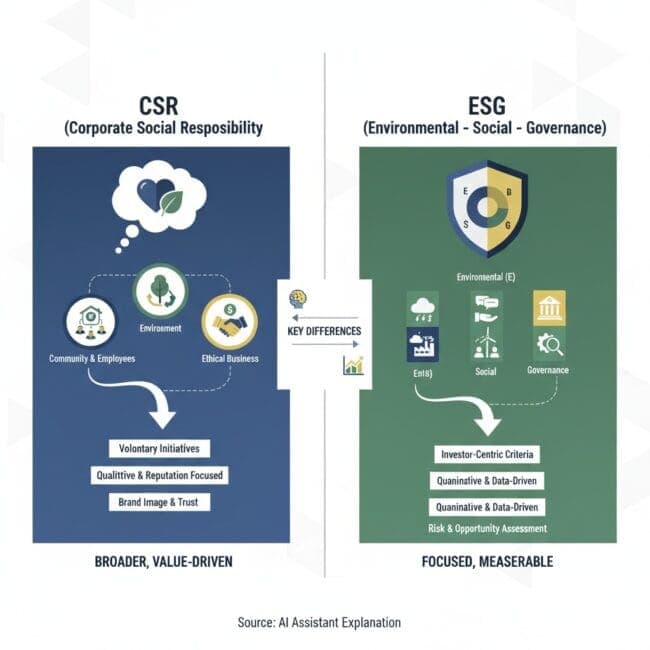
Key Differences:
- CSR is generally broader, qualitative, and voluntary, focusing on a company’s contributions to society.
- ESG is more quantitative, measurable, and used by investors for decision-making, focusing on financial risks and opportunities related to sustainability.
Origins & Context of CSR and ESG Development
History of CSR Development (1950s – 2000s)
The concept of CSR is not new. It has developed and evolved through several stages:
- The 1950s: The concept of “Social Responsibilities of the Businessman” was introduced by Howard R. Bowen in his book “Social Responsibilities of the Businessman” (1953), laying the groundwork for modern CSR. At this time, CSR primarily revolved around individual business ethics and philanthropy.
- The 1960s – 1970s: Awareness of the social role of businesses began to broaden, extending beyond mere profit. Social movements (civil rights, environmentalism) prompted businesses to pay attention to their impacts. Scholars like Archie Carroll developed the CSR Pyramid model, classifying economic, legal, ethical, and philanthropic responsibilities.
- The 1980s – 1990s: CSR began to be more integrated into business strategy. Companies realized that responsible conduct could yield competitive advantages. Concepts like “stakeholder theory” emphasized that businesses have responsibilities to a broader range of parties than just shareholders.
- The 2000s to Present: CSR became more widespread and increasingly regarded as an indispensable part of corporate management. Sustainability reports and international standards (such as GRI – Global Reporting Initiative) emerged, assisting businesses in disclosing information about their CSR performance.
ESG Emerged from Investors’ Demands for Risk Assessment (from 2004 – United Nations)
- Early 2000s: Investors began to recognize that environmental, social, and governance (ESG) factors could significantly impact a company’s financial performance and long-term value. Financial scandals, environmental issues, and labor conditions highlighted the importance of assessing these non-financial risks.
- 2004: The term ESG was first introduced in a landmark report titled “Who Cares Wins,” produced by the United Nations Environment Programme Finance Initiative (UNEP FI) in collaboration with leading financial institutions worldwide. This report demonstrated that integrating ESG factors into financial market analysis was financially material.
- 2006: The Principles for Responsible Investment (PRI) initiative was launched by the United Nations. PRI provides a framework for investors to integrate ESG issues into their investment and ownership decisions. This marked a major turning point, as ESG transitioned from an ethical concept to a practical investment criterion.
Why ESG Has Become a Mandatory Assessment Standard in Many Markets
ESG has become a mandatory assessment standard in many markets due to several combined factors:
Investor Demand
An increasing number of investors, particularly pension funds and large investment firms, seek to invest in responsible and sustainable companies. They recognize that companies with strong ESG performance tend to be more stable, carry less risk, and have the potential for long-term growth.
Risk Management
ESG factors help identify and manage significant risks that traditional CSR may overlook, such as climate risks, supply chain risks, and reputational risks resulting from labor ethics violations or poor governance.
Legal and Regulatory Pressure
Many governments and regulatory bodies worldwide have begun enacting regulations that require companies to disclose ESG information. This aims to enhance transparency, encourage sustainable behavior, and protect investors.
For example, the European Union has stringent regulations regarding sustainability reporting (CSRD – Corporate Sustainability Reporting Directive).
Green and Sustainable Growth
Global awareness of climate change and social issues has driven governments and the public to demand that businesses contribute to sustainable development goals. ESG provides a framework for measuring and tracking these contributions.
Market Competition
Companies with strong ESG performance often enjoy a competitive advantage, attracting customers, partners, and talent, while also more easily accessing capital.
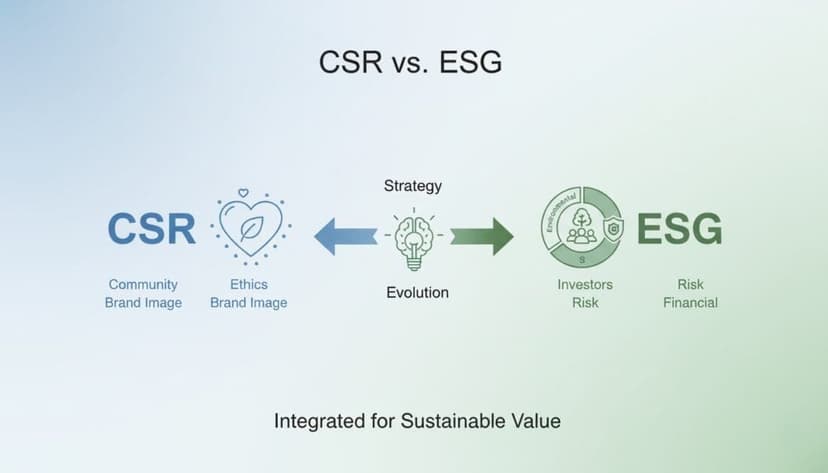
While CSR is part of a voluntary and ethical strategy, ESG has evolved into a quantitative measurement system driven by the demands of the financial market and regulatory requirements, becoming a key factor in assessing a company’s value and risk in the modern era.
Quick Comparison Table: CSR vs. ESG
To summarize the main differences and facilitate understanding, here’s a concise comparison table between CSR and ESG:
| Criteria | CSR (Corporate Social Responsibility) | ESG (Environmental – Social – Governance) |
|---|---|---|
| Objective | Voluntary spirit, ethical responsibility, brand image enhancement. | Quantitative criteria assessing investment risks and opportunities for sustainable value creation. |
| Nature | Qualitative, focused on ethics and social responsibility. | Quantitative, centered around financial effectiveness and risk. |
| Measurement | Hard to quantify, based on specific activities and perceptions. | Clear indicators and standards, specific measurable data, ranked. |
| Stakeholders | Public, customers, employees, community, management. | Investors, financial institutions, regulatory bodies, management. |
| Mandatoriness | Voluntary, highly flexible. | Increasingly mandatory in many markets, related to regulations and audits. |
| Typical Examples | – Charitable donation programs – Employee volunteer days – Reducing internal waste – Superior employee benefits | – Annual carbon emissions reporting – Percentage of women on the board – Occupational safety metrics – Customer data privacy policies – Supply chain risk assessment |
This comparison highlights how ESG has emerged as a more structured framework driven by market needs, while CSR encompasses broader ethical initiatives.
Real-World Examples of CSR and ESG Implementation
Major corporations around the world and in Vietnam have been applying both CSR and ESG in their unique ways, trending towards a shift from traditional CSR to a deeper integration of ESG.
Unilever (Multinational Corporation)
- Previously (Notable for CSR): Unilever was a pioneer in CSR with its “Unilever Sustainable Living Plan” (USLP) launched in 2010. This plan set ambitious goals for reducing environmental impact (such as lowering emissions and water consumption), improving health and living conditions for billions, and enhancing livelihoods. It exemplifies how a corporation integrates CSR into its core business strategy, not just as a charitable activity, but also in product development and supply chains.
Currently (Shifting to ESG):
With the rise of sustainable finance, Unilever places increasing emphasis on its ESG performance. They provide detailed disclosures on ESG metrics related to emissions, water management, diversity and inclusion (D&I) in the workforce, transparent governance, and compliance with international standards. Investors now examine these ESG metrics to assess risk and growth potential for Unilever.
Samsung (South Korean Technology Corporation)
- Previously (Notable for CSR): Samsung has implemented numerous global CSR programs focused on education, community support, and environmental protection. For example, the “Samsung Solve for Tomorrow” program encourages youth to tackle social issues using technology, alongside initiatives for recycling old electronic devices.
Currently (Shifting to ESG):
Samsung now places a significant focus on ESG, particularly aiming for carbon neutrality by 2050 and using 100% renewable energy for all global operations. They are also enhancing transparency in their supply chain, improving working conditions, and strengthening corporate governance due to pressure from investors, consumers, and international regulations that demand greater responsibility from major tech companies.
Vinamilk (Leading Vietnamese Enterprise)
- Previously (Notable for CSR): Vinamilk has engaged in various CSR activities tied to the community and Vietnamese children, such as the “Vietnam Rising Milk Fund,” programs supporting nutrition for impoverished children, and school construction. The company emphasizes sustainable dairy farming and environmental protection on its farms.
Currently (Shifting to ESG):
Vinamilk is progressively transitioning to integrate ESG frameworks. The company has developed sustainability reports according to international standards (GRI), setting specific targets for reducing greenhouse gas emissions, utilizing renewable energy, managing waste and water, while also enhancing animal welfare standards and sustainable supply chains. This move helps Vinamilk attract international investment funds interested in ESG, enhancing its position in global markets.
Why Are They Shifting from CSR to ESG?
Major corporations are transitioning from CSR to ESG for several key reasons:
- Investor Pressure :An increasing number of institutional investors (pension funds, large investment funds) and ESG-specific funds demand companies demonstrate strong ESG performance before investing. They view ESG as essential for evaluating long-term risks and opportunities.
- Market and Regulatory Requirements: Many developed markets are beginning to implement mandatory regulations regarding ESG disclosures. To maintain competitiveness and access to markets, companies must comply.
- More Effective Risk Management: ESG provides a rigorous framework to identify, assess, and manage non-financial risks (climate change, resource shortages, labor issues, reputational risks) that can severely impact company value.
- Operational Efficiency Optimization: Investing in ESG initiatives (such as renewable energy and waste management) can lead to reduced operational costs, increased resource efficiency, and improved profitability.
- Talent Attraction and Retention: Younger generations increasingly prioritize companies that are socially and environmentally responsible. Strong ESG performance helps attract and retain talent.
- Enhanced Access to Capital: Financial institutions and banks are increasingly prioritizing lending or offering green financial products to businesses with high ESG ratings.
Lessons for Vietnamese Businesses
- Understand the Differences and Roles: Vietnamese businesses need to recognize that CSR and ESG are not the same. CSR represents the ethical foundation, while ESG serves as a framework for financial measurement and risk management.
- Start with CSR but Aim for ESG: Small and medium-sized enterprises (SMEs) can begin with straightforward CSR activities aligned with core values. However, they should have a roadmap to gradually build ESG capabilities, especially if they plan to seek funding, expand markets, or participate in global supply chains.
- Integrate ESG into Business Strategy: ESG should not just be a report but must be integrated into the company’s strategy, operations, and governance. This includes establishing specific ESG objectives, collecting data, measuring, and reporting transparently.
- Focus on Training and Capacity Building: Investing in employee training on ESG, building dedicated teams, and seeking expert consulting when necessary will ensure effective ESG implementation.
- Enhance Transparency and Reporting: Although not yet mandatory, proactively reporting ESG metrics according to international standards will help Vietnamese companies build trust with investors, partners, and customers.
- Identify Opportunities from ESG: ESG presents not only risks but also opportunities to innovate products, services, and processes, thereby creating competitive advantages and new value.
Should Companies Choose CSR or ESG? (Combine Based on Goals)
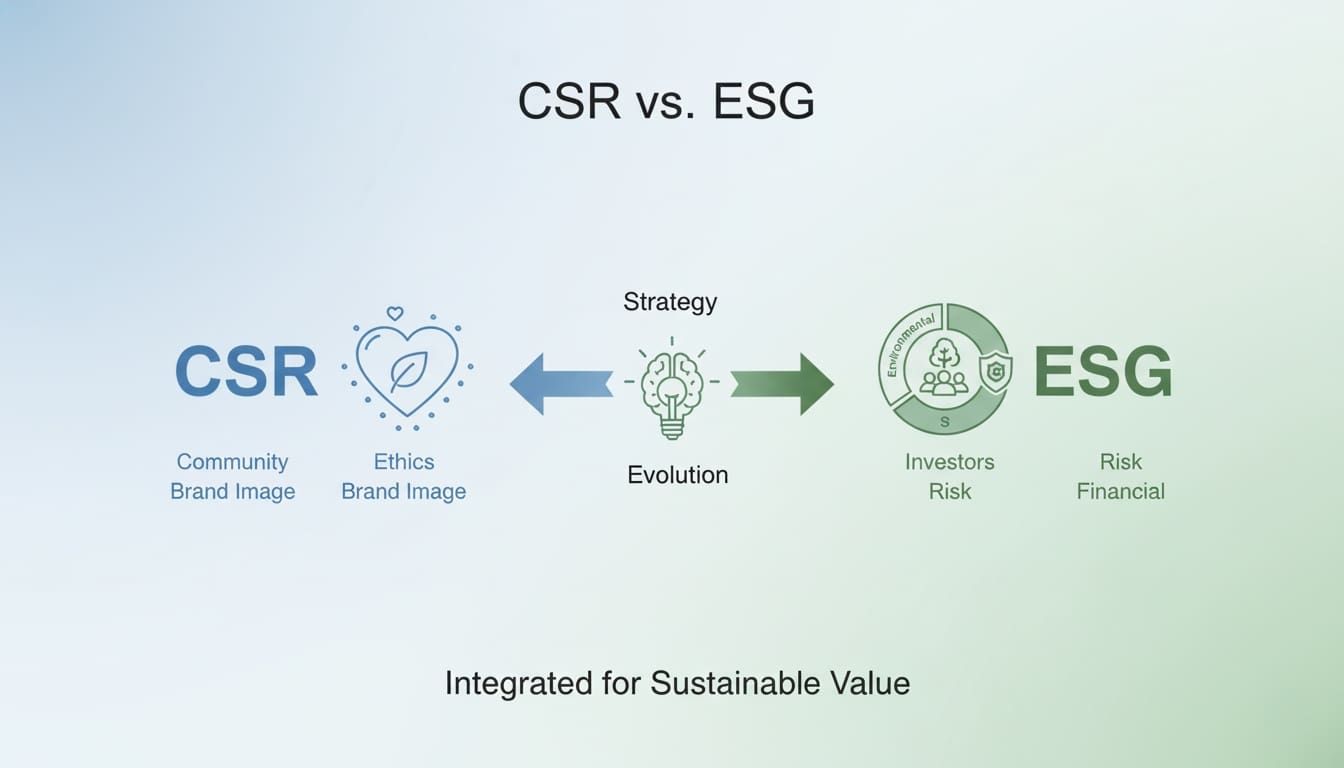
Rather than choosing between CSR and ESG, the most effective approach for businesses today is to combine both, based on their goals and development stage. CSR and ESG are not mutually exclusive; they complement each other, creating a comprehensive sustainable development strategy.
If the goal is to build brand and reputation → prioritize CSR:
If a company primarily aims to create a positive image in the eyes of the public, enhance customer and employee loyalty, and demonstrate ethical commitment, focusing on traditional CSR initiatives will be highly effective.CSR activities help forge good relationships with the community, create a positive work environment, and enhance the emotional value of the brand.
Example: A dairy company might prioritize nutrition support programs for impoverished children, which is a strong CSR action that builds a brand “for the community.”
If aiming to attract investment, manage risks, and ensure long-term growth → prioritize ESG:
If a company is seeking capital from institutional investors, wants to minimize operational and financial risks, or plans to expand into international markets, then focusing on ESG criteria is crucial.Strong ESG performance helps companies demonstrate sustainable management capabilities, attract green investment funds, reduce capital costs, and comply with increasingly stringent regulations.
Example: An energy company needs to be transparent about its carbon emissions, invest in renewable energy, and have a clear governance structure to attract investors interested in “clean energy.”
Recommendations: Combine Both Based on Industry and Strategy
In practice, businesses should view both CSR and ESG as two sides of the same coin in a sustainable development strategy:
CSR as the Ethical and Cultural Foundation: Begin by defining core values and the ethical and social responsibilities that the business wishes to uphold. This creates a solid cultural foundation for sustainability activities.
ESG as a Measurement and Management Tool: Once the CSR foundation is established, use the ESG framework to systematize, measure, and report sustainable efforts. ESG translates the good intentions of CSR into measurable, manageable, and financially valuable actions.
For industries with significant environmental impacts (e.g., manufacturing, energy, mining), prioritizing the E (Environmental) and S (Social) aspects of ESG is crucial for managing risks and ensuring compliance. At the same time, CSR must be maintained to build trust with local communities and consumers.
For service sectors or tech companies, the S (Social) factor (e.g., employee welfare, data security) and G (Governance) factor (e.g., business ethics, transparency) in ESG may take precedence. CSR remains essential in building company culture and attracting talent.
For publicly traded companies or those planning significant capital investments, establishing a robust ESG reporting system is mandatory to meet investor and market demands.
Both CSR and ESG play vital roles in sustainable development strategies but differ in objectives, measurement methods, and levels of commitment. Understanding these distinctions helps businesses choose suitable models to optimize brand reputation and investment attractiveness. In an increasingly transparency-demanding market, combining CSR with ESG is not just a trend but a long-term competitive advantage.
Currently, Mystorage is implementing various CSR and ESG activities, notably a donation box for clothes and goods located at 375 Vo Nguyen Giap, District 2. If you have clothes, shoes, or used items to donate, please bring them here!
Practical guidance: connecting CSR and ESG
CSR and ESG complement each other but are not two names for the same thing. CSR emphasises responsibility for a business’s impacts. ESG organises environmental, social and governance information for management, assessment and disclosure. The useful distinction is the question being answered and how evidence is used—not which approach is more modern.
CSR and ESG comparison
| Perspective | CSR | ESG |
|---|---|---|
| Main question | How does the company fulfil responsibilities to stakeholders? | How are E, S and G managed and evidenced? |
| Scope | Responsible business and community contribution, not just charity | Environmental, social and governance issues for the assessment purpose |
| Activities | Working conditions, customer treatment, community programmes | Identify issues, assign owners, monitor, verify and report |
| Evidence | Policies, procedures, delivery records, feedback and results | Quantitative data plus policies, controls and qualitative information |
| Users | Employees, communities, customers, partners and leaders | Leaders, customers, investors and disclosure stakeholders |
| Limit | One good activity cannot offset every negative impact | A score or report does not prove all operations are sustainable |
Review how to build a CSR programme with clear results and the three ESG pillars before combining them in practice.
Three common misconceptions
“CSR is only charity; ESG is about business”
CSR includes responsibilities to employees, customers and the environment in the business itself. Community programmes do not replace safe working conditions or truthful service information.
“CSR is qualitative; ESG is quantitative”
CSR can measure handovers, suitability of support and corrective progress. ESG also needs policies, oversight and data limitations. Numbers without methods are not sufficient.
“ESG replaces CSR or is always mandatory”
The approaches can coexist. Specific obligations follow applicable rules and contracts, not the use of the ESG label. ISO 26000 is social responsibility guidance, not a universal CSR or ESG certification.
One illustrative scenario: a company clothing collection
Consider a company collecting usable clothes from employees for a community organisation. This is a programme design example, not MyStorage operating data.
| Stage | CSR perspective | ESG evidence |
|---|---|---|
| Before collection | Confirm needs and acceptance criteria | Assign owners, risks and recording methods |
| Acceptance and sorting | Pass on suitable items without shifting disposal work to recipients | Record received and accepted quantities in the same unit and reasons for rejection |
| Storage and delivery | Keep items clean and dry and deliver as agreed | Track batches, costs, handover records and personal-data access |
| After handover | Use feedback to improve the next campaign | Report results, limitations and corrective action without inventing carbon impacts |
Kilograms collected must be distinguished from kilograms accepted and actually delivered. Collection does not prove that items reached recipients. Beneficiary numbers require suitable recipient data, not a conversion from bags of clothing. MyStorage’s clothing donation programme is a public example of a collection point; confirm accepted items and schedules. Participation is not comprehensive ESG certification.
Connect activities to data without unnecessary complexity
- Choose a real problem and identify who confirms the need.
- Define outputs and evidence of completion.
- Use a few consistent indicators with agreed units, reporting periods and duplicate handling.
- Reconcile totals with records or another responsible person.
- Distinguish confirmed results, estimates and impacts not measured.
GRI Standards provide an impact reporting framework. Select content relevant to material issues instead of turning every CSR activity into a lengthy template report.
Priorities for logistics businesses
Community programmes are more credible alongside waste reduction, customer feedback and worker protection. Combine clear CSR outputs with warehouse environmental, safety and governance indicators. Ask suppliers for evidence of each claim rather than judging labels such as CSR, ESG or green. A small, well-documented programme can be more credible than a large commitment with no defined scope.
Frequently asked questions
1. Are CSR and ESG opposed to each other?
No. They complement each other: responsible activities and structured evidence can support the same objectives.
2. Does good CSR mean a business meets every ESG requirement?
No. One programme does not establish performance across all environmental, social and governance issues.
3. Should a company stop CSR programmes to adopt ESG?
Not necessarily. Keep useful programmes and connect their evidence to the appropriate reporting scope.
4. Which indicators suit a donation programme?
Received, accepted and delivered quantities, timeliness and recipient feedback. Use consistent units and distinguish outputs from impact.
5. How should results be presented without exaggeration?
State scope, period, source and limitations. Separate verified results from estimates and do not infer unmeasured social or carbon outcomes.
6. Can one activity support both CSR and ESG?
Yes. Community activity can provide social data if recorded within the correct scope. Do not count the same result twice in consolidated reporting.
7. Do CSR and ESG need separate teams?
Not necessarily. A small business may share coordination while separating implementation, data management and review responsibilities.
8. Which should come first with a limited budget?
Start with actual impacts and risks rather than labels. Maintain responsible operations, choose a suitable community activity and collect data at a manageable scale.
9. Can extensive charity compensate for operational violations?
No. Community work does not replace responsibilities to employees, customers or the environment; operational problems still need direct action.
10. How do CSR outputs differ from social impact?
Parcels delivered or volunteer hours are activity outputs. Social impact is change experienced by recipients or communities and requires more data and time.
11. What records make CSR results usable for reporting?
Keep objectives, boundaries, activities, sourced figures, handover confirmation and limitations. Agree on units and aggregation methods first.
12. Does GRI certify that a company performs CSR well?
No. GRI supplies impact reporting standards. Using them does not automatically prove every business activity is sustainable.
13. Should marketing verify ESG results on its own?
Communication should use data reviewed by responsible specialists. Marketing can explain it but should not invent outcomes or change indicator scope.
14. How should logistics businesses combine CSR and ESG?
Run community programmes alongside electricity, damage and safety tracking. An ESG implementation framework for logistics helps assign and check the work.
15. Should every business use the same indicators?
Not mechanically. Industries and operating models have different impacts; indicators should reflect what can actually be controlled and measured.
16. What reporting errors should donation campaigns avoid?
Do not combine collected and delivered goods as separate contributions or infer people helped from item counts. Preparing and sorting donations supports clearer handover data.
17. Can green warehouse certification replace ESG assessment?
No. Building certificates cover defined assessment scopes. Green-building and management-system certification differs from company-wide ESG capability.
18. When should programmes or KPIs change?
When recipient needs, the business model, activity scope or data quality changes. Record why adjustments were made so readers understand differences between periods.
Related articles

Article
Onshore vs Offshore: Which Manufacturing Model Should Businesses Choose?
Onshore manufacturing refers to production within a company’s home country, helping to control quality, shorten delivery times, and ensure easier regulatory compliance. Offshore…
Read article

Article
How To Organize Your Home Storage Room | 10 Space-Saving Tips
Organize household storage with ten practical tips, an inventory template, safety checks and guidance on when external storage is worth considering.
Read article

Article
Secrets to Profitable Online Selling: 10 Ways to Save Costs
To sell online profitably, you not only need to increase sales but also maintain good control over operating costs. Items such as inventory, premises, packaging, shipping, and order…
Read article
