
 Tiếng Việt
 한국어
한국어 日本語
日本語Article· Updated October 15, 2026
Understanding CSR – Role and Benefits for Businesses
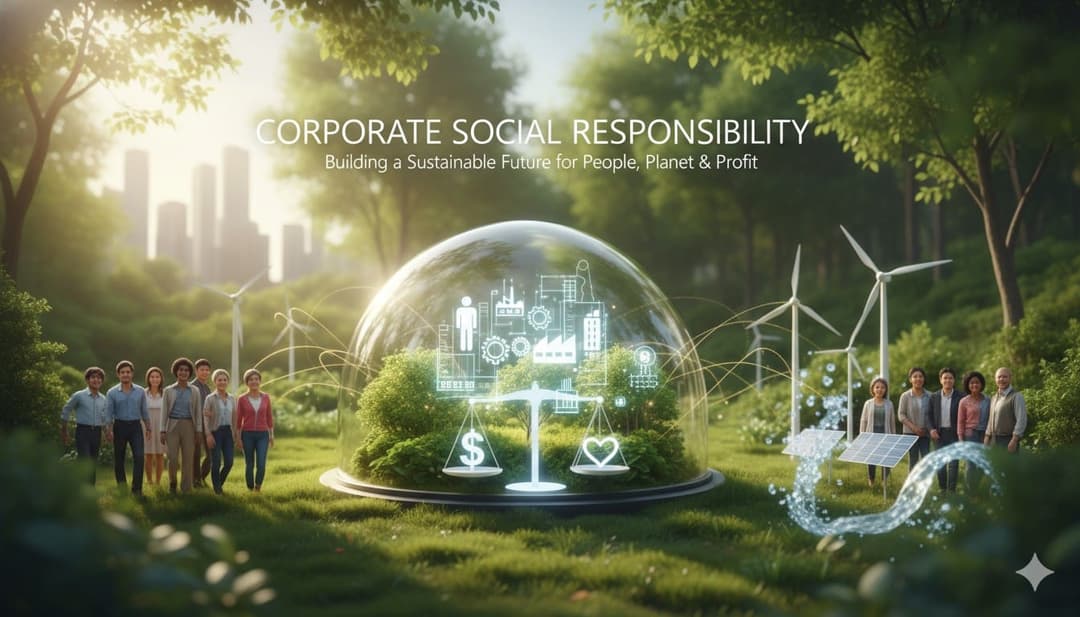
The company examples and figures such as 100% renewable energy or a 52% emissions reduction in the original discussion below have not been fully checked against their reporting periods and scope. They should not be cited as current results. CSR extends beyond charity, and an individual customer’s requirements are not a universal obligation for every business.
In the context of increasing demands for transparency, sustainable development, and international standards, Corporate Social Responsibility (CSR) has become a crucial factor for companies looking to enhance their reputation and competitiveness. However, effectively implementing CSR goes beyond mere charitable activities; it requires a systematic and measurable approach. The following article guides businesses through the steps to implement CSR in a standardized manner that delivers real value.
What is CSR?
CSR (Corporate Social Responsibility) refers to a company’s commitment to operate in an ethical, transparent manner that is responsible toward the environment, society, and all stakeholders involved.
In other words, CSR is not merely about philanthropic activities; it is a way for companies to create sustainable value for the community and themselves.
History and Development of CSR
1950s-1960s: CSR was first introduced in academic discussions, emphasizing business ethics.
1970s-1980s: The concept of CSR expanded to encompass responsibilities towards the community, employees, and the environment.
1990s: Globalization and environmental issues propelled CSR to become a critical requirement for multinational enterprises.
2000 to Present: CSR has evolved into an operational standard closely linked with sustainability reporting, transparent governance, and responsible supply chains.
Differences Between CSR, ESG, and Sustainability
CSR (Corporate Social Responsibility)
Nature of Activities: Generally voluntary social responsibility efforts.
Focus: Centered on voluntary social responsibility activities.
Goals: To reflect ethical standards and contribute to community welfare.
Examples: Educational sponsorship, community activities, afforestation, improving workplace environments.
ESG (Environmental – Social – Governance)
Measurement Standard: A set of criteria for measurement and reporting aimed at investors.
Focus: Criteria for evaluating companies on environmental performance, social impacts, and governance practices.
Goals: To assess risks, attract investments, and elevate operational standards.
Examples: Carbon footprint analysis, labor safety, governance transparency, and legal compliance.
Sustainability
Strategic Focus: Long-term sustainable development strategies.
Focus: Integrates economic development, environmental protection, and social benefits into long-term plans.
Goals: To optimize long-term value while minimizing negative impacts on future generations.
Examples: Energy optimization, implementing circular economy models, and developing green supply chains.
By understanding and implementing CSR effectively, businesses can not only enhance their societal contributions but also promote a sustainable and ethical business environment.
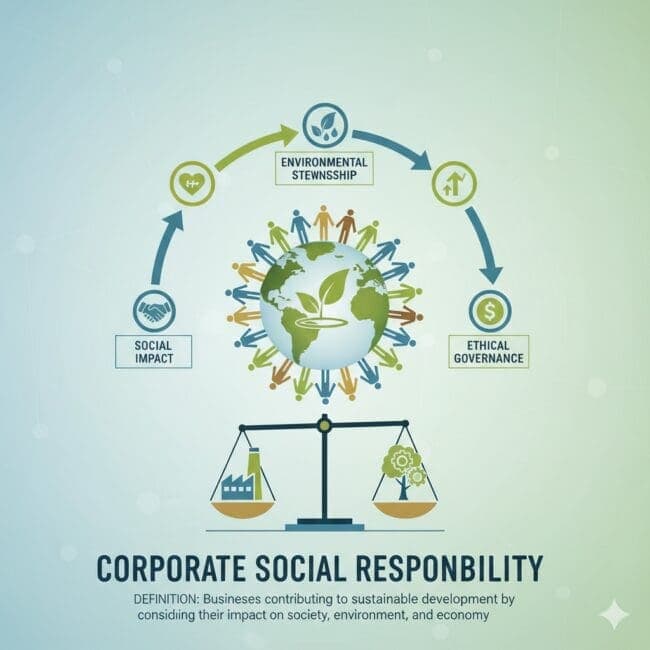
Using the three concepts without confusing them
CSR is not limited to voluntary contributions outside the business; responsibility also concerns the impacts of how the business itself operates. ESG refers to environmental, social and governance factors, not a single unified standard intended only for investors. Sustainability is a long-term direction; both CSR and ESG data can support it.
ESG should therefore not be understood as a “new version replacing CSR”. When designing a programme, separate three questions: what the business must take responsibility for, which data will track it, and what long-term change it seeks. Comparing CSR responsibilities and ESG criteria helps clarify how to use both concepts in one plan.
Internationally Recognized CSR Standards and Reporting Frameworks
1. ISO 26000 – Guidance on Social Responsibility
ISO 26000 is an international standard that provides a comprehensive framework for social responsibility for businesses. This standard focuses on seven pillars: governance, human rights, labor practices, the environment, fair operating practices, consumer issues, and community development. Although it is not certification-based, ISO 26000 helps organizations develop structured, transparent CSR strategies in line with international standards.
Seven core subjects: turning responsibility into practical action
ISO’s introduction to ISO 26000 identifies the seven subjects below. The action and evidence columns are practical examples for businesses, not certification requirements.
| Subject | Example action for a logistics or warehousing business | Evidence to review |
|---|---|---|
| Organisational governance | Assign responsibility for CSR, approval and checking results. | Responsibility assignments; budgets; review minutes. |
| Human rights | Provide a confidential feedback channel, receive reports of discrimination and follow up on remedies. | Intake procedures; case records with personal data removed. |
| Labour practices | Train staff in safe procedures and record near misses to prevent accidents. | Training records; assessment results; corrective actions. |
| The environment | Track electricity, water and materials; test waste reduction consistent with storage requirements. | Bills; meter readings; waste weighing or handover records. |
| Fair operating practices | Publish supplier selection criteria and address conflicts of interest. | Assessment forms; procurement approvals; relevant declarations. |
| Consumer issues | Explain service scope, charges, storage conditions and complaint procedures clearly. | Contracts; service information; feedback resolution logs. |
| Community involvement and development | Ask about needs before organising support and confirm receipt. | Meeting records; handover notes; partner feedback. |
When assessing suppliers, distinguish social responsibility guidance from warehouse management and industry-specific certifications. A certificate with a defined scope does not replace reviewing all seven areas of responsibility.
2. GRI Standards – International Sustainable Reporting Standards
The GRI (Global Reporting Initiative) Standards are the most widely used sustainability reporting standards globally, employed to measure and disclose the economic, environmental, and social impacts of businesses. The GRI Standards help companies:
- Enhance transparency,
- Enable comparison with other organizations,
- Meet market and investor information disclosure requirements.
3. SA8000 – Labor Social Responsibility Standard
SA8000 focuses on labor conditions and encompasses human rights, child labor prohibition, occupational safety, working hours, wages, and freedom of association. Many manufacturing, apparel, and supply chain companies utilize SA8000 to demonstrate compliance with ethical labor practices.
4. UN SDGs – 17 Sustainable Development Goals
The United Nations Sustainable Development Goals (SDGs) serve as a global framework guiding organizations towards achieving objectives by 2030. Businesses use the SDGs to:
- Align CSR with broader social and environmental goals,
- Identify strategic priorities,
- Create sustainability reports using a universally recognized language.
Prominent SDGs often adopted by companies include clean energy, climate action, sustainable consumption, gender equality, and decent work and economic growth.
5. ESG Reporting – Increasing Demand from Investors
In addition to traditional CSR, businesses today are expected to publish ESG reports to meet demands from:
- Investors,
- International partners,
- Credit institutions and funds,
- Market regulatory bodies.
ESG reporting emphasizes quantitative data such as carbon emissions, energy consumption, gender diversity, governance accountability, human resource policies, and operational risks. This framework enables companies to demonstrate transparency and long-term sustainability capability.
Choosing the right guidance, reporting standards and goals
GRI Standards support reporting on impacts on the economy, environment and people. The United Nations’ 17 Sustainable Development Goals provide a global direction, not a corporate reporting standard. Linking a programme to an SDG does not itself demonstrate impact.
Disclosure requirements must be identified for the market, type of business and specific applicable requirements; an individual customer’s or investor’s request does not mean all businesses have the same reporting obligation. When reporting, explain which standard is used and to what extent, rather than simply saying “in accordance with international standards”.
Practical Benefits of CSR for Businesses
Implementing CSR is not merely a community responsibility activity but increasingly serves as a vital business strategy that enhances competitive capability in the globalization context. As standards for sustainable development gain greater attention, CSR offers significant benefits in brand reputation, human resources, governance, and supply chains.
1. Enhanced Brand Reputation and Customer Trust
Companies that invest in CSR often receive positive evaluations from consumers, especially in highly competitive sectors. Today’s customers prefer to choose brands that are environmentally and socially responsible.
- Increases brand recognition.
- Improves the company’s image in the community.
- Builds long-term customer loyalty.
2. Attracting Quality Talent and Increasing Internal Cohesion
CSR creates a meaningful work environment, making organizations more appealing to potential employees and helping retain top talent.
- Increases employee satisfaction and engagement.
- Attracts young candidates who value sustainability.
- Improves corporate culture through social responsibility activities.
3. Reduced Operational, Governance, and Legal Risks
By adhering to CSR standards, businesses minimize the risk of penalties, lawsuits, or operational disruptions due to environmental or labor issues.
- Ensures compliance with legal regulations and international requirements.
- Mitigates the risk of disruptions in production and supply.
- Enhances transparency and standards in governance.
4. Increased Competitiveness in Global Supply Chains
For export-oriented companies or those participating in the supply chains of large corporations, CSR has become a mandatory standard. Strong implementation helps businesses better withstand the stringent demands from partners.
- Easily meet assessment criteria from international corporations.
- Increase opportunities for long-term contracts and market expansion.
- Enhance company value in the eyes of investors.
By integrating CSR practices, businesses not only fulfill their societal obligations but also foster a resilient and competitive economic environment.
Planning and implementing CSR
Choosing material CSR issues before making a plan
Prioritise issues with significant impacts on people and the environment rather than activities that are easiest to publicise. According to the introduction to the GRI Standards, determining material topics involves identifying, assessing and prioritising an organisation’s impacts.
| Prioritisation step | What to do |
|---|---|
| Define the scope: | Identify the facilities, activities and business relationships being considered; record areas without data. |
| Listen to stakeholders: | Ask employees, customers, suppliers and communities around the warehouse about the problems they actually experience. |
| List impacts: | Examples include forklift collision risks, working conditions, damaged goods, noise, discarded packaging or unclear service information. |
| Assess significance: | Consider severity, the extent of effects, whether harm can be remedied, and likelihood for potential impacts. Do not ignore serious impacts because they are difficult to address. |
| Choose actions and explain decisions: | After identifying priority impacts, use resources and feasibility to schedule implementation; record selection reasons, owners and outstanding issues. |
This is a practical way to organise work, not an official GRI scoring formula. In logistics, consider the list of issues in the context of ESG and CSR responsibilities in logistics and warehousing so that surveying charitable needs does not leave operational risks unexamined.
How Do Businesses Implement CSR?
To ensure that CSR delivers real value to a business—rather than being merely a formal exercise—companies must implement it according to a structured process aligned with strategic objectives and international standards such as GRI or UN SDGs. Below is a comprehensive guide from initiation through measurement, reporting, and communication of CSR activities.
1. Define CSR Objectives Relevant to the Industry
Businesses need to clearly identify the social and environmental issues they are facing to focus their CSR initiatives effectively, such as:
- Manufacturing Companies: Emissions, energy usage, waste management.
- Service Companies: Data security, customer experience.
- Logistics/Warehousing Firms: Carbon emissions, labor safety.
2. Analyze Environmental, Social, and Governance Impacts
This step is crucial for understanding which factors most significantly affect operations and stakeholders.
- Conduct an environmental risk assessment (E).
- Assess risks related to personnel and community (S).
- Review governance processes for transparency (G).
- Consider international customer requirements.
3. Develop a Plan and KPIs for Each CSR Project
An effective CSR plan should include:
- Measurable Objectives: Specific metrics that can be evaluated.
- Clear KPIs: Examples include percentage reduction in emissions, training hours for employees, and the number of community activities.
- Budget Projections, Timelines, and Responsible Personnel.
- Coordination Mechanism: Between Marketing, HR, and Sustainability departments.
4. Implement and Measure CSR Effectiveness
Once the plan is set, businesses proceed with execution and monitoring:
- Collect data through a regular system.
- Compare results against KPIs and industry benchmarks.
- Adjust programs if objectives are not met.
5. Establish a CSR Reporting System According to International Standards (GRI, UN SDGs)
Creating reports helps ensure transparency with customers, partners, and investors.
- Apply GRI Standards (Global Reporting Initiative) to standardize reporting metrics.
- Link CSR objectives with the 17 UN SDGs. Examples include:
- SDG 7: Clean Energy
- SDG 8: Decent Work
- SDG 12: Sustainable Consumption and Production
- Publish annual reports on the website or via a Sustainability Report.
6. Integrate CSR into the Sustainable Development Strategy
CSR should not be a standalone activity but rather part of the overarching strategy:
- Align CSR with ESG and a 3–5 year sustainable development strategy.
- Incorporate CSR into the KPIs for leadership and departments.
- Foster an internal culture aimed at sustainable development.
7. Communicate CSR Effectively
Communication helps CSR generate brand value rather than existing solely internally.
Principles of CSR Communication:
- Transparency and Honesty: Avoid “greenwashing.”
- Specific Metrics: For instance, “a 20% reduction in plastic waste within 12 months.”
- Multi-Channel Approach: Use PR, websites, social media, and video recaps.
Example Case Studies:
- Vinamilk: The “One Million Green Trees” initiative aligned with SDG 13 – Climate Action.
- IKEA: Using 100% renewable energy in operations.
- Unilever: Reducing CO₂ emissions by 52% in its supply chain.
CSR is not just a responsibility; it is also an opportunity for businesses to build sustainable brands, attract talent, and enhance competitive capabilities. With a clear process—from goal definition to impact measurement and international reporting—companies can create long-term value for both their internal stakeholders and the community. Implementing CSR correctly today lays the foundation for sustainable business growth in the future.
Currently, Mystorage is engaged in CSR activities, notably establishing a charity box for clothing and used goods collection at 375 Võ Nguyên Giáp, District 2.
Task allocation for a seven-step CSR roadmap
| Step | Required output | Coordinating roles |
|---|---|---|
| 1. Identify impacts | A list of activities, affected parties and information sources. | CSR coordinator with operations, HR and customers. |
| 2. Select priorities | Priorities with reasons and unresolved issues. | Leadership with relevant department representatives. |
| 3. Set a baseline and targets | Indicators, baseline period, measurement scope, deadlines and budget. | Data owner and plan approver. |
| 4. Implement | Specific tasks, schedule, records and exception handling. | Owner of each activity. |
| 5. Measure and reconcile | Results for the same period, source records and explanations of differences. | Recorder and reviewer independent of data entry. |
| 6. Report | Targets, results, methods, limitations and unmet commitments. | CSR coordinator and publication approver. |
| 7. Improve | Next actions, owners and completion deadlines. | Leadership and operations. |
Every indicator needs someone responsible for its data, not just an activity organiser. If results fall short, investigate the causes and adjust actions rather than changing calculations to make the report look better.
CSR in practice and measuring results
CSR means taking responsibility for the impacts a business creates. A meaningful programme goes beyond handing out gifts: understand actual needs, organise appropriate resources and follow up on results. For logistics and storage businesses, this responsibility extends to employees, customers, suppliers and communities around their facilities.
What responsibilities does CSR cover?
Start with safe working conditions, fair treatment, honest service information, responsible resource use and community support. Charitable activities are only one part of CSR and cannot replace action to address negative business impacts. ISO 26000 provides guidance on social responsibility; it is not a certification standard. A donation campaign therefore does not prove that a business is “CSR-certified”.
What value can CSR create?
- Stronger community relationships: respond to genuine needs and maintain a channel for feedback.
- Employee participation: clear responsibilities let people contribute according to their time and skills.
- Better resource use: usable items can reach people who need them instead of being discarded.
- Evidence-based trust: acceptance criteria, handover records and results show partners what was actually done.
These are potential benefits, not automatic promises of higher revenue or lower costs. Results depend on programme design and execution.
Build a CSR programme around real needs
| Programme step | Tasks and considerations |
|---|---|
| Assess needs: | agree with the receiving organisation on item types, quantities, condition and timing before collecting donations. |
| Choose partners and scope: | identify contacts, locations and responsibility for sorting, transport and handover confirmation. |
| Publish acceptance criteria: | explain accepted and excluded items, packing requirements and deadlines. Preparing clean, usable clothing before donation reduces rework. |
| Organise temporary storage: | separate unchecked, accepted and rejected items from customers’ goods. Record batches to prevent double counting. |
| Hand over and reconcile: | retain item lists, delivery dates, recipient confirmation and any discrepancies. |
| Review afterwards: | ask whether donations met needs and improve the next campaign. Use recipients’ photographs only with appropriate consent. |
CSR KPIs that avoid overstating impact
| Suggested indicator | How to record it | Limit to explain |
|---|---|---|
| Items received | Weigh or count by batch using a consistent unit | Not everything received has necessarily been donated |
| Acceptance rate | Accepted quantity / total received × 100% | Use the same unit, such as kilograms or items |
| Quantity handed over | Reconcile dispatch records with recipient confirmation | Do not infer beneficiary numbers from item counts |
| On-time handover rate | On-time handovers / total handovers × 100% | Record delays and corrective action |
| Suitability of donations | A short feedback form from the receiving organisation | Qualitative feedback does not replace long-term impact assessment |
Outputs are not the same as impact. Delivered parcels are an output; whether support improved people’s lives requires further follow-up. Do not convert kilograms of clothing into avoided CO₂ emissions without an appropriate method, assumptions and data.
Distinguishing activities, outputs, outcomes and impact
| Level | Example to track | What not to infer |
|---|---|---|
| Activity | Hold a session on safe working procedures. | Holding a session does not mean everyone can perform the procedures. |
| Output | Number of people completing guidance and an assessment. | Attendance does not prove that accidents have decreased. |
| Outcome | The rate of correct procedures in observations after training. | Use consistent observation methods, samples and follow-up periods. |
| Impact | Lasting changes in employees’ health and safety. | Long-term data and other influencing factors must be considered; do not attribute every change to one training session. |
Suggested CSR KPIs beyond donations
Select indicators suited to the priority issue. Before measuring, record the baseline period, included facilities, units, source records and how missing data will be handled. The following is an internal management template, not a set of certification indicators.
| Area | Indicator and calculation | Data source / review frequency |
|---|---|---|
| Environment | Total kWh and kWh per defined unit of activity, such as pallet-days; track both together. | Meters, bills and activity logs; monthly. Keep the comparison scope consistent. |
| Employees | People completing training and assessment / people requiring training × 100%; also track procedural errors and corrective actions. | Staff lists, assessments and on-site observations; after each session and periodically. |
| Community | Partner-confirmed handovers / planned handovers × 100%, with feedback on suitability. | Minutes, delivery schedules and feedback; after each handover. Do not convert this to beneficiary numbers without evidence. |
| Customers | Complaints resolved within the agreed deadline / complaints due × 100%. | Intake system and case closure confirmation; monthly. Include unresolved complaints. |
| Governance | Corrective actions completed on time / corrective actions due × 100%. | Inspection records and completion evidence; monthly or quarterly. Do not rely only on self-reported status. |
| Supply chain | Assessed suppliers in a priority group / all suppliers in that group × 100%. | Grouping criteria, assessment forms and corrective plans; periodically according to risk. |
To track electricity and packaging savings, combine this with green logistics solutions for transport and storage. When volumes or operating hours change, explain those changes before drawing conclusions about improvement.
Embedding CSR in everyday logistics and warehouse operations
In warehousing, CSR should shape work assignments, goods care and collaboration with partners. A community programme cannot offset unresolved negative impacts in core operations. The UN Global Compact’s Ten Principles focus on human rights, labour, the environment and anti-corruption.
| Responsibility area | How to put it into practice in a warehouse |
|---|---|
| Safety and working conditions: | Record risks by area, assign corrective actions and check again; enable incident reporting without encouraging concealment. |
| Electricity, water and materials: | Review operating schedules, measurement points and reusable materials; do not save resources by weakening necessary storage conditions. |
| Responsibility to customers: | Describe service scope accurately, record handovers and resolve feedback within a defined time. |
| Communities around the warehouse: | Receive feedback on noise, goods handling and local impacts; assign someone to follow through until resolution. |
| Responsible procurement: | Choose criteria based on material and service risks; inspect evidence rather than merely requesting a general signed commitment. |
When choosing a facility or partner, understanding the scope of warehouse industry certifications helps you ask the right questions. Check the facility name, certified activities, validity and issuer; do not infer that the entire supply chain meets a standard from one individual certificate.
CSR at MyStorage and its connection to ESG
An example: MyStorage’s clothing donation programme
The MyStorage clothing donation page describes the collection of usable clothes and shoes for local charitable organisations. It illustrates how a storage point can connect people with surplus belongings to those who need them.
Before organising a company collection, confirm accepted items and handover arrangements with MyStorage, especially for bulky goods. The public information does not establish beneficiary totals or emissions reductions, so those outcomes should not be attributed to the programme without evidence.
Connect CSR to long-term governance
A programme needs an owner, budget, procedures and records—not just a launch day. Understanding how CSR and ESG differ in purpose and use of data helps avoid equating charity with overall sustainability performance.
Storage and logistics businesses can also develop environmental, safety and governance KPIs for warehouse operations alongside community programmes. These approaches complement one another but must be reported within their proper scope.
From community activities to MyStorage’s ESG targets
MyStorage’s ESG targets page publishes goals including a 25% reduction in greenhouse gas emissions by 2028, 50% use of recycled pallets and safety training for 100% of employees. These are targets stated on the page, not confirmation that these percentages have already been achieved.
Assessing progress requires the baseline period, facility scope, calculation method, reporting period and actual results. Without those data, describe commitments or targets rather than achievements. The clothing donation programme can illustrate the community aspect, but it does not represent the full environmental and governance performance.
Businesses seeking to coordinate donations can check MyStorage’s donation acceptance requirements before organising a collection. To compare targets with operational evidence, discuss each indicator and its specific scope rather than requesting a general “good CSR” label for the entire business.
Frequently asked questions
1. Is CSR only about charity?
No. It also covers how a business treats employees, customers, partners and the environment. Charity does not replace responsibility in day-to-day operations.
2. Where should a small business start?
Choose a specific need, a reliable partner and a scale you can sustain. Agree on acceptance criteria, responsibilities and handover records before launching.
3. Can CSR be measured?
Yes. Track accepted donations, quantities handed over, progress and recipient feedback. Distinguish activity indicators from long-term social impact.
4. Can ISO 26000 be used for CSR certification?
No. ISO 26000 provides guidance on social responsibility; it is not a certification standard.
5. May we publish photographs of people receiving support?
Respect privacy and obtain appropriate consent. Reporting results does not require disclosing recipients’ identities or personal circumstances.
6. Who should manage a corporate CSR programme?
Appoint a coordinator and clarify who approves budgets, manages operations and verifies results. Donation programmes also need someone to reconcile received and delivered items.
7. How should we choose a donation partner?
Discuss actual needs, receiving capacity, delivery schedules and confirmation procedures directly. Choose a clear point of contact and do not collect more than both parties can sort and distribute.
8. How should donated clothes be prepared?
Clothes should be clean, dry, usable and sorted before packing. Guidance on preparing used clothes for donation helps reduce work for the recipient organisation.
9. Should one campaign accept every type of item?
Not without agreement from the recipient. Publish accepted categories, condition requirements and exclusions. Electronics and bulky items require separate confirmation.
10. How can we avoid double counting donations?
Assign batch identifiers and record dates, units, accepted quantities and handovers. Do not add inbound and outbound quantities together as contributions when they represent the same batch.
11. What should a CSR budget include?
Include sorting, packaging, temporary storage, transport and coordination as well as cash or goods donated. Separate direct support from organisational expenses.
12. Should we promise a beneficiary total at the outset?
Only state a justified target and distinguish it from verified results. Parcel or item counts do not automatically equal the number of people supported.
13. Why is recipient feedback important?
It helps establish whether donations were useful and matched needs. Feedback can be collected through the receiving organisation while respecting privacy.
14. Can CSR in logistics relate to everyday operations?
Yes: workplace safety, fewer damaged goods, responsible material use and community relationships all matter. Warehouse governance indicators help track activities supported by data.
15. When should a CSR programme be evaluated?
Reconcile each handover and schedule a broader review suited to the programme’s duration. Long-term impact requires follow-up beyond the event itself.
16. Should CSR reports describe limitations?
Yes. Explain missing data, rejected items and unfinished work. Clear limitations are more credible than claims of absolute success.
17. Can CSR results be included in ESG reporting?
Yes, when they fit the reporting scope and indicators. Understanding the relationship between CSR and ESG helps avoid using one community programme as a substitute for a company-wide assessment.
18. What should we confirm before taking donations to MyStorage?
Check accepted items, collection points and schedules through MyStorage’s donation programme information or contact the team first. Do not assume every facility accepts all types of goods.
Related articles

Article
Onshore vs Offshore: Which Manufacturing Model Should Businesses Choose?
Onshore manufacturing refers to production within a company’s home country, helping to control quality, shorten delivery times, and ensure easier regulatory compliance. Offshore…
Read article

Article
How To Organize Your Home Storage Room | 10 Space-Saving Tips
Organize household storage with ten practical tips, an inventory template, safety checks and guidance on when external storage is worth considering.
Read article

Article
Secrets to Profitable Online Selling: 10 Ways to Save Costs
To sell online profitably, you not only need to increase sales but also maintain good control over operating costs. Items such as inventory, premises, packaging, shipping, and order…
Read article
