
 Tiếng Việt
 한국어
 日本語
Article
Do You Need Insurance When Storing Goods In A Warehouse? What To Ask Before You Store

On this page
Storing goods in a warehouse does not require insurance in every situation, but property insurance is an important financial shield that protects the value of your belongings against force-majeure events such as fire, natural disasters or theft. The decision to buy insurance depends on the total value of the property, the type of storage unit and the liability limitation clauses set out in the storage contract.
1. Do You Need Insurance When Storing Goods?
Buying insurance when you store goods depends on the actual value of the property, how long you store it and how much risk you are willing to accept. For high-value property such as electronics, expensive furniture or large volumes of trading stock, taking out insurance is a sensible decision to guard against financial loss beyond your control.
What storage insurance really is
Understanding what storage insurance really is keeps customers from confusing physical security with financial compensation:
- The nature of goods-in-storage insurance: It is a non-life insurance contract that protects the financial interests of the property owner against loss of or physical damage to the goods caused by force-majeure events (such as fire, lightning, explosion, flood or looting) throughout the time they are kept in the storage unit.
- Legal basis under the Law on Insurance Business 2022: Under Law on Insurance Business No. 08/2022/QH15, a property insurance contract is a voluntary agreement between the policyholder and the insurer; the indemnity is determined on the basis of the actual loss at the time the insured event occurs and is capped at the sum insured agreed in the policy.
- It operates independently: The customer's property insurance is entirely separate from the building's compulsory fire insurance and from the ordinary duty of care given by the warehouse operator.
When to buy and when to skip it
Not every consignment needs separate insurance; weigh it against specific criteria:
- Cases where insurance is strongly advisable:
* Property of high economic value: Expensive technology equipment, production machinery, professional cameras, sets of precious wooden furniture or imported leather furniture.
* Large volumes of trading stock: Inventory of retail and e-commerce shops with high working-capital value, the lifeblood of the business.
* Long-term storage beyond 6 months: As the storage period stretches out, the probability of facing natural disasters and environmental changes rises accordingly.
* Storage contracts with a low compensation cap: When the provider only commits to a token payout (for example a few million dong per cubic meter at most), which does not cover the real value of the property.
- When you can skip separate insurance:
* Ordinary low-value belongings: Old clothes, books, reference documents or plastic household items that are easy to replace on the market.
* You already hold an extended property policy: Your existing household property insurance or goods insurance already covers property in transit and stored at an external warehouse.
* The storage provider offers adequate compensation: The storage contract already sets direct compensation equivalent to the value of the items you are storing.
Telling the three forms of protection apart
Customers often confuse these three legal concepts, which leads to unfortunate misunderstandings when a dispute arises:
| Comparison Criteria | Customer's Property Insurance | Warehouse Operator's Liability Insurance | Contractual Compensation Commitment |
|---|---|---|---|
| Who pays | An independent insurance company | An insurance company paying on behalf of the operator | The storage provider pays from its own pocket |
| What is protected | The actual value of the customer's property | The operator's civil liability | The property agreed in the contract |
| Conditions for payout | An insured event listed in the policy occurs | Fault must be proven to lie with the operator | Based on the breach-of-contract clauses |
| Payout limit | According to the actual value of the property | According to the operator's liability limit | Limited by agreement (usually capped) |
| Cost of participation | The customer pays the premium separately | Already built into the operating cost of the warehouse | Included in the storage service price |
| Applicable legal basis | Law on Insurance Business 2022 | Law on Insurance Business 2022 | Civil Code 2015 (deposit contract) |
2. Common Risks When Storing Goods
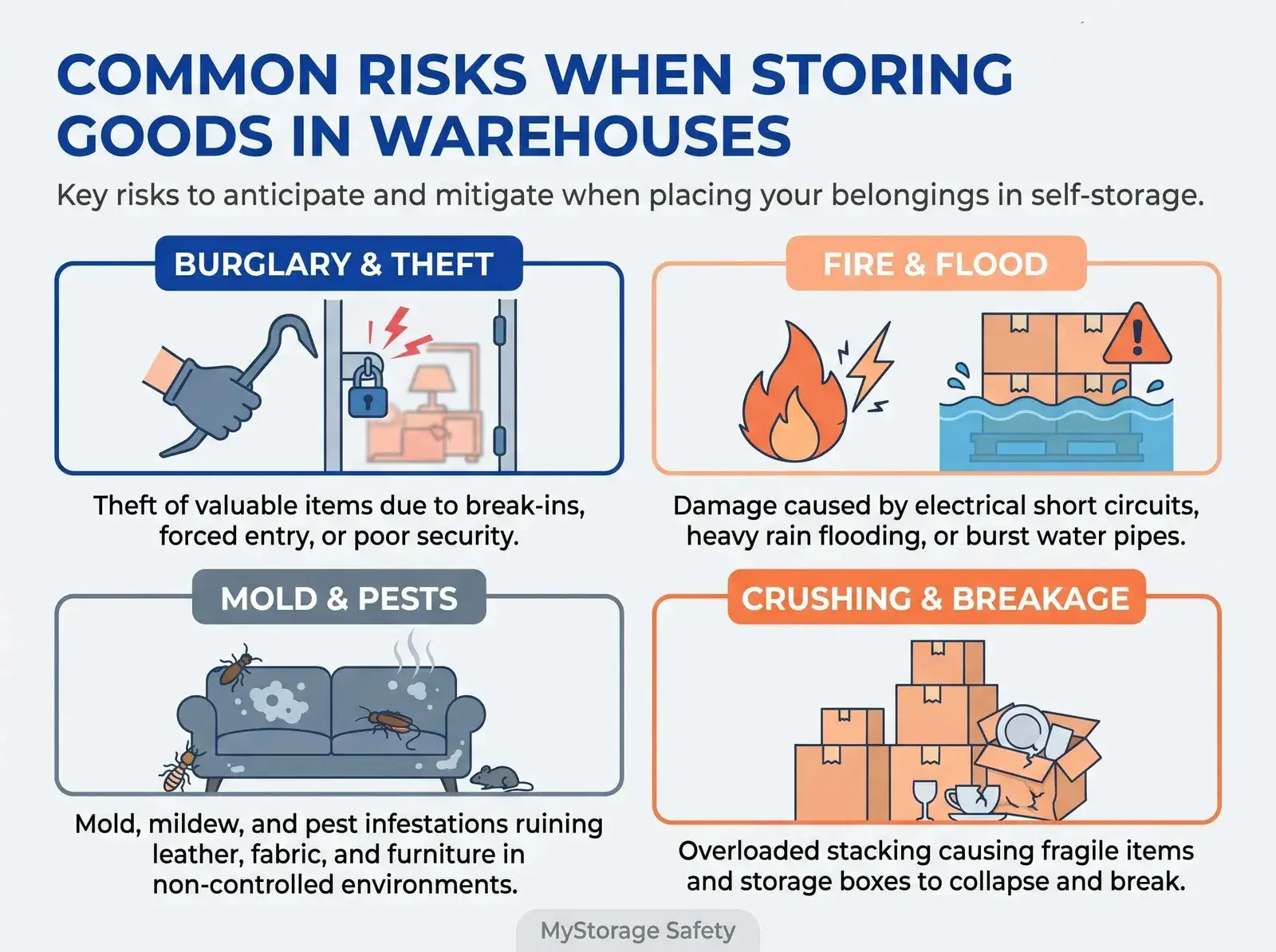
A warehouse environment concentrates large volumes of goods belonging to many different customers, and it carries many hazards: infrastructure failures, natural forces and human risk. Identifying these potential hazards accurately helps you judge how necessary insurance really is and prepare suitable preventive packing measures.
Theft and lost items
Losing property is the biggest worry when you move valuable belongings out of your daily sight:
- Intruders breaking in: Bad actors exploit night-time security gaps or camera blind spots to force doors, break unit locks and take away equipment that is easy to resell.
- Items lost during handling: In the valet storage model, staff moving goods through several buffer areas can misplace or lose a consignment.
- How insurers treat theft: Most insurance companies only accept a theft claim when there are clear signs of break-in and forced locks (burglary); mysterious disappearance or loss leaving no trace of entry is usually refused.
Fire, flooding and natural disasters
Sudden disasters arising from infrastructure or nature usually destroy property completely:
- Fire from an electrical short circuit: A short circuit in the wiring or in equipment, or a fire spreading from neighbouring premises, can burn all the belongings in a matter of moments.
- Flooding and rain driven inside: Prolonged heavy rain pushes water through the warehouse door, blocked gutters or damp seeping through cracked walls soak the cartons holding your goods.
- Burst internal water pipes: The building's water supply, drainage or sprinkler pipes rupturing unexpectedly causes local flooding across the floor of the unit.
Mould and pest damage
Besides sudden incidents, the quiet decline in condition caused by the environment also does real damage:
- High humidity causing mould: Vietnam's tropical monsoon climate, with humidity regularly above 80%, is the main reason mattresses, leather sofas, clothes and paper documents go mouldy, turn yellow and smell foul.
- Insects and rodents chewing through things: Rats, cockroaches and termites can tear cartons, gnaw the cables of electronic devices and nest inside bales of fabric.
- Deformation from stacking pressure: Stacking heavy cartons on top of soft or fragile items makes the goods underneath break, crack or crush the packaging.
3. 7 Questions to Review Before Renting
Before you sign a storage contract, asking the right questions about legal liability and the compensation mechanism will spare you troublesome disputes if something goes wrong. Ask the provider to clarify these clauses in writing rather than relying on verbal promises.
Scope of protection and exclusions
Customers need to draw a clear line between the risks that are paid out and the cases that are refused:
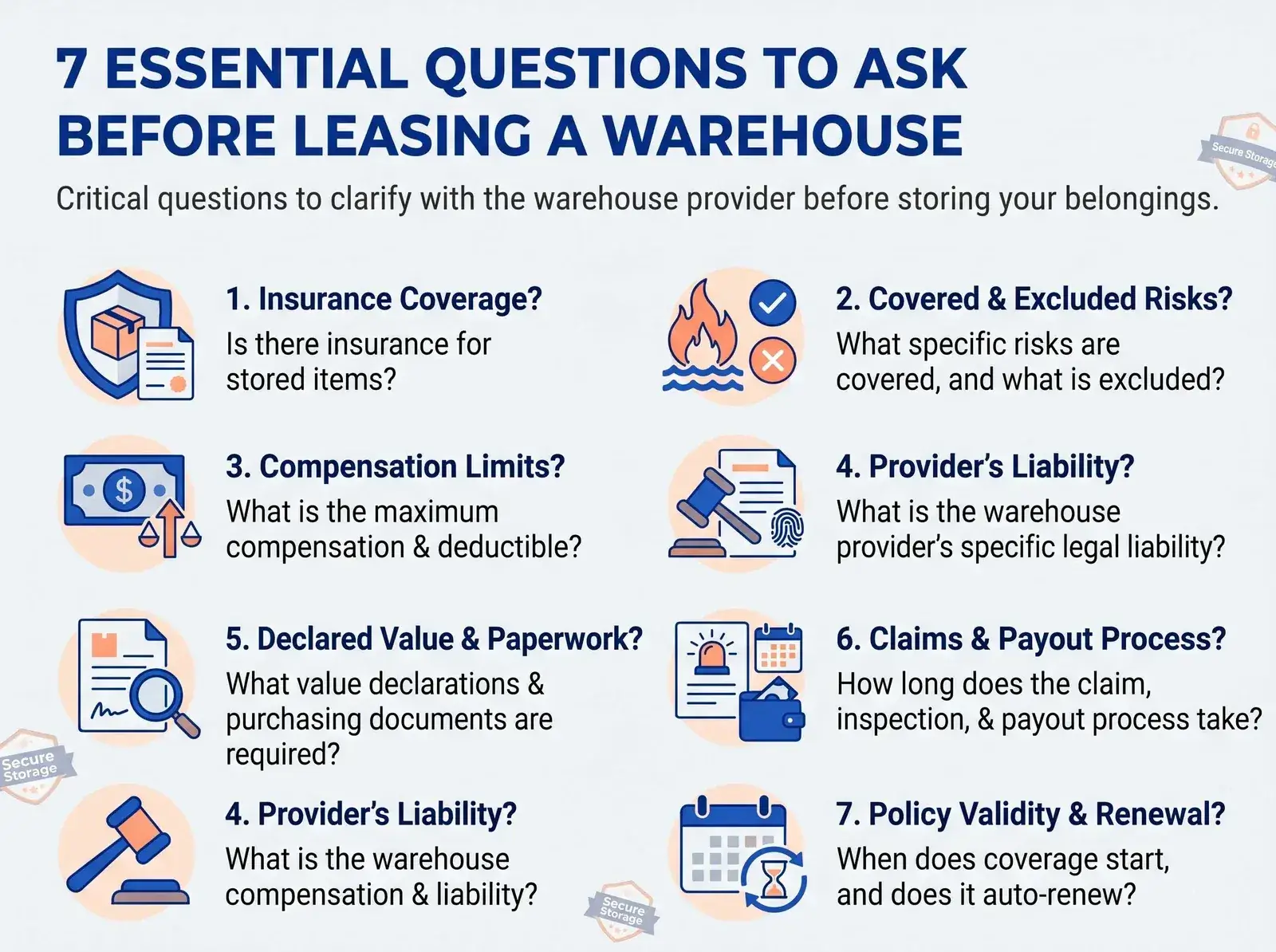
- Question 1 - Does the warehouse insure customers' property? You need to establish clearly whether the facility's insurance policy covers only the operator's own buildings or also the goods customers store inside. If the warehouse includes an insurance package, ask to see a copy of the valid insurance certificate.
- Question 2 - Which risks are insured and which cases are excluded? Ask for a detailed list of exclusions (for example natural wear and tear, weather-related mould, earthquake, war or damage caused by your own faulty packing). Special assets such as cash, gold and jewellery are usually outside the scope of ordinary insurance.
Compensation limits and liability
Establish the maximum amount you can get back when damage occurs:
- Question 3 - What is the maximum compensation and is there a deductible? Ask exactly how the payout is calculated: market value less depreciation, replacement value, or a fixed cap per cubic meter of the unit. Clarify the deductible (the amount the customer bears before the insurer pays) for each loss.
- Question 4 - How is the storage provider's liability defined? Based on the Civil Code 2015 on deposit contracts, you need a clear split between the cases where the operator must compensate and the cases where the force-majeure exemption clause applies.
Paperwork and compensation deadlines
The administrative procedures decide how workable your claim will be when you file it:
- Question 5 - What value declaration and documents are required? Ask whether you must submit an inventory of declared property before locking the unit, and whether the insurer requires original VAT invoices or accepts warranty cards and photos of the original condition.
- Question 6 - What is the incident reporting and claim settlement process? The deadline for reporting a loss from the moment you discover it (usually 24 to 48 hours). Who leads the drafting of the on-site report, and how many working days the payout takes.
- Question 7 - Is the insurance valid for the whole storage period? Confirm when cover starts (on signing the contract or once the goods are fully loaded into the unit), whether it covers loading and transport, and the conditions for extension when you want to store for longer.
4. How to Protect Your Property, With a Checklist
Financial insurance only repairs the consequences with cash after an unfortunate event has happened. The best protection is always careful preparation on the customer's side: choosing a reputable storage provider, packing to the right standard and going through the checklist thoroughly before handing over your belongings.
Packing standards and damp protection
The quality of the initial packing decides up to 80% of how safe the belongings stay for the whole storage period:
- Use 5-ply load-bearing cartons: Household belongings and goods should be packed in sturdy standard cartons, with bubble wrap around fragile items such as ceramics, glassware and electronics.
- Wrap in PE stretch film against damp: Wrap several layers of film tightly around mattresses, fabric sofas, wooden cabinets and clothes to stop moisture seeping in and to keep dust out.
- Keep everything off the floor on pallets: Never put cartons directly on the warehouse floor; always use a pallet system for goods in the warehouse in plastic or wood to raise the consignment at least 15 cm off the floor.
- Remove batteries and drain fuel: Do not leave batteries in remote controls or toys, or petrol in a motorbike tank, so that no spontaneous fire can start, as set out in the guide to storing electronic equipment safely.
Make an inventory and back up photos
Transparent documentary evidence is the hard proof that protects your rights in any compensation claim:
- Photograph and film the whole condition: Record close-ups of the exterior condition of every item before it goes into the carton, and film the whole unit before you lock the door.
- Number and label consistently: Number each consignment (Box 01, Box 02 and so on) with a summary list taped to the outside, following the scientific way to arrange a warehouse.
- Keep digital records in the cloud: Upload the storage contract, the property inventory and photos of purchase invoices to online storage platforms so you can pull them out whenever you need them.
Pre-storage checklist
The checklist below is a practical tool for reviewing every safety criterion before you formally hand your property over to the warehouse:
| Item to Review | What to Check in Practice | Standard to Meet |
|---|---|---|
| Warehouse legal papers | Warehousing business licence and a valid fire-safety acceptance file | All supporting documents available |
| Storage contract | Liability and compensation clauses, compensation cap, exclusions | Written down clearly and transparently |
| Property insurance | Clear confirmation whether customer goods are insured, and whether to buy a separate policy | A clear insurance certificate |
| Site security | 24/7 cameras with full coverage, guards on duty, doors with a personal PIN lock | Security system working properly |
| Climate control | Air conditioning holding 20°C - 24°C, dehumidifiers keeping humidity below 65% | Dry warehouse with no mouldy smell |
| Packing standard | 5-ply cartons, PE film around sofas and mattresses, pallets 15 cm off the floor | Solid packing, impact resistant |
| Digital property records | Sharp photos of every item, video of the sealed unit, detailed inventory list | Backed up on Google Drive |
| Proof of value | VAT invoices, warranty cards and documents proving ownership | Copies ready to hand |
| Emergency contact | The 24/7 hotline, the reporting deadline (24-48h) and who draws up the incident report | Warehouse manager's number saved |
5. Self-Storage Solutions and 2026 Price List
Besides insurance and security, picking a unit volume that fits is also decisive in optimising your budget, following the principles in the article on choosing the right storage area. Modern self-storage systems offer independent air-conditioned units, which minimises environmental damage risks from the outset.
The safety advantages of self-storage
The self-storage model fixes the inherent weaknesses of traditional warehousing completely:
- An independent, personalised unit: The customer has a separate unit, keeps the key and manages a personal PIN, with no mixing up or loss of belongings among other tenants.
- Air-conditioned, humidity-controlled environment 24/7: The room is kept cool at 20 to 24 degrees Celsius with an industrial dehumidifying system, removing the risk of mould ruining precious wooden furniture, leather sofas, foam mattresses or sensitive electronic components.
- Security and fire-safety infrastructure to approved standards: Equipped with automatic sprinkler heads, highly sensitive smoke detectors, wall-mounted extinguishers throughout and guards patrolling day and night.
Reference storage price list 2026
Below is the self-storage unit price list updated for 2026 in Ho Chi Minh City, calculated flexibly on the cubic meters actually used:
| Type of Storage Unit | Volume / Equivalent Area | What It Actually Holds | Reference Price (VND/Month) |
|---|---|---|---|
| Mini Box | 1 m³ to 3 m³ (about 0.5 - 1.2 m²) | Holds about 8 to 25 medium cartons (suitable for suitcases, files and personal belongings) | 550,000 - 1,200,000 |
| Standard Unit S | 4 m³ to 8 m³ (about 1.5 - 2.5 m²) | Holds about 30 to 70 boxes (enough for a student room, a folded desk and chair set) | 1,400,000 - 2,600,000 |
| Family Unit M | 9 m³ to 15 m³ (about 3.5 - 5.0 m²) | Holds about 80 to 140 large cartons (fits the contents of a 1 to 2 bedroom apartment) | 2,900,000 - 4,800,000 |
| Business Unit L | 16 m³ to 30 m³ (about 6.5 - 11.0 m²) | Holds the equivalent of a 2-tonne truck load (suitable for online retail stock, event equipment) | 5,200,000 - 8,900,000 |
| 24/7 Air-Conditioning Option | Based on the volume rented | Maintains 20°C - 24°C continuously (protects wood, leather sofas, cameras and cosmetics from mould) | 20% - 25% surcharge |
The prices above are indicative for the Vietnamese market in 2026. The actual rent may vary depending on the position of the unit (ground floor or upper floor), the length of the contract signed and the promotions available at each operating branch.
Advice on optimising storage costs
Choosing how to protect your property when you store it is not preparing for panic; it is a smart financial planning step taken by modern consumers. Understanding the contract clauses, drawing the line of compensation liability and actively applying safe packing measures will let you hand over your precious belongings with complete peace of mind.
If you are looking for a reputable self-storage service with modern infrastructure and a transparent operating process in Ho Chi Minh City, MyStorage is ready to accompany you. With 24/7 air-conditioned cool storage with optimal humidity control, multi-layer camera surveillance, personal card locks and clear contract terms, MyStorage delivers absolutely safe storage space so you can enjoy a comfortable life with an easy mind.
6. Frequently Asked Questions
A summary of the 15 questions customers most often ask about insurance, compensation and property safety when renting storage:
1. Is insurance compulsory when renting self-storage?
Vietnamese law does not require individuals to buy property insurance when renting self-storage. However, experts strongly encourage it if you are storing property of high economic value or important trading stock, to guard against force-majeure fire and flood risks.
2. If the warehouse burns or floods, who compensates?
Compensation depends on the cause of the incident and the terms agreed in the storage contract. If the incident results from a technical fault or negligence by the operator, they are responsible for compensation under the regulations. However, if it results from a force-majeure natural disaster and the warehouse followed every safety standard, the lessor may be exempted from liability under the contract.
3. How does property insurance differ from the warehouse's fire insurance?
The building's fire insurance is bought by the facility owner to protect the material value of their own construction (the frame, walls and roof). The customer's property insurance, by contrast, separately protects the value of the items and goods the customer brings in and keeps inside the unit.
4. Are mouldy electronics and wooden furniture compensated?
Most standard insurance contracts exclude damage from mould, termites or natural wear over time, because these are treated as environmental risks. To protect these items, the best solution is to choose storage with air conditioning and dehumidifiers controlling the temperature continuously 24/7.
5. How does theft with traces differ from lost belongings?
Theft with signs of break-in is where the intruder uses force to break the lock or prise the unit door open and leaves clear traces at the scene; that case is paid by insurance. Belongings lost without any trace of entry, on the other hand, are usually refused by the insurer because the facts are hard to verify.
6. How can I buy separate insurance for goods in storage?
You can contact reputable non-life insurance companies in Vietnam (such as Bao Viet, PVI, Bao Minh) directly and ask for a personal property policy. You need to provide the exact address of the storage facility, an inventory of the property, the estimated value and the facility's fire-safety certification.
7. What does the Law on Insurance Business 2022 provide?
Under Law on Insurance Business No. 08/2022/QH15, a storage property insurance contract is a voluntary agreement between the policyholder and the insurer. The insurer is responsible for explaining the rules, conditions and exclusions of liability to the customer clearly before the contract is concluded.
8. Why do storage contracts have a compensation cap?
Storage providers usually set a fixed compensation cap to control legal risk, because they cannot know the actual value of the items inside a customer's private unit. If your property is worth far more than that cap, you should take out an additional property policy of your own.
9. What invoices and documents do I need to be compensated?
When an insured event occurs you need to provide: original VAT invoices, warranty cards, photographs of the condition of the item before storage, the on-site report from the police or an independent surveyor, and a valid storage contract.
10. What are the most common refusals of insurance?
Typical exclusions include: war, riot, damage from faulty packing, self-ignition caused by the chemical nature of the goods, mould from ordinary weather, rodents and pests, and property banned from storage under the law.
11. If my own packing causes breakage, is it compensated?
It is not compensated. Both the insurer and the storage provider have clauses refusing compensation where the direct cause of the breakage is the customer stacking incorrectly, not using shock-absorbing material or using torn, low-quality cartons.
12. Can I over-declare the value of my property to be paid more?
Absolutely not. Insurers and surveyors always apply the principle of compensating the actual loss and the market value of the item at the time of the incident. Over-declaring to profit from insurance can mean the whole claim is refused and may be dealt with under the law.
13. How does self-storage liability differ from traditional warehousing?
In the self-storage model the customer locks the unit and keeps the key, so the customer is responsible for how the goods are arranged and preserved inside. In the traditional warehouse model, by contrast, staff handle and manage the goods directly, so the physical duty of care lies entirely with the warehouse operator.
14. What should I do immediately when I find damage?
You need to leave the scene untouched and not move the surrounding objects; photograph and film the whole of the damage straight away. Then report it to the warehouse management to have an incident report drawn up and signed by both parties, and notify the insurer within 24 hours.
15. What are MyStorage's security and contract standards?
MyStorage applies a strict protection process with 24/7 camera surveillance, personalised card locks on the doors, a fire-safety system certified to standard and air-conditioned, humidity-controlled units. The storage contract at MyStorage is written transparently and clearly on the rights and responsibilities of each party, bringing customers absolute peace of mind.
Related articles

Article
MyStorage Announces Case Study With Investment Fund EMIA: How AI Became A Powerful Member Of The Sales Team
MyStorage and EMIA publish a case study on the STOW AI assistant: 42-second first response, 56% automated replies, 89 hours saved per month and conversion up to about 7%.
Read article
Article
How Many Square Metres Are 5x5 And 10x10 Feet Storage Units? Unit Size Conversion Table
A 5x5 feet storage unit is about 2.32 m² and a 10x10 feet unit about 9.29 m²: conversion formula, size table, real capacity, how to choose and 2027 reference prices.
Read article
Article
Onshore vs Offshore: Which Manufacturing Model Should Businesses Choose?
Onshore manufacturing keeps production at home for quality control, while offshore cuts costs abroad. This article explains what onshore and offshore manufacturing are, a quick comparison…
Read article
