
 Tiếng Việt
 한국어
 日本語
Article
How To Calculate Pallet Positions To Rent And Plan A Peak Buffer 2027
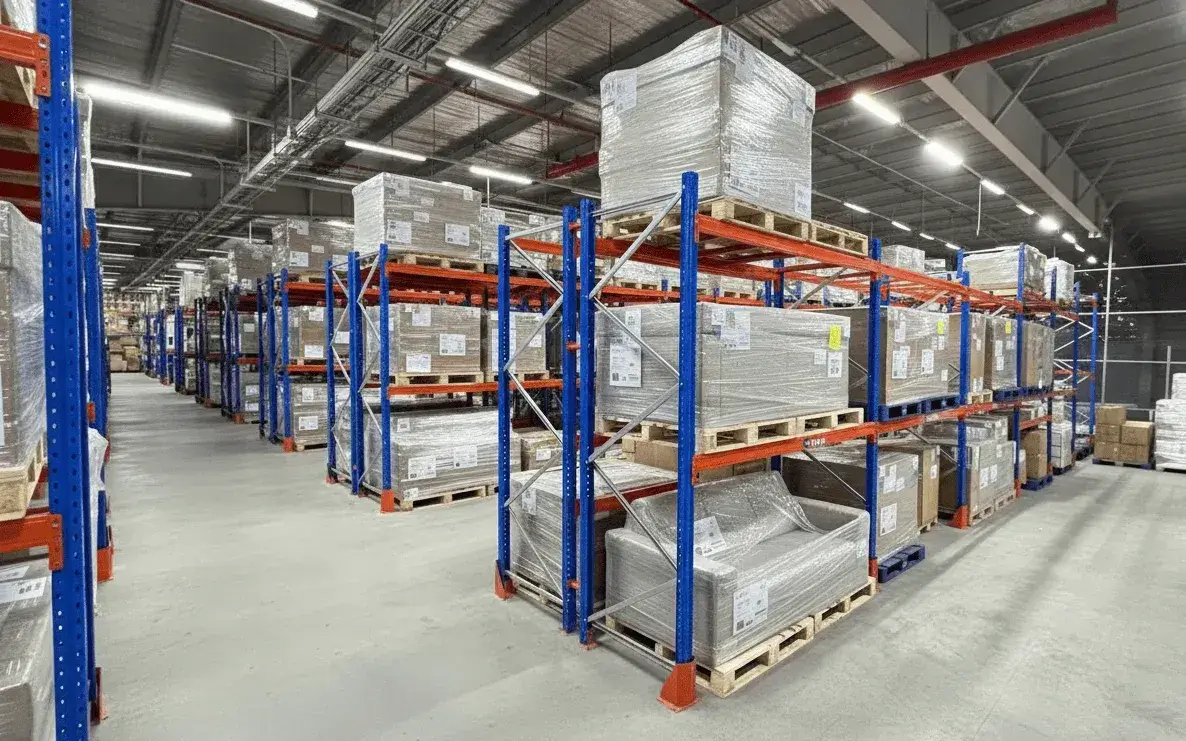
On this page
Calculating how many pallet positions to rent comes down to five core inputs: carton dimensions, units per pallet, stackability, loose-pick demand and a peak-season buffer. Applying the right formula and choosing a suitable racking system lets a business optimise storage density, avoid a sudden shortage of space and stop paying for positions it never uses.
This guide starts from the definition of a pallet position and the standard pallet sizes, then works through a three-step formula built on the Ti-Hi index, the peak buffer calculation, a comparison of selective, double deep, drive-in and pallet shuttle racking, and a worked example of 10,000 cartons with a checklist. Warehouse contracts and supplier quotes are full of terms such as SKU, FIFO and Ti-Hi, so 150+ import, export and logistics terms helps you check the exact meaning before you sign.
How Pallet Positions And Pallet Size Affect The Number You Need To Rent
A pallet position is the standard space on the floor or on a rack beam that holds one full pallet plus the safety clearance a handling machine needs. The number of positions you rent depends not only on total volume but also on packaging characteristics and the pallet standard in use, so two businesses with the same 10,000 cartons can end up renting very different numbers of positions.
This section covers three things before the formula: which pallet is in use, which inputs to collect, and why safety clearance cannot be trimmed to save space.
What A Pallet Position Is And Standard Pallet Sizes
The two most common pallet sizes in Vietnam are 1,200 × 1,000 mm, usually called the Asian or ISO size, and 1,200 × 800 mm, the Euro size. A 1,200 × 1,000 mm pallet has a 1.2 m² footprint, about 25% larger than the 0.96 m² Euro pallet, so changing the pallet standard for the same shipment changes the number of positions you need.
- 1,200 × 1,000 mm pallet: common for manufactured goods and Asian imports, suits large cartons, takes 1.2 m² of floor.
- Euro 1,200 × 800 mm pallet: common for goods exported to Europe and retail chains using the Euro standard, takes 0.96 m² of floor.
- Pallet height: a wooden pallet is about 15 cm tall, which adds to the rack opening height.
Pallet material changes the calculation too, because plastic and steel pallets carry different rack loads from wooden ones, and choosing wooden, plastic or steel pallets compares each type by goods and rack type.
Five Inputs To Collect Before Calculating Pallet Positions
Five inputs must be in hand before you calculate: carton dimensions (length × width × height), weight per carton, maximum stacking height, load-bearing stackability and the number of product codes (SKUs). Missing any one of them leaves you with a rough estimate that can be off by dozens of positions once multiplied by real inventory.
- Carton dimensions (length × width × height): decide how many cartons fit on one base layer, so measure bulged cartons and protruding corners too.
- Weight per carton: must be checked against the permitted load of the pallet and of the rack beam.
- Maximum stacking height: limited by rack opening height, ceiling height and clearance below the sprinklers.
- Crush resistance (stackability): tells you how many layers the bottom carton can carry.
- Number of SKUs: each SKU takes its own positions and cannot be pooled.
When you need to compare with renting by volume, how to calculate CBM for goods converts the same carton dimensions into cubic metres, while storage priced by m³ versus m² explains why the two methods produce different invoices for the same goods.
Safe Clearance Between Pallets And The Fire Protection System
Safety clearance covers the gap between pallets that lets a forklift work and the distance from the top of the load to the sprinkler heads of the fire protection system. International practice such as the NFPA 13 standard commonly asks for about 45 cm from the top of the load to the sprinkler head, so real stacking height is always lower than ceiling height.
- Gap between pallets: usually about 7 to 10 cm on each side of the pallet in the rack opening so a forklift can place and retrieve without hitting the frame.
- Clearance to sprinklers: subtract it from ceiling height before working out the number of layers.
- Aisles and emergency exits: must never be taken up by pallets, even when inventory spikes.
Aisle layout and keeping fast-moving goods easy to reach also change the number of usable positions, and how to arrange a warehouse scientifically sets out the principle of zoning by pick frequency. Exact figures must follow the warehouse’s own fire safety approval file, so ask the owner for the maximum permitted stacking height before multiplying by the number of pallets.
The Three-Step Formula For The Pallet Positions You Need To Rent
The basic formula takes the inventory you hold, divides it by the real capacity of one pallet, rounds up per SKU, then adds the empty-slot factor that appears as goods are picked. Working through three steps in order limits error when you sign a rental contract, because each step removes a different source of drift. The three steps are:
- Cartons per pallet = Ti × Hi, worked out from carton size and maximum stacking height.
- Pallets per SKU = SKU inventory ÷ cartons per pallet, rounded up.
- Base pallet positions = total pallets across SKUs × (1 + empty-slot factor).
Calculating Cartons Per Pallet With The Ti-Hi Index
A pallet’s capacity is set by the Ti-Hi index, the number of cartons on one base layer (Ti) multiplied by the number of layers stacked in height (Hi). A base layer of 9 cartons stacked 5 high gives 45 cartons per pallet, and adding just one layer to Hi cuts the pallets you need by about 17%.
- Working out Ti: cartons must not overhang the pallet edge because they are easily damaged in transport, so try different orientations to fit the most on the pallet face.
- Working out Hi: take the maximum stacking height, subtract the pallet height, divide by carton height and round down.
- Checking crush load: the bottom carton must carry the weight of every layer above it, otherwise reduce Hi.
With 40 × 30 × 25 cm cartons on a 1,200 × 1,000 mm pallet, Ti is 9 because 3 cartons fit along the length and 3 across the width. A stacking height of 1.5 m minus the 0.15 m pallet leaves 1.35 m, which divided by 0.25 m gives 5.4, so Hi is 5 and each pallet holds 45 cartons.
Converting Inventory To Pallets Per SKU
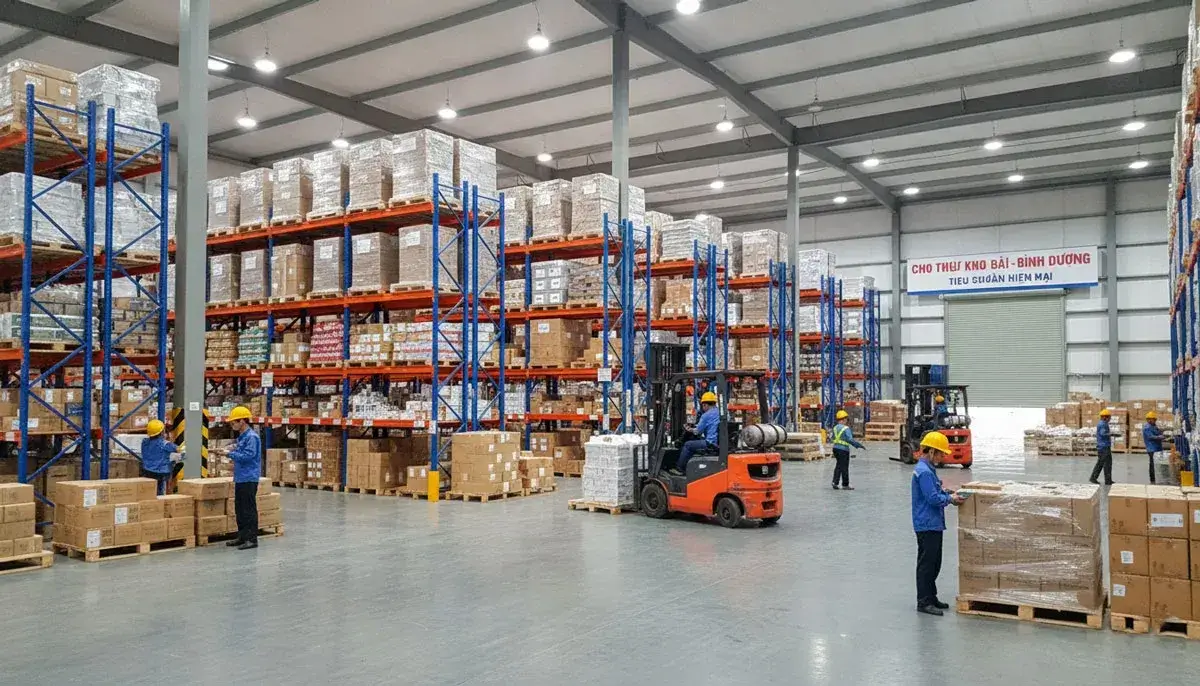
Convert average inventory into pallets for each SKU separately instead of pooling every product together. Each SKU is rounded up to a whole number, so 2.2 pallets of one code still take 3 independent positions, and ten codes that each leave 0.2 of a pallet cost 8 more positions than pooling would suggest (30 against 22).
- Round up per SKU: a pallet position cannot be split, and the remainder of one code does not offset another.
- Separate by production lot and expiry: goods from different lots do not share a pallet, and FIFO and FEFO in warehouse management explains how to ship in the right order for each product group.
- Goods that cannot be stacked: fragile goods, soft bags or weak cartons go one layer high, so each pallet takes a full rack opening instead of being floor-stacked.
Goods that cannot be stacked also drive the choice of racking system, which Part 4 of this guide analyses.
Calculating The Honeycombing Factor And The Loose-Pick Area
Honeycombing happens when a pallet position holds only part of a load or stays empty because no other pallet can be put into it, cutting real utilisation by 10% to 20% under common practice. The number of positions to rent must therefore include an empty-slot factor, and a warehouse with heavy loose picking needs a separate picking area as well.
- Empty-slot factor of about 10%: few SKUs, whole-pallet picking, few part pallets.
- Empty-slot factor of 15% to 20%: many SKUs, many lots, frequent loose picking or deep-lane racking such as drive-in.
- Picking face: reserve the lower rack openings for pallets being broken down, keep full pallets on upper levels for replenishment, and use pick to light at the lower level.
Pick to light and autonomous robots are entering warehouses with heavy loose picking, as the latest logistics trends in warehouse automation describes with market data. Returned goods are a part-pallet source that is often overlooked because each return lot mixes several codes, and the returned goods handling process shows how to set up a separate inspection area so these lots do not occupy main storage positions.
To find part pallets on a regular basis without closing the warehouse, cycle counting splits the warehouse into several small counting rounds by group of positions.
How To Calculate Peak Pallet Positions When Inventory Grows
Peak pallet positions are calculated by multiplying base storage demand by the peak-season inventory growth rate, then dividing by a target fill level of 80% to 85%. A sensible buffer keeps the warehouse running smoothly, with no blocked aisles when stock arrives in a rush and no paying for empty space all year.
The short form is: positions to rent at peak = base demand × (1 + peak growth rate) ÷ target fill level. The two sections below explain how to get the other two factors.
Finding The Peak Inventory Rate From 12 Months Of Data
Analyse at least 12 months of inbound and outbound data to find the gap between average inventory and peak inventory, because only a full year contains every repeating peak. That rate, for example a peak 30% above average, is the multiplier that separates the fixed rental from the flexible rental.
- Lunar New Year (Tet): goods arrive in a rush before Tet to be sold in time, so inventory peaks and then falls fast.
- Year-end festive season and big promotions: campaigns such as 11.11 and 12.12 lift inventory ahead of the sale date.
- Early-season raw material buying: manufacturers stockpile materials before the season.
Twelve months of data usually sits in a stock-in and stock-out file, and an Excel stock-in and stock-out management file shows how to build a monthly summary table that reveals the peak. If the peak figure is distorted by a formula, how to fix Excel formula errors and lock data helps find the wrong cell before you multiply.
Setting A Safe 85% Capacity Margin
By professional warehouse management practice, a warehouse at about 85% of its pallet positions is already considered full in operational terms. Keep 15% to 20% of positions empty so forklifts have room to shuffle goods, receive new stock not yet put away and handle returns without cutting productivity. Without that margin, every inbound truck competes with outbound picking for the same aisle.
- Shuffling goods: to reach a pallet at the back you must move the one in front, which needs a free slot to park it.
- Unallocated inbound goods: trucks arriving in a rush need buffer positions before goods go onto the racking.
- Returns and goods awaiting inspection: need their own positions, kept apart from sellable goods.
The inbound buffer can be narrowed with cross-docking, because goods move straight from the inbound truck to the outbound truck without touching the racking and so take no storage position.
Renting The Peak Buffer Flexibly At MyStorage
Pallet positions needed for only a few weeks a year should be rented flexibly rather than committed for the whole year alongside the fixed block. MyStorage runs full-service storage with shared space of more than 2,000 m² in Dong Nai, charged by the area used, with pickup and delivery as needed, which suits small and mid-sized businesses as a peak buffer:
- 24/7 air-conditioning holds 23 to 25°C, suited to moisture-sensitive goods such as electronics, cosmetics and documents.
- CCTV monitors the storage area throughout the rental.
- Personal PIN for self-storage units, so only the authorised person can open the unit.
- 24/7 access at self-storage, which suits inbound and outbound outside office hours.
- Units from 1 m³ to 23 m³, so you rent the peak volume you need instead of a year-round maximum.
- Workspace at 375 Vo Nguyen Giap for startups and online sellers to store stock and pack orders on site.
MyStorage has two self-storage facilities, 375 Vo Nguyen Giap and An Phu Sports Park; the locker points are drop-off spots for small items, not storage facilities. For large pallet volumes, send your Ti-Hi sheet and the number of positions you need to get a quote by volume or by position, because pricing depends on the facility.
This way of renting resembles the shared-warehouse model that shared warehouses and warehouse sharing describes, while packing and shipping orders inside the warehouse is a job for the fulfillment warehouse model run by third parties, which differs from renting storage space alone. A buffer that repeats by season also suits seasonal warehousing better than a year-round fixed lease.

Racking Systems And Handling Equipment That Optimise Pallet Positions
Choosing the right racking system and matching handling equipment decides directly how many pallet positions you can fit on the same floor area. Each rack type trades off access to individual products against total capacity, so the number of positions you rent only means something when tied to a specific rack type.
Selective And Double Deep Racking
Selective racking gives access to 100% of pallet positions on a FIFO basis, while double deep racking raises density by storing two pallets deep on each side of the aisle. Selective suits businesses with many SKUs and varied inbound and outbound flows, whereas double deep retrieves the outer pallet first, so it suits few codes with large quantities each.
- Selective racking: every pallet has its own position right on the aisle face, works with a standard counterbalance truck or reach truck, and keeps the empty-slot factor low.
- Double deep racking: two pallets stored one behind the other, needs a reach truck with extended forks, and the inner pallet can be retrieved only after moving the outer one.
Most businesses renting an outside warehouse do not choose racking but use what the warehouse already has, so the first question is which rack type it runs. Renting a ready-built warehouse versus building your own compares the two routes by cost structure to show when it is worth investing in your own racking.
Drive-in And Pallet Shuttle Racking
Drive-in and pallet shuttle racking reach the highest storage density because they remove most forklift aisles, with pallets stored deep in long lanes. Drive-in usually runs on a LIFO basis and needs the forklift to drive into the lane, while pallet shuttle uses a shuttle running on rails, can work FIFO or LIFO and reduces the risk of hitting the frame.
- Drive-in racking: the forklift drives into a lane between the rail-support uprights, density is high but it is LIFO, the empty-slot factor is large when a lane is part empty, and frames are hit more often.
- Pallet shuttle racking: a semi-automatic shuttle carries the pallet deep into the lane, staff only place or retrieve pallets at the lane head, and FIFO or LIFO can be selected.
- Suitable goods: few SKUs, many pallets per SKU, steady turnover, such as uniform goods in large quantities.
Deep-lane racking demands precise tracking of positions and lots, so a warehouse management system (WMS) is a companion requirement to stop pallets from different lots being mixed in one lane.
Reach Trucks And Pick To Light Decide Aisle Width
Material handling equipment such as counterbalance forklifts, reach trucks and pick to light systems directly sets aisle width and picking speed. A reach truck turns in a tighter space than a counterbalance forklift, so it allows narrower aisles and adds extra rack rows on the same floor area. The choice of truck therefore sets the aisle width long before the first pallet is placed.
- Counterbalance forklift: large turning radius, aisles usually about 3.5 to 4.5 m wide.
- Reach truck: the forks reach out instead of the whole truck turning, aisles narrower at usually about 2.7 to 3.2 m, and it lifts higher.
- Pick to light: lights on lower-level rack openings guide the picker to the right slot and quantity, shortening loose-pick time.
IoT sensors and RFID tags at the dock show pallet location and condition in real time, and IoT in warehouse management describes each sensor type and the alert thresholds to set.
Comparing Four Common Racking Systems
The table below sets four racking systems side by side by SKU access, pallet position density, required handling equipment and suitable goods. Read from top to bottom: the further you go into deep-lane racking, the higher the density, the lower the access to each product and the tighter the lot management needs to be.
| Racking system | SKU access | Pallet position density | Handling equipment required | Suitable goods |
|---|---|---|---|---|
| Selective racking | High, 100% of positions reachable | Low | Counterbalance forklift or reach truck | Many SKUs, varied inbound and outbound |
| Double deep racking | Medium, inner pallet behind outer pallet | Medium to high | Reach truck with extended forks | Few SKUs, large quantities per SKU |
| Drive-in racking | Low, LIFO by lane | High | Forklift driving into the lane, experienced operators | Uniform goods, long storage, little turnover |
| Pallet shuttle racking | Low to medium, FIFO or LIFO | Very high | Shuttle plus forklift at the lane head | Uniform goods in large quantities, steady turnover |
A Worked Example Of Pallet Positions To Rent And A Checklist
Applying the formula to a concrete hypothetical lets a warehouse manager see each step from cartons to the total pallet positions to rent and the real peak buffer. The example below uses exactly the inputs from Parts 2 and 3, so you can swap in your own figures and recalculate.
A Step-By-Step Example For 10,000 Cartons
A distribution business with average inventory of 10,000 cartons, a peak 30% higher, a 10% empty-slot factor and an 85% operating threshold needs about 290 fixed pallet positions all year, plus about 85 flexible positions at peak. The result comes from five consecutive steps, with 40 × 30 × 25 cm cartons on a 1,200 × 1,000 mm pallet, no floor stacking:
- Cartons per pallet: Ti 9 × Hi 5 = 45 cartons.
- Average pallets: 10,000 ÷ 45 = 222.2, rounded up to 223 pallets.
- Base positions with the empty-slot factor: 223 × 1.10 = 245.3, rounded up to 246 positions.
- Positions at peak: 13,000 cartons ÷ 45 = 288.9, rounded up to 289 pallets, times 1.10 gives 317.9, rounded up to 318 positions.
- Applying the 85% threshold: fixed 246 ÷ 0.85 = 289.4, rounded up to 290 positions; at peak 318 ÷ 0.85 = 374.1, rounded up to 375 positions; flexible part = 375 minus 290 = 85 positions.
Skipping the empty-slot factor and the 85% threshold gives only 223 positions, 67 short of the real figure, and the warehouse jams as soon as inventory edges up. With four-level selective racking, 290 positions equal about 250 m² of floor, an illustrative estimate at 0.85 m² per position including aisles.
Checklist Before Fixing The Number Of Pallet Positions To Rent
The checklist below gathers four groups to verify before you sign a contract: carton and pallet inputs, rack and equipment standards, operating factors and growth buffer. Each row has a clear pass standard so the warehouse manager can tick items off and avoid fixing the number of positions on total goods volume alone.
| Item | What to check | Standard to meet |
|---|---|---|
| Carton and pallet inputs | Carton dimensions, Ti-Hi, crush load and the pallet standard in use | Measured on a sample pallet, Ti-Hi recorded in writing for each SKU |
| Rack and equipment standards | Rack type at the warehouse, rack opening height, beam load, forklift type, fire protection clearance | Matches stacking height and pallet weight, confirmed by the warehouse owner |
| Operating factors | Empty-slot factor, picking area, buffer positions for inbound and returns | Empty-slot factor chosen by SKU count and loose-pick frequency, separate positions for returns |
| Growth buffer | 12-month peak rate, 85% fill threshold, plan when positions are exceeded | Fixed and flexible parts separated in the contract, short-term add-on clause included |
The higher the value of goods on each pallet, the more closely insurance and security terms deserve a look: whether you need insurance when storing goods sets out what compensation covers, while warehouse security systems analyses cameras and access control layer by layer.
Reviewing Ti-Hi And Fill Rate Every Quarter
Review the Ti-Hi index and warehouse fill rate every quarter, because a change in carton specification, pallet supplier or SKU count alters the positions you need without anyone noticing at once. A short quarterly review costs far less than renting dozens of positions too many or running out of space at peak.
- Review Ti-Hi when specifications change: each time cartons or pallets change, re-measure a sample pallet and update the SKU sheet.
- Track the fill rate: compare actual levels against the 85% threshold and against next season’s peak forecast.
- Update the peak rate: after each peak season, feed the new figure into the formula instead of keeping last year’s.
- Assign an owner: a role such as warehouse planner or supervisor keeps the Ti-Hi sheet, and warehouse job positions describes what each role does.
When the review shows demand has outgrown a block of positions, business storage in Ho Chi Minh City compares rental types by goods group, while logistics and industrial real estate places the expansion decision in the context of industrial warehouse supply.
Frequently Asked Questions About Calculating Pallet Positions
These 15 questions cover what warehouse managers and distributors ask most when working out how many pallet positions to rent, from floor area and the Ti-Hi index to peak buffer and racking choice.
How Much Floor Area Does One Pallet Position Take?
A 1,200 × 1,000 mm pallet takes 1.2 m² of floor and a 1,200 × 800 mm Euro pallet takes 0.96 m². Counting aisles, single-level floor stacking usually costs about 2 to 3 m² per position, while four-level selective racking needs only about 0.8 to 1 m². These are estimates, and the real figure changes with aisle width and rack type.
What Is The Ti-Hi Index In Pallet Loading?
Ti is the number of cartons on one base layer, Hi is the number of layers stacked in height, and Ti × Hi is the number of cartons a pallet holds. A base layer of 9 cartons stacked 5 high gives 45 cartons. Measure it on a real pallet, because bulged or overhanging cartons reduce Ti.
Why Not Fill A Pallet Warehouse To 100%?
By common practice a warehouse at about 85% of positions is already full in operational terms. A completely full warehouse has no empty slots to shuffle goods, receive new stock not yet put away or handle returns, so forklifts wait on each other, collisions become more likely and the whole outbound line slows down.
How Does Honeycombing Affect A Warehouse?
Honeycombing is the share of positions that hold only part of a load or stay empty because no other pallet can be put in, cutting real efficiency by about 10% to 20% under common convention. Warehouses with many SKUs, many lots or deep-lane racking are hit harder, so this factor must be added to the positions you rent.
How Do I Calculate Pallets For Many SKUs?
Calculate each SKU separately, round up, and only then add them together. For example three codes needing 2.2, 1.4 and 0.6 pallets take 3, 2 and 1 positions, 6 in total, not 5 as pooled 4.2 would suggest. Apply the empty-slot factor afterwards, because the remainder of one code cannot offset another.
What Is The Maximum Stacking Height On A Pallet?
Stacking height usually falls between 1.2 and 1.8 m including the pallet, depending on rack opening height, the crush load of the bottom carton and clearance to the sprinklers. Take the smallest of those three limits as the maximum stacking height, then subtract the pallet height to get Hi.
When Should I Choose Pallet Shuttle Racking?
Pallet shuttle suits a warehouse with few SKUs, many pallets per SKU, steady turnover and enough volume to repay the investment. It does not suit many small codes, because each lane should hold one code and one lot, otherwise you create many empty slots and spend time shuffling goods.
Is Selective Or Double Deep Racking Better?
It depends on SKU count and how you pick. Selective racking reaches 100% of positions, so it suits many codes with varied inbound and outbound. Double deep raises density but retrieves the outer pallet first and needs a reach truck with extended forks, so it suits few codes, many pallets per code and even turnover.
Which Warehouses Use Pick To Light Technology?
Pick to light suits warehouses with heavy loose picking and many small orders every day, such as e-commerce and retail distribution. Lights on lower-level rack openings guide the picker to the right slot and quantity, shortening training time for new staff. A warehouse that mostly ships whole pallets hardly needs it.
How Does Handling Equipment Affect Aisles?
The turning radius of the truck decides aisle width. A counterbalance forklift usually needs an aisle of about 3.5 to 4.5 m, while a reach truck needs only about 2.7 to 3.2 m, so the same floor area gains rack rows when you switch to reach trucks, which means more pallet positions.
How Are Non-Stackable Goods Counted In Pallets?
Non-stackable goods have a Hi of 1, meaning each carton or pallet takes a full position. The number of positions equals the number of pallets, and if they sit on the floor you lose both floor area and warehouse height. Multi-level racking uses the height without pressing down on goods below.
How Much Peak Buffer Should I Plan?
There is no fixed figure; take it from 12 months of inbound and outbound data: plan as much as peak inventory exceeds the average. For example a peak 30% higher, then divide by the 85% fill threshold to leave 15% to 20% of positions as buffer, and rent that part flexibly instead of fixed.
What If Goods Exceed The Rented Positions?
Rent extra positions short term at the same warehouse, or use an outside shared warehouse for slow-moving goods, instead of blocking aisles or stacking above a safe height. Put a short-term add-on clause in the contract from the start so you are not negotiating while stock is already arriving.
Are Wooden Or Plastic Pallets Better For Racking?
Wooden pallets are cheap and easy to repair, while plastic pallets are uniform in size, light and easy to clean. For heavy rack loads choose a pallet rated for the rack, usually a plastic pallet with a steel core or a steel pallet. Decide by carton weight, rack type and the hygiene needs of the goods.
How Often Should I Recalculate Pallet Positions?
Recalculate every quarter and after each peak season, and immediately when you change carton specification, change pallet standard or add many new SKUs. Each of those changes shifts Ti-Hi or the empty-slot factor, and the positions you rent drift out of line if you keep last period’s figure.
Factors in this article such as the 85% fill level and the 10% to 20% empty-slot factor are common working conventions and illustrative examples, not mandatory standards. Clearance to sprinklers, stacking height and rack load must follow the warehouse’s fire safety approval file and its own specifications, so confirm with the warehouse owner before fixing the number of positions.
Related articles

Article
First 30 Days In Ho Chi Minh City: An Arrival Checklist For Expats 2027
A moving-to-Vietnam checklist for your first 30 days in Ho Chi Minh City puts visa compliance, a local SIM, temporary residence registration, apartment hunting and banking in order, week by…
Read article

Article
Expat Gear Storage In Ho Chi Minh City: Surfboards And Diving Gear 2027
Expat gear storage in Ho Chi Minh City solves the problem of fitting bulky surfboards and scuba equipment into a compact apartment while protecting them from tropical humidity. A…
Read article
Article
Logistics Trends For 2027: Automation, AI And Green Warehouses
Logistics trends for 2027 rest on three pillars: warehouse automation, AI for demand forecasting and green warehouses meeting ESG standards. Small and mid-sized businesses should…
Read article
