
 Tiếng Việt
 한국어
 日本語
Article
Popular Decluttering Methods: Should You Choose KonMari, 4 Boxes Or 20/20?

On this page
Popular decluttering methods today include the KonMari method based on joy, the 4-box method that sorts by action, the 20/20 rule for items that are easy to replace, the 90/90 rule that judges how often you use something, and the 5-minute method for quick tidying. The best choice depends on how much you own, how much free time you have and your goal, such as cleaning before Tet, moving rooms or keeping a tidy home for good. When your cupboards are full but things still need keeping, suitcases, winter quilts and holiday decorations usually move to a self-storage service, as they top the list of household items worth putting into storage.
1. 7 Popular Decluttering Methods
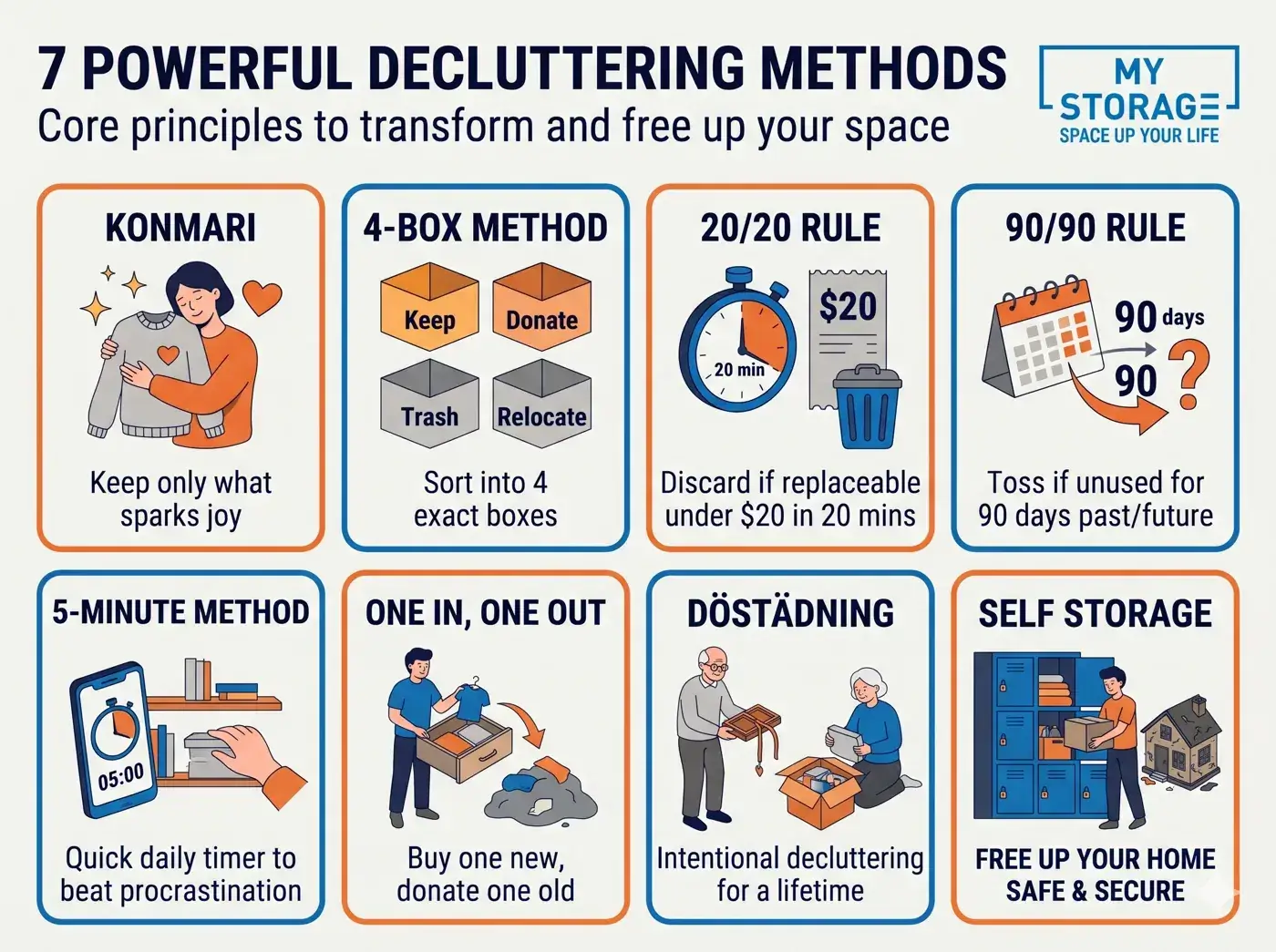
Each decluttering method has its own logic for getting past the mental block you feel in front of a pile of clutter. Understanding how each works helps you choose the right tool for your family’s habits instead of forcing yourself into a rigid formula.
The KonMari Method: Keep What Sparks Joy
The KonMari method, created by Marie Kondo, decides what to keep based on feeling and emotional connection:
- Spark joy: Hold each item and ask whether it brings real joy or value to your life now; if not, thank it and let it go.
- Sort by category, not by room: Gather everything of the same kind from the whole home in one place so you can see exactly how much you own.
- The classic order: Start with the easiest category and finish with the hardest: clothes, books, papers, miscellaneous items (komono) and finally sentimental items.
- Pros and cons: It changes how you think about living with less, but it takes a lot of focused time and is hard to do quickly in a full home or with small children.
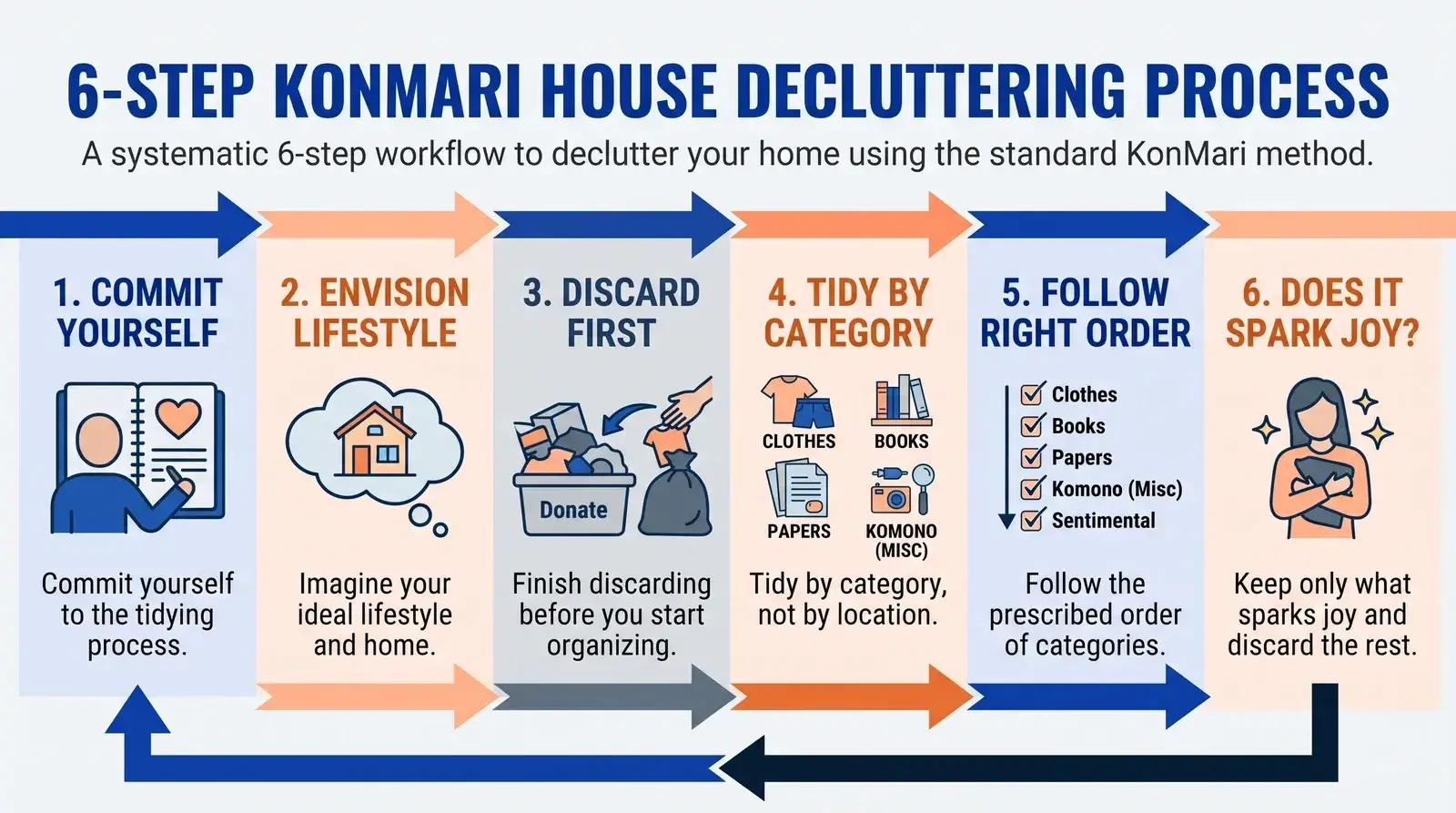
KonMari followers fold clothes upright in rows and store items by category rather than by room, following the steps for decluttering and storing your things with the Marie Kondo method.
The 4-Box Method
The 4-box method is the most visual way to sort, helping you make a firm decision on the spot:
- Prepare 4 boxes or 4 zones: Box 1 (keep and put back), Box 2 (give away or sell), Box 3 (throw away) and Box 4 (move to another room).
- Finish one area at a time: Pick a small spot such as a desk top or a drawer, take each item out and drop it into one of the 4 boxes; never put anything back before it is sorted.
- Clear the boxes straight after: When the session ends, take the rubbish out, return the relocate box to the right rooms and pack the donation box neatly.
- Main advantage: Very visual, easy for beginners, and it keeps the mess from spreading to other areas.
The 20/20 Rule for Replaceable Items
The 20/20 rule is a practical way to let go of the urge to keep things just in case:
- The principle: You can let go of a rarely used item if it can be replaced for under US$20 (about 500,000 VND) within 20 minutes.
- Where it works: Duplicate kitchen tools, spare phone cables, extra spice jars, plastic hangers or paper leaflets.
- Firm exceptions: Never apply it to legal papers, medical records, emergency medicine, heirlooms or anything hard to buy again.
- Adjust it for Vietnam: You do not need to stick to exactly US$20; ask whether buying it again would really affect your monthly budget.
The 90/90 Rule for Frequency
The 90/90 rule from The Minimalists gives you an objective time test for how much an item is really used:
- Two key questions: Have you used this item in the last 90 days? Will you definitely use it in the next 90 days?
- A clear decision: If both answers are no, the item no longer serves your daily life and should go.
- Best for clothes and household goods: Works very well for wardrobes, party shoes, home sports gear and kitchen gadgets used once and forgotten.
- Seasonal exceptions: Be flexible with winter quilts, heaters or Christmas decorations used in only one season.
The 5-Minute Method
The 5-minute method breaks the pressure into small pieces, so busy people can start without feeling overwhelmed:
- Set a 5-minute timer: Choose one surface such as a desk, shoe rack or sink and tidy it until the timer rings.
- Beat procrastination: The biggest barrier is the tiredness of picturing the whole job; 5 minutes is short enough that your brain does not resist.
- Keep a steady rhythm: Stop when the 5 minutes are up, or carry on with another short round if you feel like it.
- Small steps add up: Two or three 5-minute rounds a day keep a room tidy without giving up a whole weekend.
Many families combine five or six 5-minute rounds into a 30-minute session for tidying and organising stored items at the weekend, with each person taking one area.
One In, One Out
The one in, one out rule controls how many things come into the home, so the clutter does not come back:
- Keep the balance: Whenever you bring something new home, give away, sell or throw out an old item that does the same job.
- In practice: Buy a new shirt, let go of an old one you rarely wear; buy new shoes, clear a worn pair from the rack.
- Changes how you shop: It makes you think twice before paying and cuts impulse buying.
- Long-term control: Cupboards stay at a steady level and never become overloaded over time.
Döstädning, Swedish Death Cleaning
Döstädning (Swedish death cleaning) is responsible decluttering that lets you let go of a lifetime of belongings calmly:
- The human meaning: Sort your belongings thoughtfully so your family does not have to deal with a huge amount of things later.
- For any age: It suits anyone who wants a simpler life, especially middle-aged people or families moving to a smaller home.
- Sort keepsakes and legacy items: Keep important papers and letters in a small labelled box with a note on what each item means.
- A calm mindset: The process is slow and unhurried, letting you look back on your life and keep only what truly matters.
2. Comparing Decluttering Methods In Detail
Every method has its strengths and limits, and no single formula works for every situation. Comparing them helps you pick the right one for cases such as a quick clean before moving, a home overflowing with things or keeping order day to day.
Method Comparison Table
This table compares the 7 methods by principle, time needed, who they suit and their limits:
| Method | Core Principle | Time Needed | Best Suited To | Limits to Note |
|---|---|---|---|---|
| KonMari | Keep what brings joy and meaning | Long (several days to weeks) | People who want a full lifestyle reset | Discouraging if the home is very full |
| 4 Boxes | Sort into 4 action groups | Medium (half a day to a day) | Beginners, room-by-room tidying | Boxes must be dealt with right away |
| 20/20 Rule | Let go of cheap, easy-to-replace items | Fast to instant | Small items, accessories, kitchen tools | Not for keepsakes or documents |
| 90/90 Rule | Judge use over 3 months | Medium | Wardrobes, shoes, personal devices | Needs flexibility for seasonal items |
| 5 Minutes | Timed tidying of one small spot | Very short (5–10 minutes per round) | Busy people, procrastinators | Cannot handle a home overflowing with things |
| One In One Out | One in, one out balance | Ongoing, every day | Keeping order after a big clear-out | Does not reduce existing clutter |
| Döstädning | Reduce belongings responsibly | Long term, gradual | Families with years of accumulated items | Not a fix for urgent cleaning |
The Fastest Way to Declutter
When you need to tidy within a few hours for guests or a room handover, combining the 4-box method and the 20/20 rule is fastest:
- Use 4 boxes as the frame: Put 4 large baskets in the middle of the room and move quickly through each area, dropping items into the right basket without overthinking.
- Use 20/20 to stop hesitating: Small items, broken plastic or old bottles of little value go straight into the rubbish or the sell box within 5 seconds.
- Do not stop to organise: Fast tidying is about clearing floors and table tops; neat arranging comes later.
Cleaning before Tet usually moves from wardrobes and the kitchen to the living room and the family altar, the same order behind 8 ways to clean your home for Tet and keep stored items tidy.
For Procrastinators
People who often put things off and feel drained by tidying should start with very small steps:
- Start with 5 minutes a day: Commit to one spot such as the dressing table or dining table; when the timer rings, you may stop.
- Create a visible win: A clean corner releases dopamine and motivates you to tidy another area the next day.
- Move on to the 4-box method: Once you have a rhythm, scale up to a whole wardrobe with 4 sorting boxes.
For Homes With Lots of Things
Townhouses or apartments with decades of belongings need a layered decluttering plan:
- Apply KonMari one category at a time: Spread it over several weeks: clothes in week one, books in week two, kitchen items in week three.
- Filter with the 90/90 rule: For items with no clear emotional pull, use 90 days without use as the deciding test.
- Leave keepsakes until last: Sentimental items take the most thought; deal with them only once you are used to deciding on everyday things.
Decluttering Before a Move
Preparing to move is the best moment to cut moving costs and make the most of your new home:
- Clear out before packing: Never pack things you do not want in the new home; moving clutter only costs more truck space.
- Combine 90/90 and 4 boxes: Put everything unused in the last 3 months into the sell box or the donation box.
- Pack an essentials box: Pack one suitcase with what you need for the first 3 days in the new home (clothes, towels, phone charger, personal medicine).
Combining Methods Flexibly
Smart declutterers do not stick to one rule; they combine the strengths of each method:
- A winning mix: Use the 5-minute method to get started, KonMari to gather by category, 4 boxes to direct each item, 20/20 and 90/90 to stop hesitating, and one in, one out to keep the result.
- Make your own family rules: Adjust the US$20 or 90-day figures to suit your budget and daily rhythm.
3. A 5-Step Quick Decluttering Process
A standard 5-step process stops you running around tidying one spot while messing up another. With a clear goal, firm sorting and putting things back in the right place, you can finish a full clean of a room in one morning.
Step 1: Set Your Goal
Planning and preparing your tools before you start saves up to half the cleaning time:
- Define the scope: Choose one room or one group of items to finish this morning (for example, the whole bedroom wardrobe).
- Prepare your tools: 4 large cartons, black bin bags, tape, a marker, microfibre cloths and an all-purpose cleaner.
- Set a strict time frame: Set a 2 to 3-hour countdown for the whole job and put on upbeat music.
Step 2: Gather and Sort
Collect everything that is out of place and sort it straight into the 4 action boxes:
- Clear surfaces first: Gather cups, dirty clothes and papers from the bed, floor and tables into the middle of the room.
- Drop items into the right box: Decide at once for each item: keep, give away, throw away or relocate; spend no more than 10 seconds on any one item.
- Protect valuables: Set aside ID papers, cash, jewellery and valuable electronics in a separate safe box.
Step 3: Decide What to Keep
Use objective criteria to get past the reluctance to let things go:
- Check that it works: Does it still work well? Is it chipped, stained or broken and waiting months for repair?
- Apply 90/90 and 20/20: If you have not used it in 3 months and it is cheap and easy to replace, let it go.
- Ask the key question: If you saw this item in a shop today, would you pay to buy it again?
Step 4: Deal With the Surplus
Clear the boxes you no longer need the same day so the clutter does not return:
- Take the rubbish out at once: Tie the bags and take them to the building bin or collection point; do not leave them indoors overnight.
- Sell and donate: Photograph items in good condition to post in second-hand groups; box clean clothes for donation points.
- Make a time-limited box: Put items you are unsure about in a box labelled with a review date 30 days ahead; if you have not opened it in a month, give it all away.
Step 5: Reorganise the Room
Arranging the space around how you move makes items easy to find and put away:
- Store by frequency: Keep daily items at eye and hand level; rarely used items go on high shelves or deep under cupboards.
- Use dividers and labels: Group small items into labelled trays so everyone knows where things go.
- Keep surfaces over 70% clear: Keep the dining table, desk and floor open, with only the essentials left out.
Quick Decluttering Checklist
This 7-point checklist helps you check the quality of the session before you finish:
| Check | What to Do | Done When |
|---|---|---|
| Prepare tools | Get 4 sorting boxes, bin bags and a marker ready | All tools ready before the timer starts |
| Clear surfaces | Pick up everything lying on floors and tables | Surfaces clean, nothing left lying around |
| Sort into 4 boxes | Put each item into one of the 4 action groups | Every item has a clear next step |
| Decide what to keep | Apply 20/20 and 90/90 to rarely used items | Nothing kept just out of habit |
| Clear rubbish and old items | Take rubbish out, send donation boxes off | No sorted boxes left waiting |
| Arrange kept items | Store by frequency with labelled dividers | Any item can be found within 1 minute |
| Keep it airy | Dust surfaces and vacuum the whole floor | Room fresh and open |
Applied to the whole home, this list grows into 7 steps through every area and can free up about 30% of your storage space.
4. How To Keep Your Home Tidy After Decluttering
A good clear-out is not judged by how long the room stays clean, but by whether the household can keep up the habit of order. Fixed storage limits and a few minutes of care each day mean you never need an exhausting big clean again.
Control What Comes In
Controlling what enters the home is the most important barrier against things piling up without you noticing:
- Keep one in, one out strictly: Each time you bring home new shoes, a bag or a toy, find a similar item to let go.
- Pause 48 hours before buying: For anything non-essential, wait 48 hours; if the urge has gone after 2 days, you have saved money and space.
- Say no to useless freebies: Turn down promotional bags, free pens, giveaway mugs or paper catalogues you know you will never use.
Give Everything a Fixed Place
Every item needs a fixed home so tidying becomes a reflex:
- A place for everything: Pens in a pen pot, keys on a hook by the door, the remote on a tray on the coffee table; nothing left loose on flat surfaces.
- Put things back after use: It takes 3 seconds to return scissors to a drawer instead of 15 minutes looking for them tomorrow.
- Clear zones for each room: Kitchen items stay out of the living room; work papers stay out of the bed.
Tidy for 5 Minutes a Day
A short tidy at the end of the day keeps the home looking freshly cleaned:
- A 5-minute bedtime routine: The whole family spends 5 minutes taking cups to the sink, straightening sofa cushions and wiping the desk.
- No dishes or rubbish overnight: Clear the sink and take out the rubbish before bed to start the morning fresh.
- A 15-minute weekend round: Spend 15 minutes on Saturday morning washing cloths, sorting old papers and checking the fridge.
Manage Seasonal Items
Reviewing belongings each season keeps wardrobes and storage working at the right capacity:
- Switch the wardrobe twice a year: At the start of summer and winter, sort all clothes again; clean and pack out-of-season items into vacuum bags.
- Clear seasonal items you no longer use: Worn jumpers, old mattresses or swimwear that no longer fits should go now rather than be stored for another year.
- Keep a separate seasonal zone: Reserve full-height cupboard tops or under-bed space for seasonal items, apart from daily workwear.

Seasonal items are best kept in full-height or under-stairs cabinets, because each of the types of home storage cabinets suits a different group of things.
Set Cupboard Limits
Use the physical size of your cupboards and shelves as the maximum you are allowed to own:
- When it is full, stop buying: If the 4-tier shoe rack is full, do not buy new shoes until you sell an old pair; never buy another rack to hold more.
- Limit your hangers: Keep a fixed 30 to 40 hangers in the wardrobe; no free hangers means the wardrobe is full.
- Do not turn your home into a warehouse: Every square metre of your apartment is for living and breathing, not for old cartons.
Setting limits does not mean throwing everything away, because minimalist living and how to store the things worth keeping still leaves room for things of value.
5. When Should Decluttered Items Move Into Storage?
Decluttering does not mean throwing everything away; some belongings are still valuable but do not need to take up expensive living space. Sorting correctly between what to sell, what to give away and what to move into self-storage protects the value of your belongings in 2027.
When to Sell Second-Hand Items
Selling is a smart way to recover some money from items in good condition that you no longer need:
- Tech and household appliances: Old phones, a spare monitor, an air fryer or a juicer in working order should be sold early before they lose value.
- Furniture and sports equipment: A spare sofa, exercise bike or treadmill you rarely use should be sold to free up valuable floor space.
- Genuine designer clothing: Clothes and designer bags in good shape can be sold through reputable consignment shops.
When to Donate
Donating gives a meaningful new life to items in good condition that no longer suit you:
- Warm clothes and clean bedding: Sort intact clothes, wash them and send them to charities in highland areas or shelters.
- Textbooks and children’s books: Box old books for rural school libraries or community book projects for children in need.
- School items and children’s toys: When your children grow up, pass prams, cots and educational toys on to friends or relatives with new babies.
When to Throw Things Away
Let go of items that no longer have any use, to keep your family safe and hygienic:
- Broken items beyond repair: Chairs with broken legs, brittle plastic, burnt-out electronics or appliances so old they risk electrical faults.
- Expired and unhygienic items: Expired medicine, discoloured cosmetics, badly mouldy pillows and worn underwear should go in the bin at once.
- Separate hazardous waste: Set aside old batteries, fluorescent bulbs and e-bike batteries for dedicated e-waste collection points, not household rubbish.
Moving Things Into Storage
Moving rarely used belongings into professional storage outside the home is the best option when cupboards are full but the items still need keeping:
- Seasonal items: Large suitcases, heaters, winter quilts and Christmas decorations used only a few weeks a year belong in outside storage.
- During renovations or a move: When renovating or waiting to move into a new home, storing everything protects it from building dust.
- Long-term documents and bulky equipment: Company accounting records, camping gear, surfboards and spare furniture need a dry, safe place.
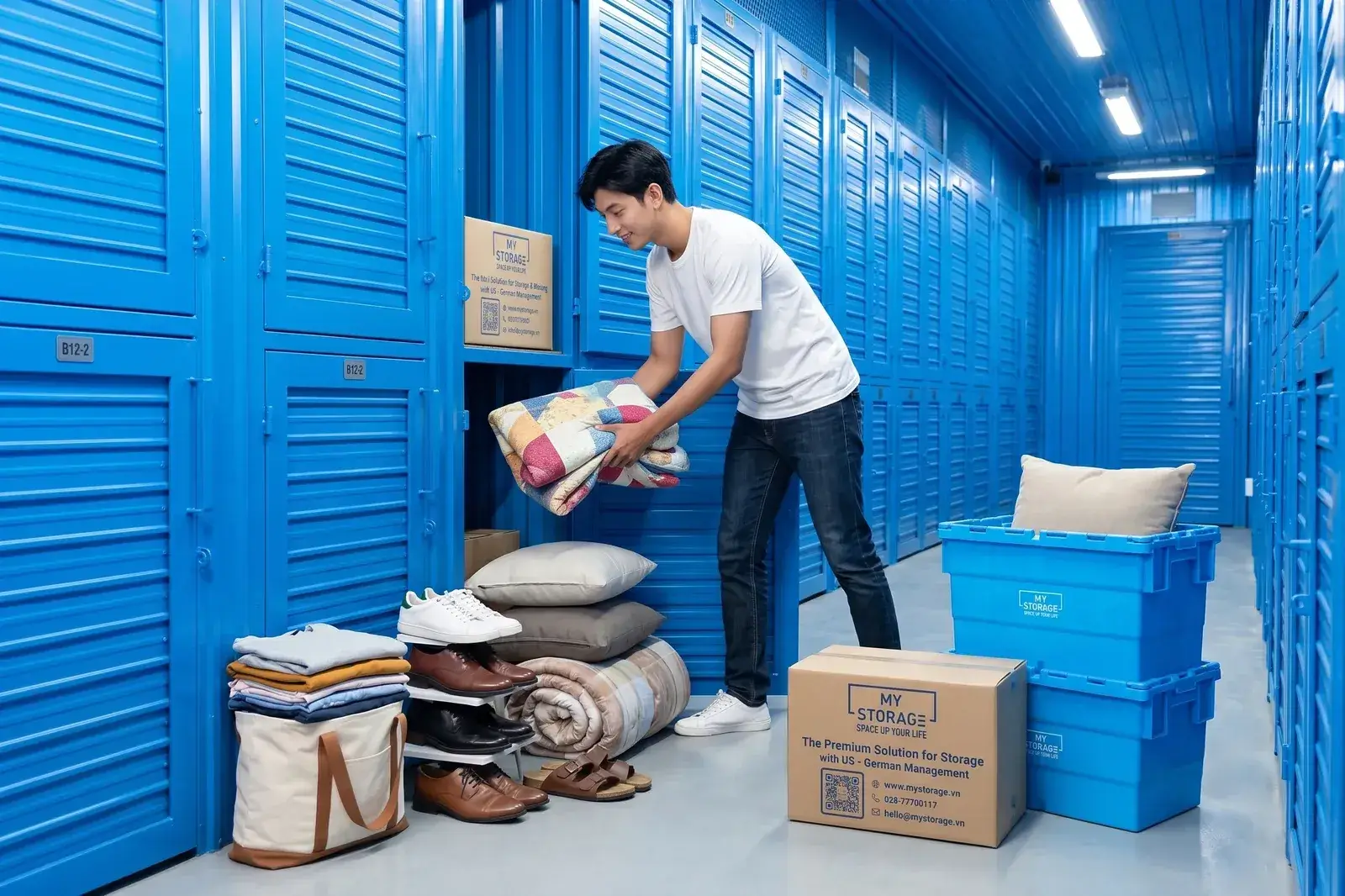
For an individual or a small family, a unit from 1 m³ (holds about 8 to 10 medium cartons) is often enough, and personal mini storage rental by the month means you only pay for the space you actually use.
Self-Storage Prices 2027
Below are the 2027 reference prices for personal and family self-storage units in Ho Chi Minh City:
| Storage Type | Equivalent Volume / Area | Typical Contents | Reference Price (per month) |
|---|---|---|---|
| Mini Box | 1 m³ to 3 m³ (about 0.5 to 1.2 m²) | About 8 to 25 cartons or 2 to 3 large suitcases (seasonal items, books) | 873,000 VND (≈ US$33.91) to 1,563,000 VND (≈ US$60.71) (1 to 3 m³, standard unit) |
| Standard S | 4 m³ to 8 m³ (about 1.5 to 2.5 m²) | About 30 to 70 boxes (suitcases, folding mattresses, camping gear, fans) | 1,796,000 VND (≈ US$69.76) to 2,886,000 VND (≈ US$112.10) (5 to 7 m³, standard unit) |
| Family M | 9 m³ to 16 m³ (about 3.5 to 5.5 m²) | About 80 to 150 boxes (spare furniture, household goods during a move) | 3,533,000 VND (≈ US$137.24) to 3,905,000 VND (≈ US$151.69) (from 10 m³, standard unit) |
| 24/7 Air-Conditioning Option | Based on the volume rented | Holds 20°C to 24°C continuously (protects premium clothing and documents from mould) | About 30% to 40% more than a standard unit |
The prices above are 2027 reference prices for MyStorage self-storage in Ho Chi Minh City, flexible monthly plan, excluding VAT; the 12-month plan is 15% cheaper. VND is the billing currency and converted figures move with the exchange rate. Actual cost depends on size, unit location and contract length; the exact price for each size appears as soon as you pick a unit size in the MyStorage storage price tool.
Storage Solutions From MyStorage
A tidy, airy home is a true place to recharge after stressful working hours.
Decluttering does not mean forcing yourself to throw away treasured keepsakes or things you will use in future. Choosing extra storage outside the home is a smart way to have a simpler, more spacious home while keeping every valuable family belonging.
The MyStorage self-storage facilities in Ho Chi Minh City offer home storage to an international standard. With private units that control temperature and humidity by air conditioning 24/7, multi-layer security cameras and individual access codes, MyStorage protects your suitcases, seasonal bedding and leisure equipment from dust and mould. You hold your own key and can access your things at any time, giving your home lasting freedom and space.
6. Frequently Asked Questions
Here are 15 short, direct answers to the most common questions about choosing and using decluttering methods:
1. Which method works best?
There is no single best method: KonMari suits a full reset, 4 boxes is best for quick room-by-room sorting, and the 5-minute method works best for busy people.
2. What is the KonMari method?
KonMari decides what to keep based on joy (spark joy) and tidies by category rather than by room. Start with clothes, then move on to books, papers and keepsakes, the same order used when decluttering and storing items with KonMari.
3. How do I use the 4-box method?
Prepare 4 boxes labelled keep, give away, throw away and relocate, then take each item out and put it straight into the right box without hesitating.
4. What is the 20/20 rule?
The 20/20 rule says you can let go of a rarely used item if it can be replaced for under US$20 within 20 minutes.
5. How do I apply the 90/90 rule?
If an item has not been used in the last 90 days and you have no plan to use it in the next 90, sell it, give it away or throw it out.
6. How can I declutter when I am busy?
Break it up with the 5-minute method each day, tidying just one corner of a table or one drawer to build the habit without burning out.
7. Should I tidy by room or by category?
Tidy by room when you need one space clean quickly; tidy by category to get full control over how much you own.
8. Any tips for procrastinators?
Start with a very short 5-minute round with a timer and pick the easiest area for a small win that gets you moving.
9. How do I decide what to keep?
Consider whether it works, how often you used it in the past year, how easily it can be replaced and how much it truly means to you.
10. Should I throw out everything unused for 90 days?
Do not apply it mechanically to seasonal items such as heaters, winter quilts and holiday decorations, or to ID papers and emergency supplies.
11. What should I do with good items I do not use?
Photograph them and sell them in online second-hand groups to recover some money, or pack them for a suitable charity.
12. How do I stop the clutter coming back?
Apply one in, one out strictly, give every item a fixed place and spend 5 minutes tidying each evening before bed.
13. Can I declutter the whole home in one day?
Only in a small apartment with few belongings; for a townhouse full of things, split it into weekly rounds so you do not burn out and give up.
14. Should I buy more cupboards?
Never buy more cupboards before decluttering; extra cupboards only let you keep piling up things you do not need.
15. When should I rent outside storage?
Rent self-storage when cupboards at home are full but you still have seasonal items, large suitcases or important documents to keep safe long term. For rarely used items, a small unit usually costs far less than renting extra living space, which makes renting storage instead of keeping things at home the cheaper option.
Related articles

Article
Storage for Students: Lockers and Monthly Self-Storage Explained
Students storing a backpack or small suitcase for a few days should use a locker; for the summer break, Tet or a room move with many boxes, a monthly self-storage unit from 1 m³ with air…
Read article

Article
Company Record Retention Periods: A Quick Lookup Table By Document Type 2027
Businesses in Vietnam must keep records for 5 years, 10 years, 20 years or permanently depending on the legal nature of each group of documents.
Read article
Article
Working From Home In A Small Space: How To Create A Clutter-Free Desk Corner
Working from home in a small space calls for smart planning so your desk does not turn into a dumping ground for household items.
Read article
