
 Tiếng Việt
 한국어
 日本語
Article
Types of Home Storage Cabinets: Uses and How to Choose
On this page
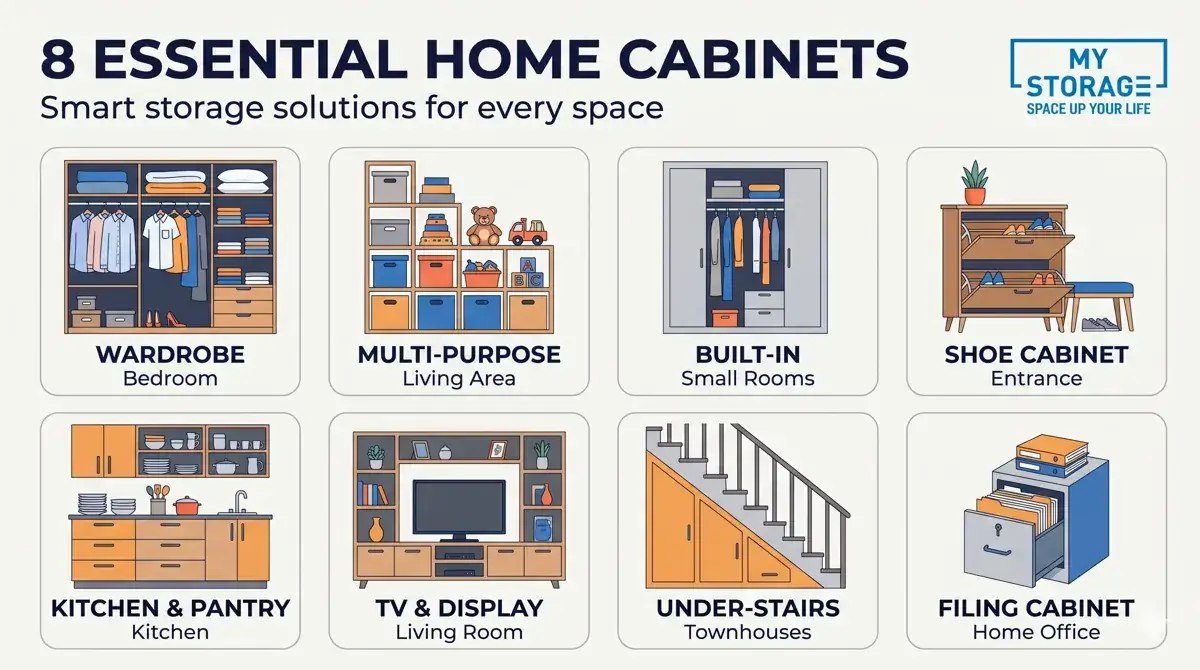
Home storage cabinets come in several main types, including wardrobes, multi-purpose cabinets, built-in cabinets, shoe cabinets, kitchen and pantry cabinets, TV and display units, under-stairs cabinets and document cabinets. Each serves a different living area, from keeping personal clothes and household goods to filing family papers. The right choice depends on room size, the building structure, the material and the weight of what you store, so you can make the most of your living space without it feeling cramped. When the cabinets at home run out of room, rarely used items can move to a self-storage service or one of the storage rental options in Ho Chi Minh City.
1. Common Types of Storage Cabinets
Storage cabinets in the home are classified by their function and where they are installed, to serve the daily activities of the family. From wardrobes and built-in cabinets to multi-purpose cabinets and under-stairs cabinets, each group has its own storage compartments, so belongings stay clearly separated and the home stays tidy.
Wardrobes for the family
A wardrobe is the most essential piece of furniture in a bedroom. It keeps clothes, fashion accessories, and seasonal bedding:
- Traditional hinged-door design: It lets you see the whole interior at once and suits bedrooms with open space and at least 60 cm clearance to open the doors.
- Sliding-door design: Doors glide smoothly on a guide track, saving as much floor space as possible, which makes it ideal for narrow rooms where the bed sits close to the walls.
- Full-height ceiling-mounted design: It uses the space from the top of the cabinet up to the ceiling for less frequently used items such as suitcases, winter quilts and spare pillows.
- Well-planned compartments: It separates long hanging space of 120 to 140 cm for dresses and overcoats, short hanging space of 80 to 90 cm for shirts and jackets, a folding area for knitwear, and small drawers for underwear and accessories.
Suitcases kept on top of the wardrobe can also hold seasonal items, as shown in 7 ways to use suitcases for home storage.
Multi-purpose cabinets
Multi-purpose cabinets offer flexible storage for several living areas, combining closed drawers with open display shelves:
- Flexible placement: They can go in the hallway, living room, study or shared corner to hold household goods, children’s toys or electronics.
- Several functions in one unit: The cabinet often has sliding drawers at the bottom, hinged doors in the middle and open shelves on top, so you can store items and display books at the same time.
- Suits apartment living: Families with young children can gather dozens of small loose items into one fixed place instead of buying several small cabinets that take up floor space.
Built-in cabinets for saving space
A built-in cabinet is a clever architectural solution that uses wall recesses or the space beside concrete columns to create flat, neat storage:
- Frees up floor area: The cabinet fronts sit flush with the surrounding walls, removing the heavy feeling of a large piece of furniture and making the room look more open.
- Hides construction defects: It neatly covers corners, protruding columns or service recesses that appear during the building of townhouses and apartments.
- Technical survey matters: Check the recess depth carefully; for a wardrobe the minimum is 55 to 60 cm. Treat the outside wall for damp and avoid hidden electrical cables before fitting the cabinet.
Shoe cabinets for a fresh entrance
A shoe cabinet placed right by the front door keeps footwear clean and stops odours spreading into the living space:
- Smart flip-door system: Tilting shelf fittings stacked in tiers can double the shoe capacity within a cabinet only 25 to 30 cm deep.
- Ventilation slots: Doors are often CNC-cut, made of louvres or fitted with ventilation mesh at the back to let air circulate, limiting mould and unpleasant smells.
- Built-in seat and hooks: The top of a shoe cabinet can take a comfortable seat for putting shoes on, with hooks for house keys, rain gear and light jackets.
Kitchen cabinets and dry-food storage
The kitchen cabinets hold all the cooking tools, crockery and dry food for the whole family:
- Upper and lower cabinets: Lower cabinets hold heavy items such as pots and pans, gas cylinders, rubbish bins and water purifiers. Upper cabinets are for everyday crockery and cooking spices.
- Standalone dry-food pantry: Tall multi-tier units with stainless steel pull-out baskets keep nuts, tinned food, instant noodles and consumables neatly organised.
- Moisture-resistant materials: Use moisture-resistant green-core wood, solid Picomat plastic or aluminium-framed glass doors in the sink area to withstand steam and frequent splashes.
TV and display cabinets
The living room cabinet combined with a TV unit improves the look of the whole home and provides space for audio-visual equipment:
- Hiding cables: Technical bays behind the cabinet panels conceal the power cords for the TV, set-top box, speaker cables and Wi-Fi equipment.
- Open display sections: Glass shelves or timber shelves with LED spotlights hold wine, trophies, models and art books.
- Ventilation for heat: Compartments housing an amplifier or a computer tower need rear vents so the equipment does not overheat during continuous use.
Under-stairs cabinets
Using the space under the stairs on the ground floor is a very effective way to tackle dead corners in a townhouse:
- Modules shaped to the slope: Compartments are measured precisely to each step of the stairs, turning a dark, unused area into a modern storage system.
- Several uses: The tallest compartment can hold a vacuum cleaner, mop or travel luggage, while lower compartments become sliding drawers for shoes or repair tools.
- Lighting and damp control: Fit automatic LED strip lights that switch on when the door opens, and check the damp-proofing at the base of the wall before installing the cabinet.
Document cabinets for the home
A household document cabinet is a secure place to keep legal papers, land certificates, contracts and family health records:
- Lockable drawers: Identity documents, savings books and important land papers should be kept in lockable drawers or in a small built-in safe.
- Hanging file trays: Compartments about 32 to 35 cm high fit A4 ring binders, so documents do not get creased or warped.
- Keep away from damp: Place the cabinet in a dry spot in the study or bedroom, away from the bathroom and out of direct strong sunlight.
For company paperwork, check the business record retention periods in Vietnam before deciding what to keep or destroy.
2. Design and Material Classification
The door design and the material are the two factors that most determine the durability, the appearance and the finished cost of a storage cabinet. Understanding the physical properties of each material, from natural wood and engineered wood to plastic and metal, helps owners make investment decisions suited to Vietnam’s humid tropical climate.
Classification by design
The way a cabinet door opens and closes affects how much space you need in front of it to work:
- Hinged-door cabinet: The most common design. The doors open between 95 and 110 degrees to reach the whole interior, and they need at least 60 cm of clear space in front so they do not knock.
- Sliding-door cabinet: The doors run sideways on aluminium tracks and take up no floor space when used, which makes them ideal for small bedrooms.
- Deep-drawer cabinet: Three-tier ball-bearing runners with dampers carry 25 to 40 kg, so you can pull the drawer fully out to see items stored at the very back.
- Open shelving without doors: It speeds up access and gives a bright, open feel, but items gather dust more easily and need to be kept tidy all the time.
Classification by material
Each material offers its own strengths in load-bearing capacity, resistance to warping and long-term durability:
- Natural wood (oak, rosewood, rosewood varieties): Dense grain, good bending strength and a luxurious natural figure. It must be kiln-dried to a standard moisture content of 10 to 12% to avoid shrinkage and cracking as the weather changes.
- Engineered wood (MDF, moisture-resistant HDF with green core): Perfectly flat, resistant to warping, termites and rot, with surfaces in melamine, laminate or acrylic that resist scratches, in more than 300 modern wood-grain colours.
- Premium solid plastic (Picomat, Ecoplast): 100% water resistance, immune to termites, lightweight. Suitable for vanity units, lower kitchen cabinets and shoe cabinets in damp areas.
- Powder-coated steel and aluminium with glass: A strong metal frame with excellent load capacity and complete resistance to fire spread; often used for office filing cabinets or stylish glass-door wardrobes.
Material comparison table
The table below evaluates the strengths, limitations and real durability of the common materials used in home storage cabinets:
| Material | Key Advantages | Limitations to Note | Suitable Spaces |
|---|---|---|---|
| Natural wood | Unique grain, lifespan of 20 to 30 years, can be carved | High cost, shrinks if not kiln-dried properly | Large wardrobes, villa living rooms, townhouses |
| MDF with green core | Reasonable cost, flat smooth surface, moisture-resistant, does not warp | Edge banding can peel if soaked for a long time | Apartment wardrobes, built-in cabinets, TV units, study desks |
| Premium solid plastic | 100% water resistance, no termites, no mould | Holds screws less well than wood, may sag if spans are too wide | Lower kitchen cabinets, vanity units, shoe cabinets near the entrance |
| Powder-coated steel | Very strong against impact, non-flammable, fully termite-proof | Plain look, metallic noise when doors open and close | Household filing cabinets, mechanical tool cabinets under stairs |
| Aluminium frame with glass | Elegant look, good light reflection, makes a room feel more spacious | High cost, glass needs frequent wiping of fingerprints | Master bedroom wardrobes, wine cabinets, display cabinets |
3. How to Choose a Cabinet for Each Room
Choosing a storage cabinet for each living space depends on how well it fits the room area, the amount of belongings you actually have and the habits of the people living there. A good cabinet not only meets the storage need but also suits the overall architectural style and does not feel oppressive or block natural airflow.
Living room storage cabinets
The living room is where guests are received, so its cabinets should be attractive and act as a focal point for the whole home:
- Prioritise built-in systems: Place the TV unit next to a full-height display cabinet to maximise storage while keeping the living room floor open and airy.
- Balance the wall: The living room cabinet should cover two thirds to three quarters of the length of the main wall. This keeps the proportions balanced, so the unit does not look too small or overwhelm the room.
- Coordinate colours: Use neutral tones such as white, beige, light grey or light oak so the living room always feels bright and elegant.
Bedroom storage cabinets
Bedroom wardrobes should be sized to the number of people using them and how they organise their clothes each day:
- Size guide for individuals and couples: A wardrobe for one person should be at least 120 cm wide; a wardrobe for two people needs 180 to 240 cm of width and a standard clear depth of 60 cm so suit jackets do not catch on the doors.
- Use the L-shaped corner: An L-shaped run of cabinets joins two walls and turns the corner into a generous space for suitcases and bulky bedding.
- Avoid mirrors facing the bed: If a wardrobe has mirrored doors, never place the mirror directly facing the head of the bed, as it can be startling and disturb rest.
Kitchen storage cabinets
The cooking area is hot and humid, so kitchen storage needs careful attention to fittings and functions:
- Arrange around the work triangle: Place dry-food storage near the fridge, pot storage near the cooking zone and clean crockery storage directly above the sink.
- Lift-up fittings: Fit hydraulic lift-up dish racks to the upper cabinets so family members of shorter height can stack crockery safely without standing on a stool.
- Handle-free or bevelled doors: Handleless doors with a 45-degree bevel avoid catching the apron or bumping into the cook while moving quickly.
Storage cabinets for small apartments
Apartments with one or two bedrooms and limited floor area need to apply smart cabinet solutions thoroughly:
- Choose moderate depth: Prefer multi-purpose cabinets 35 to 45 cm deep placed along the hallway into the room, so the walkway keeps a clear width of at least 80 cm.
- Use the space above doors: Small wall cabinets above bedroom or bathroom door frames hold boxes of items that are rarely needed.
- Match the walls: Paint the cabinet doors the same colour as the walls, so a large cabinet almost disappears into the room and small spaces feel less cramped.
A room-by-room plan for a larger household is set out in the storage layout for a 45 m² family apartment.
Storage cabinets for homes with children
Families with small children should put safety and the teaching of tidy habits at the top of the list when choosing cabinets:
- Secure the cabinet to the wall (anti-tip kit): Always use metal corner brackets and load-bearing expansion bolts to anchor tall cabinets over 1 metre high to brick walls, to prevent a child climbing the drawers from tipping the cabinet over and causing injury.
- Round off sharp edges: Choose models with rounded edges or stick silicone guards on sharp corners at a child’s eye level.
- Arrange by the child’s reach: Low compartments 40 to 80 cm high marked with toy pictures teach children to put their toys away after playing.
4. Tips for Arranging and Organising
Arranging belongings inside a storage cabinet in a scientific way can double its real capacity and save tens of minutes of searching every day. The core principles are to sort items before putting them away, arrange them by how often they are used, and label storage boxes consistently.
Sorting before storing
A thorough clear-out before items go into the cabinet is the most important step in avoiding overload:
- Three-group method: Group 1 is everyday items in active use, Group 2 is seasonal items or rarely used keepsakes, and Group 3 is damaged, broken or no-longer-fitting items to be disposed of.
- Be bold about the surplus: If a piece of clothing or household item has not been touched in the last 12 months, consider donating or selling it rather than squeezing it back into the cabinet.
- Wash and dry thoroughly: Never put clothes that are still damp or sweat-stained into a closed cabinet. This is the main cause of mould and the unpleasant smell that spreads to other garments.
Group 2 items are the first to move out of the home; the full list is in 8 groups of household items worth putting into storage.
Arranging by frequency
Arranging items vertically according to reach makes picking up and putting away as easy as possible:
- Central zone (eye and hand level, 80 to 140 cm): Reserved for work clothes, everyday home wear and items used several times a week.
- Lower zone (below 80 cm): Sliding drawers for folded clothes, underwear, socks, or heavy items such as home appliances and steam irons that are easy to take out.
- Top of the cabinet (above 180 cm): Travel suitcases, winter bedding, camping sleeping bags and archive boxes that are only needed a few times a year.
Using boxes and labels
Using dividers and containers helps drawers stay neat, as if in a shop:
- Plastic or fabric trays with compartments: Place small divided trays inside drawers to roll ties, belts, socks and underwear, so small items do not get mixed up.
- Clear lidded boxes: Stack transparent plastic boxes on the top shelf so you can see what is inside without lifting each box down.
- Label the front of each box: Use a label printer to write clear names such as “Family medicine”, “Spare electrical items” or “Spare bath towels” so everyone at home can find things at once.
Checklist before packing into the cabinet
This six-point checklist helps you thoroughly check the quality and safety of a storage cabinet before you put anything in:
| Check | What to Review | Acceptable Standard |
|---|---|---|
| Position size | Measure the clear walkway when the cabinet doors are fully open | Walkway at least 60 cm |
| Shelf load | Check shelf board thickness (minimum 17 mm) and sag | Holds 20 to 30 kg without warping |
| Sliding hardware | Open and close drawers and doors five times in a row | Doors close smoothly with soft-close, no creaking |
| Moisture and airflow | Check the back of the cabinet and the wall behind it | Back 2 cm from the wall, dry, no mould |
| Anti-tip safety | Check that the expansion bolts fixing the tall cabinet to the brick wall are secure | Cabinet stands firm and does not rock when shaken |
| Labelled boxes | All small items stored in labelled boxes | The right item can be found within 1 minute |
5. When Should You Rent Outside Storage?
Home storage cabinets work best when they hold everyday essentials. When seasonal items, bulky equipment and documents build up beyond the cabinet’s design capacity, forcing things in damages the furniture and shrinks living space; moving to an outside self-storage unit is the best choice in 2027.
Signs the cabinets are overloaded
Spotting the early signs of overload helps you free up space before the home turns into a storage yard:
- Clothes are creased from being packed tightly: The clothes rail sags, the doors are hard to close, and you spend a long time ironing clothes every morning.
- Items spill onto the floor and the top of the cabinet: Suitcases, fans and cartons of children’s toys start piling up on top of cabinets, under the bed or in corridors, spoiling the look of the room.
- Risk of shelves collapsing or drawers jamming: Drawers become heavy and hard to slide because they hold more than their rated load, and shelves sag or crack where the fixing screws sit.
- Living space feels squeezed: You feel stifled in your own home because wherever you go you bump into belongings that have no fixed place.
Home cabinets and self-storage
Combining storage cabinets at home with outside self-storage creates a complete system for managing your belongings:
- Home cabinets: They act as a transfer point for everyday items used for eating, dressing and sleeping, all within a few steps.
- Outside self-storage: It works as an extra store separate from the apartment, holding valuable items used less often, such as travel luggage, seasonal decorations, camping gear and company accounting records.
- Lower cost of living space: Instead of paying tens of millions of VND (about US$388 or more) each month to rent a larger apartment just for rarely used items, renting a small self-storage unit outside costs far less.
Price list for self-storage 2027
Here is the price list for self-storage units for individuals and families for 2027 in Ho Chi Minh City:
| Storage Type | Equivalent Volume / Area | Typical Contents | Reference Price (per month) |
|---|---|---|---|
| Mini Box | 1 m³ to 3 m³ (about 0.5 to 1.2 m²) | About 8 to 25 cartons or 2 to 3 large suitcases (seasonal items, documents) | 550,000 VND (≈ US$21.36) to 1,250,000 VND (≈ US$48.56) |
| Standard S | 4 m³ to 8 m³ (about 1.5 to 2.5 m²) | About 30 to 70 boxes (suitcases, fans, folded mattresses, children’s toys) | 1,450,000 VND (≈ US$56.32) to 2,700,000 VND (≈ US$104.88) |
| Family M | 9 m³ to 16 m³ (about 3.5 to 5.5 m²) | About 80 to 150 boxes (extra furniture, bicycles, camping equipment) | 3,000,000 VND (≈ US$116.53) to 5,100,000 VND (≈ US$198.10) |
| 24/7 Air-Conditioning Option | Based on the volume of the unit rented | Holds 20°C to 24°C continuously (protects premium clothes and leather from mould) | Surcharge of 20% to 25% |
The prices above are reference prices for the Vietnamese market in 2027. Actual rent may vary with the location of the unit, the length of a long-term contract and promotions offered at each facility.
Prices for each unit size are kept up to date in the mini storage price list for Ho Chi Minh City 2027.
Optimal storage solution
Keeping a bright, tidy living space is the foundation for restoring positive energy to the whole family after a busy day at work.
Do not let your home cabinets become overloaded and turn into a source of frustration and cramped living. Choosing a safe storage space outside is a smart way to clear your living area while keeping every memory and valuable family belonging completely intact.
The MyStorage self-storage system in Ho Chi Minh City brings modern and civilised home storage solutions to the highest standard. With private storage units that control humidity and temperature with 24/7 air conditioning, multi-layer security cameras and independent PIN access, MyStorage fully protects your designer clothes, travel luggage and seasonal items from mould and dust. You can come to pick up or drop off belongings at any time, giving your beloved home its space and peace back.
6. Frequently Asked Questions
Here are 15 short, direct answers to the most common questions about choosing and arranging storage cabinets at home:
1. What types of cabinets are there?
The common types include wardrobes, multi-purpose cabinets, built-in cabinets, shoe cabinets, kitchen cabinets, TV display cabinets, under-stairs cabinets and household document cabinets.
2. What cabinets suit a small home?
Compact homes should prioritise full-height built-in cabinets, sliding-door wardrobes and multi-purpose units with drawers, to make the most of every square centimetre of floor.
3. Are sliding-door or hinged-door cabinets better?
Sliding-door cabinets are better in narrow rooms because they need no clear space to open, while hinged-door cabinets suit larger rooms where you can see every compartment at once.
4. What are the advantages of built-in cabinets?
Built-in cabinets keep the front flush with the wall, remove the bulky look, handle construction corners and recesses, and make the most of the living area.
5. Which wood should I choose for a cabinet?
Moisture-resistant green-core MDF suits a moderate budget and a modern style; solid oak or rosewood suits owners who need durability of more than 20 years.
6. Can plastic cabinets hold heavy loads?
Standard plastic cabinets are not suitable for very heavy items because their shelves sag; use them only for light household goods, children’s clothes or bathroom supplies.
7. What is the standard size of a cabinet?
A standard wardrobe needs a clear depth of 55 to 60 cm, a height of 200 to 240 cm (or full-height), and a width of 120 to 240 cm depending on the number of doors.
8. Should I build a full-height cabinet?
Yes. A full-height cabinet makes full use of the space above the top, so you can store suitcases and winter bedding and prevent dust from building up on top.
9. How do I stop mould inside a cabinet?
Set the cabinet 2 cm away from the wall, use a moisture absorber or activated charcoal inside sealed compartments, never store damp items, and wipe dry with a clean cloth regularly. For items stored through the rainy season, follow the guide to protecting stored belongings from damp and mould.
10. Where should storage cabinets go?
Place cabinets by room function: shoe cabinets right by the door, wardrobes against a bedroom wall that does not face the bed, and the TV unit on the main wall of the living room.
11. Can I have open shelving?
Open shelves are fine for books and decorations to create an airy feel, but personal items should go into closed compartments to keep dust off them.
12. How do I keep multi-compartment cabinets neat?
Use divider boxes for underwear and accessories, roll clothes instead of stacking them high, and label the outside of each box clearly.
13. Can I store suitcases in a cabinet?
Yes, if the cabinet has a spacious full-height top. You can also fill an empty suitcase with warm winter clothes before lifting it onto the top.
14. When should I rent outside storage?
Rent self-storage outside when cabinets at home are full and seasonal items and bulky equipment spill onto the floor, making the living space feel cramped. The cost and convenience of each option are weighed up in renting storage versus keeping things at home.
15. Can self-storage replace cabinets?
Self-storage does not completely replace home cabinets. It works as an extended store for rarely used items, keeping the cabinets at home tidy and open.
Related articles

Article
Company Record Retention Periods: A Quick Lookup Table By Document Type 2027
Businesses in Vietnam must keep records for 5 years, 10 years, 20 years or permanently depending on the legal nature of each group of documents.
Read article
Article
Working From Home In A Small Space: How To Create A Clutter-Free Desk Corner
Working from home in a small space calls for smart planning so your desk does not turn into a dumping ground for household items.
Read article

Article
Suitcases Aren't Just For Travel: 7 Ways To Use A Suitcase For Storage
A travel suitcase can easily become a versatile storage solution at home when you have no trips planned.
Read article
