
 Tiếng Việt
 한국어
 日本語
Article
How to Declutter Your Home With the Marie Kondo Method: 6 Effective Steps
On this page
The Marie Kondo method of tidying up (KonMari) means sorting your belongings by category rather than room by room, keeping only the items that spark joy or serve a clear practical purpose, and giving every item a fixed home. Following the six KonMari steps properly helps you clear out surplus belongings for good, stops the clutter from creeping back, and creates a calm, orderly home that stays that way.
| Step | What to do | Result |
|---|---|---|
| Step 1 | Commit to tidying and picture your ideal home | A clear reason to see the process through |
| Step 2 | Gather everything by the 5 categories: clothes, books, papers, miscellany (komono), sentimental items | You finally see how much you own |
| Step 3 | Hold each item and decide using the "spark joy" test | Items split into 4 baskets: keep, donate, sell, recycle or discard |
| Step 4 | Organise what you keep by function and assign fixed places | Every item has its own home |
| Step 5 | Fold clothes vertically and store them sensibly | You see everything the moment you open a drawer |
| Step 6 | Put things back after use and keep the habit going | The clutter does not return |
In today's cities, apartments and townhouses are constantly overloaded with belongings. Many people spend hours every weekend tidying, only for the home to look exactly as cluttered a few days later. That failure comes from the traditional approach: moving things from one corner to another without ever reducing how much there is. Marie Kondo's KonMari method is not merely an interior-organising technique but a conversation with your possessions, one that changes how you think about buying things and puts you back in control of your home.
1. The Marie Kondo Method and Its Philosophy
The Marie Kondo method, also known as the KonMari method, is a system for organising the home created by Japanese tidying consultant Marie Kondo. What makes it distinctive is that you tidy by category of object rather than moving back and forth between rooms, and that positive feeling, "spark joy", becomes the central test for whether any item stays or goes.
Who Is Marie Kondo?
Marie Kondo is the author of the global bestseller The Life-Changing Magic of Tidying Up. Time magazine named her one of the 100 most influential people in the world:
- She began working as an organising consultant at 19, while still a student in Tokyo.
- She created the KonMari method, which has helped millions of people break the habit of hoarding.
- She draws a line between ordinary cleaning and systematic tidying: ordinary cleaning is a temporary reaction to a messy house, while KonMari tidying is a one-off turning point, done thoroughly once to set lasting order in the home.
The "Does It Spark Joy?" Principle in Everyday Life
The core of KonMari is one question: "Does this item truly spark joy for you?". The principle asks you to pick up each item with your own hands and notice your emotional response:
- Listen to your body: when you touch something you love, your body tends to relax, your eyes brighten and you feel a certain warmth. Things bought on impulse, or gifts you never use, usually bring a feeling of heaviness, guilt or indifference instead.
- Function sits alongside feeling: the joy principle does not mean throwing out practical items. Nail clippers, a screwdriver set or a folder of tax invoices create no excitement, but they "spark joy indirectly" by keeping daily life running smoothly and safely.
- Give thanks before saying goodbye: for items that have served their purpose, Marie Kondo encourages you to thank them before giving them away or selling them. This small ritual dissolves the guilt of letting go.
The Benefits of the KonMari Method
Applying the KonMari method brings changes that go well beyond a tidier house:
- Reclaiming valuable living space: many households cut 30% to 50% of their surplus belongings, which makes rooms feel larger and lets in more natural light and fresh air.
- Saving time searching: when every item has a fixed home, you stop rummaging through the wardrobe each morning or losing hours hunting for keys and important documents.
- Controlling spending habits: facing a mountain of discarded things makes past shopping mistakes obvious, which builds a more conscious approach to buying — fewer items, chosen deliberately and of better quality.
2. The Six KonMari Steps for Tidying Your Home
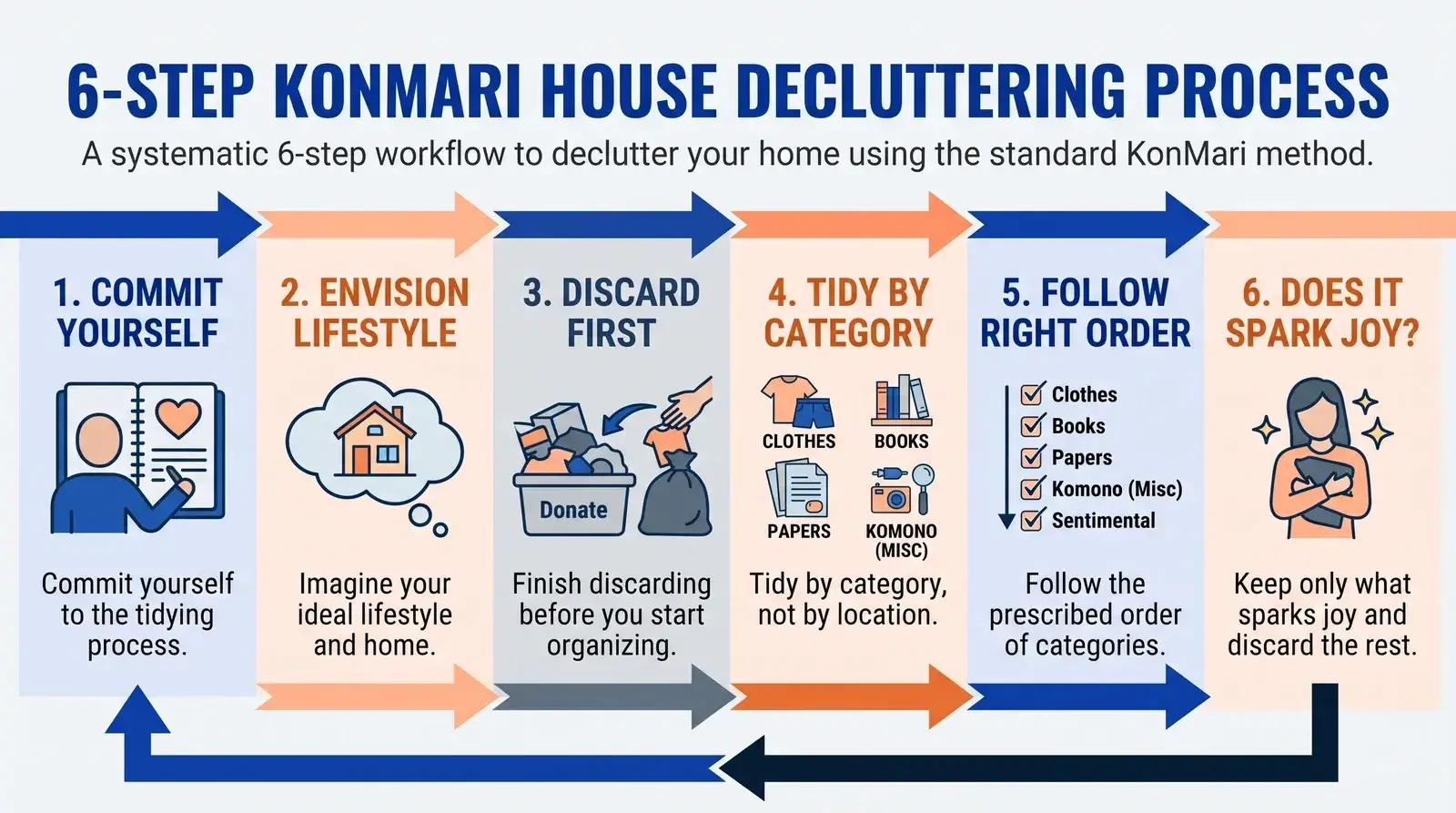
The six KonMari steps follow a deliberate psychological order. Keeping to that order, from setting your goal through gathering items by category to sorting them, stops you burning out halfway and trains you to make firm decisions about your own belongings.
Step 1: Set Your Goal and Picture Your Ideal Home
Before you touch a single item, take time to sketch out clearly the life you want to live:
- Clarify your motivation: why do you want to tidy now? Is the apartment too cramped, is the family expecting a new member, do you need a quiet place to work from home, or are you getting ready to move house?
- Describe your ideal space in detail: instead of a vague "I want a clean house", picture something specific: "I want to walk into a bedroom with a clear floor, nothing by the bed but a book and a scented candle, and the faint smell of lemongrass oil in the air."
- Build a moodboard: save images of minimalist interiors online and use them as inspiration throughout the process.
Step 2: Gather and Sort Your Belongings by Category
Marie Kondo's golden rule is to tidy by category of object, never room by room. If you do the bedroom today and the living room tomorrow, you will never see all your clothes together. The five categories must be handled in this order:
| # | Category | What to gather | Notes |
|---|---|---|---|
| 1 | Clothes | Every item of clothing from wardrobes, hangers, laundry baskets and suitcases, piled in the middle of the floor | The easiest category to decide on; seeing the real scale is a powerful jolt |
| 2 | Books | All books from shelves, the desk and the bedside table | Separate the ones you "will read" from the ones you truly love |
| 3 | Papers | Bills, insurance booklets, contracts, appliance manuals | Shred most of them; keep only what has legal value or needs action |
| 4 | Miscellany (komono) | Kitchenware, cosmetics, electronics, decorations, medicines, sports gear | Break it into small sub-groups and work through them one at a time |
| 5 | Sentimental items | Photographs and keepsakes, diaries, letters, childhood mementos | The hardest to let go of, so leave them until last |
Step 3: Decide What to Keep
Once a category is gathered in one place, work through it item by item with full attention:
- Hold each item: don't scan the pile with your eyes; pick each thing up with both hands and feel its weight and the feeling it brings.
- Ask direct questions: does this spark joy? When did I last wear this shirt? If I were shopping today, would I pay for it again?
- Sort into four baskets:
- Basket 1, keep: things you genuinely love or use for a clear purpose.
- Basket 2, donate: items still in good condition that no longer suit you.
- Basket 3, sell: items with real resale value, such as electronics or designer bags.
- Basket 4, recycle or discard: anything stained, torn or broken beyond repair.
Step 4: Organise What You Keep by Function
Only after you have removed the surplus do you start organising what remains:
- Keep like with like: every pen in one holder, every charging cable in one box, all medicines in the first-aid cabinet.
- Put daily items within reach: everyday things belong at eye or waist level so they are easy to take out and put back. Rarely used items go on high shelves.
- Don't rush to buy containers: use empty shoeboxes and clean carton lids as drawer dividers before spending money on trays.
Step 5: Fold and Store Clothes Properly
Vertical folding is the signature technique of the Marie Kondo method:
- Fold into a self-standing rectangle: a folded garment should form a flat rectangle with a level base that stands up on its own without toppling.
- File clothes like book spines: place the folds facing up and line garments along the depth of the drawer instead of stacking them. This way you see your whole wardrobe the moment you open the drawer and can pull out one shirt without disturbing the rest.
- Hang by length and colour: hang clothes rising from left to right — heavy, long, dark items on the left; light, short, pale items on the right — for a visually lighter wardrobe.
How to fold a T-shirt the vertical way:
- Lay the shirt flat on a table or bed.
- Fold both sides in towards the middle, with the sleeves folded in too.
- Fold the shirt in half lengthways.
- Fold it in three to form a rectangle that stands on its own.
- File it upright in the drawer, so you can pull it out without disturbing the others.
Step 6: Keep the Space Tidy
Tidying successfully is only the start; maintaining order is what makes a tidy home last:
- Put things back immediately: whatever you use, return it to its assigned place within 30 seconds.
- The one-in, one-out rule: every time you buy something new, choose an old item of the same kind to sell or give away.
- Review each season: every 3 to 6 months, spend a weekend morning going through your drawers and clearing out whatever has expired or stopped being useful.
3. Applying KonMari to Each Area of the Home
Every space in a home has its own mix and density of objects. Adapting Marie Kondo's principles to each area helps you get more out of the house and turn every square metre into somewhere pleasant to rest.
Tidying the Wardrobe and Accessories
The wardrobe is always the hardest battlefield, and also the most satisfying place to reorganise:
- Let go of outdated clothes: say goodbye to the outfits "saved for when I lose weight", the shirts with frayed collars and the socks worn through at the heel.
- Zone underwear and accessories: use small boxes to separate underwear, socks, belts and scarves. Roll ties and file socks upright rather than folding them inside out, which stretches the elastic.
- Separate off-season clothes: bulky wool coats and winter quilts should be cleaned and then stored in breathable fabric bags on top shelves or in covered under-bed boxes.
Organising the Living Room and Bedroom
These two spaces exist for rest and recovery, so calm and simplicity come first:
- Clear the flat surfaces: keep the coffee table, dining table and bedside table completely empty. Don't let a tabletop become a pile of junk mail, keys and half-finished glasses of water.
- Tame the electronics: bundle the cables under the TV unit into a cable sleeve, and gather the remotes for the fan, air conditioner and TV into one fixed tray.
- Keep the bed simple: keep only bedding and pillows you actually find comfortable, and resist piling on decorative cushions that take up space and gather dust. It is also worth reading where to keep old tech so retired devices don't take over the room.
Tidying the Kitchen and Household Storage
The kitchen is the heart of the home but holds the densest collection of miscellany (komono), so it needs an organised approach for hygiene:
- Clear the countertop: don't leave spice jars, cooking oil or knives scattered around the hob, where grease builds up on them. Gather seasonings into one drawer within easy reach.
- Sort the cookware: store pans and lids upright in a rack rather than stacked, so they are easy to take out and put back without clattering.
- Check expiry dates: go through the fridge and the dry store, and be ruthless with damp spice sachets, expired tins and frozen food older than six months.
Making the Most of a Small Apartment
In smaller apartments of 40 m² to 70 m², using vertical space is the key:
- Go up to the ceiling: fit built-in cupboards to ceiling height for bulky, rarely used things such as suitcases, winter heaters or spare bedding for guests.
- Choose multi-purpose furniture: beds with storage drawers, wall-mounted folding dining tables or sofas with compartments inside.
- Don't hoard cardboard boxes: strip the outer carton from anything you buy, so you avoid bringing cockroaches and insects into the home and cluttering the corners. See also the guide to making the most of a small apartment.

4. Common Mistakes When Tidying the KonMari Way
Although the KonMari method is famous, many people give up halfway because of some classic mistakes in how they approach it. Spotting these psychological traps early saves time and effort and keeps your momentum going.
Rushing to Buy Containers Before Decluttering
This is the most common beginner's mistake:
- The real problem: buying more wicker baskets, plastic boxes or shelves is really just "hiding the clutter neatly". While the surplus is still there, extra containers only make the home more crowded and cost you money.
- The right approach: only consider buying trays and boxes once decluttering is completely finished and you know exactly how much you need to store.
Trying to Tidy the Whole House in One Day
Tidying the Marie Kondo way demands intense focus to make hundreds of decisions in a row:
- Attempting it all in 24 hours overloads the brain with constant decisions (decision fatigue), which leads to frustration, an abandoned job and a house in a worse state than when you started.
- Instead, split the work into sessions by category across several weekends: clothes in the first week, books and papers in the second, miscellany in the third.
Taking the Joy Principle Too Far With Essential Paperwork
Many people misread Marie Kondo's message and throw out important documents simply because they bring no excitement:
- Birth certificates, property titles, employment contracts, diplomas, medical records and warranty cards are documents that must be stored carefully.
- The right rule for papers: gather them into a single multi-pocket folder and split them into three groups: needs action now, keep permanently and keep temporarily (utility bills for a year, for example).
Keeping Too Much Out of Regret and Nostalgia
Regret over the money you spent, or the fear that "I might need it one day", is the biggest barrier between you and a minimalist life:
- Remember that however expensive an item was, if it has sat untouched in a corner for two years its real value to your life is close to zero.
- Pass it on to someone who genuinely needs it, so it stays useful instead of gathering dust and reminding you of past waste.
If what you are letting go of is clothing, shoes, handbags or backpacks in good condition, MyStorage runs a charity donation cabinet at its self-storage facility at 375 Vo Nguyen Giap, An Khanh ward, Thu Duc City in Ho Chi Minh City. The cabinet is open 24/7, donations are collected every two weeks and passed to local charities. Toys, furniture and bulky items need to be arranged in advance; used batteries go in a separate collection cabinet, not in with the donations. You can also read the guide to donating used clothes before you drop anything off.
5. Storage Solutions When the Home Still Has No Room
Even after applying the KonMari method properly and removing the surplus, many families in small and mid-sized apartments still run out of storage because of their work or hobbies. At that point you need a clear line between everyday living space and long-term storage elsewhere.
| Keep at home (used often) | Store separately (rarely used, seasonal) |
|---|---|
| Everyday clothes for the season | Large suitcases and long-trip travel gear |
| The family's cooking equipment | Christmas trees and Tet decorations |
| Books you are reading, current work papers | Accounting records to keep for 5 to 10 years |
| Toys the children currently play with | Equipment, cameras and samples for online selling |
Sorting What Needs Long-Term Storage
To free up as much floor space as possible for living and resting, set aside the groups of things you rarely touch and store them separately:
- Seasonal items: heaters, winter quilts, artificial Christmas trees, Lunar New Year decorations, summer swimming gear.
- Luggage and travel equipment: 28-inch suitcases, camping tents, sleeping bags, skateboards and golf clubs that come out once or twice a year but occupy a whole corner.
- Records you are required to keep: invoices, tax documents and family company records that must be kept for 5 to 10 years.
- Stock and equipment for a home business: for online sellers and creators, product samples, tripods and livestream lighting turn a bedroom into an airless warehouse. See also how to manage inventory for an online business at home.
Using the Hidden Space in Your Home
Before looking at outside solutions, make sure you have used every "invisible compartment" in the house:
- Add extra shelves inside the wardrobe to use the gaps between hanging rails.
- Use plastic boxes on castors that slide under the bed, turning the space into a dust-proof store.
- Fit hooks or wire baskets on the back of bedroom and kitchen cupboard doors for light items such as hairdryers and travel irons.
When Should You Consider Self-Storage?
When the apartment has hit its physical limit and you don't want to move to a bigger, pricier place, renting self-storage is a sensible way out in these situations:
- The family is about to renovate, repaint the interior, or needs to clear a bedroom for a new baby.
- Someone travelling for long work trips wants valuables kept safely without paying rent on a whole house.
- A small business or sole trader needs secure, climate-controlled space to protect their goods.
MyStorage: Self-Storage in Ho Chi Minh City
MyStorage operates self-storage facilities in Ho Chi Minh City, offering urban families a way to extend their living space:
- Air-conditioned storage with 24/7 climate control: temperature and humidity are kept stable, protecting clothes, leather shoes, artwork, electronics and valuable books from mould in the city's hot, humid climate.
- A range of sizes: from 1 m³ units (about 8 to 10 medium cartons) up to units over 10 m³ for the contents of a whole apartment. See the mini storage sizes for details.
- Layered security: 24/7 camera surveillance, motion sensors, an alarm system, personal access codes and an individual lock on each unit. Tenants have 24/7 access; staff are on site during office hours.
- Flexible contracts: rent monthly, or take a 12-month plan and save 15%. If you would rather not move things yourself, the full-service storage option collects, transports and returns your belongings.
Not sure how much space you need? Use the AI size estimator below:
6. Reference Prices for Organising and Storage
To help you budget for reorganising your home, the table below brings together 2027 reference costs for organising supplies, decluttering services and air-conditioned self-storage at MyStorage:
| Item | Specification | Estimated cost (VND) | Payment basis |
|---|---|---|---|
| Drawer divider and fabric box set | Standard set of 6 to 12 pieces | 250,000 – 600,000 | One-off purchase |
| Home decluttering and organising service | Professional organiser | 150,000 – 300,000 / hour | By the hour or by room package |
| MyStorage self-storage 1 m³ (air-conditioned) | About 8 to 10 medium cartons | 1,136,000 – 1,256,000 / month | Flexible monthly rental |
| MyStorage self-storage 2 m³ (air-conditioned) | About 15 to 20 cartons or 2 to 3 large suitcases | 1,630,000 – 1,802,000 / month | Flexible monthly rental |
| MyStorage self-storage 3 m³ (air-conditioned) | Luggage, equipment, a mattress and boxes | 1,869,000 – 2,065,000 / month | Flexible monthly rental |
| MyStorage self-storage 5 m³ (air-conditioned) | The contents of a small bedroom plus suitcases and boxes | 2,524,000 – 2,790,000 / month | Flexible monthly rental |
| MyStorage self-storage 7 m³ (air-conditioned) | Bedroom and small living room furniture | 3,533,000 – 3,905,000 / month | Flexible monthly rental |
View prices and book now to get the offer →
7. Start Your New Life Today
Tidying with the Marie Kondo method is not simply about clearing things off the floor; it is a way of renewing your home and clearing your mind. When you have the courage to let go of what belongs to the past and keep only what brings real joy now, you create a home full of inspiration and calm to come back to.
If you have finished the KonMari steps and the apartment still has no room for keepsakes, travel luggage or business stock, MyStorage's air-conditioned, securely monitored self-storage can free up the space so you can enjoy a simpler, tidier life. See the MyStorage locations in Ho Chi Minh City to find the nearest site, or contact MyStorage for advice on the right unit.
8. Frequently Asked Questions About the Marie Kondo Method
What is the Marie Kondo (KonMari) method?
The Marie Kondo method is an approach to organising the home developed by Japanese expert Marie Kondo. It focuses on tidying by category rather than by room, and uses the feeling of joy (spark joy) as the guide for deciding what to keep and what to let go.
How many steps does the KonMari method have?
The KonMari method has six steps: set your goal and picture your ideal home; gather belongings by the 5 categories; decide item by item what to keep; organise things by function; fold and store them properly; and keep the habit of putting things back to maintain order.
What are Marie Kondo's five categories in order?
The required order is: 1. Clothes; 2. Books; 3. Papers; 4. Miscellany (komono, including kitchenware, cosmetics and electronics); 5. Sentimental items.
Where should you start tidying with the KonMari method?
Start with clothes, because it is the largest category, the easiest to sort and the easiest to make emotional decisions about, which sharpens your judgement before you reach harder categories such as miscellany or sentimental items.
Does the KonMari method require throwing out a lot?
No. The Marie Kondo method does not encourage extreme discarding; it directs you to value what you keep. What stays and what goes depends entirely on your own feelings and practical needs.
What is the advantage of folding clothes the Marie Kondo way?
Vertical folding makes clothes stand up in the drawer like book spines, so you see your whole wardrobe at a glance and can pull out one garment without disturbing anything around it.
Does the Marie Kondo method work in small apartments?
It works very well. The tighter the apartment, the more it benefits from KonMari — removing the surplus, making full use of vertical space and freeing up the floor.
How should you handle important documents while tidying?
Shred old paid bills and manuals you can find online. Keep only legal records, property titles, contracts and insurance in a single multi-pocket folder, stored somewhere dry.
Should you discard keepsakes and unwanted gifts?
If a gift brings you no joy, remember that its real purpose was to convey affection at the moment it was given. You can thank it for that and pass it on to someone who needs it or sell it, without feeling guilty.
Why does Marie Kondo advise against buying boxes before tidying?
Because buying containers too early only hides the clutter instead of solving it. Buy boxes only after decluttering, when you know exactly what size and quantity you need to store.
How do you stop the house from getting cluttered again?
The key is giving every item one fixed place and returning it there within 30 seconds of using it, combined with the rule of "one new item in, one old item out".
Can you tidy your partner's or children's belongings this way?
Marie Kondo advises never to throw out someone else's things without their agreement. Tidy your own belongings first, as an example that encourages the rest of the family to join in voluntarily.
What should you do with valuable items you no longer use?
For working second-hand electronics, handbags or expensive household goods, photograph them and list them in resale groups or on e-commerce platforms, so you recover some money and someone else gets the use of them.
Where should you keep rarely used items such as suitcases and Christmas trees?
Pack seasonal items into sealed plastic boxes, label them clearly and keep them somewhere you rarely need to reach, such as the top of a ceiling-height cupboard or under the bed — or in an external self-storage unit if the home has no space left.
How much does air-conditioned mini self-storage at MyStorage cost per month?
Air-conditioned self-storage at MyStorage costs about 1,136,000 – 1,256,000 VND a month for a 1 m³ unit (about 8 to 10 medium cartons) and about 1,630,000 – 1,802,000 VND for a 2 m³ unit (about 15 to 20 cartons or 2 to 3 large suitcases) on the flexible monthly plan, excluding VAT. The 12-month plan is 15% cheaper. You can check the exact price for your size before booking.
Related articles

Article
Warehouse Jobs in Vietnam: Roles, Requirements, Salaries and Career Paths
Look up 15 warehouse jobs in Vietnam: duties, education, certificates, years of experience, 2027 reference salaries by level and career paths from warehouse worker to storekeeper…
Read article

Article
Returned Goods Processing: Inspection, Classification and Restocking
Six-step returned goods process: RMA intake, gate receiving, quarantine, quality inspection, four grading groups and stock updates. Includes an Excel tracking template, the formulas that…
Read article

Article
Fix Excel Inventory Formula Errors and Lock Data with Data Validation
How to lock data with Data Validation to stop mistyped SKUs, read the #N/A, #VALUE!, #REF! errors and SUMIFS returning 0, protect sheets from pasted-over formulas, plus tips on barcode…
Read article
