
 Tiếng Việt
 한국어
 日本語
Article
Storage for Students: Lockers and Monthly Self-Storage Explained

On this page
MyStorage 12.12 Smart Locker Offer: 24% Off
Any size - Any duration - All locations
Locker rental from just VND 40,000/hour (≈ US$1.55). Discount applied automatically when you book at booking.mystorage.vn, no code needed · 12/11 - 13/12/26.
Storage services for students offer two flexible options: lockers for small, short-term personal luggage, and self-storage units rented by the month for bulky belongings, a move between rooms, or a long summer or Tet break. Depending on the number of cartons, the size of the suitcases and how long you need to keep them, students can pick the model that saves the most on rent while keeping personal belongings completely safe. This guide compares the two options, explains packing and sets out the prices; you can also look at the self-storage service and the storage rental options in Ho Chi Minh City.
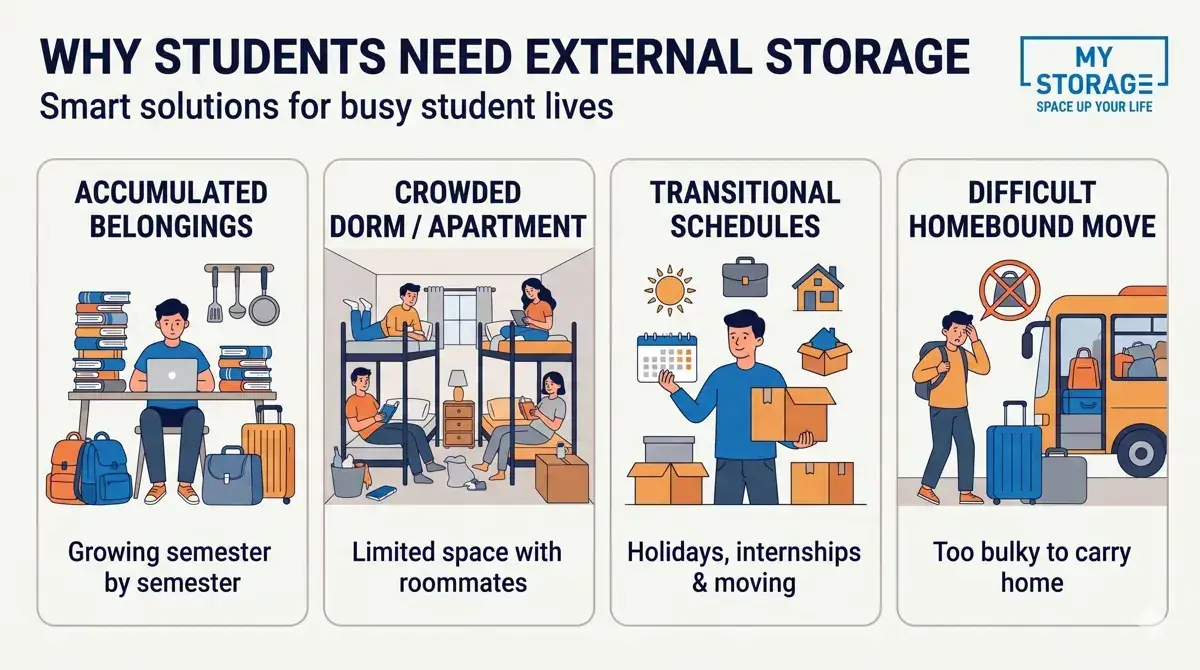
1. Why Students Need Storage
The need to store belongings and rent storage by the month comes from the way possessions pile up over the years of study, the small size of rented rooms, and a schedule that keeps changing. Rather than paying to keep a rented room through the whole break, or hauling bulky luggage back to the home province, putting things into professional storage helps students manage their budget and travel with peace of mind.
Belongings pile up over the years
The volume of a student's belongings tends to double after each academic year, quickly outgrowing the room's original capacity:
- University textbooks and coursework: Dozens of specialist books, notebooks, graduation projects and study models build up over each exam period and take over the shelves.
- Household goods and furniture: A rice cooker, induction hob, fan, kettle, folding mattress and a collapsible desk are the essentials bought gradually while living independently.
- Clothes and personal luggage: Clothes for all four seasons, thick winter coats, trainers and large suitcases for trips home take up most of the wardrobe.
- Equipment for hobbies: A guitar, home gym equipment, a mini printer and room decorations make the living space more and more cramped.
Cramped rooms and dormitories
Limited living space in major cities creates heavy storage pressure for university students:
- Sharing space with roommates: A rented room of 15 to 20 square metres often houses 2 to 4 people, which sharply reduces the personal storage area for each person.
- Strict dormitory rules: Dormitory management usually limits the number of electrical appliances and prohibits storing bulky items under beds or in shared corridors.
- The study corner gets invaded: Items with nowhere to go pile up on the desk, the floor or the top of the wardrobe, reducing concentration and creating a stifling feeling during exam season.
Schedules change quickly
The rhythm of student life and the study timetable shift every term, bringing a need for flexible living arrangements:
- Long summer and Tet breaks: Students leave the city for 1 to 3 months; continuing to pay full rent just to keep a few boxes of belongings is a considerable waste.
- Moving rooms periodically: Changing roommates, transferring university or finding a room closer to a part-time job forces students to move belongings between locations.
- Internships and exchange programmes: Internships in industrial zones on the city's edge, a military training term or an international exchange programme call for a safe way to store belongings for several months.
Taking things home is hard
Carrying all your belongings back to the home province for a short break is a real headache for students from other provinces:
- Expensive transport costs: Freight charges for heavy cartons and bulky suitcases on coaches or planes rise sharply at peak holiday times, and carriers often refuse to take them.
- Risk of damage and loss: Luggage handling in a crowded coach station easily breaks household goods, tears boxes of books or loses important tech accessories.
- Hard physical work: Students have to carry heavy packages from the room to the coach station and back, which is tiring and takes up valuable time.
2. When to Put Things in Storage
Students need storage mainly at the key transition points of the academic year: the summer break, Tet, a change of accommodation or an internship away from campus. Identifying the exact situation helps students choose the right rental term and the right way to protect their belongings, avoiding unnecessary rent.
Going home for the summer
The summer break of 2 to 3 months is when students need storage most during the academic year:
- Saving on room rent: Giving up the room before going home and putting everything into storage saves a student 4 to 10 million VND (about US$155 to US$388) in rent across the summer.
- Protecting belongings from damp in the rainy season: June to August in the southern cities is the heavy rain season; leaving things in a closed, damp room easily leads to mouldy mattresses, ruined books and rusted appliances.
- Enjoying the break with peace of mind: Belongings kept in air-conditioned storage with camera monitoring let students relax with family without worrying about security at the rented room.
For items stored through the rainy season, follow the guide to protecting stored belongings from damp and mould.
Going home for Tet
The traditional Tet break of 3 to 4 weeks carries real risks to property if belongings are left in an empty room:
- Theft in rented housing blocks: At Tet most tenants go home, leaving rows of rooms deserted and giving thieves the chance to force doors and take property.
- Widespread risk of electrical fire: Leaving a room for a long stretch without switching off the mains, or an old electrical system in the building, carries a serious fire risk.
- Storing valuable items: Gather important items such as a computer monitor, hair dryer, graphics equipment and documents into a small locked storage unit.
Moving to a new room
The gap between the day you leave the old room and the day the new one is handed over often leaves students stuck:
- Bridging the handover gap: When the old tenancy ends on the 30th but the new room is not handed over until the 5th, renting storage for a few days is the only practical answer.
- Avoiding a pile of belongings: Instead of leaving things in a friend's room and crowding them out, moving all the boxes into self-storage lets you take your time setting up the new room.
- Moving in stages: You can move things from storage to the new room in small batches by motorbike or ride-hailing, without paying for an expensive truck.
Leaving the dormitory
The end of the academic year at university dormitories always comes with a requirement to clear out all personal belongings:
- Management seals the rooms: Most dormitories do not allow students to leave personal belongings in the room over the summer, so the rooms can be disinfected and repaired.
- Moving from the dormitory to a rented room: Second and third-year students preparing to move out need somewhere to keep their belongings while they look for a suitable room.
- Separating what to take and what to store: Take only a light backpack of clothes home, and put all the boxes of books and bedding into a self-storage unit near campus.
Interning away from campus
The graduation internship at an industrial zone outside the city, or in another province, brings a need for short-term accommodation:
- No need to keep a room in the centre: Students move into company accommodation or rent a small room near the internship for 3 to 6 months.
- Storing all study materials: Specialist books, a desk and chair and larger appliances stay in storage, waiting for the return to campus for the graduation project.
- Flexible rental terms: It is easy to extend the storage contract month by month, depending on how the internship actually progresses.
Exchange programmes or study abroad
Taking part in a short scholarship or an international exchange calls for a long-term way to look after your belongings:
- Six months to a year away: Too long to keep a rented room, but too short to sell off all the household items built up over several years.
- Keeping documents and keepsakes: Personal items, research materials and souvenirs need to be kept somewhere dry and safe from pests.
- Flexible authorisation to collect: Professional storage providers let students authorise a relative or friend to collect their belongings when needed.
Trips of 6 to 24 months are covered separately in storage for students going abroad.
Waiting for a new room
A new room still being repaired, painted or fitted out means students cannot move in straight away:
- The new room is not finished: The landlord pushes back the handover date to redo the bathroom, lay tiles or add waterproofing, a few days later than first agreed.
- Protecting belongings from construction dust: Putting things into clean storage keeps bedding, clothes and electronics free of cement dust and the strong smell of paint.
- No early rent to pay: You avoid taking the room early, before it is ready, just to have somewhere to put the cartons.
Storing rarely used items
A small room needs space freed up to create an airy place to study and rest through the academic year:
- Storing out-of-season items: A winter heater, a thick quilt or cold-weather clothes used only a few weeks a year go into storage, making room in the summer wardrobe.
- Keeping large travel suitcases: Size 24 and 28 inch suitcases that take up a corner of the room go into storage, to be taken out only for a long trip.
- Grouping rarely used items: Course materials from earlier years kept for later reference are boxed up and stored neatly.
Which items to move out first is set out in 8 groups of items worth putting into storage.
3. Locker or Monthly Storage?
Choosing between a locker and a monthly self-storage unit depends directly on how much you have, how big the items are, and how long you need to store them. A locker suits a backpack or small bag for a few days, while monthly self-storage is the complete answer for cartons, large suitcases and household items during a long trip home.
Lockers for small items
A personal locker is extremely convenient for storing a small number of items that you need to reach often:
- Standard compartment sizes: Each locker is usually 35 to 45 cm wide, 45 to 50 cm deep and 40 to 90 cm high.
- Suited to personal items: It fits a laptop backpack, a travel bag, a few folders of paperwork or a small cabin suitcase of 20 inches.
- Flexible rental periods: You can rent by the day, the week or the month, collecting the locker quickly with a PIN code or a smart card.
- Limits to note: A locker cannot hold large cartons, a fan, a folding mattress or several pieces of luggage at once.
Self-storage for larger loads
Monthly self-storage is the best option when students need to clear a room completely or store things long term:
- A range of unit sizes: Units run from 1 m³ and 2 m³ up to 6 m³, holding comfortably 8 to 50 cartons along with bulky items.
- A separate storage space: Each student has an independent unit with its own lock, with full control over how things are arranged and checked.
- Controlled conditions: Professional self-storage runs air conditioning at 20°C to 25°C continuously, 24/7, which stops mould from ruining books and clothes.
- Multi-layer security: Infrared security cameras record continuously, automatic fire alarms are in place and security staff are on duty 24/7 to keep belongings safe.
The terms, paperwork and points to check are covered in personal mini storage rental; the comparison with keeping things in your room is in renting storage versus keeping things at home.
Comparing the two options
This detailed comparison helps students identify which form of storage matches their real needs:
| Criterion | Personal Locker | Monthly Self-Storage |
|---|---|---|
| Storage space | A metal compartment of fixed size | A separate unit with its own locking door |
| Volume | Under 0.3 m³ (about 30 to 80 litres) | From 1 m³ to 6 m³ (8 to 50 large cartons) |
| Suitable items | Laptop backpack, handbag, 20-inch cabin suitcase | Boxes, large suitcases, fans, folding mattresses, books |
| Best rental period | A few days to a few weeks | By the month (1 month, 3 months or a full term) |
| Storage conditions | Ordinary room temperature | Air conditioning controlling heat and humidity 24/7 |
| Access control | Electronic PIN or personal key lock | Card or code at a multi-layer security door |
| Best suited to | Students leaving a bag while out, storing a backpack | Students going home for summer or Tet, moving rooms |
How to choose
Students can follow these four simple steps to decide between a locker and a self-storage unit:
- Step 1 – Gather everything to be stored: Put all the items you plan to store in one corner of the room to see how much there really is.
- Step 2 – Measure the largest item: If you have a suitcase of 24 inches or more, a large carton or a folding mattress, you must choose self-storage, because it will not fit through a locker door.
- Step 3 – Fix the exact storage period: Under 10 days with only 1 or 2 bags, choose a locker; from 1 month for the summer break, choose monthly storage.
- Step 4 – Consider sharing a unit: If you only have 4 or 5 boxes, you can invite 1 or 2 roommates to share a 2 m³ unit and split the rent.
4. Packing and Protecting Your Things
Packing correctly is what keeps a student's belongings free of mould, scratches and losses throughout the storage period. Standard cartons, moisture absorbers and clear labels make both the move into storage and the collection afterwards quick and easy.
Sorting carefully first
Dividing belongings into separate groups before packing makes the best use of box space and makes things easier to find:
- Clothing and textiles: School clothes, warm jackets, bedding and the room's curtains.
- Books and documents: University textbooks, revision materials, notebooks and important personal papers.
- Electrical appliances: Rice cooker, desk fan, kettle, desk lamp and hair dryer.
- Miscellaneous personal items: Room decorations, clothes hangers, storage baskets and sports equipment.
Choosing boxes and padding
Good packing materials protect belongings safely through handling and long-term storage:
- Use 3 to 5 ply cartons: Prefer standard sizes of 40x30x30 cm or 50x40x40 cm; sturdy board stops boxes being crushed when stacked several high.
- Tape the base in an H shape: Run one strip of tape along the centre of the base and two more along the edges, to reinforce the bottom and stop it bursting when carried.
- Bubble wrap against impact: Wrap 2 to 3 layers of bubble wrap around fragile items such as plates, glasses, mirrors or a kettle before putting them in the box.
- Silica gel moisture absorbers: Put 2 to 3 sachets in the middle of each box of clothes and books, to stop moisture building up and causing mould.
Packing tips by type
Each kind of item needs its own packing technique to stay in good condition:
- Clothes and bedding: Wash and dry thoroughly before storing; fold flat or use vacuum bags to cut the volume by half.
- Books and textbooks: Lay books flat with the spines outward; spread them across smaller cartons (under 15 kg each) so boxes are not too heavy and do not tear at the base.
- Electronics and appliances: Clean the grease from the rice cooker and dry it; tie the cables neatly with plastic ties; remove the fan blade and store it separately so it does not break.
- Using the inside of a suitcase: Pack rolled clothes or soft items into an empty suitcase before closing it, turning the suitcase into a perfect storage container.
More ways to use an empty suitcase as a storage container are in using suitcases for home storage.
Checklist before storing
This eight-point checklist helps students check the packing thoroughly before moving items to storage:
| Check | What to Do | Acceptable Standard |
|---|---|---|
| Clean the items | Dry clean bedding, clean the rice cooker and appliances | Everything completely dry, no smell of food |
| Box standard | Pack into sturdy cartons, seal with H-shaped taping | Boxes square, not bulging or torn, strong |
| Box weight | Weigh each box of books and appliances | No box over 15 to 20 kg |
| Labelling | Stick a note with the contents and a phone number | Writing clear and easy to read when handling |
| Protecting fragile items | Wrap plates and mirrors in bubble wrap, mark as fragile | No rattling when the box is shaken gently |
| Photographing the items | Photograph everything before and after boxing | Images on file to compare the condition |
| Important documents | Keep ID card, original certificates and bank cards separate | Carried with you, not packed into stored boxes |
| Checking for prohibited items | Check that no fresh food or flammable material is included | 100% compliance with storage safety rules |
Items not allowed in storage
Follow the storage safety rules strictly, to protect your own property and the whole facility:
- No fresh food: Leftovers, fresh fruit, opened snacks or anything that spoils easily must never go into a box, because it attracts rodents and insects and creates a bad smell.
- Flammable liquids and chemicals: Petrol, medical alcohol, spray paint, mini gas canisters, lighters and strong cleaning solutions are completely prohibited, to prevent fire.
- Living things and plants: Pets and potted plants cannot go into a storage unit, because there is no light or fresh air.
- Cash and precious metals: Cash, gold, expensive jewellery and original certificates should be kept with you rather than placed in storage.
5. Student Storage Prices 2027
Storage costs for students are set flexibly by unit volume and the actual rental period, which saves a great deal compared with keeping a whole rented room. The 2027 reference prices below, together with tips on estimating volume, help you choose an option that fits a student budget.
What affects the rent
The cost of student storage is governed by these five basic factors:
- Unit volume (m³): The most important factor in the price; the larger the unit, the higher the monthly cost.
- Length of the contract: Longer terms (a full 3-month summer or a 6-month semester package) always attract a discount of 10% to 20% compared with renting month by month.
- Temperature and humidity control: A unit with air conditioning running 24/7 against mould usually costs 15% to 20% more than a naturally ventilated one, but keeps books and clothes completely safe.
- Location and support services: A facility near the centre or near major university clusters; truck support for moving student belongings and cartons supplied to your door.
Estimating the volume you need
Estimating the volume accurately lets students rent the right size of unit and avoid wasting money:
- Converting standard cartons: A medium carton (50 cm long, 40 cm wide, 40 cm high) holds about 0.08 m³. Roughly 10 to 12 such cartons equal 1 m³ of unit volume.
- Measuring bulky items: Length x width x height (in metres) gives the volume in m³ of items such as a standing fan, a large suitcase or a folding desk.
- Allowing spare space: Add 10% to 15% spare volume to leave a narrow walkway or an air gap between the boxes inside the unit.
Prices by district and unit type are kept up to date in the storage price list for Ho Chi Minh City 2027.
Self-storage price list 2027
Below are the 2027 reference prices for self-storage units and lockers in Ho Chi Minh City, aimed at student needs:
| Storage Type | Volume / Equivalent Area | Typical Student Contents | Reference Price (per month) |
|---|---|---|---|
| Personal Locker | 0.2 m³ to 0.4 m³ (single-door locker) | One large laptop backpack, one travel bag and a few folders | 180,000 VND (≈ US$6.99) to 320,000 VND (≈ US$12.43) |
| Student Mini Unit | 1 m³ to 2 m³ (about 0.5 to 0.8 m²) | 8 to 16 medium cartons, or 2 large suitcases plus a fan | 450,000 VND (≈ US$17.48) to 850,000 VND (≈ US$33.02) |
| Standard S | 3 m³ to 5 m³ (about 1.2 to 1.8 m²) | 20 to 40 cartons (everything from 2 students sharing a room) | 1,100,000 VND (≈ US$42.73) to 1,850,000 VND (≈ US$71.86) |
| Student Group M | 6 m³ to 10 m³ (about 2.2 to 3.5 m²) | 50 to 80 boxes (suits a group of 3 to 4 students clearing a room) | 2,100,000 VND (≈ US$81.57) to 3,200,000 VND (≈ US$124.30) |
| 24/7 Air-Conditioning Option | Based on the volume rented | Holds 20°C to 24°C continuously (protects books and textiles from mould) | Surcharge of 15% to 20% |
The prices above are reference prices for the Vietnamese market in 2027. Actual rent may vary with the branch location, seasonal student support programmes and the length of the contract signed.
Storage solutions from MyStorage
Storing belongings safely and sensibly is what lets students set their worries aside and enjoy a meaningful break with family.
Rather than paying millions of VND for an empty rented room through the summer, or struggling to carry bulky packages to the coach station, choosing a modern storage space in the city is the most economical and sensible decision for today's students.
The MyStorage self-storage system in Ho Chi Minh City offers professional student storage packages at very affordable cost. With mini self-storage units controlling humidity and temperature by air conditioning 24/7, continuous security camera monitoring and flexible access, MyStorage looks after every box of books, bedding and study equipment. Students can easily invite roommates to share a unit and split the cost, going home for the summer or Tet without worrying about theft or damp.
6. Frequently Asked Questions
Here are 15 short, direct answers to the questions students ask most often about storage services and monthly rental:
1. Can students rent storage by the month?
Yes. Professional self-storage providers always offer very flexible monthly packages, from 1 month and a 3-month summer to a full academic year. The steps to rent and the paperwork needed are in the complete mini storage guide for Ho Chi Minh City.
2. Where to store things over the summer?
Students should rent a monthly self-storage unit with air conditioning to keep everything from the room safe and save on rent.
3. What to store when going home for Tet?
Put valuable property and electronics into storage if the rented room is in an area with poor security or few people around during Tet.
4. Does a locker fit a suitcase?
A personal locker only fits a 20-inch cabin suitcase; for 24 or 28-inch suitcases you must rent a self-storage unit.
5. What is the difference between storage and a locker?
A locker is a small fixed compartment for personal items short term, while self-storage is a separate unit of 1 m³ or more for many boxes.
6. Should I rent storage when moving rooms?
Very much so if there are a few days between leaving the old room and taking the new one, giving you somewhere to keep things without troubling friends.
7. Can I store things for one term?
Yes. Students on an internship or exchange of 3 to 6 months can sign a full-term storage contract at a preferential rate.
8. Should I store things during an internship?
Put everything from the room into storage so you can give up the old room, saving you from paying rent in two places through the internship.
9. Should I store things when studying abroad?
Students going abroad short term should choose air-conditioned self-storage so books, keepsakes and personal items do not grow mouldy while away.
10. How should clothes be packed?
Clothes should be washed, dried thoroughly and folded into vacuum bags or cartons with moisture absorbers to prevent odours.
11. Are books safe in storage?
Very safe if you choose storage with air conditioning holding humidity under 60%, which protects textbook pages from yellowing or insect damage.
12. Can I store electronics?
You can store appliances such as a rice cooker, fan or computer monitor after wrapping them in bubble wrap and disconnecting the power.
13. Can I share a unit with friends?
Sharing works well: a 2 m³ to 3 m³ unit holds enough for 2 to 3 students, bringing the cost down to a few hundred thousand VND (about US$8 to US$12) each.
14. How much is the deposit?
Providers usually ask for a deposit of one month's rent, and this is returned in full as soon as the contract ends.
15. How do I collect my things?
Students simply show their ID card or the electronic contract, settle any remaining charges and go straight into the unit to collect their belongings.
Related articles
Article
Company Record Retention Periods: A Quick Lookup Table By Document Type 2027
Businesses in Vietnam must keep records for 5 years, 10 years, 20 years or permanently depending on the legal nature of each group of documents.
Read article
Article
Working From Home In A Small Space: How To Create A Clutter-Free Desk Corner
Working from home in a small space calls for smart planning so your desk does not turn into a dumping ground for household items.
Read article
Article
Suitcases Aren't Just For Travel: 7 Ways To Use A Suitcase For Storage
A travel suitcase can easily become a versatile storage solution at home when you have no trips planned.
Read article
