
 Tiếng Việt
 한국어
한국어 日本語
日本語Article· Updated October 15, 2026
What is 4PL in Logistics? Benefits and Operating Model
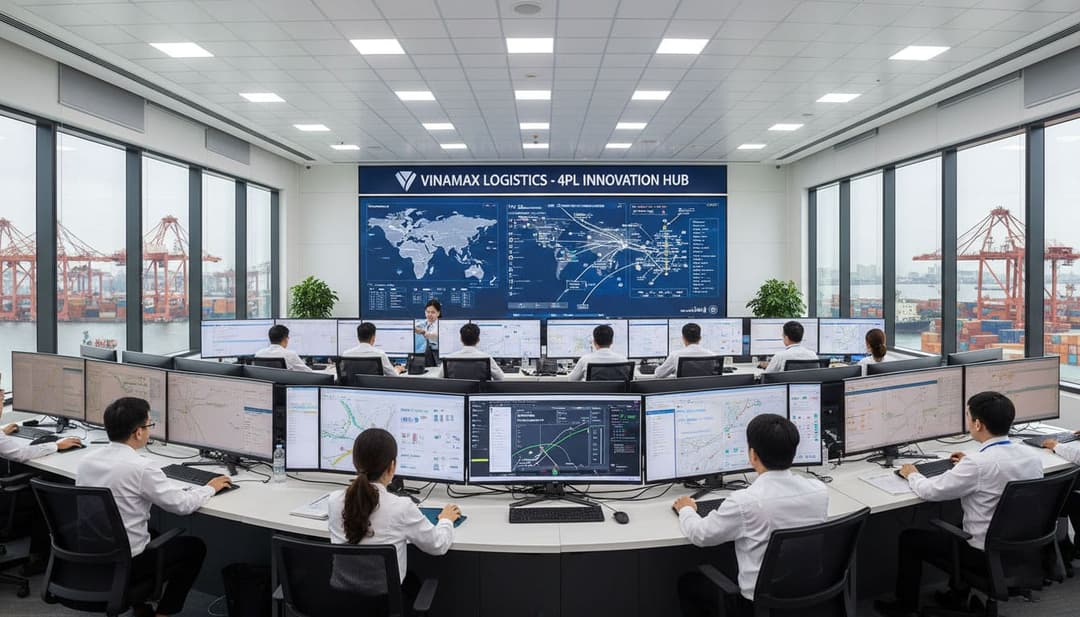
4PL (Fourth Party Logistics) is a model where a single entity manages the entire supply chain for a business, including coordinating 3PL providers, optimizing operations, and managing data. Unlike 3PL, which only provides individual services, 4PL acts as a “coordination hub,” helping businesses reduce costs, increase efficiency, and focus on core activities.
What is 4PL in Logistics?
4PL (Fourth-Party Logistics) is a logistics model where a fourth party is responsible for managing the entire supply chain on behalf of a business, from planning and coordinating transportation and warehousing providers (3PLs) to optimizing processes and analyzing data. Unlike 3PLs that directly execute logistics services, 4PLs act as an orchestrator, not owning trucks or warehouses, but controlling and optimizing the business’s entire logistics ecosystem.
The term 4PL was first trademarked by Accenture in 1996, defined as “a supply chain integrator that assembles and manages the resources, capabilities, and technology of its own organization with those of complementary service providers to design, build, and run comprehensive supply chain solutions.” Today, 4PL has become a popular model for multinational corporations with complex supply chains spanning multiple countries.
How Does 4PL Differ from 3PL? — Understanding Correctly to Avoid Confusion
Confusion between 3PL and 4PL is common, partly because many 3PL companies refer to themselves as “4PLs” when they offer additional management services. The real distinction lies in asset ownership and scope of responsibility.
| Criteria | 1PL | 2PL | 3PL | 4PL |
|---|---|---|---|---|
| Definition | Business self-transporting | Pure transport/warehouse provider | Integrated logistics service provider | Comprehensive supply chain integrator |
| Asset Ownership | Yes (own vehicles, warehouses) | Yes (trucks, warehouses) | Often yes | No — purely management |
| Service Scope | Self-transportation | Transport/storage | Transport + warehouse + distribution | Entire supply chain |
| Role | Executor | Executor | Integrated executor | Designer & orchestrator |
| Technology | None | Low | Medium (TMS, WMS) | High (AI, big data, control tower) |
| Suitable for | Small businesses, simple goods | Basic goods | Medium-large businesses | Multinational corporations, complex supply chains |
Key takeaway: 3PL executes – 4PL strategizes and orchestrates. A 4PL typically manages multiple 3PL providers simultaneously, selecting and allocating work to each entity based on capabilities, costs, and actual performance, similar to how a general contractor manages specialized subcontractors.
The “Orchestrator” Role — What Does 4PL Actually Do?
The most intuitive image to understand 4PL: think of air traffic control, which doesn’t fly any planes but coordinates the entire air traffic flow to ensure safety, efficiency, and no conflicts. 4PL does exactly that for a business’s supply chain.
5 core functions of 4PL:
- Supply chain design: Analyzing the entire current logistics network, identifying bottlenecks, redundancies, and optimization opportunities. Proposing an optimal distribution network structure (number of warehouses, locations, goods flow) based on real data simulations.
- Supplier selection and management: Evaluating, selecting, and contracting with the most suitable 3PL providers, carriers, and warehousing companies for each product segment and market. Monitoring KPI performance in real-time and continuously adjusting work allocation.
- Operations: A data center monitors the entire flow of goods from the factory to the end recipient, detecting disruptions early (port congestion, customs delays, vehicle shortages) and activating contingency plans before issues affect customers.
- Continuous optimization: Analyzing historical and forecast data to optimize inventory, transportation routes, and costs. Applying AI and machine learning to predict demand and adjust logistics plans before actual demand changes.
- Reporting and transparency: Providing comprehensive dashboards on supply chain performance for business leadership, from logistics costs per SKU to delivery times per market, with enough data for strategic decision-making rather than just operational management.
Businesses adopting the 4PL model report an average reduction of 15–25% in overall logistics costs and an improvement in on-time delivery rates by 10–20% in the first year of implementation (Gartner Supply Chain Report, 2023). However, actual benefits depend heavily on the initial complexity of the supply chain; the more suppliers and markets a business has, the higher the value of 4PL.
Where Does 4PL Stand in the Vietnamese Logistics Market?
The 4PL model in Vietnam is in its nascent stage, more prevalent among large FDI enterprises, while most Vietnamese businesses are still at the 3PL or even 2PL stage.
Some international logistics corporations providing 4PL services in Vietnam include DHL Supply Chain, Kuehne+Nagel, DB Schenker, and Geodis, often serving multinational manufacturing clients in the electronics, automotive, and fast-moving consumer goods (FMCG) sectors.
The Vietnamese logistics market reached an estimated size of 40–42 billion USD in 2023, with an average growth of 14–16% per year (VLA, 2024), but logistics costs still account for 16–17% of GDP, significantly higher than the 8–10% in developed economies. This is precisely the gap that the 4PL model can fill as the market matures.
Forecast: By 2030, demand for 4PL services in Vietnam is projected to grow by 20–25% CAGR due to the shift of global supply chains into the region (Frost & Sullivan, 2024); the market is at the beginning of a steep growth curve.
4PL Operating Model
4PL operates by standing between the business and logistics service providers (3PLs, carriers, warehousing companies), integrating all data, coordinating all activities, and continuously optimizing through a single point of contact. Businesses do not need to manage each supplier individually; 4PL does that, reporting back with a single set of aggregated KPIs.
The core difference of the 4PL operating model compared to all previous logistics levels: 4PL does not own any physical assets—no trucks, no warehouses, no airplanes. All the value 4PL creates comes from its ability to design systems, manage relationships, and process data, which is why 4PL is considered the logistics model of the digital age.
Where Does 4PL Stand in the Logistics Ecosystem?
To understand the 4PL operating model, it’s essential to clearly visualize its position within the entire ecosystem:
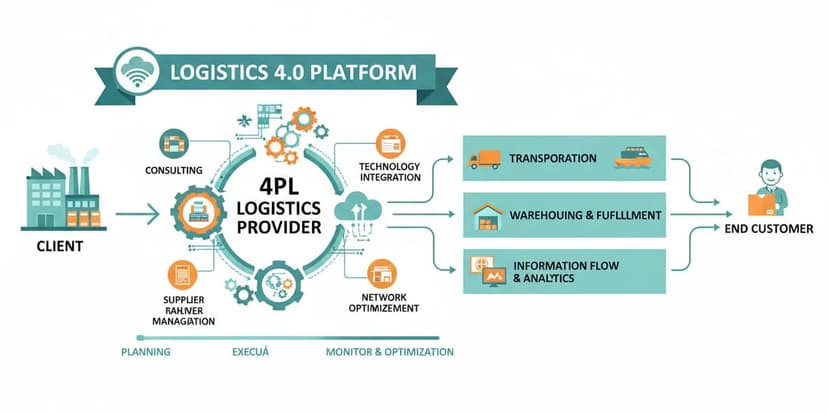
A business works with a single 4PL point of contact. The 4PL, in turn, manages the entire network of underlying suppliers, allocates work based on real-time performance data, and is fully responsible for all output results to the business.
This model solves a common problem for large enterprises: managing 5–15 different logistics providers simultaneously, each with its own reporting system, SLA, and problem-solving approach, creating a chaotic mess of information where no one has a complete overview.
Transportation Management — Network-Wide Optimization, Not Per Trip
Transportation management is one of the three operational pillars of 4PL, but the 4PL’s approach is entirely different from that of a typical business or 3PL.
4PL doesn’t book vehicles per trip — 4PL optimizes the entire transportation network:
- Network Design: Analyzes the entire flow of goods from factory to transit warehouse, from warehouse to distribution point, and from distribution point to end customer, then proposes an optimal structure. A decision like “adding a cross-docking warehouse in Da Nang” can reduce total transportation costs by 20% for the entire Central region.
- Carrier Management: Maintains a list of transportation providers continuously evaluated and ranked by KPIs such as on-time rate, damage rate, and scalability during peak seasons. Orders are automatically allocated to the most suitable carrier for each type of goods, route, and time requirement based on algorithms, not manual decisions.
- Freight Consolidation: Combines multiple small shipments from the same business (or different businesses in a shared 4PL model) into a larger load to leverage bulk rates and reduce the number of trips. An FMCG business with 50 delivery points in Ho Chi Minh City can reduce from 50 individual deliveries to 8–10 optimized route trips.
- Statistics: Freight consolidation and route optimization by 4PL help businesses reduce transportation costs by an average of 12–18% in the first year of implementation, potentially saving billions of VND annually for businesses with large shipping volumes (McKinsey Operations, 2023).
Warehouse Management — No Owned Warehouses, But Every Warehouse Optimized
4PL does not directly operate warehouses but is responsible for the performance of the entire warehousing system within a business’s supply chain.
How 4PL manages warehousing:
- Warehouse Provider Selection and Evaluation: 4PL establishes warehouse evaluation criteria (location, area, warehouse class, ISO/LEED certification, WMS system) and selects the most suitable 3PL provider for each region and type of goods. For an FMCG business requiring 8 distribution warehouses nationwide, 4PL evaluates and manages all 8 units according to the same set of standards.
- Standardizing Warehouse Processes: Establishes unified SOPs (Standard Operating Procedures) for all warehouses in the network inbound, counting, storage, outbound, and defective goods handling processes ensuring customers receive a consistent experience regardless of which warehouse the goods originate from.
- Optimizing Inventory Allocation: Analyzes sales data and demand forecasts to determine how much inventory should be held at each warehouse. Goal: minimize overall inventory (freeing up working capital) while maintaining the committed order fill rate. Inventory Management — From “Just in Case” to “Just in Time, Just in Place”
Inventory management is the area where 4PL creates the greatest and most measurable financial value.
Most businesses manage inventory based on experience, holding a lot of stock “just in case” to avoid stockouts. The result is working capital tied up in unnecessary inventory, while some SKUs still run out due to inaccurate forecasting.
4PL replaces experience with data and algorithms:
- Demand Forecasting: Analyzes historical sales data, market trends, seasonality, and external factors (promotions, events, weather) to forecast demand for each SKU in each region. Forecasting accuracy increases from 60–70% (manual) to 85–92% (machine learning) under stable market conditions.
- Optimizing Safety Stock: Calculates optimal safety stock levels for each SKU based on actual demand variability and replenishment lead time, rather than applying a fixed number for all.
- Real-time Inventory Visibility: Connects data from all warehouses in the network to a single dashboard, providing precise information on how much stock is in which warehouse, its status, and enabling inter-warehouse coordination when one area is short while another has surplus.
- Financial Impact: Inventory optimization by 4PL typically reduces total inventory value by 20–35% while maintaining or improving fill rates. For a business with 100 billion VND in inventory, this frees up 20–35 billion VND in working capital for reinvestment into the business (Gartner, 2023).
Technology & Data — The Indispensable Foundation of 4PL
4PL cannot operate without technology — this is what distinguishes 4PL from all previous logistics models. If 3PLs need trucks and warehouses to operate, 4PLs need data and a technology platform as core assets.
Typical technology stack of a 4PL:
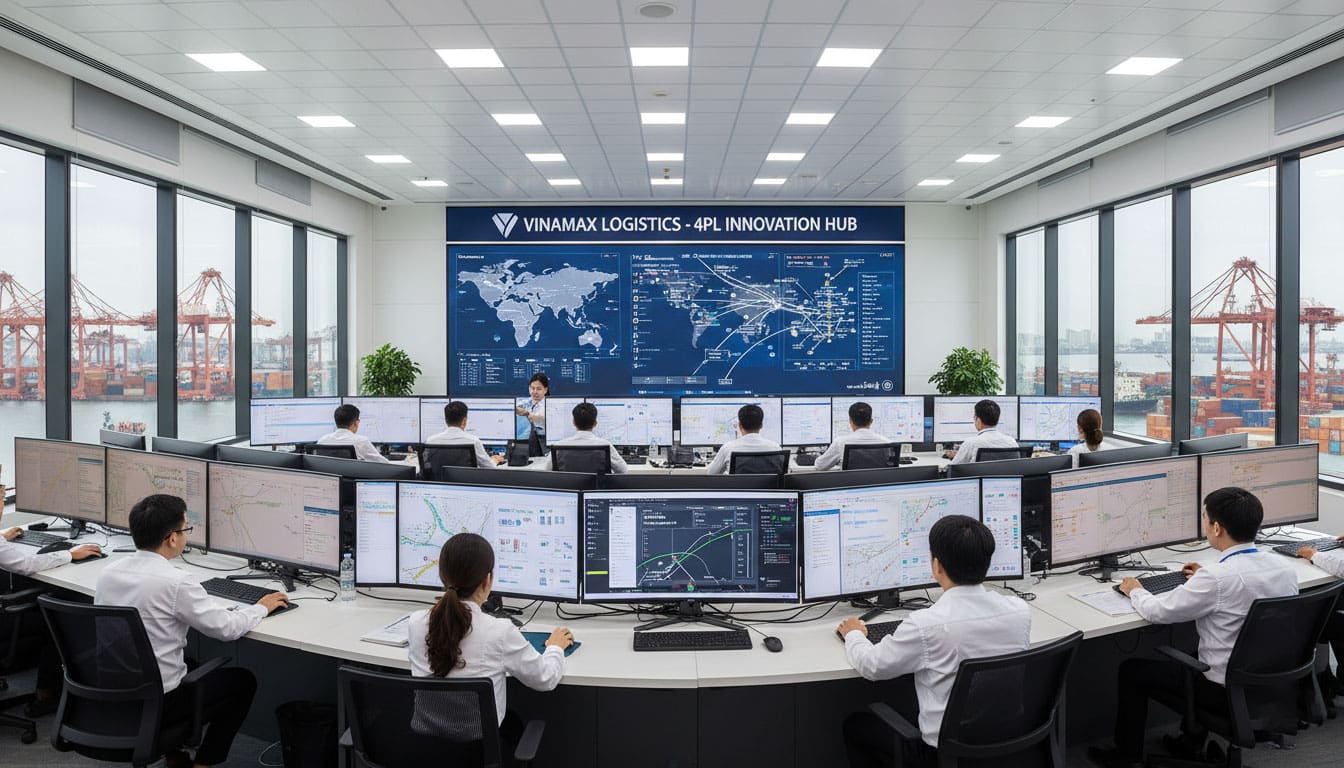
Control Tower Platform: A central system that aggregates real-time data from all suppliers (vehicle location, warehouse status, order status) displayed on a single dashboard. When disruptions occur (delayed ship, broken-down truck, flooded warehouse), the control tower immediately alerts and suggests alternative solutions.
- Multi-carrier Integrated TMS: A transportation management system connected to all carriers in the network, allowing scheduling, tracking, delivery confirmation, and payment processing on a single platform.
- Multi-site Integrated WMS: Manages inventory and warehouse processes across the entire network of warehouses, not just individual sites, enabling intelligent goods coordination between warehouses.
- Analytics & AI Engine: Processes historical and real-time data to forecast demand, optimize routes, detect anomalies, and propose continuous improvements. An advanced 4PL can predict supply chain disruptions 3–7 days in advance based on weather, port, and macroeconomic data.
- API Integration Layer: Connects with the business’s ERP system (SAP, Oracle) and all supplier systems, ensuring data flows automatically without manual entry, eliminating human errors, and accelerating response to changes.
| Technology | Role in 4PL | Replaces What |
|---|---|---|
| Control Tower | Real-time end-to-end visibility | Manual email/phone reports |
| Multi-carrier TMS | Automated transport booking & optimization | Excel tracking, calling carriers |
| Multi-site WMS | Unified multi-warehouse inventory management | Disconnected individual warehouse systems |
| AI Forecasting | High-accuracy demand forecasting | Experience + spreadsheets |
| API Integration | Automated data synchronization | Manual entry, periodic reports |
Benefits of Using 4PL
4PL helps businesses optimize logistics costs, increase operational efficiency, provide full transparency of supply chain data, and free up resources to focus on core business activities. These are not four independent benefits; they amplify each other: greater data transparency leads to better decisions, better decisions reduce costs, and reduced costs free up budget for investment in business growth.
It’s important to emphasize: the benefits of 4PL are directly proportional to the complexity of the supply chain. A business operating 3 warehouses and 2 transport providers will benefit less than a business managing 15 warehouses and 10 logistics providers across 5 markets. This is why 4PL is most common in multinational corporations and is spreading to fast-growing medium-sized enterprises.
Benefit 1 — Optimized Logistics Costs
Logistics costs in Vietnam account for 16–17% of GDP, nearly double the 8–10% seen in developed economies (VLA, 2024). A significant portion of this difference stems from inefficient operations: sub-optimal goods movement, empty return trips, excess inventory, and unforeseen incident handling costs.
4PL tackles logistics costs on three simultaneous levels:
- Transaction Level — reducing per-shipment costs: By managing the aggregated shipping volume of multiple clients (or the entire network of a large enterprise), a 4PL possesses greater bargaining power with carriers than any single business. Shipping costs can decrease by 8–15% simply by consolidating volume and negotiating long-term contracts with preferred carriers.
- Network Level — optimizing distribution structure: Analyzing and redesigning warehouse networks and goods flow—deciding where to place warehouses, how many to have, and which goods to store where—can reduce overall transportation costs by 12–20% by shortening distances and minimizing transshipments.
- Inventory Level — freeing up working capital: Optimizing inventory through more accurate demand forecasting helps reduce inventory value by 20–35%—not by accepting stockouts, but by placing the right amount of goods in the right place at the right time.
Businesses adopting 4PL typically report a 15–25% reduction in total logistics costs within the first year of implementation (McKinsey Operations, 2023). For a business with 1,000 billion VND in revenue and logistics costs accounting for 15% of revenue (150 billion VND), a 20% saving equals 30 billion VND annually—a substantial sum for reinvesting in business growth.
Benefit 2 — Increased Operational Efficiency
Operational efficiency in logistics isn’t just about “on-time delivery”; it’s about the ability to handle larger volumes with the same resources, recover quickly from disruptions, and continuously improve based on real-time data.
- Significantly increased on-time delivery rate: With a fragmented management model (businesses handling each supplier individually), on-time delivery rates often hover around 75–85% due to a lack of overall visibility and slow response to issues. A 4PL, with its real-time control tower and standardized exception management processes, pushes this figure to 90–97%—the level required by retailers and international partners.
- Faster exception handling: Every supply chain encounters issues like delayed vessels, customs holds, vehicle breakdowns, or full warehouses. The difference lies in the speed of detection and resolution. A 4PL detects issues before they impact customers, thanks to real-time data, and activates pre-prepared contingency plans instead of managing crises after delays have occurred.
- Standardized processes across the entire network: When a business manages multiple suppliers independently, each supplier may have its own way of working—packaging, labeling, incident reporting, handling faulty goods. A 4PL imposes a unified set of SOPs (Standard Operating Procedures) across the entire network, minimizing errors due to inconsistent communication and ensuring a consistent experience for the end customer.
- Flexible scalability: Businesses managing their own logistics face significant challenges when expanding—hiring more staff, negotiating additional contracts, integrating more systems. A 4PL already has the supplier infrastructure and technology in place, making expansion into new markets or doubling volume during peak seasons a matter of adjusting within an existing system, not building from scratch.
Benefit 3 — Data Transparency Across the Supply Chain
This is a benefit many businesses underestimate when evaluating 4PL, but in reality, it has the most significant strategic impact in the long term.
- The problem for businesses without 4PL: Logistics data is scattered across multiple systems: WMS from warehouse A, TMS from carrier B, Excel tracking from the internal logistics team, emails from supplier C. No one has a complete picture; management has to wait for weekly consolidated reports to understand what truly happened that week.
- 4PL creates a single source of truth: A single dashboard displays everything: number of orders in transit, number of packages at each warehouse, on-time rate by supplier, logistics costs by SKU, inventory by region, and real-time incident alerts. This data updates continuously, not just at the end of the week.
- Sufficient data for strategic decision-making: By knowing the exact logistics costs for each SKU in each region, businesses can make more precise pricing and distribution decisions. By knowing which supplier has the lowest on-time rate seasonally, businesses can proactively adjust contract allocations. This is a shift from reactive logistics management (solving problems after they occur) to predictive logistics management (preventing problems before they occur).
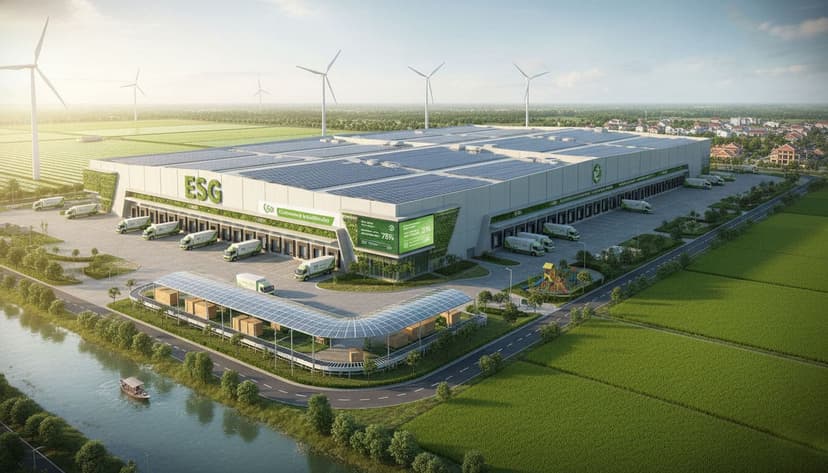
- ESG reporting — a rapidly growing benefit: With the wave of Scope 3 emissions reporting requirements from parent companies and EU/US partners, transparent logistics data from a 4PL becomes direct input for ESG reports, eliminating the need for manual estimation or requesting data from individual suppliers.
73% of supply chain leaders state that a lack of real-time data visibility is the biggest challenge in logistics management (Gartner Supply Chain Survey, 2023)—this is precisely the problem 4PL thoroughly addresses.
Benefit 4 — Focus on Core Business
This benefit is often mentioned last, but in reality, it’s the most strategic reason why large corporations choose 4PL.
- The true cost of self-managing logistics: Businesses that manage their own logistics don’t just pay direct operational costs; they also pay the opportunity cost of all personnel, leadership time, and technological resources focused on logistics instead of on products, customers, and markets. A talented Supply Chain Director spending 60% of their time handling daily operational issues represents wasted resources for both the individual and the company.
- 4PL transforms logistics from a burden into an advantage: When a 4PL takes on all operational complexities, the internal team shifts to a strategic role: setting service standards, evaluating 4PL performance, analyzing insights from data, and planning distribution network development. They move from executors to decision-makers.
- Faster market response speed: Launching new products in new markets is no longer hindered by the question of “how to build logistics infrastructure there?” A 4PL already has an existing network and supplier relationships. Go-to-market time is shortened from 6–12 months (building logistics from scratch) to 4–8 weeks (activating the 4PL’s existing network).
| Before 4PL | After 4PL |
|---|---|
| Logistics team handles 20–30 individual suppliers | Logistics team manages 1 4PL partner |
| Consolidated performance reports take 3–5 days | Real-time dashboard updates continuously |
| New market expansion: 6–12 months preparation | New market expansion: 4–8 weeks activation |
| Logistics incidents: detected after 12–24 hours | Logistics incidents: detected and handled within 1–4 hours |
| Logistics costs: 15–20% of revenue | Logistics costs: 10–14% of revenue (after optimization) |
| Leadership spends 40–60% of time on operations | Leadership focuses 80%+ on strategy |
Disadvantages and Challenges of 4PL
4PL can make businesses dependent on external partners, require significant switching costs, and demand a level of data and governance maturity that many Vietnamese businesses are not yet ready for. No model is perfect, and understanding the downsides of 4PL is a prerequisite for deciding whether to adopt it, and if so, how to implement it to mitigate risks.
Most failures in 4PL adoption do not stem from the model itself but from unrealistic expectations and inadequate preparation—businesses expect 4PL to solve all problems immediately, whereas in reality, it is a long-term transformation process requiring serious investment from both sides.
Challenge 1 — Partner Dependence: A Risk Not to Be Overlooked
When entrusting the entire supply chain management to a 4PL, businesses are placing a significant portion of their operational capacity into the hands of an external partner. This is a calculated trade-off, but a real one, not a pure benefit.
The risk of dependence manifests in three dimensions:
- Operational Dependence: As internal logistics teams are downsized or restructured after 4PL adoption, businesses gradually lose their self-operating capability. If the 4PL partner faces bankruptcy, serious technical issues, or contractual disputes, the business may lack sufficient personnel and processes to manage operations independently in the short term. The transition period to a new 4PL partner or re-establishing self-operation often takes 6–12 months—a timeframe long enough to cause severe disruption.
- Data Dependence: All historical operational data—transportation routes, supplier performance, inventory models—resides within the 4PL’s system. When a contract ends or is terminated, businesses must negotiate to retrieve their own data, which isn’t always smooth if contract terms aren’t clearly defined from the outset.
- Pricing Dependence: After 2–3 years of partnership, once a business is deeply integrated with the 4PL system, its bargaining power in contract renewal negotiations significantly weakens. This is the “switching cost lock-in” phenomenon, where the cost of switching to a new partner is too high, forcing businesses to accept less favorable terms.
How to mitigate risks: Clearly negotiate terms for data portability (ownership and export rights at any time), an exit plan (an orderly transition process upon contract termination), and KPI penalties (penalties for not meeting service standards) right from the initial contract negotiation phase—not after dependence has been established.
Market Reality: 42% of businesses adopting a comprehensive logistics outsourcing model report concerns about partner dependence as their biggest challenge (Deloitte Global Outsourcing Survey, 2023), ranking above both costs and technology issues.
Challenge 2 — Initial Costs and Payback Period
4PL isn’t cheap, especially during the initial setup phase. Businesses need to understand the cost structure clearly to avoid surprises and to realistically assess whether the ROI will meet expectations.
Three layers of costs are often underestimated:
- System Implementation Cost: Integrating a business’s ERP system with the 4PL’s technology platform—API connections, historical data synchronization, dashboard configuration—typically takes 3–6 months and incurs consulting/technical costs ranging from 50,000–300,000 USD, depending on scale and complexity. Many businesses overlook this expense in their initial ROI calculations.
- Internal Change Management Cost: Restructuring the internal logistics team, training personnel to work with the new model, and building capabilities to oversee the partner—these costs are difficult to quantify but are genuinely expensive in terms of time and leadership resources. Businesses often take 12–18 months to get a 4PL model running truly smoothly.
- 4PL Service Operating Cost: 4PL management fees are usually structured as a management fee + gainsharing (a fixed monthly fee plus a percentage of achieved cost savings). For a medium-sized supply chain in Vietnam, the management fee can range from 15,000–80,000 USD/month, depending on the scope of services. For small businesses, this figure might exceed the optimal value delivered.
Actual Payback Period: Businesses with sufficiently complex supply chains typically reach their break-even point after 12–24 months and achieve clear positive ROI after the 2nd–3rd year. For businesses with simpler supply chains, the payback period extends, and the benefits may not sufficiently offset the transition costs.
Practical Scale Threshold: 4PL typically generates positive ROI only for businesses with logistics costs exceeding 5 million USD/year or managing 5+ logistics providers across 3+ markets. Below this threshold, 3PL or a hybrid model is often more cost-effective.
Challenge 3 — Serious Digital Transformation Requirements
4PL operates on data, and good data only comes from properly implemented information systems. This is the biggest practical barrier for most Vietnamese businesses considering 4PL.
- The “Garbage In, Garbage Out” Issue: 4PL uses AI and machine learning to forecast demand, optimize routes, and detect issues. But if input data—inventory, orders, transportation costs—is inaccurate, incomplete, or inconsistent across systems, algorithms will make incorrect decisions. Many businesses discover they need to invest seriously in data cleansing and data governance before 4PL can operate effectively.
- Minimum Technical Infrastructure Requirements: To integrate with a 4PL platform, businesses minimally need: a modern ERP with APIs (SAP, Oracle, or equivalent); a WMS system at operating warehouses; and digitized and consistently stored order and shipping data for at least 2–3 years of history. Businesses still using Excel and email as primary logistics management tools are not ready for 4PL—and if they force implementation, the result will be high costs with no benefits.
- Internal Capability to Oversee 4PL: The paradox of 4PL: even with full operational outsourcing, businesses still need an internal team capable of evaluating, monitoring, and challenging the 4PL partner. Without someone internally who deeply understands logistics, the business cannot know if the 4PL is performing well or merely reporting favorable numbers. This is a capability that requires investment to build, not something that can be entirely outsourced.
- Data Security Risks: Sharing sensitive business data—cost of goods, customer lists, distribution strategies—with a 4PL partner creates security risks that must be managed through strict contractual clauses (NDA, data security SLA) and regular audits.
Summary: Is 4PL Right for You?
| Signs You Should Consider 4PL | Signs You’re Not Yet Ready for 4PL |
|---|---|
| Logistics costs >5 million USD/year | Logistics costs <2 million USD/year |
| Managing 5+ logistics providers | Using 1–2 stable logistics providers |
| Operating in 3+ markets/countries | Operating domestically, simple supply chain |
| Have ERP and sufficiently standardized historical data | Still managing with Excel and email |
| Internal logistics team is overwhelmed | Internal logistics team is operating stably |
| Ready to invest 12–24 months for transformation | Need a quick solution within 1–3 months |
A Balanced Perspective: 4PL is a powerful tool but not for everyone. Fast-growing businesses with increasingly complex supply chains will benefit greatly—but they need thorough preparation regarding data, contracts, and internal oversight capabilities. Smaller businesses with simple supply chains should first consider high-quality 3PLs, then advance to 4PL when their scale and complexity are sufficient to generate real ROI.
Real-World Examples of 4PL Models
Many large corporations worldwide have adopted 4PL to manage complex supply chains spanning multiple countries — and measurable results show that this model creates real value when implemented in the right context. In Vietnam, 4PL is in its formative stages but has shown clear signs of application, especially within the FDI manufacturing sector and e-commerce.
The case studies below are selected to illustrate four different application contexts — from manufacturing to retail, from developed to emerging markets — helping businesses identify which context is closest to their own situation.
Case 1 — Unilever: 4PL Reimagines the Entire Global Supply Chain
Context: Unilever operates over 400 factories in 190 countries, with thousands of SKUs moving through one of the world’s most complex distribution networks. Before adopting 4PL, Unilever managed hundreds of individual logistics providers in each market — leading to high costs, inconsistency, and a lack of end-to-end visibility.
4PL Solution: Unilever partnered with a global 4PL provider to redesign its entire distribution network, standardizing logistics providers by geographical region, implementing a control tower to monitor all goods flow in real-time, and integrating sales data into a centralized inventory forecasting system.
Measured Results: A 15% reduction in overall logistics costs within the first two years of implementation. The On-Time In-Full (OTIF) order completion rate increased from 78% to 91%. The number of logistics providers was consolidated and standardized, significantly reducing management complexity. Unilever also extracted Scope 3 emissions data from logistics operations for global ESG reporting — something impossible with the previous fragmented model.
Application Lessons: 4PL is most effective when implemented at the network design level — not patched onto an existing system. Unilever took nearly 3 years for a complete transformation and only saw clear ROI from the second year.
Case 2 — Nike: 4PL for High-Speed Fashion Supply Chains
Context: Nike manufactures in over 40 countries (with Vietnam being one of its largest production bases, accounting for about 50% of Nike’s total global footwear production as of 2023) and distributes to over 190 countries. Sportswear is characterized by short product lifecycles and highly volatile demand influenced by seasons and sporting events — placing extremely high demands on supply chain speed and accuracy.
4PL Solution: Nike implemented an integrated 4PL model with its D2C (Direct-to-Consumer) system — connecting real-time sales data from all channels (Nike.com, app, stores) with inventory planning and production scheduling systems in Vietnam and Indonesia. The 4PL coordinates goods flow from factories in Ho Chi Minh City and Hai Phong through regional distribution hubs to the end consumer.
Measured Results: Reduced factory-to-shelf time to 60 days compared to 90–120 days previously. Demand forecasting accuracy increased to 88%, significantly reducing stockouts or overstocking in key markets. Nike also reduced inventory by 30% in regional distribution centers by optimizing goods flow based on real-time data.
Application Lessons: 4PL is particularly suitable for industries with short product lifecycles and rapidly changing demand, where accurate forecasting and quick response are direct competitive advantages, not just a cost optimization problem.
Case 3 — General Motors: 4PL in Complex Automotive Supply Chains
Context: Automotive manufacturing has one of the world’s most complex supply chains — a single car has over 30,000 components from thousands of suppliers. General Motors faced the challenge of ensuring Just-in-Time delivery: components arriving at the assembly line at the exact right moment, neither too early (incurring storage costs) nor too late (stopping the line).
4PL Solution: GM was one of the first corporations to adopt a large-scale 4PL model — partnering with a 4PL provider to manage all inbound logistics (components from suppliers to factories) in North America. The 4PL was responsible for coordinating over 12,000 component suppliers, scheduling shipments for each assembly shift, and managing buffer inventory at transit hubs near factories.
Measured Results: A 26% reduction in inbound logistics costs within the first 3 years of implementation. Line stoppages due to component shortages decreased by 40%. GM freed up its internal team, previously responsible for supplier coordination, to focus on product design and manufacturing process improvements.
Application Lessons: For supply chains with thousands of suppliers, 4PL is not an optimal choice — it’s a prerequisite for efficient operation. No internal team can manage 12,000 suppliers with Just-in-Time precision without the technology systems and standardized processes of a 4PL.
Case 4 — Vietnam Market: How is 4PL Taking Shape?
Market Context: Vietnam does not yet have many detailed publicly disclosed 4PL case studies, partly because the model is still new, and partly due to sensitive commercial information. However, clear trends in 4PL adoption can be identified through the activities of international logistics corporations in this market.
4PL Application in FDI Manufacturing: Electronics giants like Samsung (Bac Ninh, Thai Nguyen) and LG (Hai Phong) operate integrated supply chains in Vietnam with a model close to 4PL: a global logistics partner (often DHL Supply Chain or Kuehne+Nagel) is responsible for all inbound and outbound logistics, coordinating dozens of local transport and warehousing providers, and integrating with the parent company’s production planning system in Korea. This is a 4PL model in practice, even if not always explicitly named as such.
4PL Application in E-commerce: Lazada and Shopee, Vietnam’s two largest e-commerce platforms, operate a model similar to 4PL for their logistics ecosystems: they don’t own all delivery fleets or warehouses, but coordinate a network of hundreds of delivery partners, third-party fulfillment centers, and last-mile delivery services through a technology platform and centralized control tower. Same-day delivery rates in Ho Chi Minh City and Hanoi reach 85–90% thanks to this coordination model.
Growth Signals: DHL Supply Chain, Kuehne+Nagel, and DB Schenker are all expanding their 4PL services in Vietnam, focusing on the electronics, automotive, and FMCG sectors. According to VLA (2024), demand for integrated logistics services (including 4PL) in Vietnam is projected to grow at a 20–25% CAGR from 2024–2030, significantly faster than the overall logistics industry growth rate (14–16%).
Key Takeaway for Vietnamese Businesses: You don’t need to be Samsung or Unilever to benefit from a 4PL mindset. Fast-growing SMEs managing 5 or more logistics providers and starting to export to multiple markets can begin building 4PL capabilities even without hiring an official 4PL partner. The most practical first step: implement a TMS (Transportation Management System) and integrate data from suppliers into a single dashboard, which is the technological foundation upon which every 4PL model is built.
Summary: Common Lessons from Case Studies
| Case | Industry | Core Challenge | Notable Results |
|---|---|---|---|
| Unilever | Global FMCG | Too many suppliers, inconsistency | 15% cost reduction, OTIF increased from 78% to 91% |
| Nike | Fashion/Sportswear | Short product cycles, volatile demand | Factory-to-shelf reduced by 30 days, inventory reduced by 30% |
| General Motors | Automotive | Just-in-Time with 12,000 suppliers | Costs reduced by 26%, line stoppages reduced by 40% |
| Samsung/LG VN | FDI Electronics | High-speed cross-border supply chain | Stable operations, integrated with parent company |
| Lazada/Shopee VN | E-commerce | Coordinating hundreds of delivery partners | Same-day delivery reached 85–90% in major cities |
Three common lessons emerge across all cases: 4PL creates the greatest value when the supply chain is complex enough to benefit from centralized coordination; actual transformation time is always longer than expected (averaging 18–36 months); and high-quality data is a prerequisite — no good data, no good 4PL.
Overview of 4PL Logistics Companies in Vietnam
4PL logistics companies in Vietnam are primarily international corporations and some large domestic enterprises capable of managing entire supply chains, coordinating multiple 3PL providers, and optimizing operations with technology. This group includes names like DHL Supply Chain, Kuehne + Nagel, and Maersk, along with several domestic businesses moving closer to the 4PL model.
| Company | Type | 4PL Level | Main Services | Strengths | Suitable For |
|---|---|---|---|---|---|
| DHL Supply Chain | Global | ⭐⭐⭐⭐⭐ | 4PL, LLP, SCM end-to-end | 4PL standard, global network | Large corporations |
| Kuehne + Nagel | Global | ⭐⭐⭐⭐⭐ | Control tower, 4PL | Strong data & visibility | MNCs, import/export |
| DB Schenker | Global | ⭐⭐⭐⭐ | 3PL + 4PL | Automotive, industrial | Manufacturing businesses |
| CEVA Logistics | Global | ⭐⭐⭐⭐ | Integrated logistics | Strong global network | Multinational companies |
| Maersk | Integrated | ⭐⭐⭐⭐ | End-to-end logistics | Shipping + logistics | Large import/export |
| Gemadept | Vietnam | ⭐⭐⭐ | Port + warehouse | Strong infrastructure | Large domestic enterprises |
| ITL Corporation | Vietnam | ⭐⭐⭐ | Integrated logistics | Diverse ecosystem | SMEs → Enterprises |
| Transimex | Vietnam | ⭐⭐⭐ | Warehouse + transport | Strong warehousing | Trading businesses |
| Sotrans | Vietnam | ⭐⭐⭐ | Integrated logistics | Long-standing experience | Traditional businesses |
| Bee Logistics | Vietnam | ⭐⭐ | Freight forwarding | Flexible | SMEs |
| Ninja Van | Platform | ⭐⭐ | Last-mile, tech | Data & speed | E-commerce |
| GHN | Platform | ⭐⭐ | Delivery | Extensive network | Online shops |
4PL logistics companies in Vietnam are mainly international corporations such as DHL, Kuehne+Nagel, and Maersk, while domestic enterprises are developing towards integration to approach this model. The choice of a suitable provider depends on the scale, complexity of the supply chain, and budget of the business.
FAQ
Implementing 4PL begins with four practical steps: (1) Assess readiness — verify the business has an ERP system, at least 2 years of logistics history data, and is currently managing 5 or more logistics providers; (2) Define scope — full supply chain 4PL or specific functions (transportation, warehousing, inventory); (3) Select the right 4PL partner for your industry and scale — in Vietnam, DHL Supply Chain, Kuehne+Nagel, and DB Schenker are leading providers; (4) Run a pilot on one region or product line before full-scale rollout. From contract signing to stable operations typically takes 12–18 months.
4PL differs from 3PL in its fundamental role: 3PL executes logistics services (moving freight, operating warehouses), while 4PL designs and orchestrates the entire logistics ecosystem — owning no trucks or warehouses but managing multiple 3PL providers simultaneously through technology and data. Businesses can transition from 3PL to 4PL, but must meet minimum thresholds: logistics costs exceeding USD 5 million per year, managing 5 or more logistics providers, and having a modern ERP system. Below these thresholds, a high-quality 3PL typically delivers better ROI.
4PL costs are typically structured as management fee + gainsharing: a fixed monthly management fee plus a percentage share of achieved cost savings. Management fees for mid-sized supply chains in Vietnam range from USD 15,000–80,000 per month depending on service scope. Additionally, initial system setup costs (ERP integration, control tower configuration) add USD 50,000–300,000. Realistic payback period: 12–24 months for businesses with sufficiently complex supply chains. Businesses reach break-even when 4PL costs fall below the logistics savings generated — typically from year 2 onward.
4PL creates real cost reductions, not just cost displacement — but across different levels: (1) Transaction level — consolidated freight volumes achieve better carrier rates, reducing transportation costs by 8–15%; (2) Network level — redesigning freight flows and warehouse positioning reduces distribution costs by 12–20%; (3) Inventory level — more accurate forecasting reduces inventory value by 20–35%, freeing up working capital. Combined, businesses report 15–25% total logistics cost reduction in the first year of implementation (McKinsey Operations, 2023). The 4PL management fee typically consumes 20–40% of savings achieved — the remainder is net benefit to the business.
This is a real but manageable risk when contracts are properly structured. Businesses do not lose strategic control — they continue to set service standards, choose markets, and direct supply chain strategy. What changes is that day-to-day operational control is transferred to the 4PL provider. The real risk is technical dependency: once data and processes reside in the 4PL’s systems, the cost of switching to a new partner after 2–3 years becomes very high. Prevention requires three mandatory contract clauses: data portability (right to export all data at any time), exit plan (orderly handover process), and KPI penalty (financial penalties for failing to meet service standards).
This is the most serious risk of the 4PL model and requires contingency planning from the outset. Without a backup plan, a major 4PL partner failure could cost a business 6–12 months to restore operational capability — long enough to lose market share and breach customer commitments. Preventive measures: (1) Select a 4PL partner with significant scale and stable financial history; (2) Maintain a minimum internal logistics capability; (3) Require a specific business continuity plan in the contract, including a recovery time objective (RTO) of no more than 72 hours for technical incidents; (4) Purchase business interruption insurance covering supply chain risks.
4PL in Vietnam is in its formative stage — well established among large FDI businesses but relatively new for domestic enterprises. International 4PL providers operating in Vietnam include DHL Supply Chain, Kuehne+Nagel, DB Schenker, and Geodis — primarily serving electronics, automotive, and FMCG sectors. Lazada and Shopee operate a 4PL-equivalent model for their logistics ecosystems — coordinating hundreds of delivery partners through centralized technology platforms, achieving same-day delivery rates of 85–90% in major cities. Vietnam’s integrated logistics market is forecast to grow at 20–25% CAGR from 2024–2030 (VLA, 2024).
Logistics costs in Vietnam account for 16–17% of GDP — nearly double the 8–10% seen in developed economies such as the US, EU, and Japan (VLA, 2024). This gap reflects underdeveloped transport infrastructure, a shortage of modern logistics centers, and fragmented supply chain management. 4PL can directly address the “operational inefficiency” component of this 16–17% figure — particularly for exporters needing to standardize processes to international standards and for FDI businesses needing to integrate Vietnamese logistics operations into their global supply chains.
Most Vietnamese SMEs are not yet ready for full 4PL — but can adopt 4PL thinking to improve logistics now. 4PL generates real ROI when logistics costs exceed USD 5 million per year and the business manages 5 or more logistics providers — thresholds most Vietnamese SMEs have not yet reached. Instead, SMEs should: (1) Choose a high-quality 3PL with data reporting and continuous improvement capabilities; (2) Invest in a basic TMS to gain visibility across all freight flows; (3) Standardize logistics data now — this is the foundation for moving to 4PL when scale is sufficient. Fast-growing SMEs approaching these thresholds should begin evaluating 4PL 12–18 months before they actually need it.
Four major trends are shaping 4PL in Vietnam and Southeast Asia through 2030: (1) AI-driven control towers — next-generation 4PL systems predicting supply chain disruptions 3–7 days in advance using weather, port, and macroeconomic data; (2) Sustainability integration — 4PL becoming the primary source of Scope 3 emissions data for ESG reporting, mandatory for EU exporters from 2026 (CBAM); (3) 4PL for SMEs — low-cost SaaS-based 4PL platforms are emerging, democratizing a model previously reserved for large corporations; (4) Cross-border ASEAN 4PL — cross-border logistics under RCEP is driving demand for 4PL platforms coordinating Vietnam–Thailand–Indonesia–Malaysia supply chains on a single platform. The global 4PL market is forecast to reach USD 78 billion by 2030, growing at 9.4% CAGR (Grand View Research, 2024).
Related articles
Article
Onshore vs Offshore: Which Manufacturing Model Should Businesses Choose?
Onshore manufacturing refers to production within a company’s home country, helping to control quality, shorten delivery times, and ensure easier regulatory compliance. Offshore…
Read article

Article
How To Organize Your Home Storage Room | 10 Space-Saving Tips
Organize household storage with ten practical tips, an inventory template, safety checks and guidance on when external storage is worth considering.
Read article

Article
Secrets to Profitable Online Selling: 10 Ways to Save Costs
To sell online profitably, you not only need to increase sales but also maintain good control over operating costs. Items such as inventory, premises, packaging, shipping, and order…
Read article
