
 Tiếng Việt
 한국어
 日本語
Article
Why Does Tidying Reduce Stress? The Link Between Your Living Space And Your Mind
On this page
Tidying your home lowers stress through three mechanisms: it clears visual overload, cuts the cognitive load on the brain and restores the feeling of being in control of your space. Psychology research links a cluttered home to higher cortisol levels and weaker concentration, so putting each corner back in order creates both physical order and a natural mental reset. When the house is tidy but still cramped, the family belongings you rarely use can move into a family storage unit rented by the month; how to sort them first is set out in popular decluttering methods.
1. Why A Cluttered Home Causes Stress
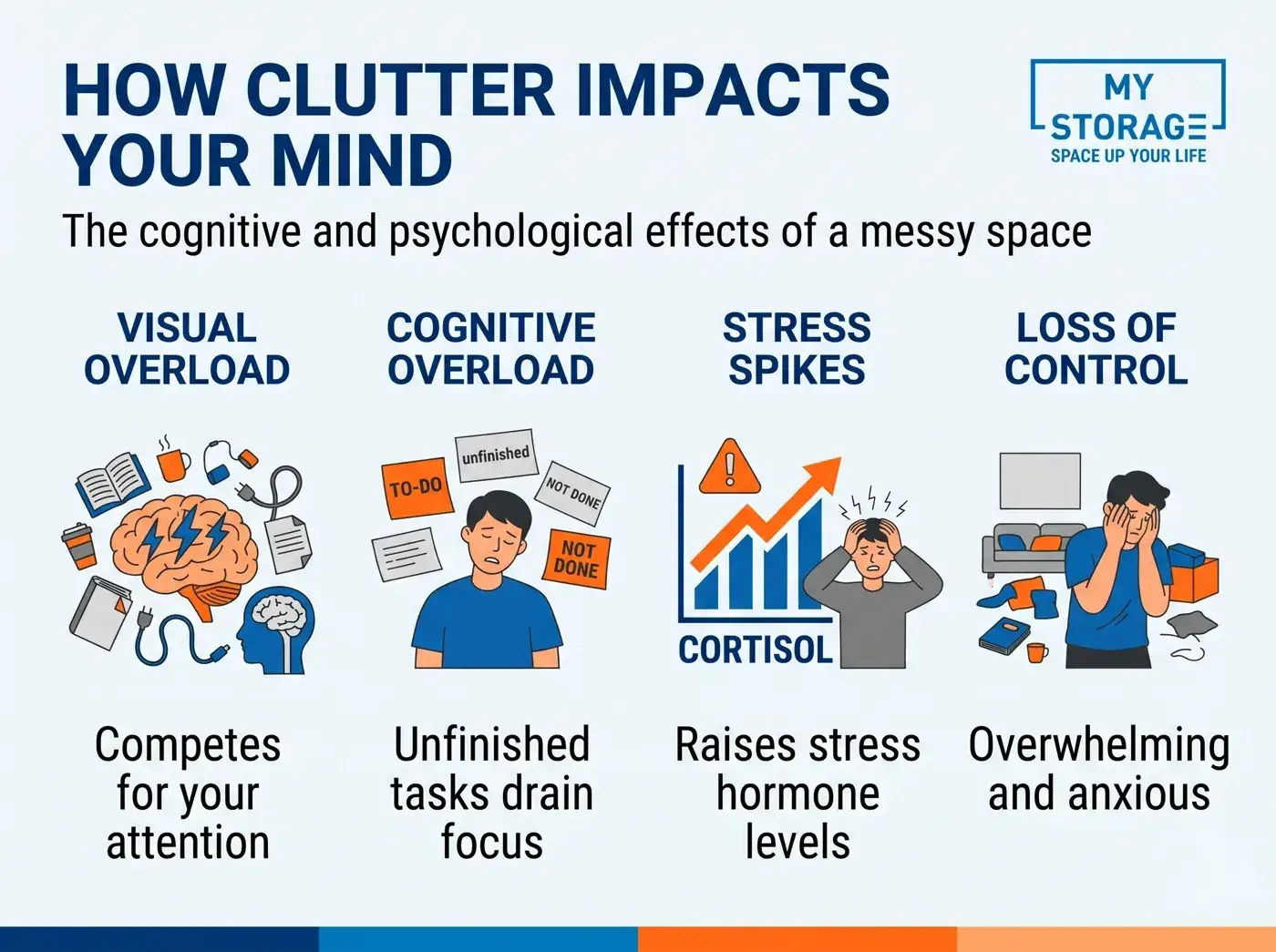
A room full of scattered belongings is not only an aesthetic problem but a constant source of nervous tension for the people living in it. The human brain is wired to look for order; when it has to take in a stream of chaotic visual signals from unfolded laundry, piles of books and tangled cables, the nervous system slides into quiet cognitive overload.
Visual Overload Inside The Home
Visual overload happens when your field of vision is surrounded by too many objects with no rule to them, so the eye has no resting point and the brain keeps processing. Three signs are easiest to spot:
- The brain is constantly pulled in different directions: Every item out of place sends a visual signal the brain has to process, leaving the eyes with no natural place to rest.
- Processing energy runs down: Seeing dozens of jumbled objects at once drains the prefrontal cortex, the part responsible for logical thinking and decisions.
- A stifling, closed-in feeling: Too many objects block walkways and open floor, triggering a defensive psychological reflex and unconscious muscle tension.
Higher Cognitive Load On The Brain
Clutter raises cognitive load because every misplaced item works like an unfinished task nagging at you in the background. Three mechanisms are at work:
- The Zeigarnik effect of unfinished business: A pile of clothes on a chair or dishes in the sink is an invisible reminder that something is still undone, leaving a constant sense of guilt.
- Harder to filter information: When the surroundings are too messy, the brain struggles to tell important information from visual noise it should ignore.
- More brain fog: Prolonged cognitive overload leaves you tired, less able to hold short-term information and quick to snap at small things.
Losing The Sense Of Control Over Your Space
A home without order erodes your sense of running your own life, because you lose control inside your own space. Three common signs:
- Powerless in your own space: Not finding a house key or an important document when you are in a hurry creates frustration and a sense that you manage life badly.
- Self-esteem wears down: Many people hesitate to invite friends or family over simply because the room is too messy, and start withdrawing.
- The domino effect of giving up: When one corner becomes messy and nothing is done, the giving-up mindset turns other areas into dumping grounds too.
Research On Cortisol And A Cluttered Home
Psychology research has found that people who describe their home as cluttered carry higher cortisol levels, which do not drop in the evening the way they do for people with tidy homes. Three notable findings:
- Saxbe and Repetti (2010): Researchers at the University of California (UCLA) followed married couples and found that women who described their home as cluttered, messy or full of unfinished work kept cortisol levels high through the day.
- An abnormal cortisol curve: In people living in tidy spaces, cortisol falls naturally in the evening so the body can sleep; in people living in cluttered homes that drop does not happen, leaving the body on alert.
- A two-way relationship: The researchers stress that this is a correlation in both directions: stress makes people less willing to tidy, and a cluttered home pushes stress higher again.
Clutter Competing For The Attention Of Eye And Brain
Neuroscience shows that scattered objects in your field of vision compete directly for the brain’s processing resources, which lowers your ability to concentrate. Three key points:
- Princeton University (McMains & Kastner, 2011): Using functional MRI, researchers showed that several visual stimuli appearing at once compete directly with each other for representation in the brain.
- A limit on visual cortex capacity: A cluttered environment restricts concentration, so a simple task takes longer than it would in a tidy room.
- What it means in practice: Clearing your desk is really clearing your brain’s bandwidth, which restores deep thinking and creativity.
2. 7 Mental Benefits Of Tidying Your Home
Rearranging your belongings produces psychological changes that go well beyond having a clean house. When you actively restore order to the space around you, the mind also loosens its knots of anxiety, bringing a sense of calm and inner confidence.
Less Visual Pressure In Your Living Space
Clearing floor and table surfaces gives your eyes immediate rest, because they have somewhere to settle instead of jumping between objects. Three changes you notice at once:
- The eyes find a resting point: Empty stretches of table and floor let the gaze stop instead of hopping from one object to the next.
- The room feels larger than it is: Fewer objects in view make the same floor area feel more open, especially in a small apartment.
- Light travels further: Clearing things away from windows and walkways lets daylight reach deeper into the room, which supports your body clock.
Regaining Control Over Your Life
Every item put back in its place is a small decision you make and carry out yourself, so tidying returns a sense of control when much else is out of reach. Three effects:
- A clear zone of control: When many things are beyond your reach, a tidy drawer is concrete proof that you still govern your own environment.
- Less of a feeling of chaos: Physical order around you reduces the sense that everything is slipping out of control.
- More day-to-day confidence: A tidy space makes you willing to invite family over instead of hesitating.
A Sense Of Completion And Achievement
Tidying is one of the few tasks that shows a visible result the same day, so it creates a feeling of completion faster than most work. Three reasons:
- Immediate feedback: Unlike long-term projects, a clean table is a result that appears after 15 minutes.
- A chain of small wins: Each finished area creates the drive to do the one next to it.
- Less procrastination: Seeing a small job completed makes it easier to start the bigger ones waiting for you.
Better Concentration While Working
A tidy desk returns bandwidth to the brain, so you start work faster and make fewer mistakes. Three concrete changes:
- Fewer distractions: Keeping only the tools for the current task means you are not spending willpower resisting unconscious distraction.
- A shorter run-up to work: With no time lost hunting for documents or tools, you begin work sooner.
- Fewer errors: A clear space reduces mix-ups between documents and items.
Better Sleep In A Tidy Bedroom
A bedroom with few objects sends a safety signal to the nervous system before bed, which makes deep sleep easier to reach. Three things to do:
- The bed is only for sleeping: Not leaving half-worn clothes, a laptop or a work bag on the bed helps the brain separate resting space from working space.
- An empty nightstand: Keep only a lamp, a glass of water and the book you are reading; put chargers, medicine and bills in a drawer.
- Less dust, easier breathing: Fewer objects in the bedroom means fewer places for dust, which helps anyone prone to allergies.
Fewer Conflicts Within The Family
A tidy shared space reduces the small repeated frictions between family members, because nobody is hunting for things or stepping over clutter. Three visible changes:
- Fewer arguments over lost items: When everything has a fixed address, nobody has to hunt for the keys or the TV remote.
- Clearer division of chores: Once belongings have a place, housework is easier to share out, including with children.
- A more pleasant shared space: An airy living room makes the family want to sit together instead of retreating to separate rooms.
Building Positive Daily Habits
Regular tidying pulls other healthy habits along with it, because the rhythm of the day becomes steadier. Three knock-on effects:
- A spillover effect: People who keep a tidy home tend to keep steadier eating and exercise routines too.
- Light daily movement: Cleaning and sorting is gentle physical activity that stretches you out after long hours sitting.
- A steadier daily rhythm: A five-minute desk reset before bed becomes the signal that the day is over.
3. 6 Ways To Tidy Your Home That Reduce Stress
Many people fall into the trap where tidying makes them more stressed, because they set ambitious goals or try to make everything perfect in a day. For tidying to work as mental recovery, break the pressure into pieces and keep your own comfort in view.
The 15-Minute Timer Rule
Setting a timer for exactly 15 minutes and stopping when it rings is how you get past the initial reluctance without burning out. Three principles when you apply it:
- A manageable block of time: Set the alarm for exactly 15 minutes; commit to working only within it and allow yourself to stop as soon as it rings.
- One small area only: Pick something tiny such as a dressing table, a sock drawer or the kitchen sink; do not spread into other areas.
- Less psychological resistance: 15 minutes is too short for the brain to find an excuse to delay; you will be surprised how much gets done.
The 4-Box Method For Family Belongings
The 4-box method sorts items into Keep, Give away, Throw out and Store, which lets you decide firmly instead of agonising over each object. Three steps:
- Prepare 4 boxes or 4 corners: Keep (things used regularly), Give away (still good but to be donated or sold), Throw out (broken items) and Store (rarely used but worth keeping).
- The one-touch rule: Pick each item up and put it into one of the 4 boxes within 5 seconds; never pick it up and put it back to think about later.
- Clear the rubbish box at once: Take the rubbish bag out of the house right after the session so you enjoy the empty space immediately.
The Store box is usually the one that fills fastest and gets abandoned halfway, so decide where it goes while you pack it; if the house has no room left, 8 groups of household items worth putting into storage shows which groups should leave first.
Start With The Corner That Stresses You Most
Start with the corner that bothers you most each time you see it, because clearing one hot spot gives the clearest relief. Three steps:
- Identify the stress hot spot: Ask yourself which corner irritates you most, usually a desk buried in paper or a pile of clothes on the bed.
- Finish that one hot spot: Give the whole session to that area; removing the biggest stressor brings noticeable relief.
- Skip areas out of sight: Leave closed cupboards and the storeroom for now; prioritise the open surfaces you see every day.
Arrange Items By How Often You Use Them
Arranging by frequency means daily items stay within arm’s reach while seasonal things are stored deepest, which keeps daily life running smoothly. Three tiers:
- Tier 1 - within reach (daily): Toothbrush, phone, wallet and house keys in open positions you can reach in one step.
- Tier 2 - within range (weekly): Steam iron, hairdryer and current project documents in drawers or shelves at chest height.
- Tier 3 - stored deep (seasonal or rare): Winter quilts, suitcases and repair tools on the top of a wardrobe or in a separate storage unit.
Keep Up Short Daily Tidying
A few minutes of tidying each day keeps the home in better shape than saving everything for the weekend. Three short rituals worth keeping:
- A 5-minute desk reset before bed: Collect the glasses to the sink, straighten the sofa cushions and wipe the desk so you wake up to a clean space.
- The clean plate rule: Wash the dishes right after the meal or load the dishwasher; never soak them overnight, because a dirty sink is a stress trigger first thing in the morning.
- One thing on the way: Every time you leave the living room for the bedroom, pick up one item that is in the wrong place and take it back.
Drop Perfectionism When Tidying
The target is tidy enough to live in, not gallery-perfect, because the pressure to be perfect is exactly what makes people give up. Three things to accept:
- Tidy, not perfect: Do not pressure yourself to sort every shirt by colour code or to buy a full set of expensive matching boxes.
- Allow mess within limits: With small children or on busy days the house will be untidy; what matters is knowing how to restore order when you have time.
- Share the housework: Ask your partner for help and teach children to put their toys away; do not take it all on and end up exhausted and resentful.
4. Areas Of The Home To Tidy First
Each functional area of the home affects a different psychological aspect. Working through the key spaces in order of priority helps you regain emotional balance quickly without being overwhelmed.
Tidying The Bedroom For Quiet Sleep
The bedroom deserves to be tidied first because it is where you recover after a long day, and what sits around the bed affects sleep directly. Three things to do:
- Clear the bed completely: The bed holds only the mattress, pillows and duvet; never turn it into a place for half-worn clothes, a laptop or a work bag.
- Clear the nightstand: Leave only a bedside lamp, a glass of water and the book you are reading; put chargers, medicine and bills in a closed drawer.
- Put clothes away in a closed wardrobe: Hang clean clothes properly and drop dirty ones straight in the laundry basket; do not hang clothes in layers behind the door.
Tidying The Home Work Desk
The desk is where mental strain builds up fastest in the home, so the emptier the surface, the lighter your head. Three things to do:
- The paperless desk rule: Scan invoices and sticky notes into files and put important contracts in a folder; do not let stacks of paper pile up in front of you.
- Hide the cables under the desk: Fit a cable tray to hide the power strip and chargers; clear space under your feet keeps the mind alert.
- Strip out fussy decoration: Keep one small plant or one family photo; remove dusty figurines and souvenirs.
Tidying The Shared Living Room
The living room is the space that connects family members, so clearing the coffee table and collecting the toys is enough to make everyone want to sit together. Three things to do:
- Clear the coffee table: Keep only a tray for the remotes and a vase; clear away snack wrappers and cups each evening.
- Add a toy basket for small children: Put a large rattan basket in a corner so the children’s toys can be gathered quickly after play.
- Reorganise the TV shelf and display cabinet: Sort books and magazines, remove old audio cables and dust the equipment.
Tidying The Kitchen And Cooking Area
A clean kitchen inspires cooking and keeps the family’s hygiene in order, and an empty counter makes the biggest difference. Three things to do:
- Clear the countertop: Put the blender and air fryer into a lower cabinet if they are not used daily; an empty counter means wiping away grease takes 2 minutes.
- Clear out the fridge weekly: Throw away expired leftovers, wilted vegetables and out-of-date sauces; a fridge without odours brings peace of mind.
- Group the seasonings: Use a turntable or a tiered spice rack to gather the oil and fish sauce bottles into one cluster beside the stove.
Tidying Checklist By Area
The table below reviews 5 key areas of the home with the usual problem, the main tidying action and the mental benefit you can expect.
| Area To Tidy | What Usually Causes Stress | Main Tidying Action | Expected Mental Benefit |
|---|---|---|---|
| Bedroom | Clothes piled on the bed, a cluttered nightstand | Clear the bed, put clothes away, empty the nightstand | Easier to fall asleep, deeper and calmer rest |
| Work desk | Papers everywhere, dangling cables, dust | File the papers, hide the cables in a tray | Better concentration, less work stress |
| Living room | Children’s toys scattered, snacks on the coffee table | Gather toys into a basket, clear the coffee table | An airy shared space, a closer family |
| Kitchen | Greasy counter, sink full of dishes overnight | Wash dishes at once, store rarely used appliances | Inspiration to cook, better household hygiene |
| Balcony and storeroom | Old cartons piled up, broken items blocking the way | Throw out rubbish, sell old items, organise the shelves | More room to breathe, more natural light |
5. Family Storage Solutions For A Home With Too Much Stuff
Many families have tidied hard and the home still feels cramped, simply because the floor area cannot hold everything they need to keep. With urban housing prices in 2027, the answer is not buying more cabinets to cram things into, but combining a space plan at home with a family storage unit outside.
Separating Everyday Items From Items To Keep
Split what is in the house into two groups: things you use stay in the living space, things you only keep move out of the bedroom and living room. Three groups to define:
- Things you use: Clothes worn weekly, everyday dishes, the work computer; these have to stay in the living space.
- Things you keep: Large suitcases, winter heaters, a spare mattress for guests, tax records, camping gear and keepsakes; still valuable but touched a few times a year.
- The paradox of occupied living space: Keeping items you use once a year in the bedroom or living room turns expensive living space into a storeroom.
Making The Most Of Family Storage At Home
Using dead space such as the top of wardrobes and under the bed holds more family belongings without spoiling the look of the room. Three ways to do it:
- Floor-to-ceiling shelving: Build the wardrobe to the ceiling to use the space above it for winter quilts and suitcases.
- The space under the bed: Use plastic boxes on castors for off-season clothes or old books under the bed.
- Matching labelled storage boxes: Group small items into standard cartons and label the outside so they are easy to find.
Each kind of cabinet suits a different group of belongings, so when you are choosing furniture to hold things, the types of home storage cabinets shows which can take heavy quilts and which only suit light items.

When Should You Use A Family Storage Unit?
Use a family storage unit when the house is tidy but still cramped, or when you need a safe place during a transition. Three common situations:
- A small apartment with many keepsakes and seasonal items: You cannot bring yourself to throw away mementoes or the children’s expensive toys, but the home has no room to breathe.
- A family renovating or moving: You need a safe, clean place to keep all the furniture for a few weeks or months.
- Freelancers and online shop owners working from home: Samples, bulky filming equipment and documents need to move out to give the living space back to the family.
Renovation is when belongings are most at risk from dust and paint, so storing belongings during home renovation sets out which groups need wrapping and which should leave the house entirely.
Family Storage Rental Prices 2027
Family storage is priced by unit volume and contract length, with the smallest unit starting at 1 m³. The table below shows reference prices for 2027 in Ho Chi Minh City.
| Unit Type | Equivalent Volume / Area | What It Holds For A Family | Reference Price (Per Month) |
|---|---|---|---|
| Mini Box | 1 m³ to 3 m³ (about 0.5 - 1.2 m²) | 8 to 25 cartons or 2 to 3 large suitcases (seasonal items, books, keepsakes) | 873,000 VND (≈ US$33.91) - 1,563,000 VND (≈ US$60.71) (1 to 3 m³, standard unit) |
| Standard S | 4 m³ to 8 m³ (about 1.5 - 2.5 m²) | 32 to 80 boxes (spare furniture, fans, folding mattress, sports gear) | 1,796,000 VND (≈ US$69.76) - 2,886,000 VND (≈ US$112.10) (5 to 7 m³, standard unit) |
| Family M | 9 m³ to 16 m³ (about 3.5 - 5.5 m²) | 72 to 160 boxes (the contents of an apartment during renovation) | 3,533,000 VND (≈ US$137.24) - 3,905,000 VND (≈ US$151.69) (from 10 m³, standard unit) |
| 24/7 Air-Conditioning Option | Based on the volume rented | Holds 20°C - 24°C continuously (against mould on clothes and documents) | About 30% - 40% more than a standard unit |
These are 2027 reference prices for MyStorage family storage in Ho Chi Minh City, flexible monthly plan, excluding VAT; the 12-month plan is 15% cheaper, and 1 m³ holds about 8 to 10 medium cartons. VND is the billing currency and converted figures move with the exchange rate. Actual cost varies with unit size, location and contract length. The price per cubic metre falls as units grow, so when you compare mini storage rental prices in Ho Chi Minh City, include what you expect to add during the year.
MyStorage Family Storage In Ho Chi Minh City
A lean, airy home is the calmest refuge a family has from the pressures of modern life.
Tidying your home to reduce stress does not mean forcing yourself to throw away family keepsakes you have kept for years. Choosing a professional family storage unit outside is how you get a roomier home and still keep everything the household values.
MyStorage family storage in Ho Chi Minh City offers monthly storage for household belongings. With private self-managed mini units fitted with air conditioning that controls humidity and temperature 24/7, multi-layer security cameras and independent PIN access, MyStorage protects suitcases, winter bedding, the Christmas tree, spare mattresses and household appliances from dust, insects and mould. Each family has its own unit with its own key, free to arrange and collect things at any time, which gives the home back its space and the household a lighter feeling day to day.
6. Frequently Asked Questions About Tidying And Stress
Fifteen answers to the most common questions about the link between tidying your home and mental health:
Why does tidying your home reduce stress?
Tidying cuts visual overload, lowers the cognitive load on the brain and creates a sense of control over your environment. When a home is full of scattered objects, the visual system keeps sending signals to the prefrontal cortex, forcing the brain into silent multitasking to ignore the excess. Clearing one flat surface removes those distractions, and seeing items back in their place creates the feedback of control that calms the mind.
Does tidying improve your mood?
Yes, through two routes: gentle physical activity and a calmer visual experience. Cleaning and sorting needs coordination between movement and attention, which works much like active meditation. Seeing a tidy room makes the brain register a sense of achievement, and an open space lets daylight reach further into the room, which supports your body clock.
Is a cluttered home bad for mental health?
Living in a cluttered home for a long time is associated with higher cortisol, weaker concentration and poorer sleep. Research at the University of California found that people who described their home as cluttered had unusually high evening cortisol compared with people with tidy homes. Scattered belongings leave the mind with no resting point, creating the feeling that housework never ends.
Why does looking at a messy home feel tiring?
Because every misplaced item acts as an unfinished tidying request sent to the brain, which causes decision fatigue. Walking into a room with clothes on the chair, toys on the floor or leftovers on the table makes the brain spend energy unconsciously asking where each item should go and when it will be dealt with. That background processing leaves you heavy-headed before you have lifted a finger.
Does tidying help with anxiety?
Yes, because tidying brings a wandering mind back to something concrete and tangible. Anxious people often feel everything is slipping out of control; sorting a pile of papers or folding shirts creates a small but clear zone of control. The repetitive movements also break the loop of negative thinking and steady your breathing.
Does tidying improve concentration?
Yes, because it frees bandwidth in the prefrontal cortex. Researchers at Princeton University showed that scattered objects in your field of vision compete directly for the processing resources of eye and brain. When the desk holds only what the current task needs, the brain no longer spends willpower resisting distraction, so continuous thinking lasts longer.
How often should you tidy?
The most workable schedule combines a quick 10 to 15 minutes a day with one 45 to 60-minute session at the weekend. The common mistake is saving all the housework for the two days off, which turns rest time into heavy labour. Daily, just clear the sink, wipe the table and take out the rubbish; at the weekend wash the bedding, vacuum and clear the fridge; periodically move off-season things into a family storage unit.
How many minutes a day should you tidy?
About 10 to 15 focused minutes is enough to keep the main surfaces in order without exhausting you. Set the alarm for 15 minutes at a fixed time, for example 8pm after dinner, and stop when it rings whether you have finished or not. Limiting the time stops the brain from dreading housework and turns tidying into a natural habit.
Where should you start tidying?
Start with the area that bothers you most each day, usually the bed or the work desk. If you walk into the bedroom and see a messy bed, falling asleep is harder; if you sit at a desk buried in paper, you put work off. Clearing one hot spot completely creates the first visible win and the motivation to handle the other corners.
What is the 4-box method?
It is a technique that sorts belongings into four action groups: Keep, Give away, Throw out and Store, so you avoid drawn-out hesitation. Prepare four large cartons, pick up each item and decide within 5 seconds using the one-touch rule, never putting it back down to think about later. The Store box is for seasonal items, spare bedding and keepsakes, which are exactly what suits a family storage unit.
Does tidying help you sleep better?
Yes, a tidy and airy bedroom helps the body cool down naturally and makes deep sleep easier to reach. A smooth bed and an empty nightstand send a signal of relaxation to the brain. Leaving half-worn clothes or work documents around the bed does the opposite, triggering stressful trains of thought right before you try to sleep.
Why do you feel lighter after tidying?
Because three things happen at once: cognitive load drops, the reward system releases dopamine and an unconscious psychological weight lifts. Every surplus object in the home acts as an invisible thread tying up your attention; putting them in order is also tidying your mind and creating breathing room for thought.
How do you keep a home tidy when you are busy?
Rely on three rules: one in one out, the one-minute rule and a fixed address for every item. Anything that takes under a minute, such as hanging up a coat, putting the keys away or washing a cup, gets done immediately. When you buy something new, give away something equivalent so the total amount of stuff does not creep up year after year.
What if you have too much but do not want to throw anything away?
Separate by frequency of use instead of forcing yourself to discard: everyday items stay at home, while keepsakes and seasonal things move into a family storage unit. Forcing yourself to part with mementoes usually just adds regret. Storage with humidity-controlled air conditioning keeps the home airy while the memories stay intact; which groups should go first is listed in 8 groups of household items worth putting into storage.
Does renting family storage reduce stress?
Yes, because it returns several square metres of living space immediately without forcing you to choose what to throw away. Cramped space is a hidden source of tension between family members in cities. Moving spare mattresses, suitcases, the Christmas tree or children’s toys into a monthly self-managed unit gives everyone room to breathe, at a fraction of the cost of moving to a larger apartment; the price for each unit size is set out in personal mini storage rental by the month.
Related articles
Article
Leaving Ho Chi Minh City For Tet 2027: What To Do With Your Belongings
Before you leave Ho Chi Minh City for Tet 2027, you can lock up your rented room, put suitcases in a smart locker for a late flight, or rent a self-storage unit by the month; declutter…
Read article

Article
Too Much Stuff As A Freelancer? How To Organise Your Home Workspace
Freelancers should separate the work zone from the living zone, declutter by how often each item is used and use wall shelves, pegboards and mobile drawer units; when gear, records and…
Read article

Article
Popular Decluttering Methods: Should You Choose KonMari, 4 Boxes Or 20/20?
There is no single best decluttering method: KonMari suits a full reset, the 4-box method suits beginners tidying room by room, the 20/20 and 90/90 rules speed up decisions, the 5-minute…
Read article
