
 Tiếng Việt
 한국어
 日本語
Article
How Many Square Metres Are 5x5 And 10x10 Feet Storage Units? Unit Size Conversion Table
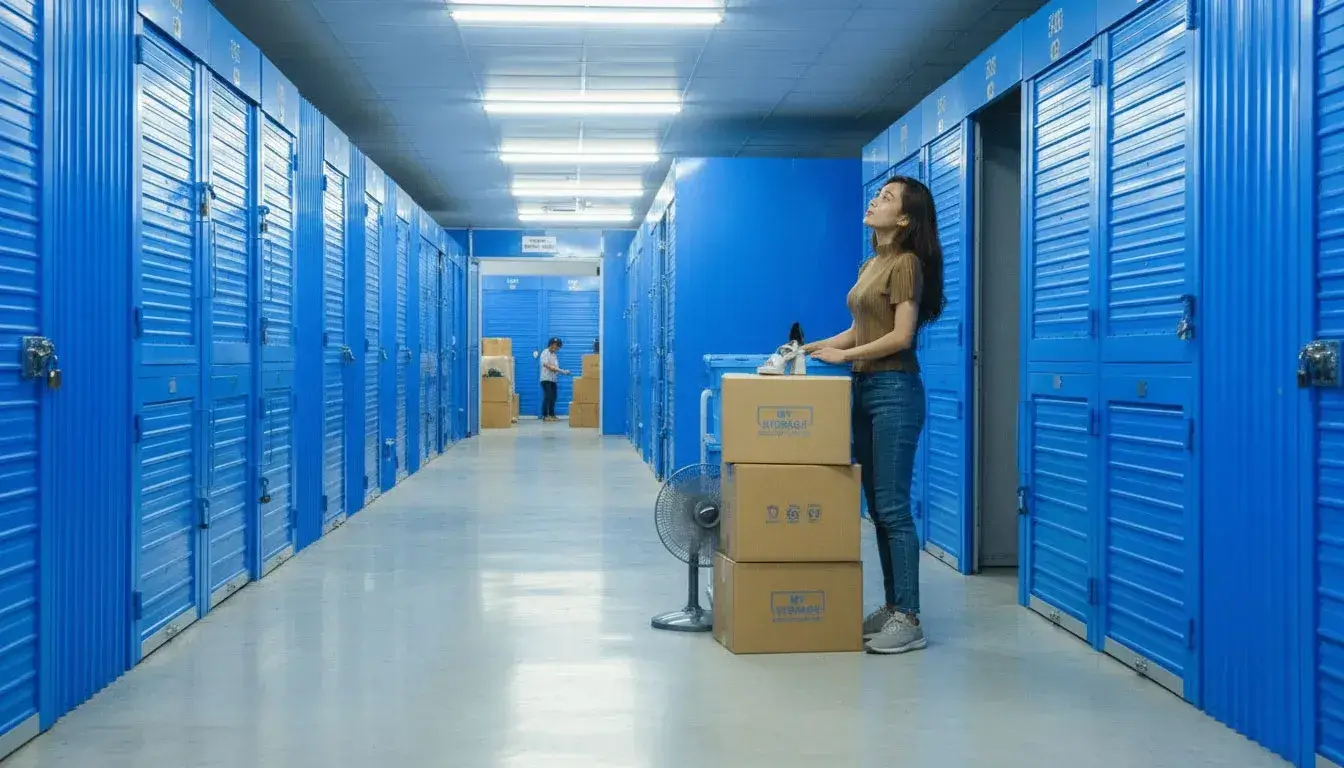
On this page
A 5x5 feet storage unit is equivalent to about 2.32 m² of floor space, while a 10x10 feet unit has a floor area of about 9.29 m² under the international standard. Knowing how to convert feet to square metres helps individuals and businesses picture the real storage space in Ho Chi Minh City and choose a self-storage unit that fits without wasting money on monthly rent.
When you need to free up living space, self-storage is how many Vietnamese keep their belongings while staying in control of them. The short clip below tells how Vietnamese people take back their living space by renting personal storage.
1. How Many m² Are 5x5 and 10x10 Feet Storage Units? Size Conversion Table
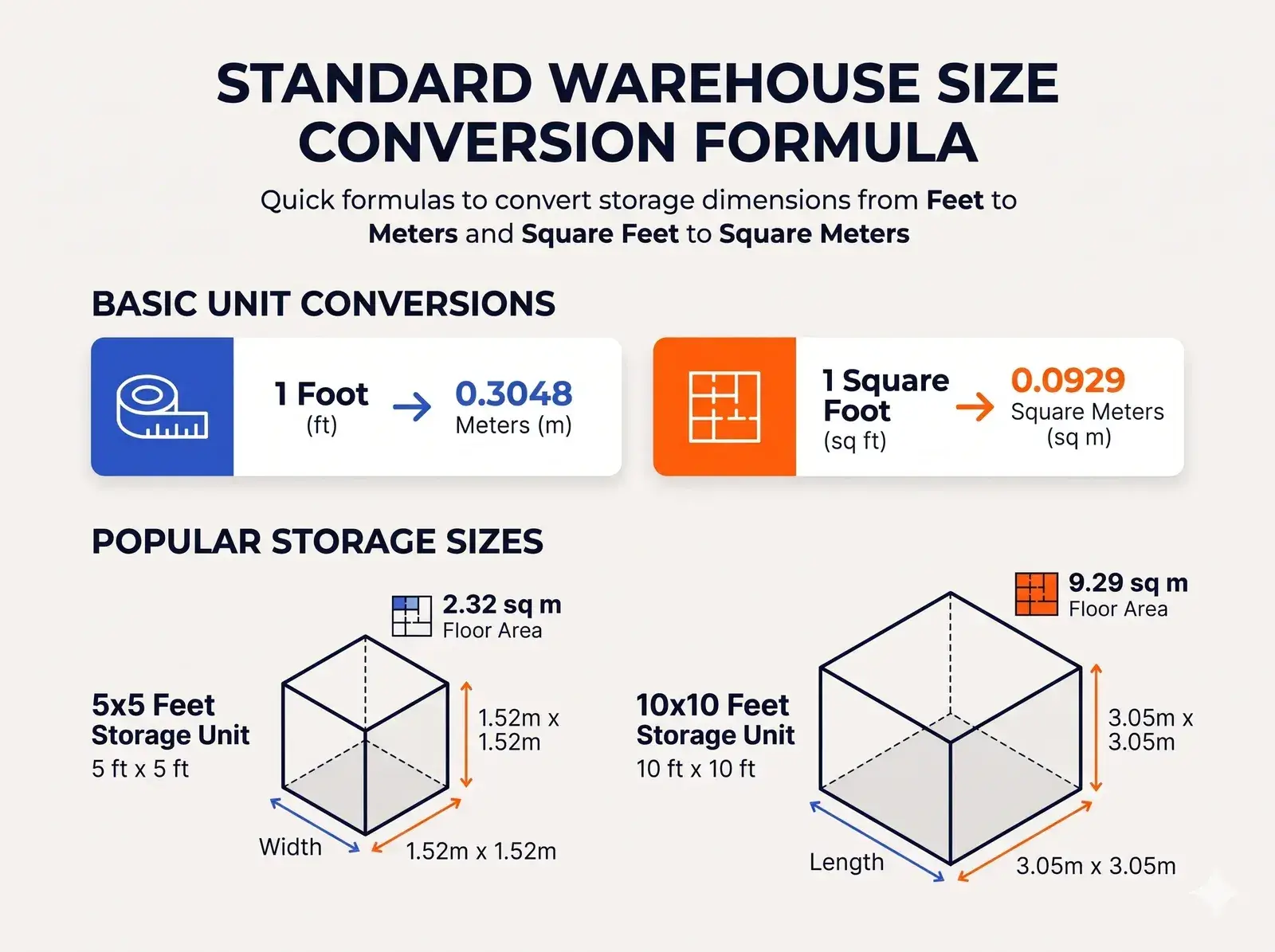
A 5x5 feet storage unit has a floor area of exactly 2.32 m² (1.524 m x 1.524 m), while a 10x10 feet unit has 9.29 m² (3.048 m x 3.048 m). Many people mistake a 5x5 feet unit for 5 m², but in reality it is less than half that.
What Is a Foot? the Formula to Convert Feet to Metres and m²
The foot (symbol ft, or a single prime mark) is a unit of length in the Imperial (British and American) system, used widely around the world:
- Length conversion: 1 foot is exactly 0.3048 metres (m)
- Area conversion: 1 square foot (ft²) is the area of a square with 0.3048 m sides, so 0.3048 x 0.3048 = 0.092903 m²
- Formula for square metres: area (m²) = length (ft) x width (ft) x 0.092903
- 5x5 feet unit: 5 x 5 x 0.092903 = 2.322575 m², rounded to 2.32 m²
- 10x10 feet unit: 10 x 10 x 0.092903 = 9.2903 m², rounded to 9.29 m² or about 9.3 m²
| Unit | Conversion |
|---|---|
| 1 foot (ft) | 0.3048 metre (m) |
| 1 square foot (ft²) | 0.092903 square metre (m²) |
| 5x5 feet unit | 1.52 m x 1.52 m, floor area 2.32 m² |
| 10x10 feet unit | 3.05 m x 3.05 m, floor area 9.29 m² |
Why Are International Storage Sizes Usually Given in Feet?
The self-storage industry began and grew strongly in North America from the 1960s before spreading worldwide:
- Construction standards: multinational storage developers use feet-based modules (5 ft steps: 5x5, 5x10, 10x10, 10x20) to standardise metal partitions and roll-up doors
- Reference material: when searching for storage on overseas websites or franchise documents, unit sizes are usually shown in ft
- Conversion needed in Vietnam: the Vietnamese storage market uses square and cubic metres, so converting lets renters compare with real rooms at home
Nominal Area vs Usable Area
When reading storage specifications, renters need to tell the outer footprint from the usable interior:
- Nominal area (gross area): area measured to the wall centre or the outer edge of the partition (exactly 5x5 feet is 2.32 m²)
- Usable area (net usable area): the interior floor after deducting partition frames and the door track, usually a slight loss of about 3% to 5% against the nominal size
- Effect of the unit structure: some units may have structural columns, technical boxes or fire pipes crossing the ceiling, which slightly reduce usable volume
Size Conversion Table for Storage Units From Feet to m²
The table lets you quickly look up the area of common self-storage units by international standard. Volume is calculated with an assumed 2.5 m ceiling; real ceilings differ from one facility to another.
| Unit size (feet) | Length x width (metres) | Floor area (m²) | Estimated volume (m³, 2.5 m ceiling) |
|---|---|---|---|
| 5x5 ft | 1.52 m x 1.52 m | 2.32 m² | About 5.8 m³ |
| 5x10 ft | 1.52 m x 3.05 m | 4.65 m² | About 11.6 m³ |
| 5x15 ft | 1.52 m x 4.57 m | 6.97 m² | About 17.4 m³ |
| 10x10 ft | 3.05 m x 3.05 m | 9.29 m² | About 23.2 m³ |
| 10x15 ft | 3.05 m x 4.57 m | 13.94 m² | About 34.8 m³ |
| 10x20 ft | 3.05 m x 6.10 m | 18.58 m² | About 46.5 m³ |
| 10x30 ft | 3.05 m x 9.14 m | 27.87 m² | About 69.7 m³ |
How to Read the Sizes of 5x5, 5x10, 10x10 and 10x20 Feet Units
Understanding the ratios between dimensions helps you picture a unit against the rooms in your home:
- 5x5 feet unit (2.32 m²): a square space equal to a large walk-in closet or a small bathroom
- 5x10 feet unit (4.65 m²): twice the depth of a 5x5, about the size of a small spare bedroom or a long hallway, suited to a motorbike and many boxes
- 10x10 feet unit (9.29 m²): a spacious square space about the size of a standard bedroom in a 2-bedroom apartment
- 10x20 feet unit (18.58 m²): about a garage that fits one 7-seat car plus dozens of items stacked around it
How to Convert Storage Area From Feet to m²
To work out the area of a unit of any size yourself, use one of three methods:
- Quick calculation on your phone: enter length x width (in feet) then divide by 10.764, since 1 m² is about 10.764 ft². Example: (5 x 5) / 10.764 = 2.32 m²
- Use an Excel sheet: the function =CONVERT(A2*B2,"ft2","m2"), where A2 and B2 are length and width in feet
- Rough mental conversion on site: take the area in square feet, divide by 10 and subtract about 7% to get an approximate figure in square metres
To estimate the volume of what you need to store as well, see how to calculate storage size with AI.
2. What Fits in a 5x5 and a 10x10 Feet Storage Unit?
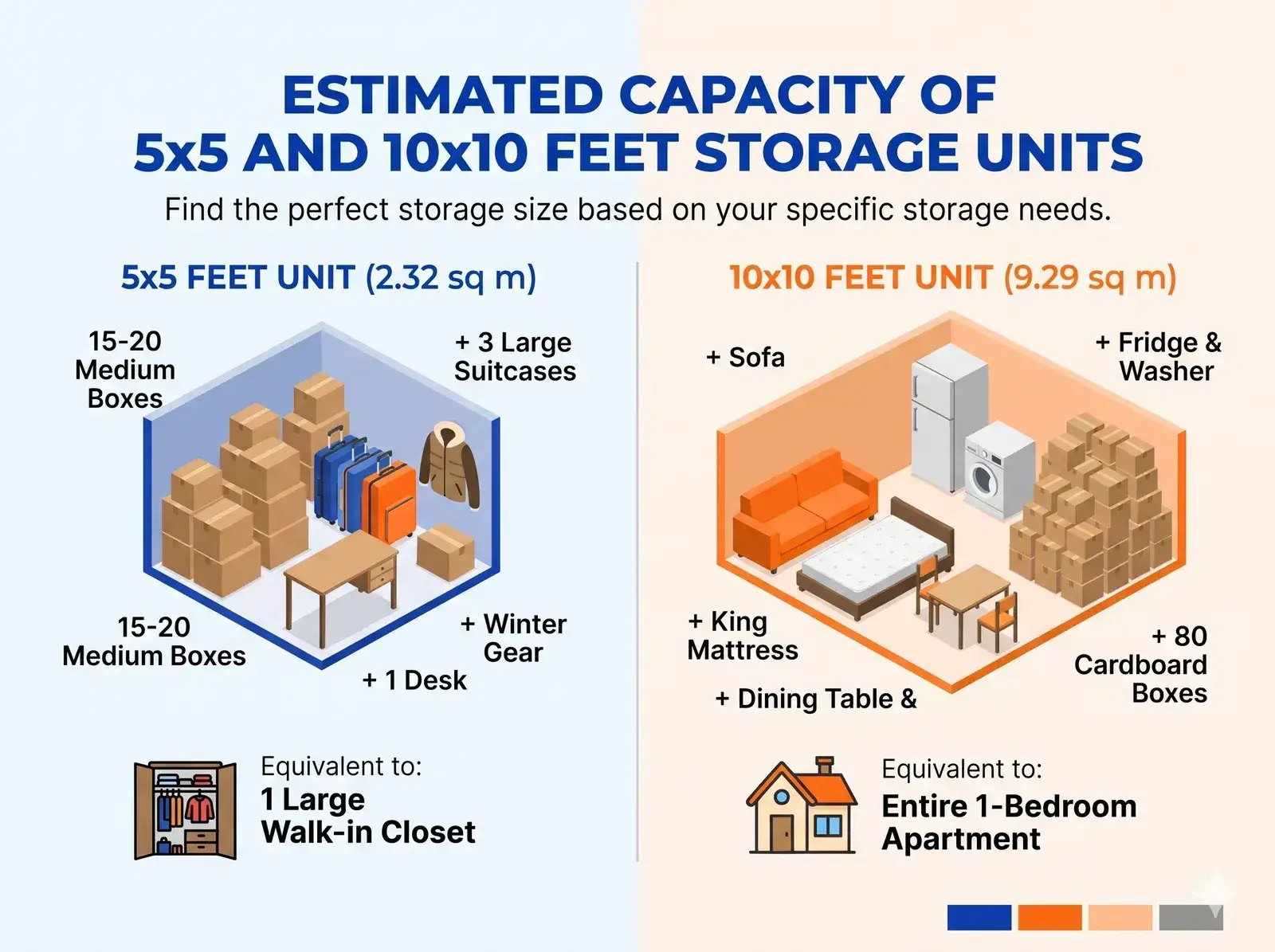
A 5x5 feet unit (about 5.8 m³, equal to 46 to 58 medium cartons if you only stack boxes) suits a moderate amount of personal belongings, while a 10x10 feet unit (about 23.2 m³, equal to 186 to 232 medium cartons) has room for the furniture and goods of a household or small shop. Real capacity depends on item size, packing, unit height and layout.
Real Capacity of a 5x5 Feet Unit (2.32 m²)
A 5x5 feet unit (about 5.8 m³ with a 2.5 m ceiling) is a compact choice for people who need to free up living space:
- Cartons: about 46 to 58 medium cartons if you only stack boxes (8 to 10 per m³); with bulky items, a typical mixed load is 15 to 20 cartons of 60 x 40 x 40 cm plus suitcases, a folding work desk and winter clothes
- Luggage and outdoor gear: room for 3 to 5 large travel suitcases, a golf bag, a surfboard, a tent and seasonal clothes
- Small furniture: fits a folding desk and chairs, a swivel office chair, a standing fan and a vacuum cleaner
- Stock of a small online shop: about 200 to 400 fashion, cosmetics or phone accessory products packed in small boxes
Real Capacity of a 10x10 Feet Unit (9.29 m²)
A 10x10 feet unit (about 23.2 m³) has the space of a household storeroom; according to the MyStorage unit size guide, a 17 m³ unit already holds the contents of a 2 to 3 bedroom apartment:
- Furniture of a 1-bedroom apartment: 1 long sofa, a coffee table, a 300-litre fridge, a washing machine, a king-size spring mattress, a dismantled wardrobe and a 4-seat dining table
- Household cartons: about 186 to 232 medium cartons if you only stack boxes; with large furniture, about 70 to 100 cartons when moving or renovating a home
- Business goods: about 6 to 7 pallets stacked one high, or about 15 to 16 pallets 1.2 m high if stacked by volume, before any aisle; see pallets for warehouse storage
- Office records: enough room for steel shelving holding hundreds of boxes of long-term accounting records
Estimated Capacity of 5x5 and 10x10 Feet Units
| Unit | Floor area | Volume (2.5 m ceiling) | Equivalent to |
|---|---|---|---|
| 5x5 feet | 2.32 m² | About 5.8 m³ | A large walk-in closet: 46 to 58 medium cartons, or 15 to 20 cartons plus 3 suitcases, 1 work desk and winter clothes |
| 10x10 feet | 9.29 m² | About 23.2 m³ | All the belongings of a 1-bedroom apartment: sofa, king mattress, fridge, washing machine, dining table and about 70 to 100 cartons |
Factors That Affect Real Storage Space
How well a unit is used depends not only on floor area but also on technical factors:
- Ceiling height: a ceiling of 2.5 m to 3.0 m lets you stand mattresses and tall cabinets upright or install multi-tier shelving to use the volume
- Dismantling and packing: a dining table with legs removed or a bed with slats removed takes up much less space than one left whole
- Aisle: if you rent storage for business and pick and pack orders daily, set aside about 15% to 20% of the floor area for a central aisle
- Applying scientific layout principles: applying scientific warehouse arrangement with heavy items at the bottom and light items on top will increase capacity by a further 30%
3. How to Choose the Right Storage Area for Your Needs
To choose the right area, start from the list of items to store, the size of each item and how often you take things out, instead of estimating by the number of boxes alone. Choosing a unit that is just enough saves money and stays convenient to use.
Estimating Floor Area From a Real List of Belongings
The method below helps you avoid renting a unit so tight that things get damaged or so large that money is wasted:
- Step 1: list all your belongings: list the number of cartons, suitcases, large furniture and electronics to store
- Step 2: measure bulky items in three dimensions: measure length, width and height of items that cannot be stacked, such as sofas, fridges and washing machines
- Step 3: convert to cubic metres (m³): add up the real volume of everything (length x width x height of each item)
- Step 4: divide by the unit height: divide the total volume by the ceiling height (usually 2.5 m), then multiply by a handling allowance of 1.2 to 1.3 to get the floor area to rent
Choosing a Unit by Access Frequency and Rental Period
How you plan to use the unit decides the size you should choose:
- Static, long-term storage (moving, rarely used items): choose a unit that just fits your belongings (for example a 5x5 feet unit) and stack boxes up to the ceiling because you rarely need to go in
- Dynamic, short-term storage (online shops): choose a unit at least one size larger than the real storage need (for example 10x10 feet instead of 5x10 feet) so you can fit divided steel shelving and leave an aisle for counting and packing
- Storing belongings while away for a long time: a mini 5x5 feet unit is usually the right, economical choice; see where to store your vehicle and belongings on a long trip
Safety Standards to Check Before Signing a Contract
Before paying a deposit, visit in person and check the facility against these criteria:
- Temperature and humidity control: keep a stable temperature below 26 °C and humidity below 65% so foam mattresses, leather sofas and paper records do not mould
- Fire protection acceptance: check that the automatic sprinkler system, smoke sensors and wall hydrants meet legal safety standards
- Multi-layer security: guards on duty 24/7, cameras covering the corridors and a separate lock for each unit
- Hygiene and pest control: a dry facility without a musty smell and with regular rodent and insect control
4. Renting Storage by Area (M²) vs by Volume (M³)
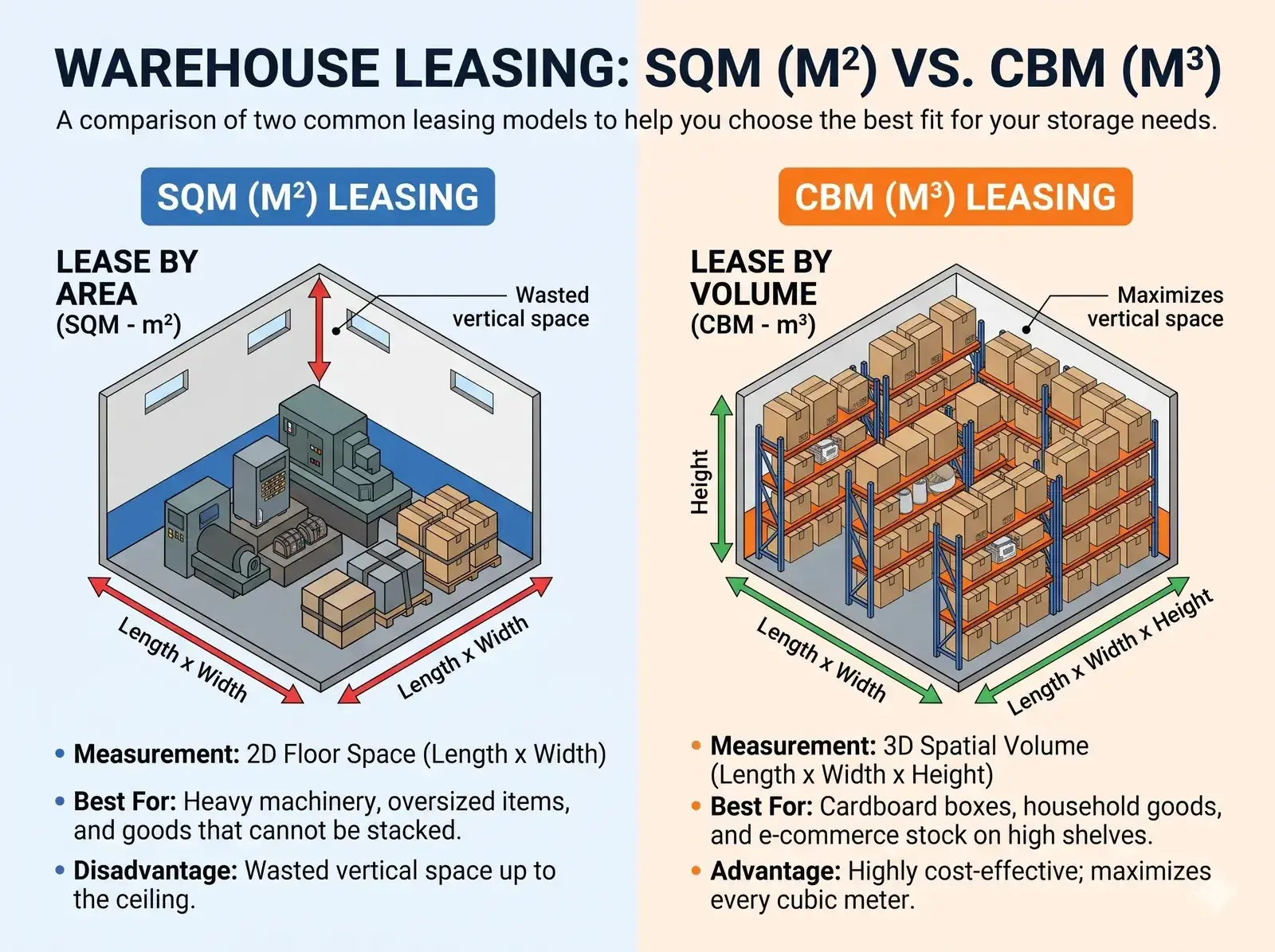
Renting by m² charges only for floor area, while renting by m³ covers the whole three-dimensional space, including ceiling height. For boxes stacked many tiers high, pricing by volume lets you use the full height of the unit and reflects the space you actually use.
The Real Difference Between Floor Area (M²) and Volume (M³)
Many customers are confused when comparing quotes under these two pricing methods:
- By floor area (m²): you pay for the two-dimensional floor your goods occupy, whether the ceiling is 2 m or 4 m high
- By volume (m³): cost is based on three-dimensional space (length x width x height), that is, the volume your belongings actually take in the unit
- Converting between the two: a 10x10 feet unit has a floor of 9.29 m²; with a 2.5 m ceiling the volume is 9.29 x 2.5 = 23.23 m³
| Criterion | Rent by area (m²) | Rent by volume (m³) |
|---|---|---|
| Measures | Two-dimensional floor (length x width) | Three-dimensional block (length x width x height) |
| Best for | Very heavy items that cannot be stacked, industrial machinery | Cartons, household goods, online stock on tall shelves |
| Drawback or advantage | Wastes the airspace above the stock | Uses every cubic metre of the unit |
When Should You Rent by Floor Area (M²)?
- Heavy machinery that cannot be stacked: heavy industrial equipment, large safes or generators must sit on the floor with nothing placed on top
- Showroom combined with storage: you need wide floor space so customers can walk in and try products
- Very short turnover: express parcel hubs need large floors to sort parcels within hours and send them out
When Should You Prefer Renting by Volume (M³)?
According to the analysis in comparison of renting by m³ and by m², renting by volume has an edge for most personal needs:
- Household goods and moving: boxed belongings can be stacked 4 to 5 tiers, using the full 2.5 m ceiling so you can rent a smaller unit
- Online shops with many small SKUs: using multi-tier shelving to classify goods by modern warehouse management principles helps save up to 40% of cost compared with renting floor area in m² the traditional way
- Flexible volume: customers can easily ask to adjust storage volume up or down by a few cubic metres month by month without re-signing a complicated space lease
5. Reference Prices and Self-Storage Solutions at MyStorage
At MyStorage in Ho Chi Minh City, self-storage units are sized by volume, from 1 m³ (holds about 8 to 10 medium cartons) to 23 m³ (larger than the 17 m³ unit that holds the contents of a 2 to 3 bedroom apartment), so a 5x5 feet unit is close to a 5 to 7 m³ unit and a 10x10 feet unit is close to the largest 23 m³ unit. A 5 m³ unit has a reference price of 1,796,000 – 1,984,000 VND (about US$70–77) per month on the flexible plan, standard storage, excluding VAT.
Converting Feet Sizes to MyStorage Units
| Size (feet) | Volume (2.5 m ceiling) | Nearest MyStorage unit |
|---|---|---|
| 5x5 | About 5.8 m³ | About 5 to 7 m³ |
| 5x10 | About 11.6 m³ | About 12 m³ |
| 10x10 | About 23.2 m³ | About 23 m³ (the largest unit) |
| 10x15 | About 34.8 m³ | Beyond the largest unit; look at warehouse space or a container |
| 10x20 | About 46.5 m³ | Beyond the largest unit; look at warehouse space or a container |
MyStorage sizes units in m³, not in feet, so this table is only a reference; see all sizes in the storage unit size guide from 1 to 23 m³. For volumes above 23 m³, read our comparison of containers, storage units and warehouses for businesses.
Estimating the Unit You Need
Take photos of your belongings and let MyStorage’s AI Size Estimator work out the volume for you. The tool is free; how to use it is covered in how to calculate storage size with AI.
Self-Storage Reference Prices for 2027
Choose the rental type, size and temperature to see today’s MyStorage prices and book with current offers:
Below are 2027 reference prices for indoor self-storage units, excluding VAT:
Standard storage
| Unit size | Flexible plan (per month) | 12-month plan (per month) |
|---|---|---|
| 1 m³ | 873,000 – 965,000 VND (about US$34–37) | 742,000 – 820,000 VND (about US$29–32) |
| 2 m³ | 1,185,000 – 1,309,000 VND (about US$46–51) | 1,007,000 – 1,113,000 VND (about US$39–43) |
| 3 m³ | 1,415,000 – 1,563,000 VND (about US$55–61) | 1,202,000 – 1,329,000 VND (about US$47–52) |
| 5 m³ | 1,796,000 – 1,984,000 VND (about US$70–77) | 1,526,000 – 1,687,000 VND (about US$59–66) |
| 7 m³ | 2,612,000 – 2,886,000 VND (about US$101–112) | 2,220,000 – 2,453,000 VND (about US$86–95) |
| 10 m³ or more | 3,533,000 – 3,905,000 VND (about US$137–152) | 3,003,000 – 3,319,000 VND (about US$117–129) |
Air-conditioned storage
| Unit size | Flexible plan (per month) | 12-month plan (per month) |
|---|---|---|
| 1 m³ | 1,136,000 – 1,256,000 VND (about US$44–49) | 966,000 – 1,067,000 VND (about US$38–41) |
| 2 m³ | 1,630,000 – 1,802,000 VND (about US$63–70) | 1,386,000 – 1,532,000 VND (about US$54–60) |
| 3 m³ | 1,869,000 – 2,065,000 VND (about US$73–80) | 1,588,000 – 1,756,000 VND (about US$62–68) |
| 5 m³ | 2,524,000 – 2,790,000 VND (about US$98–108) | 2,146,000 – 2,371,000 VND (about US$83–92) |
| 7 m³ | 3,533,000 – 3,905,000 VND (about US$137–152) | 3,003,000 – 3,319,000 VND (about US$117–129) |
| 10 m³ or more | 4,853,000 – 5,363,000 VND (about US$189–208) | 4,125,000 – 4,559,000 VND (about US$160–177) |
These are reference prices for 2027, billed in VND; the figures in brackets are approximate conversions, and exchange rates move. The 12-month plan is 15% cheaper than the flexible plan and air-conditioned units cost about 30% to 40% more. From 10 m³ upwards the price depends on the actual size, so ask for a quotation rather than inferring it from the table. A breakdown of each charge is in our guide to storage rental costs in Ho Chi Minh City 2027 by district; prices for the smaller sizes are also in mini storage prices in Ho Chi Minh City.
Self-Storage Joined to a Workspace at 375 Võ Nguyên Giáp
At the 375 Võ Nguyên Giáp site (An Khánh, Thu Duc City), MyStorage has a workspace for startups and online sellers: you can sit and work there, take stock from your unit and pack orders on the spot, instead of carrying goods home and out again to the carrier. The self-storage units there are air-conditioned, with individual locks, multi-layer security, 24/7 access and a loading area. MyStorage supports transport and handling on a separate quotation, apart from the storage rent. If you only need to store personal belongings, see personal mini storage.
6. Frequently Asked Questions About 5x5 and 10x10 Feet Storage Sizes
The questions below quickly answer how to convert storage sizes from feet to square metres, real capacity and how to choose a unit.
Is a 5x5 feet storage unit 5 m²?
No. A 5x5 feet unit has a floor area of exactly 2.32 m² (1.524 m x 1.524 m), less than half of 5 square metres. Many people get confused because the number 5 comes first, so tell feet and metres apart when reading international storage material.
Is a 10x10 feet storage unit close to 10 m² of floor area?
Yes. A 10x10 feet unit has a floor area of exactly 9.29 m² (3.048 m x 3.048 m). In advice and floor-space estimates, it is usually rounded to about 9.3 m² so customers can picture it easily.
How many metres is one foot and how many m² is one square foot?
Under the international standard, 1 foot (ft) is exactly 0.3048 metres. 1 square foot (ft²) is 0.092903 square metres. Conversely, 1 square metre is about 10.764 square feet.
Can a 10x10 feet storage unit hold all the furniture of an apartment?
A 10x10 feet unit (about 9.29 m² of floor and about 23 m³ of volume) holds the contents of a standard 1-bedroom apartment: a dismantled bed and mattress, sofa, fridge, washing machine, dining table and about 60 to 80 household cartons.
How many standard cartons can a 5x5 feet storage unit hold?
By volume (about 5.8 m³ with a 2.5 m ceiling), a 5x5 feet unit holds about 46 to 58 medium cartons if you only stack boxes (8 to 10 per m³). With an aisle and other items, the real number is lower, for example about 15 to 20 cartons of 60 x 40 x 40 cm plus 2 to 3 suitcases.
Why do international storage companies use feet instead of metres?
Self-storage began in the United States and Canada, where the Imperial system dominates. Sizes such as 5x5, 10x10 and 10x20 feet have become the manufacturing standard for metal partitions and roll-up doors, so international brands keep the names to match their technical specifications.
Is it cheaper to rent storage by area (m²) or by volume (m³)?
If your goods can be stacked many tiers high (cartons, consumer packages, boxed household items), renting by volume (m³) is usually cheaper because you use the whole ceiling height instead of paying for floor area left empty above.
What is the usual ceiling height of a self-storage unit?
At professional self-storage facilities, the clear height is usually 2.5 m to 3.0 m, enough to stand mattresses and wardrobes upright or install 3 to 4 tier steel shelving. The exact height differs by facility, so ask the provider.
How do I calculate the volume in m³ from a 10x10 feet unit?
Multiply the converted floor area of 9.29 m² by the real height of the unit. For example, with a 2.5 m ceiling the volume is 9.29 x 2.5 = 23.225 m³, about 23.2 cubic metres.
Is the usable area smaller than the nominal area when I rent a 10x10 feet unit?
Slightly. 10x10 feet (9.29 m²) is the nominal size; after deducting partition frames and the door track, the clear floor is usually about 8.8 m² to 9.0 m² (a loss of about 3% to 5%).
What size unit should an online shop with 100 to 200 orders a day choose?
With this volume and hundreds of SKUs, the shop owner should choose a unit equal to 10x10 feet (about 9.29 m²) or 10x15 feet (about 13.94 m²), enough for 4 to 6 rows of steel shelving while leaving an aisle for picking and packing. A 10x15 feet unit (about 34.8 m³) already exceeds MyStorage’s largest 23 m³ unit, in which case compare warehouse space.
How much aisle should I leave inside a 10x10 feet unit?
If you go in often to take goods out, leave a central corridor about 60 to 80 cm wide (15% to 20% of the floor area). That lets you move around and reach upper shelves without unloading all the boxes onto the floor.
Can I install multi-tier shelving in a 5x5 feet unit?
Yes. In a 5x5 feet unit (1.52 m x 1.52 m), you can place 1 or 2 sets of slotted-angle steel shelving against the wall, dividing the space into 3 to 4 independent tiers, which protects the boxes below from being crushed and makes items easy to find.
Will a spring mattress or L-shaped sofa fit in a 5x5 feet unit?
Each side of a 5x5 feet unit is only 1.52 m, so a 2 m one-piece spring mattress or a whole L-shaped sofa cannot lie flat. If the ceiling is higher than 2.5 m, you can stand the mattress upright or take the sofa apart into separate pieces to store it safely.
Does MyStorage charge by m² or m³?
MyStorage’s self-storage units are priced by volume in cubic metres, from 1 m³ to 23 m³, so you only choose a unit size close to the volume of your belongings. See the price for your exact size with the Check Price tool.
Which MyStorage unit equals a 5x5 or 10x10 feet unit?
A 5x5 feet unit (about 5.8 m³) is close to a 5 to 7 m³ unit, and a 10x10 feet unit (about 23.2 m³) is close to the largest 23 m³ unit. MyStorage sizes units in m³, so choose by the volume of your belongings rather than by feet.
Related articles
Article
Onshore vs Offshore: Which Manufacturing Model Should Businesses Choose?
Onshore manufacturing keeps production at home for quality control, while offshore cuts costs abroad. This article explains what onshore and offshore manufacturing are, a quick comparison…
Read article
Article
How To Organize Your Home Storage Room | 10 Space-Saving Tips
Organising a home storage room means sorting by purpose, using vertical shelving and labelling boxes. This article shares 10 space-saving tips, a sample inventory and post-organising…
Read article

Article
Secrets to Profitable Online Selling: 10 Ways to Save Costs
Selling online profitably means controlling operating costs, not just boosting sales. This article covers the costs that eat a shop’s profit, 10 secrets to profitable online selling, when a…
Read article
