 Tiếng Việt
 한국어
한국어 日本語
日本語Article· Updated September 28, 2026
How to Donate Used Clothes: What to Give and How to Prepare
An item of clothing that no longer fits you may still be useful to someone else. Donating used clothes keeps good items in use; worn-out fabric can instead be reused or recycled. Reviewing what you really need is also a small step toward a more organized home with less unnecessary storage.
To help donations reach recipients in good condition, check each item, wash and dry it, then sort and pack everything carefully. Once ready, choose a suitable receiving point in Ho Chi Minh City, such as a charity clothing cabinet or a community organization that currently needs the items you plan to give.
Which Clothes and Items Should You Donate?
Clothes that no longer fit or are rarely worn can still be useful gifts when they are clean, intact and functional. When clearing your wardrobe, put yourself in the recipient's position: could this item be worn immediately, or does it need a broken zip or stain repaired? The actual condition matters more than how long you have owned it.
|
Good to donate |
Do not donate |
|---|---|
|
Intact T-shirts, shirts and jackets |
Heavily torn clothes |
|
Usable trousers, shorts and skirts |
Moldy or unpleasant-smelling items |
|
Good children's clothes |
Clothes too worn to use |
|
Seasonal clothing |
Damaged shoes or peeling soles |
|
Good office wear |
Items missing important parts such as zippers or buttons |
|
Clothes that no longer fit but remain usable |
Items requiring repair before use |
Clothes That Can Be Donated
The following items are usually suitable when clean and in good working condition:
- T-shirts, shirts and jackets
- Trousers, shorts and skirts
- Children's clothes
- Seasonal clothing
- Good office clothing
- Clothes that no longer fit but remain usable
Seasonal clothing deserves a careful check before it is sent. A jacket may be intact but still need cleaning and drying if it smells damp or has mold. If the problem cannot be resolved, keep it out of the donation pile.
Other Items You May Consider Donating
Besides clothes, some compact personal items may be accepted depending on each receiving point's policy:
- Shoes
- Handbags and backpacks
- Stuffed toys
- Toys
- Books and notebooks
- Some household items
Shoes should have solid soles and be a complete pair. Bags need working straps and zippers. Keep books, toys and household items separate and ask the receiving point first. A place requesting clothes may not have the space or staff to accept other items.
Items You Should Not Donate
Items that are unhygienic or no longer functional should be repaired, recycled or disposed of appropriately instead of passing the sorting burden to the receiving organization.
- Heavily torn clothes
- Moldy or unpleasant-smelling items
- Clothes too worn to use
- Broken shoes or peeling soles
- Items missing important parts
- Items requiring repair before use
A simple test is to ask yourself whether you would willingly use the item if you needed it. This helps separate genuinely useful donations from things that should be repaired or recycled.
How to Check and Prepare Used Clothes Before Donating
After selecting good items, wash them, treat stains and dry everything completely before folding. If preparing several bags, sorting and packing by category makes checking easier and helps recipients organize donations faster. The steps below take you from wardrobe clearing to a ready-to-deliver package.
- Clear and select: Remove rarely used clothes and decide which are still suitable. Donation should not be a way to pass damaged items to someone else.
- Check condition: Inspect collars, sleeves, seams, zippers, buttons, stains, damp smells and shoe condition.
- Wash and dry: Wash thoroughly, dry completely and avoid packing anything damp.
- Sort: Group items by type, size or recipient when practical.
- Pack: Fold neatly and use clean bags or sturdy cartons.
While clearing your wardrobe, divide items into three groups: keep, donate, and repair or recycle. Separate bags from the beginning so damaged items are not mixed with prepared donations.
Quick Checklist Before You Donate
Do a final check to prevent unsuitable items from being mixed in during transport:
- ☐ Still usable
- ☐ Not torn or heavily damaged
- ☐ No mold
- ☐ No unpleasant smell
- ☐ Washed
- ☐ Completely dry
- ☐ Checked again
- ☐ Folded and packed
Before tying bags or closing boxes, check all pockets for documents, money or personal belongings. If sending several packages, label the category on the outside so the receiving team can sort them quickly.
If you have many bags or boxes, ask the receiving point about capacity and handover arrangements before visiting. Packages that can be lifted safely are easier for both the carrier and recipient.
Donation Process: From Clearing Your Wardrobe to Giving
The process can follow five steps: clear and select items, check quality, wash and dry, sort and pack, then bring them to a receiving point or contact a suitable charity. For bulky items or large quantities, contact the organization first to confirm capacity and transport arrangements.
Process Overview
- Clear the wardrobe and identify items no longer needed
- Check quality
- Wash and dry
- Sort and pack
- Find a receiving point and deliver the donation
Direct Donation or Collection Organization?
For a few bags, you can bring them to a nearby receiving point. For large quantities or bulky items, contacting the organization first helps both sides agree on the handover. The table below suggests a suitable option for each situation.
|
Method |
Suitable for |
Note |
|---|---|---|
|
Fixed receiving point |
A few bags of clothes |
You control when to deliver |
|
Charity clothing cabinet |
Compact clothes or shoes |
Check accepted items first |
|
Charity organization |
Large quantities or community programs |
Contact them in advance |
|
Door-to-door collection |
Many items that are difficult to transport |
Confirm supported area |
|
Campaign donation |
Items matching a campaign theme |
Check the campaign dates |
Where Can You Donate Clothes in Ho Chi Minh City?
In Ho Chi Minh City, donors can choose a receiving format based on the type and quantity of items:
- MyStorage charity clothing cabinet: suitable for usable clothes and shoes.
- Pagodas or charity organizations: contact them before sending a large quantity.
- Community programs: check each campaign's theme and receiving dates.
- Clothing collection points: prioritize locations convenient for your route.
- Seasonal donation campaigns: sort items according to the target group.
After finding a convenient receiving point, check its hours, current needs and capacity. A quick call or message can prevent a wasted trip if the location is full or temporarily closed.
For a specific campaign, follow the published needs. A winter-clothing drive requires different preparation from a children's-clothing drive. Choosing correctly helps the organizers sort and distribute items sooner.
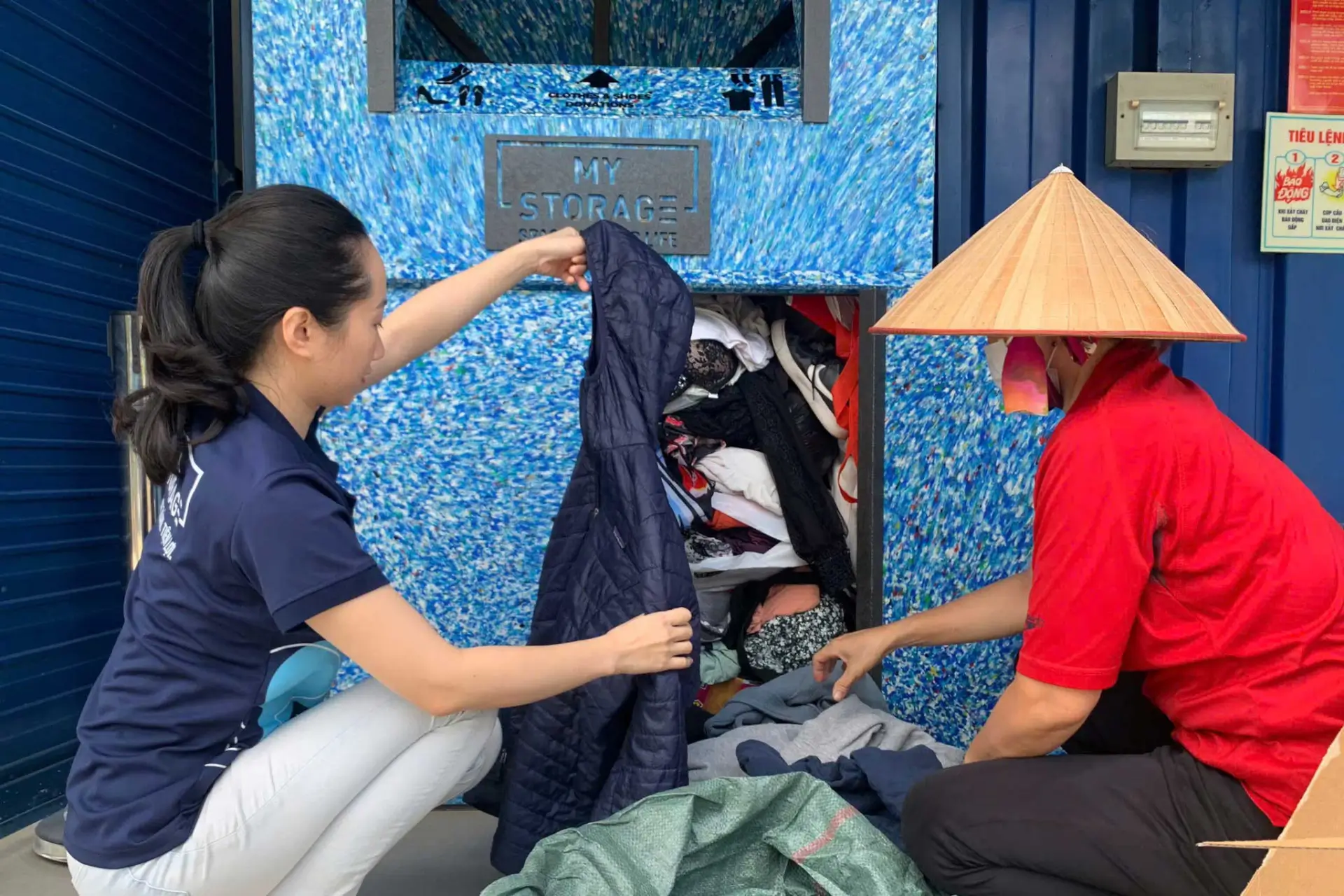
MyStorage staff sort donated clothes and household items for communities affected by flooding in Central Vietnam.
Donating Used Clothes at the MyStorage Charity Cabinet
The MyStorage charity cabinet accepts usable used clothes and shoes at 375 Vo Nguyen Giap, An Khanh Ward, Thu Duc City, Ho Chi Minh City. Donations are collected periodically and transferred to Phuoc Tuong Pagoda, where volunteers inspect and sort them before giving suitable items to people and families facing hardship.
Each donation goes through collection, sorting and delivery. Reusing good clothes reduces waste while supporting the community through a practical everyday action.
What Does the MyStorage Charity Cabinet Accept?
The receiving point focuses on practical items that are easy to check and sort:
- Usable used clothes
- Usable shoes
- For bulky items such as toys or furniture, contact MyStorage first for guidance
Keep bags tidy and avoid overfilling them. If the cabinet is full or an item does not fit, contact the responsible team instead of leaving items outside.
Donation Location
The receiving point is convenient for residents in the eastern part of the city and nearby areas:
- 375 Vo Nguyen Giap, An Khanh Ward, Thu Duc City, Ho Chi Minh City
- Located in the An Phu area of Thu Duc
- Convenient for residents of Thao Dien, Binh Thanh, Thu Duc and District 1
Check MyStorage's latest receiving information before travelling, especially when bringing many boxes or bulky items.
What Happens After You Donate?
Donations are checked so suitable items reach the people who need them:
- MyStorage collects donations periodically
- Items are transferred to Phuoc Tuong Pagoda
- Volunteers inspect and sort each item
- Suitable items are given to people and families facing hardship
Because the pagoda checks each item, washing and sorting at home makes the volunteers' preparation work easier.
If you have usable clothes or shoes, wash, dry and pack them neatly before bringing them to the MyStorage charity cabinet at 375 Vo Nguyen Giap.
A clean, folded shirt delivered to the right place can become useful to someone else while giving you more space at home.
Frequently Asked Questions About Donating Used Clothes
Which clothes are suitable for donation?
Suitable clothes are clean, intact, mold-free, free of unpleasant smells and still usable. Prioritize shirts, trousers, skirts, jackets and good children's clothes.
Do I need to wash clothes before donating?
Yes. Wash and completely air-dry or machine-dry clothes before packing. This improves hygiene, limits mold and reduces sorting work for the receiving organization.
Can I donate lightly torn clothes?
Only if the tear has been repaired and the item remains fully usable. Heavily torn clothes, missing zippers or buttons and items needing extensive repairs should be recycled or handled another way.
Can I donate shoes, handbags and backpacks?
Yes, if they are clean and usable. Check each receiving point's rules because not every location accepts every type of item.
How should donated clothes be packed?
Fold and sort them by group, place them in clean bags or cartons and label the contents outside. Clean shoes, pair them correctly and keep them separate from clothes.
Where is the MyStorage charity cabinet?
The MyStorage charity cabinet is at 375 Vo Nguyen Giap, An Khanh Ward, Thu Duc City, Ho Chi Minh City. It accepts usable used clothes and shoes.
Do I need an appointment before bringing clothes to MyStorage?
For a few bags of clothes or shoes, you can bring them to the receiving point. For a large quantity or bulky items, contact MyStorage first to confirm capacity and transport guidance.
What happens to clothes after they are placed in the cabinet?
MyStorage collects and transfers them to Phuoc Tuong Pagoda. Volunteers inspect, sort and give suitable items to people or families facing hardship.
Can I donate toys or large furniture?
Large items are not usually accepted by the charity cabinet. Contact MyStorage first or find an organization with suitable transport and storage capacity.
When should I store items instead of donating them?
Store an item when you still need it in the future, it has sentimental value or you only temporarily lack space. Donate it when it is usable but no longer needed and could benefit someone else.
Related articles
Article
IoT in Warehouse Management: Temperature, Humidity & Security
Explore IoT in warehouse management, from temperature and humidity sensors to security alerts and WMS integration. Learn about system components, implementation steps, indicative costs and…
Read article
Article
Rent a Ready-Built Warehouse or Build Your Own? Comparing Costs and Timelines
When expanding storage and distribution capacity, business leaders often face a critical strategic decision: should they rent a ready-built warehouse or invest their own capital in building…
Read article
Article
Can You Use an Apartment as a Warehouse or Office? Space Solutions for Online Shops and Small Businesses
Is it legal to rent an apartment as a warehouse or office? Explore the rules, risks, and suitable storage solutions for online shops and small businesses.
Read article
