
 Tiếng Việt
 한국어
 日本語
Article
Storage Ideas For A Studio Apartment Under 40m²: Making The Most Of Your Space 2027
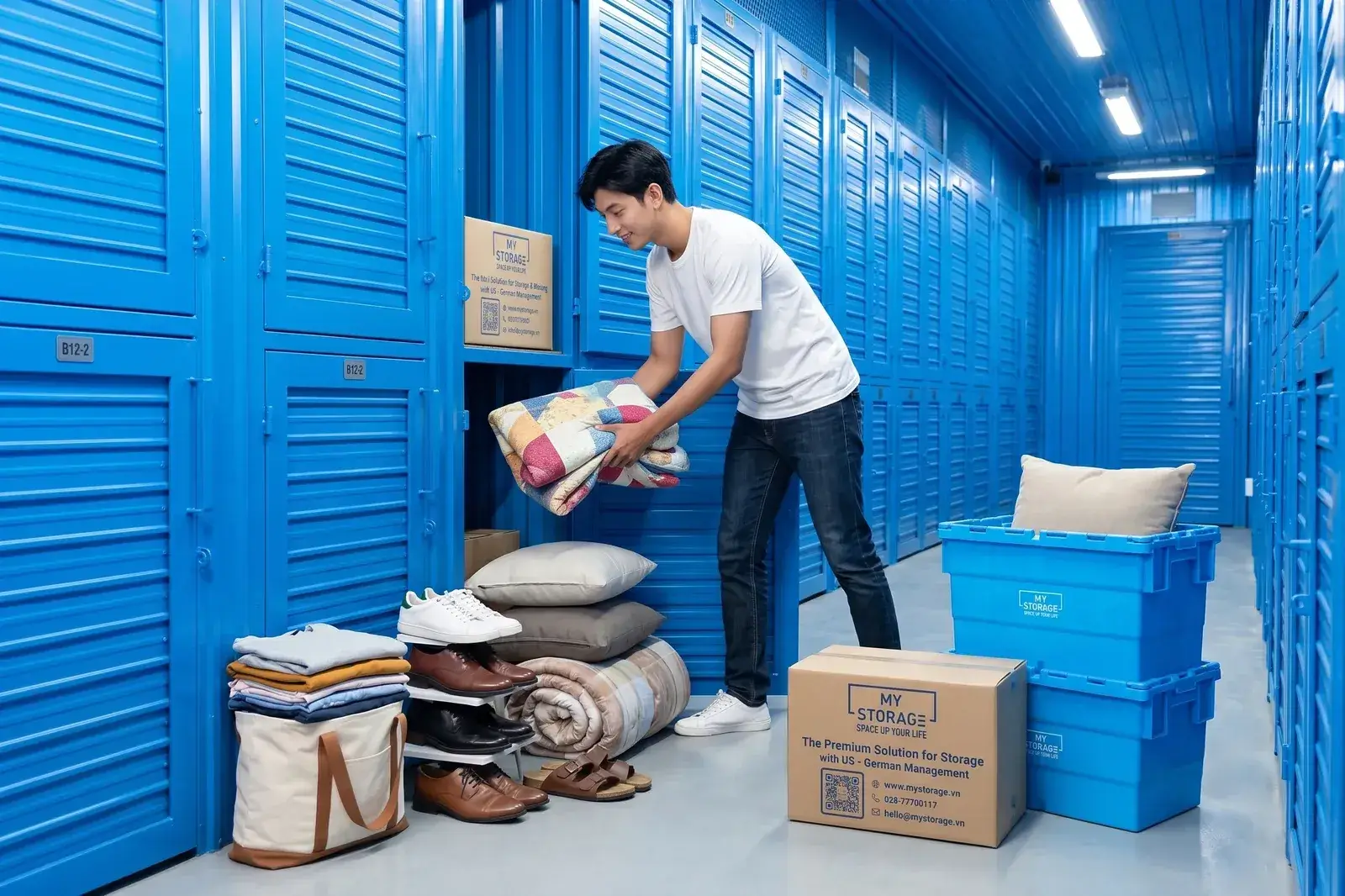
On this page
To make the most of the storage space in a studio apartment under 40m², use the vertical axis with floor-to-ceiling wardrobes, choose multi-purpose furniture and move rarely used belongings into a family storage unit outside the home. How to arrange each zone of a small home is covered in more depth in optimising space and storage in a small apartment.
Studio apartments of 25m² to 40m² are now a leading housing choice for single young professionals, newly married couples and specialists working in large cities such as Ho Chi Minh City and Hanoi. The appeal is an affordable rent or purchase price, a convenient central location and a modern way of living. The biggest challenge most studio residents face a few months after moving in is the explosion of belongings. With no fixed partition walls, even the smallest mess in the kitchen corner or on the desk is in plain sight, turning the home into a cramped miniature warehouse.
The core solution to keeping a studio tidy and airy is not forcing yourself to give up every personal interest, but a smart space-organisation strategy combined with a sensible split of what you store where. This 2027 practical guide covers the principles for exploiting every centimetre of floor area, how to pick transforming furniture and the most effective way to extend your living space.
1. The Storage Challenge Of A Studio Apartment
An open plan with no partitions feels spacious at first but is a hard problem of visual management and keeping belongings under control.
What Makes Studio Open Plans Different
A studio gathers every living function onto a single floor plate, so how disciplined you are about arrangement decides whether the home reads as tidy or messy. Three defining traits:
- No screening space: Unlike a multi-bedroom apartment where a closed door hides a temporary mess, everything in a studio, from the bed and the desk to the kitchen, sits in the same line of sight.
- Conflicting functions: Cooking smells settle easily into bedding or an open wardrobe without zoning, ventilation and closed storage.
- Limited floor area: Under 40m², a standard double bed plus a traditional wardrobe already take over 40% of the circulation area, leaving the walkways cramped.
The Pressure Of Accumulating Belongings
The volume of household belongings grows over time while the floor area stays the same, so a studio feeling overloaded after about a year is entirely normal. Three sources of build-up:
- The seasonal effect: Large suitcases, winter heaters, spare quilts and Christmas trees are used a few weeks a year but occupy the top of the wardrobe or the space under the bed for the other 11 months.
- Hobbies taking up room: Yoga gear, tennis rackets, cameras, shoe collections and professional books fill the empty floor corners within a year of moving in.
- Convenient shopping habits: Online sales quietly build up packaging, cartons and mini appliances beyond what the existing cupboards can absorb.
Seasonal items are usually the first group that has to leave the home, and seasonal storage shows how to rotate them through the year.
How A Cramped Home Affects The Mind
Living for a long time in a tight, cluttered space does real damage to mental health and productivity. Three documented effects:
- More cognitive fatigue: Research in environmental psychology shows that constant visual clutter keeps sending stimuli to the cortex, raising the stress hormone cortisol and making it harder to unwind after work.
- Poorer sleep quality: Seeing a pile of unfinished paperwork or clothes heaped on a chair right before bed triggers anxiety, which delays sleep and breaks it up.
- Losing the appetite for home life: A messy home kills the motivation to cook properly or invite friends over, which indirectly pushes up the cost of eating out.
The mechanism behind clutter and stress is analysed in tidying and home storage that reduces stress, along with how to clear one small cluster a day.
2. Storage Principles For A Small Home
Four golden principles of space organisation double your storage capacity without eating into the living area.
The Vertical Axis Principle
Exploiting a ceiling height of 2.8m to 3.2m is the fastest way to free the floor without discarding anything. Three ways to use it:
- Move rarely used items up high: The band from 2m up to the ceiling is ideal for off-season bedding, suitcases and document boxes you seldom touch.
- Use wall-mounted supports: Instead of freestanding bookcases eating floor space, fit slim wall shelves and keep the floor clear for circulation.
- Use the back of doors: Hang a rail or a multi-pocket fabric organiser behind the entrance door and wardrobe doors for shoes, a hairdryer, an iron and small accessories.
Prioritise Multi-Purpose Furniture
Every piece of furniture in a studio under 40m² has to carry at least two real functions, otherwise it is simply eating floor area. The three most effective:
- Bed with built-in drawers: A bed frame with deep drawers underneath or a hydraulic piston lift turns the whole base into a giant horizontal cupboard.
- Smart sofa bed: A presentable place to receive guests and work by day, and with one easy pull a comfortable bed at night for you or a visiting friend.
- Coffee table that doubles as a desk: A living-room table with a spring-lift top, for tea at low height and raised to chest level to work from the sofa.
Each cabinet type suits a different group of belongings, so when you are choosing furniture, the types of home storage cabinets tells you which ones take heavy quilts and which only suit light items.
The Smart Concealment Rule
Creating an unbroken visual plane makes the room read as almost twice its real size, because the eye is not chopped up by dozens of objects. Three ways to do it:
- Limit dusty open shelving: Multi-tier open shelves expose every bit of clutter and scatter attention; prefer cabinets with closed doors or a plain fabric curtain.
- Use flat handleless doors: Wardrobe and kitchen fronts in flat panels painted the wall colour (white, beige or light grey) with push-to-open fittings let the units blend into the wall.
- Group items into matching boxes: Use plastic boxes or rattan baskets of one colour and size, labelled on the outside so things are easy to find and still look tidy.
Limit How Much You Own
Controlling what comes into the home is the most durable way to prevent clutter, because no amount of clever arranging keeps up with shopping. Three rules:
- One in, one out: Every time you buy a new shirt, a new pair of shoes or a new appliance, you sell, give away or discard an equivalent old one.
- Control duplicate appliances: A small apartment needs one multi-function air fryer rather than an oven, a food dehydrator and a separate roaster.
- A quarterly clear-out: Spend one weekend session every 3 months reviewing the wardrobe and the drawers; anything unused for 6 months leaves the living space.
Clearing out is easier with a framework, and decluttering and storage methods compares KonMari, the 4-box method and 20/20 so you can pick what suits you.

3. Space-Saving Storage Ideas For A Studio
Smart design solutions turn forgotten dead corners into useful storage compartments.
Make The Under-Bed Space Work
The space under the bed is the single biggest storage seam in a studio, at 1.5 m³ to 2 m³, the equivalent of 12 to 20 medium cartons. Three ways to use it:
- Ball-bearing drawer runners: Build 2 to 4 deep drawers along the side of the bed for bed linen, pillowcases, underwear and house clothes; they glide quietly without scratching a wooden floor.
- A single-piece hydraulic bed: A piston lift raises the whole mattress in a second, opening a large dust-proof compartment for 2 large suitcases and a spare folding mattress.
- Storage boxes on castors: With a traditional high-legged bed, just buy purpose-made plastic boxes with tight lids and wheels that roll smoothly underneath.
Floor-To-Ceiling Cabinet Systems
Building cabinets to the ceiling removes the dead gap on top, where dust and stacked boxes usually collect. Three benefits:
- 30% more capacity: A 2.8m floor-to-ceiling wardrobe gives you a generous top shelf, perfect for wool blankets, spare cushions and keepsake boxes.
- A ceiling that looks higher: Vertical lines running from floor to the ceiling edge trick the brain into reading the room as taller and more substantial.
- A sensible storage hierarchy: Shoes and the vacuum cleaner at the bottom; everyday clothes hanging within reach in the middle; the top shelf reserved for long-term storage.
That top shelf mostly holds quilts and off-season clothes, so clothing and fabric storage against mould decides whether they are still usable a season later.
Floating Wall Shelves
Floating shelves exploit bare wall without taking a centimetre of floor, which suits a home under 40m². Three places worth fitting them:
- Above the desk: Two floating timber shelves above the monitor hold professional books, a half-read novel, a desk clock and an air-cleaning plant.
- Fan-shaped corner shelves: The dead corner where two walls meet is usually wasted; a semi-circular corner shelf adds room for perfume, scented candles and photo frames.
- A floating shelf over the toilet: A powder-coated steel shelf above the cistern holds rolled towels, spare toilet paper and shower gel neatly.
Room Dividers That Double As Shelving
An open double-sided shelf instead of a brick wall divides the space and stores things while keeping the light and the airflow. Three benefits:
- Separating living room and bedroom: A 1.8m open timber bookcase between the sofa area and the private bed area still lets natural light through, so the home stays bright.
- Decoration and storage in one: The bedroom face holds books and a phone charger; the living-room face displays ceramics and a compact speaker.
- Easy to move later: A freestanding divider shelf can be shifted or removed when you want a new layout, with no effect on the building structure.
Folding Tables And Stacking Chairs
Movable furniture lets the room switch from daytime living mode to night-time rest mode in seconds. Three pieces worth buying:
- Wall-mounted drop-leaf dining table: A timber top fixed to the wall opens for 2 to 4 people at mealtimes and folds flat against the wall at just 5cm deep.
- Clever folding desk: A desk hidden inside a bookcase door; lower the front and it becomes a solid work surface.
- Stacking or flat-folding chairs: Pick dining chairs that stack or fold flat so they can hang on a wall hook behind the door after each meal.
People working from home also carry equipment and samples, and storage for freelancers working from home deals specifically with separating the work corner from the living corner.
4. Storage Solutions Zone By Zone
Optimise the four key living zones of a studio under 40m² with specific design details.
The Sleeping And Resting Corner
The bed area should be the clearest part of the home, because it decides whether you sleep well or lie awake. Three details worth doing:
- A wall-mounted bedside unit: Skip the bulky freestanding nightstand; fit a small drawer straight onto the wall for glasses, phone and medication.
- Wall or ceiling bedside lights: A wall-mounted reading light on a swing arm frees 100% of the bedside surface for a night-time glass of water.
- A sliding-door wardrobe: Choose sliding doors over traditional hinged ones so you can place the bed right beside the wardrobe without the door catching.

The Multi-Purpose Living Area
A studio living room is a place to receive friends, a home cinema and a weekend retreat at once, so every piece here has to play several roles. Three details:
- Wall-mounted TV with hidden cables: Mount the TV on the wall and run the cables in the wall or in trunking painted the wall colour; this removes the bulky TV unit that eats 1.5m² of floor.
- A storage ottoman: Round or rectangular felt-covered ottomans with a lift-off lid hide cushions, a movie blanket and a games console.
- A rug to anchor the zone: A well-sized woven rug under the sofa defines the living-room boundary with no physical partition at all.
The Compact Cooking Corner
A studio kitchen has to be as lean as possible so the home does not pick up smells or drown in pots, because it sits right beside the bed. Three details:
- Magnetic strips and stainless rails: Fit a magnetic knife strip on the kitchen wall and a stainless rail for ladles, shears and oven gloves right under the upper cabinets.
- A multi-tier pull-out spice unit: Design a narrow 15cm to 20cm pull-out beside the hob that holds every bottle of oil, fish sauce and jar of pepper.
- A sink cover for extra surface: Buy a timber board or steel tray that fits the sink; when nothing is being washed the sink becomes a prep surface.
The Bathroom And Laundry Area
The bathroom of a small apartment usually doubles as the laundry, so it has to exploit height rather than floor. Three details:
- Floor-to-ceiling shelving over the machine: Put the front-loader underneath and build metal shelving or wall cabinets above for detergent, fabric softener, the laundry basket and the mop.
- A mirror cabinet: A mirror that opens onto a shallow 12cm cabinet keeps toothbrushes, toothpaste, skincare and razors dry and out of sight.
- A multi-bar towel rack behind the door: Fit a staggered multi-bar rail on the bathroom door so towels dry fast without taking wall space.
Studio Apartment Tidying Checklist
The table below reviews the five living zones of a studio under 40m², with the standard that tells you a zone is actually tidy.
| Functional Zone | What Usually Causes The Mess | Key Design Solution | The Tidiness Standard |
|---|---|---|---|
| Sleeping area | Half-worn clothes, spare bedding, bulky suitcases | Hydraulic lift bed, floor-to-ceiling sliding wardrobe | A flat bed surface with nothing piled on it |
| Living corner | Trailing TV cables, scattered cushions, remotes | Wall-mounted TV, storage ottomans | A clear coffee table and open walkways around the sofa |
| Cooking area | Greasy spice bottles, pans taking the worktop | Wall rails, pull-out spice unit, sink cover | At least 70% of the worktop clear after cooking |
| Work corner | Loose paperwork, charging cables, books | Wall-folding desk, floating wall shelves | Only a laptop and one small decorative object on the desk |
| Bathroom and laundry | Detergent on the floor, wet cosmetics on the basin | Recessed mirror cabinet, multi-tier shelving over the machine | A dry bathroom floor and a clean, uncluttered basin |
Books and documents are the heaviest and most damp-sensitive group on that list, so mini storage for books and personal documents is what many people choose once the shelves at home are full.
5. Extending Studio Space With Outside Storage
When the studio has been exploited to its limit and belongings still overflow, the most economical answer is to move rarely used items into a family storage unit.
Sorting Belongings By Frequency And Season
Separating weekly items from assets you only keep frees 3 m² to 5 m² of floor straight away. Three groups to define:
- Keep in the studio (high frequency): Work clothes, sleepwear, everyday crockery, the computer and personal cosmetics; these serve daily life directly.
- Store outside (low frequency): Travel suitcases, thick winter coats, sports gear (golf clubs, skateboards, camping tents), old books, tax files and family keepsakes.
- The rent you are wasting: If you rent a studio at 10 million VND (≈ US$388) for 35m², about 300,000 VND/m²/month, using 3m² of floor just for suitcases and cartons means paying nearly 1 million VND a month of rent for storage space.
Sports gear in particular is bulky and awkward to stack, so storing sports equipment neatly shows which pieces stand, hang or lie flat.
When Should You Rent Outside Storage?
Rent a family storage unit when the home has been arranged to its limit and is still cramped, or when you need a safe place through a transition. Three common situations:
- Living in a studio under 35m²: You like a minimal way of living and want the home clear enough for yoga or guests, but cannot bring yourself to throw away valuable collections.
- Freelancers and online shop owners working from home: Samples, filming equipment and accounting paperwork belong in a family storage unit outside so the home gets its quiet back.
- Moving house or renovating: You need a clean, air-conditioned compartment to keep personal belongings for a few weeks or months before moving into the new place.
Renovation is when belongings are most at risk from dust and paint, so storing belongings during a home renovation sets out which groups need sealing and which should leave the house altogether.
Family Storage Price List 2027
Rent is charged by volume and contract length, and the smallest unit starts at 1 m³. The table below shows 2027 reference prices in Ho Chi Minh City.
| Unit Type | Volume | Real Capacity | Reference Price 2027 (per month) |
|---|---|---|---|
| Mini Box | 1 m³ to 3 m³ | 8 to 25 cartons or 2 to 3 large suitcases (winter clothes, books, toys) | 873,000 VND (≈ US$34) - 1,563,000 VND (≈ US$61) |
| Standard S | 5 m³ to 7 m³ | 40 to 70 boxes (spare mattress, fans, sports equipment, shop samples) | 1,796,000 VND (≈ US$70) - 2,886,000 VND (≈ US$112) |
| Family M | From 10 m³ | 80 to 150 boxes (everything from a studio apartment during a renovation) | 3,533,000 VND (≈ US$137) - 3,905,000 VND (≈ US$152) |
| Air conditioning 24/7 | By unit volume | Held at 20°C to 24°C (protects clothes, leather and documents from mould) | About 30% - 40% above the standard unit |
These are 2027 reference prices for MyStorage family storage in Ho Chi Minh City on the flexible monthly plan, excluding VAT; the 12-month plan is 15% cheaper and 1 m³ holds about 8 to 10 medium cartons. The actual cost moves with unit size, location and contract length. VND is the billing currency and converted figures move with the exchange rate. The price per cubic metre falls as units get larger, so when comparing against mini storage rental prices by volume, include whatever you expect to add during the year.
For the same pile of belongings, charging by cubic metre or by square metre produces a different invoice, and storage priced by m³ versus m² puts both on the same basis.
MyStorage Family Storage For Studio Residents
A small studio only breathes once the rarely used things leave the home instead of being pushed into another cupboard. That is exactly the job a family storage unit does.
Optimising your living space does not mean discarding keepsakes or the expensive clothes you rarely wear. Choosing a professional family storage unit outside is how you extend the living space while keeping everything you own.
MyStorage family storage in Ho Chi Minh City rents private units by the month to studio residents. Each unit gives you:
- Air-conditioned units 24/7: Temperature and humidity are controlled around the clock, keeping suitcases, winter bedding, leather and documents away from tropical damp.
- Multi-layer security: CCTV covers the aisles and the facility is monitored continuously.
- A personal PIN: You hold your own code and your own lock, and nobody else can open the unit.
- 24/7 access: Self-storage tenants collect their things on their own schedule, with no need to book a staff member.
- Units from 1 m³: Start small and scale up, paying only for the volume you actually use.
- Free transport: MyStorage collects and delivers to your door, so studio residents do not have to move suitcases and cartons themselves.
- Workspace at 375 Võ Nguyên Giáp: This site has a workspace for startups and online sellers, so you can store stock and pack orders on the spot.
Prices by unit size are set out in personal mini storage rental, and you can work out your own cost with the tool below.
6. Frequently Asked Questions About Studio Storage
Fifteen practical answers on arranging and storing belongings in a studio apartment under 40m².
In what order should you tidy a studio apartment?
The most effective way is to tidy by functional cluster rather than by room, starting with the sleeping area. Because a studio is one open floor plate, split it into 4 clusters: sleeping, working, living and kitchen, and finish one cluster a day in 15 to 20 minutes. While tidying, apply the touch-it-once rule: pick an item up and put it straight into its assigned place.
Should a studio have floor-to-ceiling wardrobes?
Yes, a floor-to-ceiling wardrobe adds over 30% capacity and removes the dusty dead corner on top. The 40cm to 60cm gap between a standard wardrobe and the ceiling usually ends up stacked with suitcases and old cartons. Building to the ceiling with flat fronts in the wall colour adds a discreet compartment for winter bedding and makes the ceiling look higher.
Is under-bed storage genuinely useful?
Very useful: drawers or a hydraulic lift under the bed give you 1.5 to 2 cubic metres of storage. Instead of letting the space collect dust and lint that is hard to sweep, a bed with ball-bearing drawers keeps bed linen, towels and house clothes tidy. With a hydraulic bed you lift the whole mattress one-handed to hide 2 large travel suitcases without using any more floor.
How do you choose multi-purpose furniture for a small home?
Prefer pieces with a simple transformation mechanism, durable metal fittings and restrained colours. Avoid anything that transforms through a complicated sequence of parts, because you will give up after a few weeks. A sofa bed that pulls open in 3 seconds, a coffee table with a spring-assisted lift top or a wall-mounted drop-leaf dining table are the most practical and durable pieces for a small home.
How do you divide a studio into zones?
Use an open double-sided bookcase, a ceiling-track curtain or a slim steel-framed glass panel rather than building a plasterboard wall. A solid wall cuts up an apartment under 40m², blocks airflow and kills the natural light. An open timber bookcase 1.6m to 1.8m high screens the bed for privacy while giving dozens of compartments usable from both sides.
Where do you store winter clothes in a studio?
Wash them, vacuum-pack them in compression bags, then put them on the top shelf of the floor-to-ceiling wardrobe or send them to outside storage. Compression bags cut the volume of down jackets, wool coats and thick quilts by up to 75%. Once the air is out, stack the bags in square fabric boxes and lift them to the top. If the volume is too large, an air-conditioned family storage unit is the best way to avoid mould.
How many things should a 30m² apartment hold?
A 30m² apartment should hold roughly 150 to 200 essential personal items to keep the breathing density above 60%. Cramming in more pushes the room into visual overload. Limit each person to 30 to 40 seasonal outfits and 3 to 4 pairs of everyday shoes, and strip the kitchen appliances back; everything else should be sold or moved into a personal storage unit outside.
How do you keep a studio kitchen tidy?
The trick is to keep at least 70% of the worktop clear and wash up straight after cooking. Do not leave an air fryer, a blender or a rice cooker on the worktop unless you use them daily; put them in the lower cabinets. Fit a stainless rail on the wall for ladles and shears, and use a narrow multi-tier pull-out to gather every bottle into one closed compartment.
Do floating wall shelves suit a small home?
Yes, floating shelves exploit vertical wall without taking a centimetre of floor. You can fit them above the desk, in a fan shape across a corner, or above the toilet cistern. Keep it to 2 or 3 slim shelves and arrange things sparsely and selectively; covering a whole wall in open shelving feels heavy and collects a lot of dust.
Where do you hide suitcases in a studio?
The best places are inside a hydraulic lift bed, on the top shelf of a floor-to-ceiling wardrobe, or nested inside each other. Use the Russian-doll rule: a 20-inch case inside a 24-inch case inside a 28-inch case. Inside the smallest one, pack thin blankets or off-season clothes. How to divide belongings between cases is covered in smart packing and clothing storage for suitcases.
What should you get rid of in a studio?
Be decisive about old cartons, clothes unworn for a year, broken electronics and unused promotional items. Many people keep dozens of phone boxes, shoe boxes and plastic bags thinking they will be needed, but in practice they attract cockroaches and mice and take valuable space. Photograph sentimental objects and pass on anything with no real remaining use.
Can you keep a pet in a studio apartment?
Yes, but the pet’s equipment has to be built into the storage furniture to avoid mess. Instead of a large wire crate in the middle of the room, design a ventilated compartment for the cat litter tray under the shoe cabinet, or build climbing steps into the wall shelving. Dry food and pet shampoo belong in sealed boxes inside a cupboard so the smell stays contained.
Is renting outside storage expensive?
Renting storage is far cheaper than upgrading to a larger apartment. In Ho Chi Minh City in 2027, moving from a 35m² studio to a 50m² one-bedroom costs an extra 3 to 5 million VND (≈ US$117 to US$194) a month in rent. A mini box at a family storage facility has a reference price of 873,000 to 1,563,000 VND (≈ US$34 to US$61) a month, enough for suitcases, quilts and seasonal items.
What fits in a mini storage unit?
A mini box of 1 m³ to 3 m³ comfortably holds 8 to 25 standard cartons or 2 to 3 large suitcases. That is a sensible volume for a studio resident storing sports gear (golf bag, tennis rackets, skateboard), a heater, a spare folding mattress, Christmas and Tet decorations and dozens of boxes of books and papers to keep long term.
Why should studio residents choose MyStorage?
MyStorage rents self-storage units with air conditioning 24/7, multi-layer CCTV, a personal PIN and access on your own schedule. Unlike traditional damp warehouses, the units are temperature and humidity controlled, so clothes, leather and electronics do not grow mould. MyStorage also transports free when collecting and delivering, and family storage for household goods and luggage shows which groups to send first.
Related articles

Article
What Is A Shared Warehouse? Structure, Process And How It Works
A shared warehouse is a storage model in which several businesses share the space, handling equipment and operating staff of one standard facility, which optimises cost compared with…
Read article

Article
Between Check-Out And Your Flight: What To Do In Saigon With Luggage
Between a noon hotel check-out and an evening flight, a 24/7 smart locker, an air-conditioned self-storage unit or free door-to-door delivery gets the bags off your hands so you can tour…
Read article
Article
Saigon Layover Guide: What To Do With 6 To 12 Hours And Your Luggage
A Saigon layover of 6 to 12 hours gives you time to leave Tan Son Nhat, drop your bags in secure luggage storage and see District 1; this guide covers visa rules, airport timings, storage…
Read article
