
 Tiếng Việt
 한국어
한국어 日本語
日本語Article· Updated October 22, 2026
Logistics and Supply Chain Management: Key Differences
On this page
Logistics and Supply Chain Management (SCM) are two closely related activities involving the transportation, storage, and management of the flow of goods, information, and resources from suppliers to customers. Logistics focuses primarily on transportation and storage, whereas SCM manages the entire chain from sourcing to the end consumer.
Understanding how the two concepts differ helps a business connect everyday operations with longer-term planning. When stock begins to outgrow the available space, comparing storage rental services is one practical way to turn that plan into a workable storage arrangement.
What Is Logistics?
Logistics involves planning, executing, and controlling the transportation and storage of goods—as well as the associated flow of information—to ensure products reach the right place at the right time for the most reasonable cost. Originating in the military sector before being widely applied in business, logistics acts as the physical link connecting the various stages of the supply chain.
In modern business, logistics has evolved beyond simple transportation into an integrated system linked with Warehouse Management Systems (WMS), Transportation Management Systems (TMS), and real-time data to optimize the entire flow of goods. For B2B needs, the business storage model allows for flexible capacity expansion without the need for investment in fixed warehouse facilities.
Key Logistics Activities
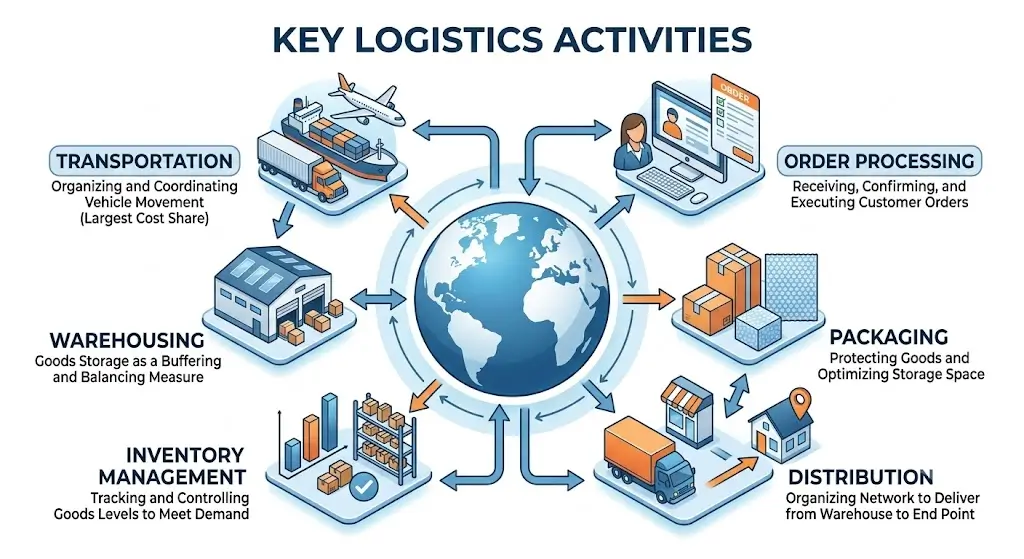
- Transportation: organizing and coordinating the transport of goods between points in the supply chain—from suppliers to warehouses, and from warehouses to points of sale or end customers. Transportation typically accounts for the largest share of costs in logistics operations. Choosing among common types of cargo trucks requires matching load capacity to shipment volumes and warehouse access.
- Warehousing: storing goods under suitable conditions, acting as a buffer between the time of production or import and the time of actual consumption. Full-service warehousing can support receiving, storing, and dispatching goods upon request.
- Inventory management: tracking and controlling the quantity of goods at any given time, ensuring inventory levels meet demand without tying up working capital unnecessarily.
- Packaging: protecting goods during transport and storage while optimizing space to reduce logistics costs. Businesses can proactively prepare packaging materials suited to specific product categories.
- Distribution: organizing the network to move goods from the warehouse to points of sale or directly to the customer.
- Order processing: receiving, confirming, and coordinating the order fulfillment process from the moment the customer places an order until successful delivery.
Logistics Objectives and Operational Principles
Effective logistics is often evaluated based on the "7 Rights" principle—a common framework helping businesses balance service quality and operating costs: See also cold chain logistics.
- Right product.
- Right quantity.
- Right condition and quality.
- Right place.
- Right time.
- The right customer.
- The right cost.
Achieving all seven rights at once is the ideal. In practice, delivery speed and cost often need to be balanced, so the logistics approach must suit the products, business model and warehouse location. For deliveries around Ho Chi Minh City, deciding which warehouse area can reduce transport costs belongs at the planning stage, before a lease is signed.
What Is Supply Chain Management (SCM)?
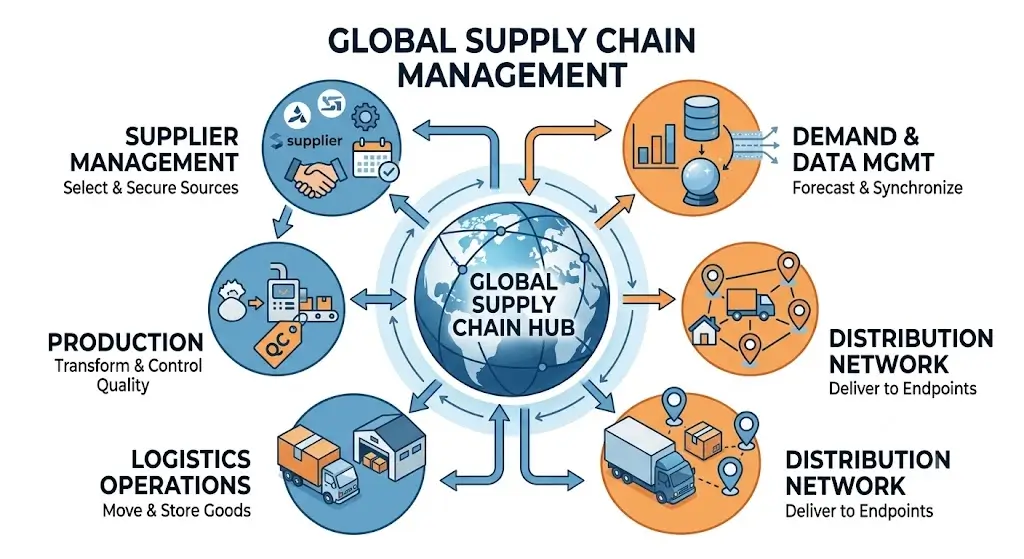
Supply Chain Management (SCM) is the process of planning, organizing, and controlling the entire flow of goods, information, and finances across the value chain—from raw material suppliers, through production and logistics, to the final consumer. Unlike logistics, which focuses on physical operations, SCM is strategic in nature and encompasses the relationships among various stakeholders throughout the entire supply ecosystem.
An effective SCM system not only optimizes operating costs but also enhances a business's forecasting capabilities, enables rapid responses to market fluctuations, and builds a sustainable competitive advantage through close collaboration among supply chain partners. Businesses can integrate self-managed warehouses to proactively handle entry and exit, inventory management, and goods coordination.
Scope and Links of SCM
- Supplier management: selecting, evaluating, and maintaining relationships with raw material suppliers to ensure a stable supply regarding quality, price, and delivery schedules.
- Production: transforming raw materials into finished goods through planning, manufacturing, and quality control processes.
- Logistics: handling the transportation and storage of goods between supply chain links; a core operational component within the scope of SCM.
- Distribution: moving products from production sites or central warehouses to points of sale or end customers via appropriate networks.
- Demand and data management: forecasting market trends and collecting/sharing data among parties to synchronize operations and minimize inventory surpluses or shortages.
SCM and Logistics — An Inclusive Relationship
- Logistics is a component within the broader scope of SCM; they are not entirely separate concepts.
- Logistics is responsible for the physical flow of goods, whereas SCM coordinates suppliers, production, finance, and data, as well as long-term demand fulfillment strategies.
- A business may deliver goods quickly and on time, yet its SCM remains inefficient if there is a lack of coordination between production, procurement, and demand forecasting. When deciding on resource allocation, businesses should also consider the choice between onshore and offshore models.
How Does Logistics Differ from Supply Chain Management?
The key difference lies in the scope of management. Logistics focuses on the transportation, storage, and distribution of goods, whereas supply chain management encompasses logistics as well as procurement, production, supplier management, demand forecasting, and distribution. Therefore, logistics is a component of SCM rather than an equivalent concept.
|
Criteria |
Logistics |
Supply Chain Management (SCM) |
|---|---|---|
|
Scope |
Narrower; focuses on the physical flow of goods |
Broader; encompasses the entire value chain |
|
Focus |
Transportation, warehousing, inventory, and distribution |
Sourcing, production, logistics, data, and partnerships |
|
Objective |
Delivering goods to the right place at the right time at a reasonable cost |
Optimizing overall performance, responsiveness, and competitive advantage |
|
Activities |
Transportation, warehousing, packaging, order processing |
Procurement, production, logistics, distribution, demand forecasting |
|
Timeframe |
Usually focuses on day-to-day operations |
Includes both operations and long-term strategy |
Goods that are sensitive to temperature or humidity need suitable storage conditions built into the logistics plan. Air-conditioned storage and refrigerated storage serve different temperature requirements; the right choice depends on the goods rather than the label alone.
What Role Does Logistics Play in the Supply Chain?
Logistics ensures the efficient transport and storage of goods between the various links of the supply chain. A well-organized system can reduce delivery times, control inventory, optimize transportation costs, and enhance the ability to meet customer demand.
- Goods transportation: ensures goods move along the correct routes and on schedule—from suppliers to warehouses, and from warehouses to customers.
- Warehouse and inventory management: maintaining optimal inventory levels to avoid shortages or surpluses that could impact cash flow and order fulfillment capabilities.
- Product distribution: designing a network to efficiently deliver products to the right sales points or end customers.
- Information flow management: tracking and sharing data on orders, inventory, and shipping status to facilitate timely coordination among parties.
- Supporting customer fulfillment capabilities: shortening delivery times, increasing order accuracy, and improving the customer experience.
For an online seller, storage and packaging costs come straight out of each order's margin. Practical ways to make online selling profitable by controlling costs therefore go hand in hand with inventory and delivery planning, not just advertising or pricing.
Key Components of Supply Chain Management
A supply chain typically comprises multiple links, ranging from raw material suppliers to the end customer. Key components include sourcing, procurement, production, inventory management, warehousing, transportation, distribution, information management, and partner relationship management.
- Sourcing and Procurement: identifying suppliers, purchasing raw materials, and managing relationships to ensure a stable supply at reasonable costs.
- Production: planning, executing production, and controlling quality to ensure output meets standards.
- Inventory Management: forecasting demand, controlling inventory levels, and maintaining safety stock to balance storage costs against order fulfillment capabilities.
- Warehousing: storing goods, picking, packing, and fulfillment. Regarding records and documents that require specific management, document storage services help with categorization and saving office space.
- Transportation & Distribution: organizing inbound transport, outbound transport, and last-mile delivery.
- Information & Data Management: tracking goods, managing orders, forecasting demand, and sharing data among supply chain partners.
Storage needs can fluctuate significantly due to seasonality. The seasonal warehousing model allows businesses to flexibly expand or reduce space during Tet, sales events, and festivals.
How Does a Supply Chain Work?
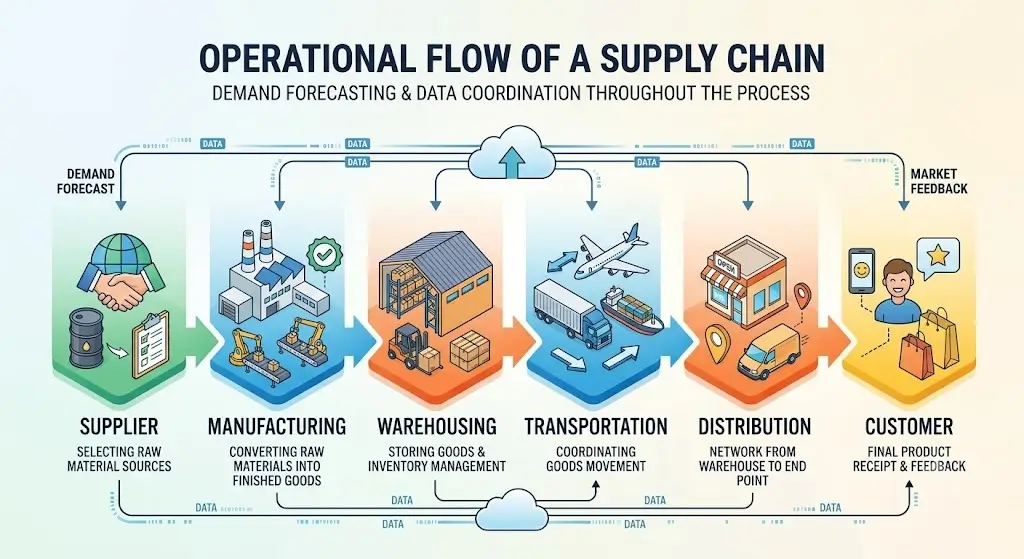
A supply chain typically begins with demand forecasting and raw material sourcing, then moves to production, warehousing, transportation, and product distribution to customers. Data is utilized throughout the process to coordinate resources and respond to market changes.
Supplier → Production → Warehouse → Transportation → Distribution → Customer
Demand Planning
This is the starting point that shapes all subsequent operational plans. Businesses analyze historical sales data, market trends, and seasonality to forecast future demand. The more accurate the forecast, the lower the risk of excess inventory or stockouts. Common tools include time-series analysis, machine learning models, and qualitative data from the sales team. Once the expected stock volume is clear, comparing storage prices by unit size helps create a realistic budget while leaving room to adjust as demand changes.
Sourcing & Procurement
Based on the demand plan, businesses search for, evaluate, and select suppliers that meet requirements regarding quality, price, and delivery capability. This stage involves contract negotiation, order placement, progress tracking, and the development of long-term partnerships to mitigate disruption risks. Supplier addresses should also be checked against regular inbound routes: lower rent may not offset the cost of longer or more frequent journeys.
Manufacturing
Raw materials are transformed into finished goods through processes such as production scheduling, assembly line operations, quality control, and performance management. Aligning production plans with demand forecasts helps prevent overproduction or the inability to fulfill orders.
Warehousing
After production, finished goods are counted, arranged according to FIFO or FEFO principles, and prepared for picking and packing when orders arrive. The warehouse acts as an important transfer point, allowing goods to be directed to different destinations. Understanding Grade A, B and C warehouse classifications helps match the facility's infrastructure to the operation; these are warehouse grades, not categories of stock.
Transportation
Goods are transported from the warehouse to distribution points or directly to customers via road, sea, air, or rail. Selecting the optimal mode, load capacity, and route directly impacts logistics costs and delivery times. Airport-bound routes need to be assessed using actual journey times. MyStorage locations should also be compared by their access and unloading arrangements, not just their addresses.
Distribution
Goods are delivered to retail stores, agents, or directly to consumers in e-commerce models. Distribution networks must ensure market coverage while controlling costs and inventory levels at each location. When customers are concentrated in the city centre, a nearby storage point can ease deliveries. The decision should balance space costs against transport time rather than favouring a distant warehouse solely for lower rent.
Customer
Customers receive products and experience services. Feedback regarding delivery times, product quality, and after-sales support is fed back into Demand Planning, creating a continuous improvement loop for the entire supply chain. Small shops can look to the model of warehousing mobile phone accessories for online shops. to organize SKUs more compactly.
The Role of Logistics and SCM for Businesses
Logistics and supply chain management help businesses control the flow of goods, reduce operating costs, and enhance customer responsiveness. When managed effectively, the supply chain also boosts competitiveness, mitigates disruption risks, and optimizes the use of warehousing, transportation, and inventory resources.
- Cost optimization: reducing transportation, warehousing, and excess inventory costs through efficient resource coordination.
- Reduced delivery times: shortening the time from order placement to product receipt thanks to optimized processes.
- Inventory control: maintaining appropriate stock levels to avoid shortages or surpluses that tie up capital.
- Improved customer experience: delivering on time and in the correct quantity and quality boosts satisfaction and customer retention.
- Increased competitiveness: a flexible supply chain enables businesses to respond more quickly to market fluctuations.
- Risk reduction: forecasting and contingency planning help mitigate the impact of supply or transportation disruptions.
A new business can test its supply capacity on a small scale before expanding. A warehouse for market testing can reduce the risk of a long lease. A realistic budget brings together expected stock volumes, travel costs and the area being served, rather than rent alone.
For boxed goods, the right packaging size and quality help reduce damage, simplify stacking and make better use of space. Agree on carton specifications before estimating the area required. That way, when considering storage rental in Ho Chi Minh City, businesses can compare the same stock volume and layout instead of looking only at the price per square metre.
FAQs on Logistics and Supply Chain Management
Are logistics and supply chain management the same?
No. Logistics focuses on transportation, warehousing, inventory, and distribution; SCM encompasses sourcing, procurement, production, finance, data, logistics, and partner relationships. Logistics is a key component of SCM.
How does logistics fit into the supply chain?
Logistics connects the links through the flow of goods and information: receiving raw materials, moving goods into storage, warehousing, order processing, transportation, and delivery. If logistics is disrupted, production plans and the entire chain's ability to serve customers are affected.
Do small businesses need supply chain management?
Yes. Even small-scale operations require demand forecasting, supplier selection, inventory control, and delivery tracking. Businesses can start with simple processes, clear metrics, and flexible warehousing services rather than investing in massive systems from the outset.
What metrics are used to evaluate logistics performance?
Commonly used metrics include the On-Time In-Full (OTIF) rate, inventory accuracy, inventory turnover, logistics costs as a percentage of revenue, order processing time, damage rate, and return rate.
What roles do WMS and TMS play in logistics?
A WMS supports the management of storage locations, inbound and outbound operations, inventory levels, and warehouse picking and packing. A TMS assists with transport planning, route selection, vehicle tracking, and delivery cost control. When integrated, the two systems synchronize warehouse and transportation data more effectively.
How can logistics costs be reduced without compromising service quality?
Businesses should standardize packaging, classify inventory by priority, optimize delivery routes, accurately forecast demand, and select warehouse locations close to target markets. Flexible warehousing options also help convert fixed costs into variable costs based on demand.
How do Incoterms affect logistics and the supply chain?
Incoterms define the responsibilities, costs, and risks shared between the seller and the buyer at specific delivery points. The chosen term directly influences who arranges transport, purchases insurance, handles customs procedures, and bears the risk while goods are in transit.
Should a business manage its own logistics operations or hire a 3PL provider?
Self-operation is suitable when a business has stable output, a specialized team, and sufficient resources to invest in warehouses, vehicles, and technology. Outsourcing to a 3PL provider is appropriate when rapid expansion is needed, fixed costs need to be converted into variable costs, or access to a professional transportation network is required.
How do you choose the right warehouse location for a supply chain?
Factors to evaluate include proximity to suppliers and customers, transit times, truck accessibility, rental costs, risks of flooding or traffic congestion, and scalability. An optimal location balances total logistics costs; it is not necessarily the warehouse with the lowest rent.
What is reverse logistics?
Reverse logistics is the process of moving goods from the customer back to the seller, distributor, or manufacturer for returns, repairs, reuse, recycling, or disposal. A clear process helps minimize losses, recover product value, and improve the after-sales experience.
Logistics is the operational foundation that ensures the efficient movement and storage of goods, whereas supply chain management is the strategic system coordinating the entire flow of goods, information, finances, and partners from the source of supply to the customer. Distinguishing between these two concepts helps businesses identify areas for improvement, select appropriate technologies, and build more flexible logistics networks.
When a business needs to expand capacity, optimize inventory, or test new markets, a flexible storage solution can help reduce the burden of initial investment. MyStorage offers various options based on cargo type, rental duration, and the level of operational support, allowing businesses to remain proactive at every stage of their growth.
Related articles
Article
What Is Cold Chain Logistics? Process, Standards and Solutions
Cold chain logistics keeps temperature and humidity within a strict range from origin to consumer. This guide covers the standard temperature bands, the four-step process, GDP and HACCP…
Read article
Article
What Is Cycle Counting? How to Run It Without Stopping Sales
Cycle counting means counting part of your stock on a repeating schedule instead of closing the warehouse for a full count. This guide covers ABC classification, how to schedule counts, a…
Read article
Article
What Is a WMS? Functions, Benefits and How to Choose a Warehouse Management System
A WMS is warehouse management software that digitises the flow of goods from receiving and location assignment to real-time stock control, picking and dispatch. This guide covers its core…
Read article
