 Tiếng Việt
 한국어
한국어 日本語
日本語Article· Updated October 5, 2026
What Is 3PL? Third-Party Logistics, Services, Benefits and How to Choose
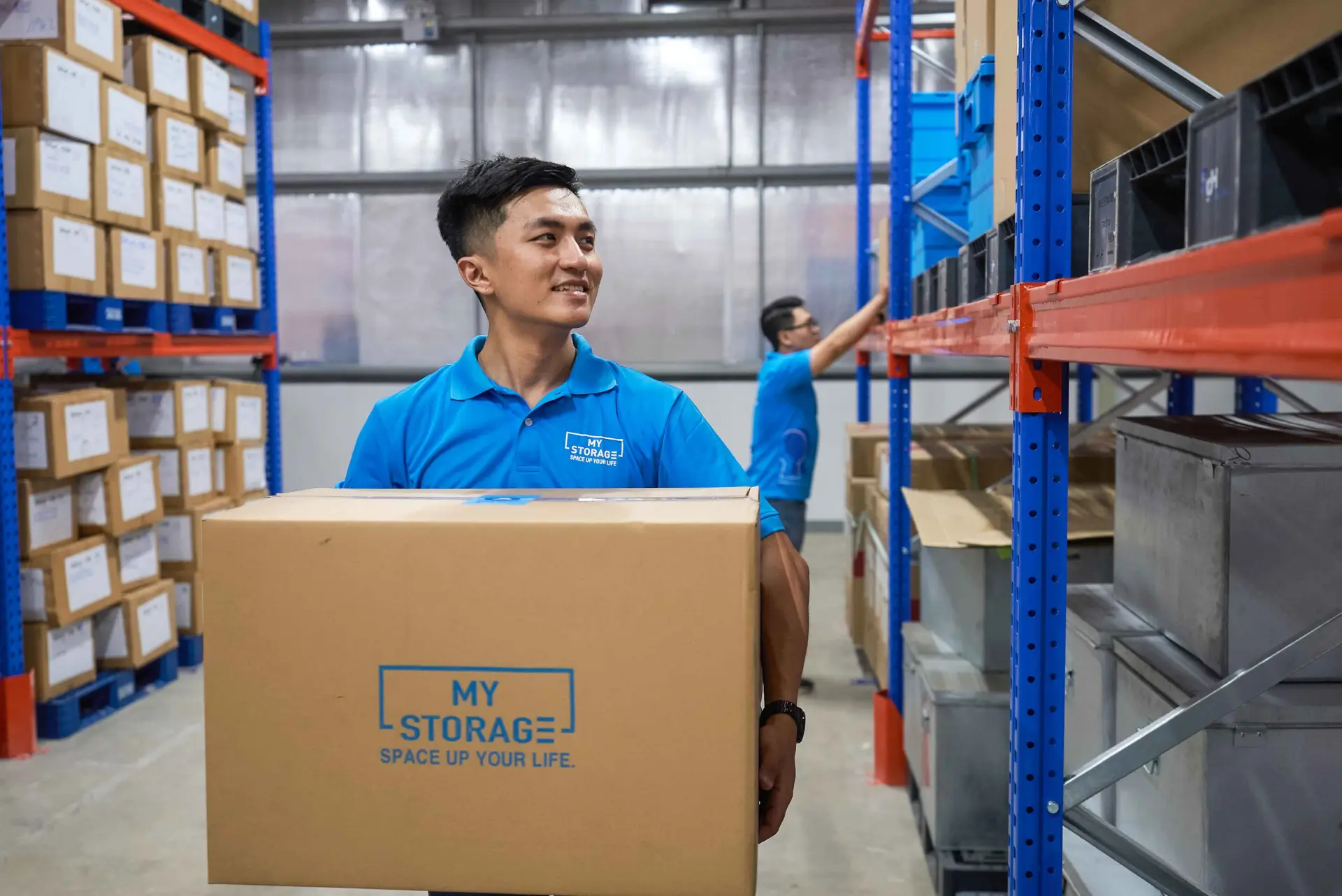
3PL (Third-Party Logistics) is a model in which a business hires an external logistics provider to handle one or more activities, such as transportation, warehousing, inventory management, packing, fulfillment and distribution. Compared with running logistics in-house, 3PL gives businesses access to the specialist expertise and existing logistics infrastructure of a third-party provider.
What Is 3PL?
3PL, short for Third-Party Logistics, refers to outsourced logistics services: a business hires an external provider to handle some or all of its logistics activities. Common services include warehousing, transportation, inventory management, packing, fulfillment and goods distribution.
What Does Third-Party Logistics Mean?
A “third party” is an independent logistics company, rather than the manufacturer (the first party) or the customer (the second party). It acts as an intermediary that performs logistics activities on behalf of the business. Instead of investing in its own infrastructure and workforce, the business signs a service contract to outsource part of its supply chain to a 3PL provider.
How Does 3PL Work?
A 3PL provider receives goods from a business, stores them in a warehouse, processes orders as requested and delivers them to end customers. The entire process follows an agreed service-level agreement (SLA). Inventory and order data are usually synchronized so that the business can monitor operations in real time.
How Does 3PL Differ from In-House Logistics?
The main differences are the investment required, the degree of control and how the business organizes its operational resources. The comparison table below provides an overview, while these three points explain the trade-offs between the two models.
- A business running logistics in-house must invest in warehouses and transport vehicles, and recruit its own logistics employees.
- 3PL allows a business to use a provider’s existing infrastructure and workforce without investing in them directly.
- In-house operations provide full control. With 3PL, however, the business coordinates and monitors performance through service metrics (SLA/KPI) instead of directly managing every stage.
The key differences are the level of investment and the way operations are controlled.
|
Criterion |
In-house logistics |
3PL |
|---|---|---|
|
Infrastructure |
Invest in your own warehouses, vehicles and systems |
Use the provider’s existing infrastructure |
|
Workforce |
Recruit and train your own staff |
The 3PL provider’s specialist team |
|
Control |
Direct management of every stage |
Monitoring through SLA/KPI |
|
Scalability |
Depends on owned assets |
Flexible according to volume |
Which Businesses Commonly Use 3PL?
- E-commerce: needs to process large order volumes and deliver quickly.
- Retail and distribution: require storage across several geographic areas.
- Manufacturing: seeks to separate logistics from core production activities.
- Businesses entering new markets: may not want to invest in infrastructure from the outset.
- Seasonal businesses: experience substantial fluctuations in logistics demand.
What Services Does 3PL Include?
Depending on the provider, a business can purchase individual services or an integrated solution covering warehousing, fulfillment, transportation and order management.
- Warehousing and goods storage: receiving, storage and inventory management within the 3PL provider’s warehouse network.
- Inventory management: real-time tracking, stocktaking, SKU management and inventory reporting.
- Order fulfillment: receiving orders, picking, packing and handing goods over for shipment.
- Transportation and distribution: inbound, outbound and last-mile delivery.
- Packing and goods handling: meeting product standards and shipping requirements.
- Reverse logistics: handling exchanges and returns, defective-product recalls and returned shipments.
- Value-added services: labeling, kitting, repacking and cross-docking.
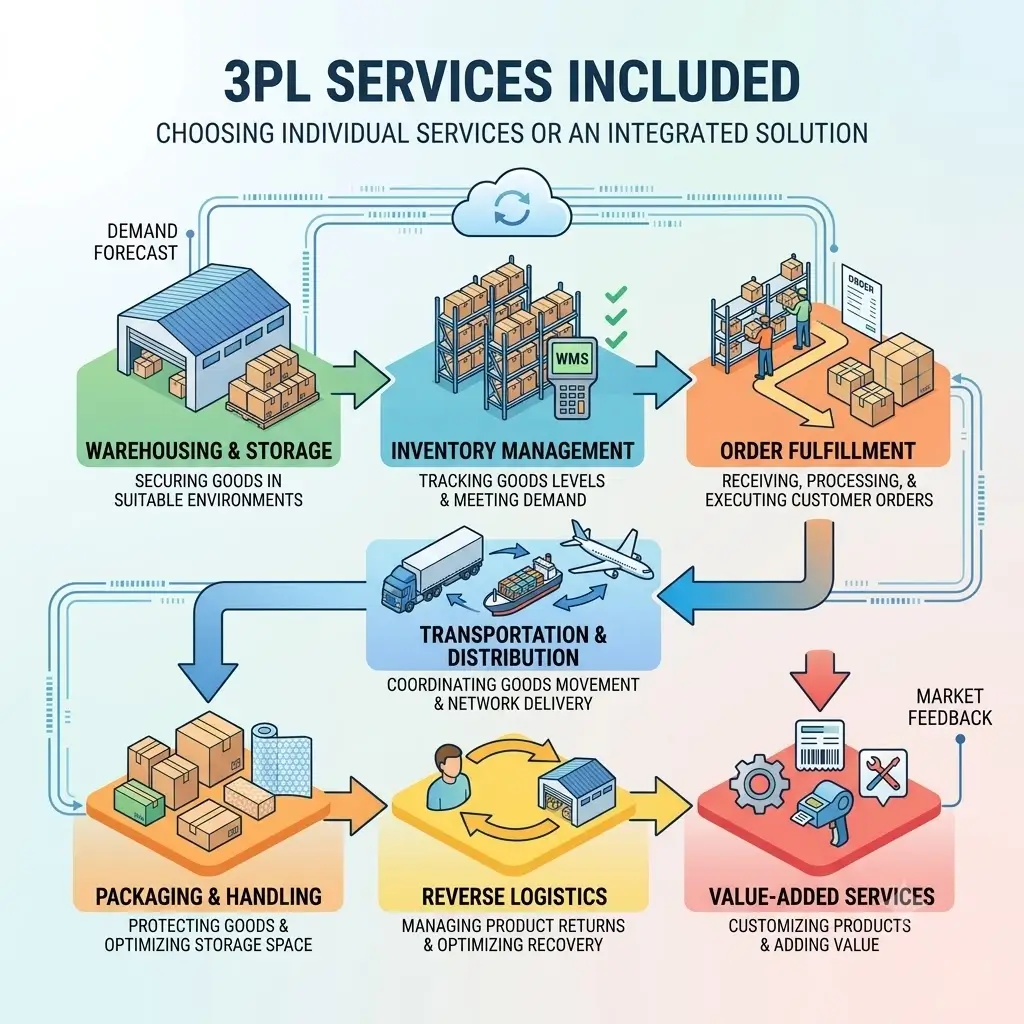
Overview of the services provided by an integrated 3PL model.
The 3PL Operational Workflow
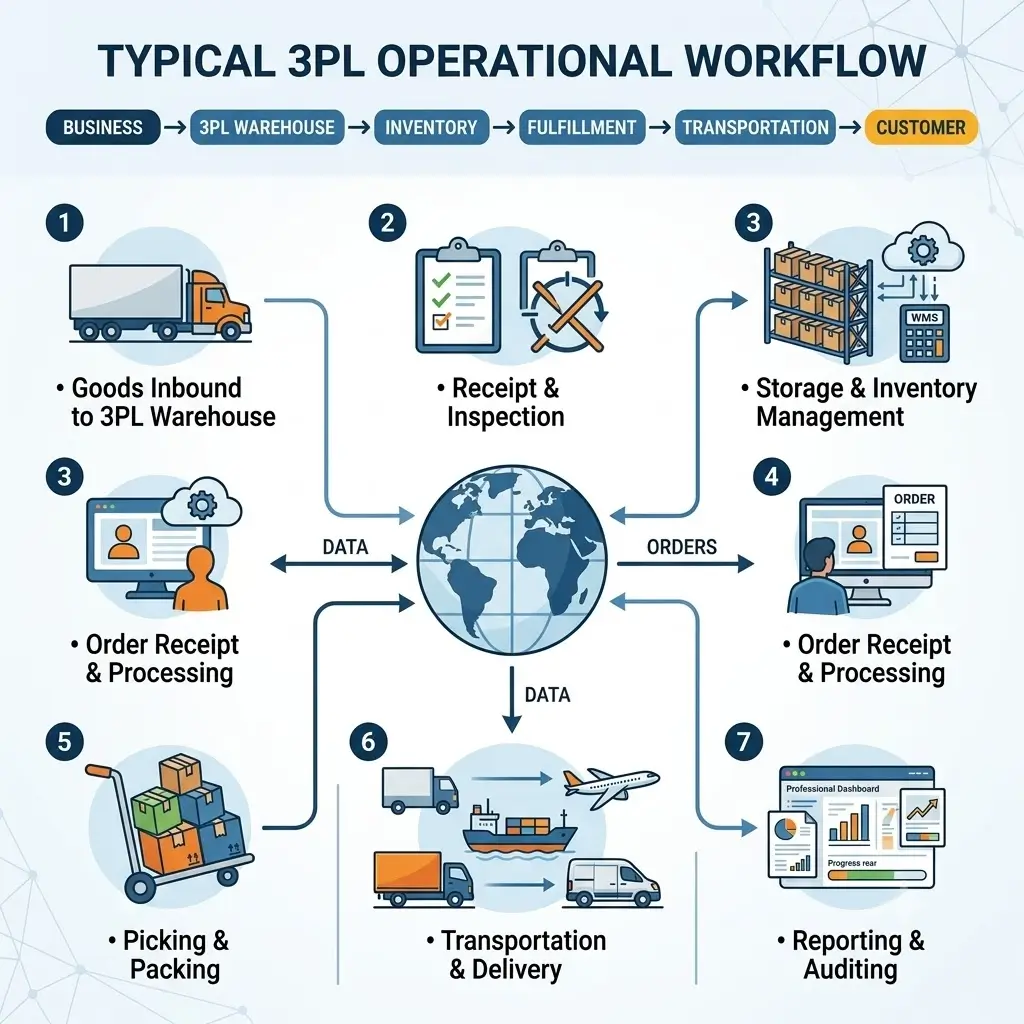
In a 3PL model, a business delegates one or more logistics stages to a partner. A typical flow is: Business → 3PL Warehouse → Inventory → Fulfillment → Transportation → Customer.
Diagram of the 3PL workflow, from goods receipt to delivery and reconciliation.
- Step 1: Send goods to the 3PL warehouse. Goods are transported from the factory or supplier to the warehouse.
- Step 2: Receive and inspect goods. Count the goods, check the documentation and inspect the condition of incoming stock.
- Step 3: Store goods and manage inventory. Organize and store goods and update the WMS.
- Step 4: Receive and process orders. Orders from the business or end customers enter the 3PL system.
- Step 5: Pick and pack. Pick the ordered items and pack them to the agreed standards.
- Step 6: Transport and deliver. Hand shipments over to the carrier for delivery to end customers.
- Step 7: Report and reconcile. Provide reports on inventory, orders and delivery status.
Benefits of 3PL for Businesses
- Lower upfront investment: no need to build a warehouse or buy your own vehicles.
- Access to warehouse and transport infrastructure: use an existing network without spending time establishing it.
- Lower operational staffing needs: reduce the need to recruit and train warehouse, picking and packing teams.
- Focus on core activities: direct resources toward production, sales and product development.
- Easier scaling: increase or decrease storage and order-processing capacity flexibly as demand changes.
- Better fulfillment: use specialist processes and technology to improve speed and accuracy.
- Access to new markets: shorten delivery times through a warehouse network spanning multiple areas.
What Are the Disadvantages of 3PL?
3PL can reduce direct control, increase a business’s dependence on its partner’s service quality and generate costs according to the scope of services used. The SLA, responsibilities, data arrangements and fees should be clearly defined before cooperation begins.
- Less direct control: the business no longer manages every operational stage itself.
- Provider dependency: the 3PL provider’s capabilities and stability directly affect results.
- Complex pricing: storage, handling and transportation may be charged separately.
- Service-quality risks: order errors or delivery delays affect the customer experience.
- System integration: the WMS and APIs must be compatible with existing sales platforms or ERP systems.
- Data security: clear confidentiality commitments are needed for order, customer and inventory data.
Which Industries Is 3PL Suitable For?
3PL is particularly suitable for industries with fluctuating goods volumes, many SKUs, fast-delivery requirements or plans to enter new markets without immediately investing in their own warehouse and operations team. Suitability depends not only on the industry but also on order volume, storage requirements, distribution coverage and the ability to integrate data between the business and its logistics partner.
For example, e-commerce and fashion businesses often need fast order processing, flexible packing and returns management. FMCG, retail and manufacturing businesses, meanwhile, need reliable storage capacity, inventory control and distribution coordination. For pharmaceuticals or goods requiring special storage conditions, businesses should prioritize partners with suitable infrastructure, quality-control procedures and standards.
The table below offers a quick comparison of each industry’s core requirements. When selecting a 3PL provider, businesses should also assess SKU counts, inbound and outbound frequency, return rates, documentation requirements and delivery areas to develop an SLA that reflects actual operations.
|
Industry |
Common 3PL requirements |
|---|---|
|
E-commerce |
Fulfillment, last-mile delivery |
|
Retail |
Warehousing, distribution |
|
FMCG |
Storage, distribution |
|
Fashion |
Fulfillment, reverse logistics |
|
Electronics |
Warehousing, inventory management |
|
Manufacturing |
Inbound/outbound logistics |
|
Pharmaceuticals |
Storage and transportation meeting specific requirements |
|
Consumer goods |
Warehousing, fulfillment, distribution |
What Is Included in 3PL Service Costs?
Indicative costs in Ho Chi Minh City: For ordinary goods, businesses should budget for each operational stage rather than looking only at warehouse rental prices. The table below shows common indicative rates, which may vary with product type, SKU count, volume and service terms.
|
Item |
Indicative fee |
Common charging basis |
|---|---|---|
|
Ambient storage |
Approx. VND 250,000–400,000/pallet/month |
Per pallet, floor area or storage position |
|
Goods receipt (inbound) |
Approx. VND 2,000–8,000/carton or VND 10,000–30,000/pallet |
Counting, labeling and system entry |
|
Pick & pack |
Approx. VND 2,000–5,000/order with 1–3 SKUs |
Per order, SKU or packing specification |
|
Order processing/fulfillment |
Approx. VND 5,000–15,000/order |
Depends on SKU count and packing requirements |
|
Outbound |
Approx. VND 3,000–8,000/order |
Warehouse dispatch fee, excluding delivery charges |
|
Value-added services |
Quoted separately |
Labeling, kitting, repacking, cross-docking |
These rates are indicative only at the time of writing. Actual quotations must reflect the industry, volume, storage conditions and scope of the SLA.
Costs depend on the service type, storage area or stock volume, order count, handling method, transportation and value-added services. Businesses should assess total logistics costs rather than comparing only storage unit rates.
- Storage fees: based on floor area, pallets or SKUs.
- Inbound fees: receiving, counting and putting goods into storage.
- Picking and packing fees: based on the number of orders or items handled.
- Fulfillment fees: a package covering receipt through handover for transportation.
- Transportation fees: based on distance, weight, volume and transport mode.
- Inventory-management fees: tracking, stocktaking and periodic reporting.
- Value-added service fees: labeling, kitting, repacking or cross-docking.
Total 3PL cost = Storage fees + Goods-handling fees + Fulfillment fees + Transportation fees + Additional-service fees.
Indicative 3PL Prices in Vietnam
Prices vary by area, warehouse type and operating model. The figures below are indicative at the time of writing in September 2026.
|
Item |
Indicative price range |
|---|---|
|
Approx. USD 4.5–6/m²/month |
|
|
Ambient pallet storage |
Approx. VND 250,000–400,000/pallet/month in Ho Chi Minh City |
|
Approx. VND 600,000–900,000/pallet/month |
|
|
Approx. VND 1,200,000–1,800,000/pallet/month |
|
|
Pick & pack |
Approx. VND 2,000–5,000/order with 1–3 SKUs |
|
Outbound |
Approx. VND 3,000–8,000/order |
These figures are indicative only and may vary by area, product type, volume and each provider’s policies. Businesses should request a detailed quotation based on their actual requirements.
How to Choose a 3PL Provider
When selecting a 3PL provider, assess its warehouse network, locations, operational capacity, technology, fulfillment capabilities, transport coverage, SLA and total costs.
- Warehouse locations and network: proximity to demand centers or multiple warehouse sites can shorten delivery times.
- Floor area and capacity: sufficient for current needs, with room to expand.
- WMS: accurate real-time inventory tracking.
- API integration: connectivity with sales platforms, websites or ERP systems.
- Fulfillment capability: assess order-processing speed and accuracy.
- Transport network: directly affects delivery times and delivery costs.
- SLA and KPIs: clarify order processing, on-time delivery and accuracy.
- Scalability: the ability to handle sudden increases in volume.
- Fire prevention and safety: warehouses must meet storage regulations.
- Costs and contracts: clarify fees, payment and termination terms before signing.
3PL allows a business to delegate some or all of its logistics activities, including storage, inventory management, order processing and transportation, to a specialist partner. This model suits e-commerce, retail, FMCG and other industries that need flexible storage and distribution expansion without taking on substantial upfront investment.
Before partnering with a provider, businesses should:
- Define their logistics requirements: storage, fulfillment, transportation or a complete package.
- Compare capabilities: assess providers’ warehouse locations and technology.
- Clarify the SLA: costs and responsibilities in the contract.
- Request a detailed quotation: rather than relying only on indicative prices.
Choosing the right model and a suitable 3PL partner helps businesses optimize logistics costs, improve delivery speed and focus resources on their core business activities.
Frequently Asked Questions About 3PL
1. What is 3PL?
3PL is third-party logistics: a business hires an external partner to provide warehousing, transportation, fulfillment or inventory management.
2. How does 3PL differ from fulfillment?
Fulfillment is one part of 3PL, focusing on order processing. 3PL may also cover warehousing, transportation and distribution.
3. Should small businesses use 3PL?
It can be suitable, especially when they do not yet want to invest in their own warehouse, vehicles and operations team, or when order volumes fluctuate seasonally.
4. How are 3PL costs calculated?
Costs usually include storage, inbound handling, picking and packing, fulfillment, transportation and additional services.
5. Can 3PL manage inventory in real time?
Many 3PL providers use a WMS to update stock levels, SKUs and reports. Businesses should clearly confirm the scope of available data in the contract.
6. What is an SLA in 3PL services?
An SLA is a service-level agreement that may specify order-processing times, accuracy, on-time delivery rates and incident-handling procedures.
7. Does 3PL handle returns?
Yes. Reverse logistics usually includes receiving returns, sorting and inspecting them, and restocking or processing them according to the applicable rules.
8. When should a business run logistics in-house instead of using 3PL?
In-house logistics suits businesses with stable volumes, a need for detailed control and sufficient resources to invest in infrastructure and staff.
9. What should be checked before signing a 3PL contract?
Check the SLA, fee schedule, WMS/API systems, data security, insurance, fire safety, warehouse capacity and liability terms.
10. Can 3PL support expansion into new markets?
Yes. A 3PL provider’s warehouse and transport network can help a business establish distribution in new areas more quickly.
Related articles
Article
Rent a Ready-Built Warehouse or Build Your Own? Comparing Costs and Timelines
When expanding storage and distribution capacity, business leaders often face a critical strategic decision: should they rent a ready-built warehouse or invest their own capital in building…
Read article

Article
Can You Use an Apartment as a Warehouse or Office? Space Solutions for Online Shops and Small Businesses
Is it legal to rent an apartment as a warehouse or office? Explore the rules, risks, and suitable storage solutions for online shops and small businesses.
Read article
Article
Combining Storage Rental and Livestreaming for Online Shops: An Efficient Operating Model
Combining storage rental with a livestreaming space is a modern operating solution that allows online sellers to integrate product storage, sample preparation, live sales sessions, and…
Read article
