
 Tiếng Việt
 한국어
한국어 日本語
日本語Article· Updated October 22, 2026
Warehouse Security Systems: CCTV, Access Control, Humidity & Fire Safety
On this page
The security system in the warehouse not only includes surveillance cameras but also needs to combine access control, environmental condition monitoring, incident warning and fire protection systems. A safe warehouse needs to simultaneously control risks such as unauthorized access, loss of goods, inappropriate humidity or temperature, and fire and explosion risks.
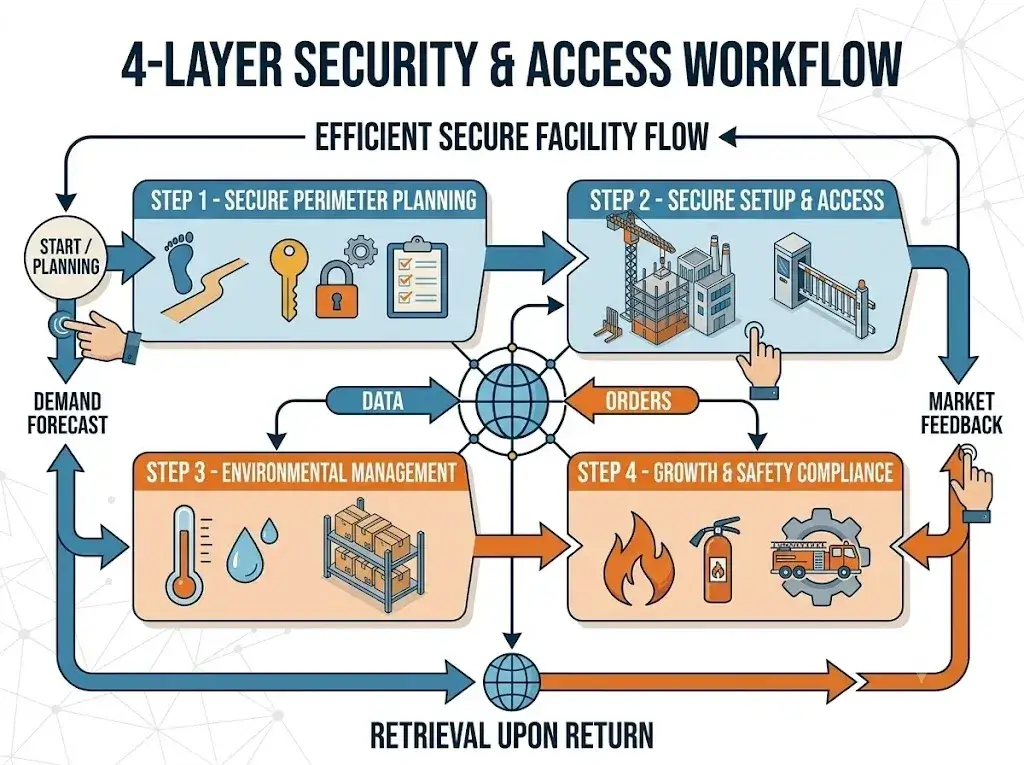
The entire system can be visualized in a series of four consecutive layers: Security, Access Control, Environment, Fire Safety. The necessary level of each layer in this chain is not the same between warehouses, but depends on the type of goods being stored, the value of the shipment, warehouse size and actual operating characteristics.
1. Layers in the Warehouse Security System
A warehouse security system often includes many layers of control: surveillance cameras (CCTV) for observation, access control systems to limit access, environmental sensors to monitor temperature and humidity, and fire protection systems to detect, warn and handle fire risks. These layers need to be designed to work together, rather than operating separately as unrelated independent systems.
Each layer in the warehouse security system undertakes a separate goal, but when combined, it will form a much more comprehensive protection chain than investing in just a single system:
Why Is Just Having a Camera Not Enough?
Many businesses when looking for warehouses often just ask "does the warehouse have a camera" but forget that cameras only solve a small part of the entire security problem. In fact, the camera has obvious limitations:
- Cameras are mainly used for recording and monitoring after the incident has occurred
- Cameras cannot by themselves prevent unauthorized people from entering the warehouse
- The camera cannot control storage conditions such as temperature or humidity
- Cameras are not a substitute for fire alarm or fire protection systems
- Cameras alone do not guarantee access to the entire entry and exit process of each individual
This is why professional warehouse now moves towards a multi-layer security model, in which cameras are just a link, not the whole solution.
Distinguish Between Security and Warehouse Safety
These two concepts are often used interchangeably, but actually refer to two different groups of risks that a professional warehouse needs to manage simultaneously:
- Security focuses on preventing intrusion, theft and unauthorized access to storage area
- Safety focuses on fire prevention, environmental conditions, equipment operations and emergency exits
A warehouse that is only strong in security but weak in safety (or vice versa) still poses great risks to the goods and people inside.
2. CCTV Cameras in the Warehouse: Monitoring and Troubleshooting
CCTV cameras in the warehouse help monitor key areas such as doors, storage areas, loading and unloading area, import-export areas and points with high risk of loss. The real value of the camera system lies not only in recording, but also in the ability to retrieve events, accurately determine the time and area of the incident when investigation is needed.
Location Where the Camera Needs to Be Installed
The camera arrangement needs to cover all potential risk points, not just stopping at the main entrance. Locations that should be prioritized for camera installation include:
- Warehouse gate
- Doors to functional areas
- Import and export area
- Cargo loading and unloading area
- Storage area for high-value goods
- Corridors and main walkways
- Packaging area
- Parking lot and area outside the warehouse
- Points delivery of goods
Necessary Features of Warehouse Cameras
Not all cameras are suitable for use in a warehouse environment. An effective warehouse camera system should have the following features:
- Recording resolution is suitable for detailed recognition requirements
- Ability to observe in low light conditions (infrared at night)
- Wide viewing angle to reduce blind spots
- Ability to store data for a long enough period of time
- Remote access and review capabilities
- Motion detection feature
- Warning when detecting unusual activity
- Ability to integrate with other warehouse management systems
The Value of 24/7 Camera Monitoring
Many warehouse rental units often advertise "24/7 cameras" as a plus point, but the real value lies in the chain of benefits behind this phrase: continuous monitoring helps maintain visibility throughout, thereby making incident investigation much easier than a system that only records at certain hours. This ability is especially valuable in situations such as:
- Lost goods
- Goods were damaged for unknown reasons
- Disputes during the delivery process
- Unauthorized person appears in the warehouse
- The incident occurred in the loading and unloading area
3. Access Control and Access Logs
Access control helps businesses determine who is allowed to enter the warehouse, which areas and at what times. When combining an access control system with cameras and access logs, businesses get a full event retrieval system, instead of just knowing in general "someone entered the warehouse" without being able to specifically determine who it is.
Forms of Entry and Exit Authentication
Depending on the budget and required level of security, businesses can choose one or a combination of the following forms of authentication:
- Magnetic card or RFID card
- PIN code
- Fingerprint
- Face recognition
- Electronic lock
- Access control system integrated with management software
Decentralize Authority by Warehouse Area
Not every area in the warehouse should be open to everyone. Area-based access permissions helps minimize the risk of unauthorized access to sensitive areas, you can refer to the following decentralization model:
Log in and Out and Compare Data
The access log is an indispensable accompanying data of the access control system, helping businesses accurately answer questions when needing to re-check the incident:
- Who entered that area?
- At any specific time
- In which area in the warehouse?
- Support investigation when problems arise
- Control activities of personnel and external contractors
- Cross-reference with camera recording data
By combining three data sources simultaneously, businesses get a much more complete picture than if they only rely on a single system. The role of each system can be summarized in the following framework: the access control system answers the question of who is allowed in, surveillance cameras answer the question of what happened, and the access log answers the question of when the incident happened. When these three data sources are collated together, a business's ability to retrieve and clarify facts will be significantly more accurate than relying on just a single source.

4. Monitor Temperature and Humidity in the Warehouse
Controlling humidity in the warehouse helps reduce the risk of goods being affected by unsuitable storage environments, especially with papers, textiles, furniture, electronics, packaging and other moisture-sensitive products. Environmental monitoring systems often include temperature and humidity sensors, continuous monitoring data, and warning mechanisms when parameters exceed pre-set thresholds.
Risk of Inappropriate Humidity
Improper humidity can cause different types of damage depending on the type of goods being stored, specifically as follows:
- Mold grows on the surface of goods
- Corrosion to metal parts
- Damaged packaging
- Warping of wooden furniture and organic materials
- Reduces the overall quality of the product
- Affects papers and archives
- Affects electronic goods or other sensitive groups of goods
Environmental Monitoring and Treatment Process
A complete environmental monitoring system usually operates in a series of four consecutive steps: sensing, monitoring, warning, processing. Specifically, this process usually takes place as follows:
- Humidity sensors are installed at important locations in the warehouse
- The system records data continuously over time
- The system detects when parameters exceed allowable thresholds
- Send a warning to the department in charge
- Personnel do actual inspection at the scene
- Adjust the air conditioning system or dehumidifier if necessary
Is It Necessary to Simultaneously Monitor Temperature and Humidity?
The answer is yes, especially for warehouses with specific storage requirements for each type of goods, because temperature and humidity often affect product quality at the same time. The level of concern between these two factors varies depending on the type of product, you can refer to the following table:
It should be noted that a "standard" relative humidity level should not be applied to all types of goods, because the appropriate parameter threshold must be determined based on the specific characteristics of each type of goods and individual storage requirements, instead of mechanically applying a fixed number to the entire warehouse.
5. Fire Protection System in Warehouse
Fire protection in the warehouse needs to be approached as a complete system of prevention, detection, warning and fire fighting or incident response, instead of just equipping a few fire extinguishers for the sake of it. Items may include fire alarm systems, fire extinguishing equipment, and automatic fire sprinkler systems appropriate to the risk of the facility, along with clear escape plans and response procedures.
Current Fire Prevention Regulations in Vietnam
In Vietnam, the Law on Fire Prevention, Fighting and Rescue No. 55/2024/QH15 was passed by the National Assembly on November 29, 2024 and takes effect from July 1, 2025. Decree 105/2025/ND-CP issued on May 15, 2025 detailing a number of articles and measures to implement this Law, also takes effect from the same time. When evaluating legal requirements on fire protection for warehouses, businesses should refer to these current documents instead of previous old regulations.
Fire Protection Items Required
A full fire protection system for a warehouse usually includes the following items:
- Fire detection and alarm system
- Portable fire-fighting equipment
- Automatic fire sprinkler system or other suitable fire extinguishing system
- Water source for fire fighting according to design
- Escape route
- Signs and emergency exit instructions
- Warning system when there is a problem
- Plan periodic inspection, maintenance and drills as required
According to current regulations, the facility must meet fire safety conditions, including equipping appropriate fire prevention and fighting equipment and systems, fire alarm communication equipment according to the prescribed roadmap, developing fire fighting and rescue plans, and working with forces to perform fire prevention and fighting tasks at the facility in accordance with the law.
The Risk of Fire and Explosion Is Common in Warehouses
Warehouses often concentrate many factors that increase risk of fire and explosion Compared to other types of construction, including:
- Carton packaging in large quantities
- Wooden or plastic pallets
- Other flammable materials
- Goods are stored at high density
- Electrical equipment system for operation
- Some groups of goods have specific dangerous properties
This level of risk is even more noteworthy when looking at actual data: according to statistics from the Police Department of Fire Prevention, Fighting and Rescue (Ministry of Public Security), in 2023 the whole country recorded 3,440 fires, of which among the cases whose causes were clearly investigated, 1,345 cases stemmed from electrical system or equipment failures, accounting for about 58.6% of the total number of cases with the cause clarified. With the typical use of many electrical equipment for lighting, forklift operation, refrigeration systems or packaging machinery, warehouses are high-risk environments related to this group of causes. Therefore, fire protection design for warehouses needs to consider the type of goods, storage method, density of goods and specific project characteristics. An identical checklist should not be applied to all types of warehouses.
Points to Check Before Renting a Warehouse
Before sign a warehouse rental contract, you should request an actual review of the following fire protection items, instead of just relying on the lessor's recommendation:
- Records and legal documents related to fire prevention and fighting of the facility
- Fire alarm system
- Fire fighting system
- Automatic fire sprinkler system if equipped
- Emergency exit
- Emergency escape sign
- Portable fire-fighting equipment
- Procedures for handling problems
- Periodic system inspection and maintenance schedule
See more: What is Warehouse Fire Protection? Regulations and Standards You Need to Know
6. Checklist for Assessing Warehouse Security and Safety
When choosing a warehouse, businesses should not just ask "does the warehouse have cameras" but need to evaluate the entire security chain: cameras, access control, environmental conditions, fire protection, incident management processes and data retrieval capabilities. This checklist should be assessed flexibly according to the type of goods and actual risk level of each business, instead of mechanically applying it to all cases.
Camera and Access Control
The first group of criteria to check is directly related to the warehouse's ability to monitor and control access:
- Cameras are installed in key areas
- Ability to retrieve camera data when needed
- There is an access control system
- There is decentralization for each specific area
- There is a log of entries and exits
- Have separate procedures for customers or outside contractors
Conditions for Storing Goods
The second group of criteria is related to the ability to protect the quality of goods against the impact of the storage environment:
- There are regular temperature measurements
- Have regular humidity measurements
- There is a warning when the parameter exceeds the allowed threshold
- Have an air conditioning system or dehumidifier when necessary
- There is a handling process when abnormal parameters are detected
Ability to Respond to Fire and Explosion
The third group of criteria evaluates the warehouse's readiness to respond to fire and explosion risks:
- There is a fire alarm system
- Equipped with fire fighting equipment
- Have an automatic fire sprinkler system or other suitable system
- There is a clear escape route
- There are complete instructions
- There is a regular inspection and maintenance schedule
- Have a specific incident response plan
Operating Procedures and Personnel
The final group of criteria evaluates the actual operating capacity of the warehouse management team, a factor that is often overlooked but greatly affects the effectiveness of the entire security system:
- There are security personnel on duty at the warehouse
- Have a clear troubleshooting process
- There is someone specifically responsible for each item
- There is periodic backup of camera data
- Have a clear delivery and receipt process
- There is a process for reporting incidents to relevant parties
Investment Costs for Warehouse Security Systems
The cost of investing in a security system for a warehouse depends on the amount of equipment and technology used and the area to be covered. Below is the general reference price range on the market at the time of compilation, helping businesses get a rough idea before surveying and receiving detailed quotes according to actual needs:
This price is for reference and a general estimate on the market, not an official quote from any specific supplier. Actual costs depend heavily on warehouse area, risk level, type of stored goods, equipment brand and specific technical requirements according to current fire prevention regulations. Especially with fire protection systems, businesses are required to work with design and construction units with sufficient professional capacity to ensure compliance with legal regulations, instead of just relying on reference prices to self-deploy.
7. Overall Assessment Before Choosing a Warehouse
A modern warehouse is not only measured by area and rental price, but also by the level of security control, storage conditions and ability to respond to risks throughout the operation. Therefore, when comparing different warehouse options, businesses should request an actual inspection of the camera system, access control, environmental monitoring and fire protection before making a decision, instead of just relying on the description on the contract or recommendation from the lessor.
See more: What is Logistics Warehouse? · What is CFS Warehouse? · What is 3PL? · What is a Warehouse Management System (WMS)? · Standard Warehouse Standards · What is a Ready-Built Warehouse?
Frequently Asked Questions About Warehouse Security Systems
What Does the Warehouse Security System Include?
A complete warehouse security system usually includes surveillance cameras, access control system, environmental monitoring system (temperature, humidity), fire protection system and accompanying incident management processes.
Do Warehouse Cameras Need to Operate 24/7?
For warehouses that require continuous monitoring, cameras are often designed to operate 24/7. The scope of monitoring and data retention period should be decided based on the risk level and actual operating requirements of each warehouse, and do not necessarily apply the same in all cases.
What Is Warehouse Access Control Used For?
This system is used to identify and limit who is allowed to access each specific area in the warehouse, and record access logs for retrieval when needing to investigate incidents.
Why Do Warehouses Need to Control Humidity?
Improper humidity can affect the quality of many commodity groups and packaging, especially environmentally sensitive items such as papers, furniture, textiles and electronics.
Can Cameras Replace Fire Protection Systems?
No. Cameras only serve the purpose of monitoring and recording incidents, while fire protection is a completely separate system, responsible for detecting, warning and responding to fire and explosion risks.
When Renting a Warehouse, What Security Systems Should You Check?
At least four groups should be checked: surveillance cameras, access control system, environmental monitoring system and fire protection system, and also consider the actual operating and troubleshooting procedures of the warehouse management unit.
Where Should Warehouse Cameras Be Placed?
Priority should be given to gates and doors, import and export areas and loading and unloading areas, main aisles, packaging areas and high-value goods storage areas. Specific locations need to be surveyed to reduce blind spots.
Does 24/7 Camera Mean Absolute Security?
No. Continuous recording supports monitoring and troubleshooting, but does not replace access control, operating procedures, environmental monitoring or fire protection.
How Should I Check the Camera Data Retention Time?
Ask about the actual retention time, who has review rights, and how to extract data when problems arise. There is no one-size-fits-all deadline; need to compare with risk level and operational requirements.
How to Detect Camera Blind Spots in the Warehouse?
When surveying, follow the flow of goods from the gate to the storage, loading and delivery areas; Compare the actual viewing angle of each camera with locations where incidents are likely to occur.
Does the Warehouse Need to Separate Permissions for Customers and Contractors?
Yes. Guests and contractors should only access areas and times necessary according to approved procedures; Entrances and exits need to be recorded for traceability.
What Information Should Be Recorded in the Warehouse Entry and Exit Log?
Logs need to show who accessed it, when, where, and what permissions were granted. When there is a problem, this data can be compared with camera images and delivery records.
Can Magnetic Cards, PIN Codes and Biometrics Be Used Together?
Possible, if risk level and operating procedures require it. Regardless of the form used, access rights need to be tied to each person, reviewed and revoked when no longer needed.
Does the Humidity Sensor Prevent Mold on Its Own?
No. Sensors only measure and warn; The warehouse still needs field inspection, appropriate packaging and adjustment of storage conditions when parameters exceed thresholds.
Is There a Standard Moisture Level for All Goods?
No. The appropriate threshold depends on the characteristics of the goods, packaging materials and the manufacturer's storage instructions; A general number should not be applied to the entire warehouse.
When the Temperature or Humidity Exceeds the Threshold, How Should the Warehouse Handle It?
The department in charge needs to verify measurements, check the scene and determine the cause. Then take appropriate measures, record results and monitor to avoid repeat incidents.
Does an Air-Conditioned Warehouse Need to Monitor Humidity?
Yes, if the stored goods are sensitive to humidity. Conditioning does not by itself prove that storage conditions are suitable; need to rely on measurements at the storage area and the requirements of each type of goods.
Is Only a Fire Extinguisher Enough to Assess Warehouse Fire Protection?
Not yet. It is necessary to review the overall records applicable to the facility, fire detection and alarm systems, firefighting equipment, escape routes, response procedures and maintenance inspection schedules.
Before Renting a Warehouse, What Fire Protection Records Should I Request to Check?
Businesses should request to see legal documents and fire protection inspection and maintenance documents applicable to the facility they intend to rent. The specific type of documents depends on the characteristics and legal scope of that facility.
What Factors Does the Cost of a Warehouse Security System Depend On?
Cost depends on the area to be covered, number of access points, type and value of goods, level of environmental monitoring, fire protection requirements and operating procedures. An actual survey is needed to receive a suitable quote.
Related articles
Article
What Is Cold Chain Logistics? Process, Standards and Solutions
Cold chain logistics keeps temperature and humidity within a strict range from origin to consumer. This guide covers the standard temperature bands, the four-step process, GDP and HACCP…
Read article
Article
What Is Cycle Counting? How to Run It Without Stopping Sales
Cycle counting means counting part of your stock on a repeating schedule instead of closing the warehouse for a full count. This guide covers ABC classification, how to schedule counts, a…
Read article
Article
What Is a WMS? Functions, Benefits and How to Choose a Warehouse Management System
A WMS is warehouse management software that digitises the flow of goods from receiving and location assignment to real-time stock control, picking and dispatch. This guide covers its core…
Read article
