
 Tiếng Việt
 한국어
 日本語
Article
Saigon Layover Guide: What To Do With 6 To 12 Hours And Your Luggage
On this page
A Saigon layover of 6 to 12 hours gives you ample time to step outside Tan Son Nhat International Airport (SGN), drop your heavy bags at a secure luggage storage facility, and explore the sights, street food and historic architecture of Ho Chi Minh City before your next flight. Unlike many transit hubs sitting dozens of kilometres outside the city, Tan Son Nhat is only 7 to 8 kilometres from District 1, so even a moderate transit window is enough for Vietnamese street coffee, a bowl of pho and a walk past French colonial landmarks without risking your connection. A few hours of luggage storage in Saigon is what turns a transit stop into a half-day in the city rather than a wait at the gate.
A smooth transit still takes planning. Clearing immigration, handling local currency, reading the traffic and, above all, putting your suitcases somewhere secure are what keep the visit stress-free. This 2027 transit guide covers each of those steps so every hour counts.
1. Is A Saigon Layover Worth Leaving The Airport?
Leaving Tan Son Nhat Airport during a layover is worthwhile once your transit window passes 6 hours, which gives you roughly 3 to 7 hours of exploring time in central Saigon. Below that, immigration and the return trip eat the whole window.
Layover Time Requirements For Leaving Tan Son Nhat
A scheduled transit buffer of at least 6 hours is what makes leaving the terminal and returning without rushing realistic. Three bands are worth knowing:
- Under 5 hours (stay airside): Clearing international immigration, collecting checked bags if needed, driving into the centre and returning through security takes at least 3.5 to 4 hours, which leaves almost no exploring margin.
- 6 to 8 hours (the express city run): Gives you about 3 to 4 hours of sightseeing in District 1, enough for one or two landmarks, an unhurried lunch and a Vietnamese coffee.
- 9 to 12 hours (the comprehensive experience): The sweet spot for transit travellers: several cultural sites, a street food crawl, a spa treatment and some browsing without constantly checking your watch.
A layover is the short end of a spectrum that runs to weeks: people flying in and out of Ho Chi Minh City every month usually move from hourly lockers to a monthly unit, which is the pattern described in storage for long business trips.
Visa And Immigration Realities For Transit Travellers
Whether you can leave the terminal at all depends on your nationality and your visa documents, not on how long your layover is. Four points decide it:
- Visa exemptions for eligible passports: Travellers holding passports from ASEAN member states, the United Kingdom, France, Germany, Italy, Spain, Japan, South Korea and the Scandinavian countries have visa-free entry for up to 45 days under 2027 rules.
- Vietnam electronic visa (e-visa): If your nationality needs an entry visa, including citizens of the United States, Canada and Australia, apply for the 90-day single-entry e-visa online at least 3 to 5 working days before you fly.
- No transit-without-visa exit: Tan Son Nhat does not let transit passengers clear border control just to see the city. Without an e-visa or an exemption you stay in the international transit lounge.
- Immigration queue estimates: Allow 30 to 60 minutes for immigration and customs in normal hours, and up to 90 minutes during the late-afternoon arrival peak.
Distance From Tan Son Nhat Airport To The City Centre
Tan Son Nhat sits unusually close to downtown Ho Chi Minh City, about 7.5 kilometres from District 1, but traffic rather than distance sets your timeline. Four figures to plan around:
- Physical proximity: The direct distance from the airport to District 1 landmarks such as the Saigon Central Post Office is roughly 7.5 kilometres.
- Off-peak transit time: Between about 09:30 and 15:30, a taxi or ride-hailing car covers it in 25 to 35 minutes.
- Rush hour congestion: Between 07:30 and 09:00 and again from 16:30 to 19:00, the Cong Hoa, Nam Ky Khoi Nghia and Truong Son corridors slow to a crawl and the trip stretches to 50 or 60 minutes.
- Return planning: Budget a full 45 to 60 minutes for the ride back so traffic never threatens your boarding call.
2. Managing Your Luggage During A Saigon Layover
Wheeling heavy luggage through Ho Chi Minh City is exhausting and slow, so dropping your bags somewhere secure is the first move after immigration, not an afterthought. The options differ in price, location and how private the storage is.
Airport Left Luggage Counters At Tan Son Nhat
Both terminals have left luggage counters for passengers who want their bags close to the gate, which suits very short transits. Three things to know before you join the queue:
- Terminal 2 location: In the international arrivals hall on the ground floor, a left luggage counter operates near columns 13 and 14, past the customs exit.
- Terminal 1 location: Domestic terminal storage sits near the domestic arrival exit.
- Operational limits: Fees are charged strictly per piece, queues build during arrival peaks, and bags sit on open warehouse shelving rather than in private lockers.
Counter opening hours and the exact per-bag fee change from time to time, which is why the guide to luggage storage at Tan Son Nhat airport is worth checking the week you fly rather than relying on an old quote.
Smart Luggage Lockers In The City
Smart lockers in central districts let you store bags yourself, with no counter and no queue, and bill by the hour rather than the day. Three features matter for a layover:
- PIN and smartphone access: Locker networks let you reserve, lock and unlock a private compartment with a digital code instead of waiting for staff.
- Hourly as well as daily billing: Rather than a flat daily rate for a few hours, lockers price by the hour, which suits a transit stop.
- Drop-off points away from the airport: Leaving bags near District 1 or Thao Dien lets you walk, join a scooter tour or sit in a street cafe without watching your suitcase.
Distance from the drop-off point back to the terminal decides whether you make your flight, and the luggage storage options around Tan Son Nhat range from a few minutes to half an hour apart by car, so pick by your actual route rather than by price alone.
Why You Should Not Drag Luggage Around Saigon
Saigon pavements are not built for wheeled suitcases, so walking with your bags costs far more energy than most visitors expect. Three practical reasons:
- High kerbs and uneven pavements: Footpaths are often taken up by parked motorbikes, dining tables and vendors, which pushes pedestrians down into the traffic lane again and again.
- Tropical heat and humidity: Rolling a 20-kilogram suitcase under the sun at 32°C to 35°C leaves you soaked within ten minutes.
- Safety and awareness: Hands free, you can cross roads comfortably, take photos, hold an umbrella and keep your phone and passport away from passing scooters.
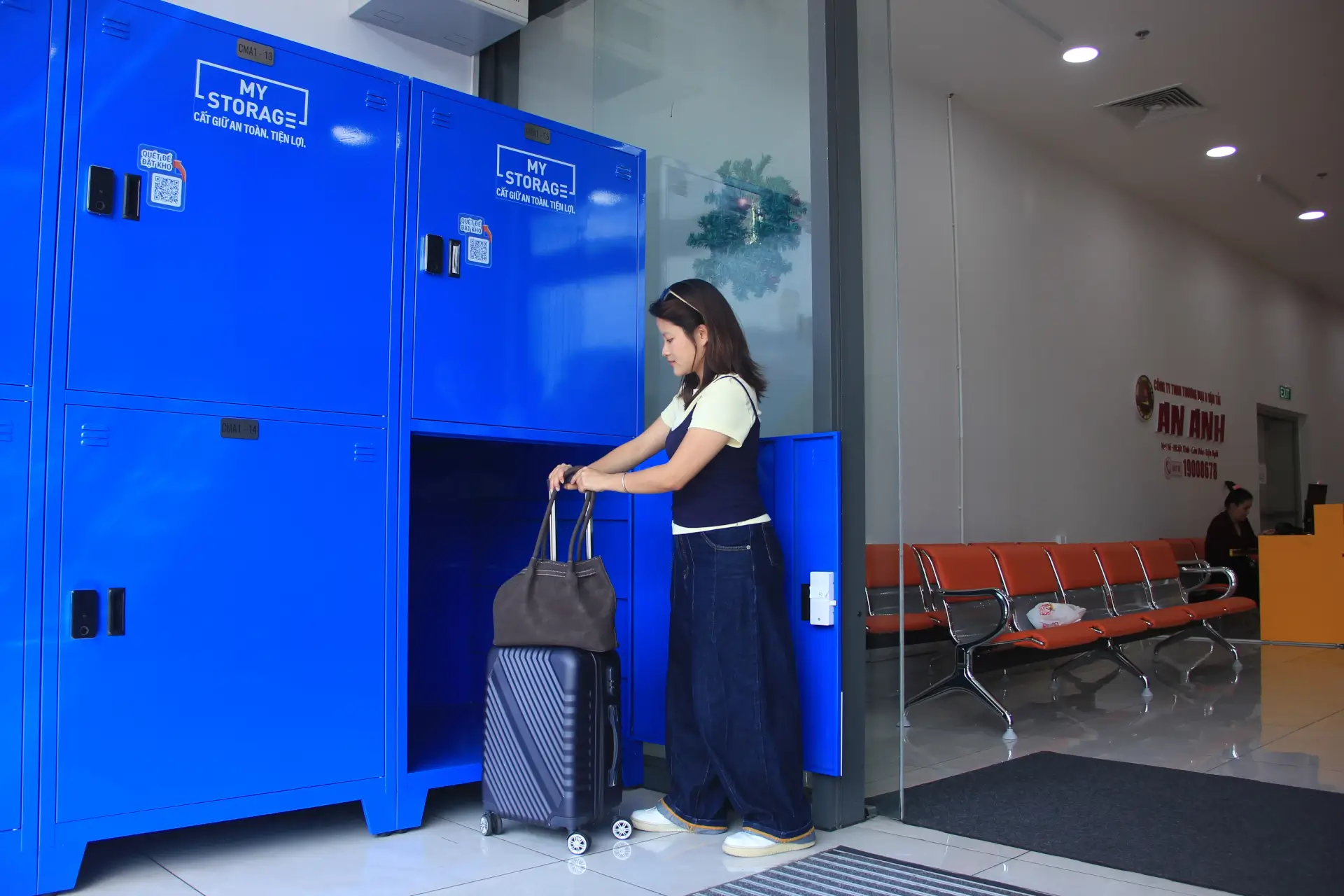
MyStorage Luggage Storage For Travellers
MyStorage offers short-term luggage lockers and private self-storage units for travellers in Ho Chi Minh City, which covers both a few hours between flights and a few weeks between trips. Three features are worth comparing against an airport counter:
- Climate-controlled self-storage units: Tropical humidity is hard on electronics, leather bags and cosmetics, and MyStorage self-storage units run air conditioning that holds temperature and humidity around the clock.
- Layered physical security: Each unit has its own lock, with CCTV, access logging and on-site security covering the facility.
- Sizes from a locker to a walk-in unit: Compartments run from locker size for a backpack up to walk-in units that take several large suitcases, so you are not paying for volume you do not use.
If your trip is longer than a layover and the bags stay behind for weeks, safe luggage and suitcase storage in Ho Chi Minh City covers the monthly options rather than the hourly ones.
3. Saigon Layover Itineraries By Transit Window
A focused, geographically compact route is what keeps a layover out of traffic, so pick the itinerary that matches your window rather than trying to cover the whole city. Three routes cover the usual transit lengths.
The 6-Hour Express Layover Route
With six hours you can reach District 1, see two landmarks and eat properly, as long as you drop your bags first. Hour by hour:
- Hour 1, arrival and baggage drop: Clear immigration, withdraw local currency at an airport ATM, leave large bags in a secure locker and book a ride-hailing car to District 1.
- Hour 2, coffee and architecture: Arrive at Paris Square, look over the Saigon Central Post Office and the brick facade of Notre-Dame Cathedral, then sit down for a Vietnamese iced milk coffee (ca phe sua da).
- Hour 3, food: Walk five minutes for a bowl of beef noodle soup (pho bo) or a freshly toasted banh mi with pate, roast pork and pickled daikon.
- Hour 4, quick souvenir shopping: Walk the covered alleys of Ben Thanh Market or a boutique on Dong Khoi Street for Marou chocolate, coffee beans or lotus tea.
- Hours 5 to 6, back to the airport: Book your return ride, collect your stored luggage, clear security and reach the gate with margin to spare.
One large case in storage still leaves you carrying a day bag, and a cabin suitcase doubles as that day bag if you pack it to open flat; the ways to use a suitcase for storage show how to split contents so the case you keep is the light one.
The 8-Hour Cultural Layover Route
Eight hours is enough to add a museum and a proper rest stop to the express route, without moving far between stops. The shape of the day:
- Hours 1 to 2, transit and history: Travel from the airport to the War Remnants Museum in District 3 and spend 90 minutes with the photojournalism exhibits and the aircraft collection.
- Hours 3 to 4, colonial landmarks: Walk past the Independence Palace, on to the Saigon Opera House and the People’s Committee Building.
- Hours 5 to 6, lunch and foot massage: Take an unhurried lunch of southern specialities such as sizzling pancakes (banh xeo) and fresh spring rolls (goi cuon), then a 60-minute herbal foot massage.
- Hours 7 to 8, riverside walk and return: Walk the pedestrianised Nguyen Hue Boulevard to the Saigon riverfront before heading back to Tan Son Nhat with time in hand.

The 12-Hour Full-Day Layover Route
Twelve hours allows two distinct districts and a sunset, which is as much as any layover can hold. The day runs roughly like this:
- Morning, heritage and Chinatown: Start in Cho Lon (District 5) with the incense spirals of Thien Hau Pagoda and the wholesale stalls of Binh Tay Market.
- Midday, art and street dining: Head back towards the centre for the Museum of Fine Arts in its yellow colonial mansion, then lunch on broken rice with grilled pork (com tam) in an alley eatery.
- Afternoon, cafes and craft beer: Find the cafes hidden inside the retro block at 42 Nguyen Hue and try local craft beers brewed with passion fruit or dragon fruit.
- Evening, sunset and dinner: Take an early dinner at a rooftop bistro over the skyline, or a 45-minute cruise on the Saigon River.
- Night, return to the terminal: Collect your stored bags and reach Tan Son Nhat fed, rested and well ahead of boarding.
Pre-Departure Checklist For Layover Travellers
The table below is the run-through to do before you step out of the terminal, with the check that tells you each item is actually done.
| Stage | Action Item | Verification Criteria |
|---|---|---|
| Pre-departure | Check visa regulations | E-visa approved or passport eligible for the visa exemption |
| Arrival gate | Secure your onward boarding pass | Connecting flight pass printed or saved on your phone |
| Arrival hall | Get local currency | Withdraw 500,000 to 1,000,000 VND at an airport ATM for small purchases |
| Connectivity | Set up mobile data | International roaming active or a travel eSIM installed |
| Luggage drop | Store suitcases securely | Heavy bags in a locker or storage unit, receipt or code saved |
| Transport | Install a ride-hailing app | Grab or Be installed with an international card linked |
| Exploring | Track traffic in real time | Departure alarm set 3.5 hours before scheduled take-off |
| Return | Retrieve stored luggage | Bags checked against tags, then straight to security |
Packing before you leave home decides how fast the baggage drop goes: one locker-sized bag for the city and the rest sealed in the big case saves repacking on the pavement, and the smart packing tips for neat luggage cover how to split a case that way.
4. Transit Logistics And Travel Tips For Saigon
Transport, connectivity and weather are where layover plans usually slip, so settle all three before you leave the terminal. Four areas cover the lot.
Airport Transport And Grab Taxis
Ride-hailing is the simplest way out of Tan Son Nhat because the fare is fixed before you board and there is no language barrier. Three options and one cost to expect:
- Ride-hailing apps (Grab and Be): Install the app beforehand, link a card and book from the designated pickup lanes. Fares to District 1 run between 120,000 and 180,000 VND.
- Metered taxis: If you prefer a street taxi, queue at the official counters for Vinasun (white with green and red stripes) or Mai Linh (all green), and avoid drivers soliciting inside the arrivals hall.
- Airport gate fee: Vehicles leaving the airport pay an automated gate fee of roughly 10,000 to 15,000 VND, which is legitimately added to your meter or app receipt.
Currency Exchange And SIM Cards
You need a little cash and a working data connection before you go anywhere, because street vendors do not take cards and Grab needs data. Three steps:
- Cards versus cash: Restaurants, department stores and supermarkets take Visa and Mastercard, while street food stalls, market traders and small cafes are cash only.
- Withdrawing Vietnamese Dong: Use the bank ATMs just outside the terminal exit, such as BIDV, Vietcombank or HSBC, for interbank rates.
- Mobile data: An eSIM bought online before landing is fastest; otherwise a prepaid tourist SIM from the Viettel or Vinaphone kiosks in arrivals costs roughly 200,000 to 300,000 VND.
Weather And Packing Essentials
Ho Chi Minh City has two seasons rather than four, and which one you land in decides what you carry for the day. Three things to plan for:
- Dry season (December to April): Temperatures of 32°C to 36°C with strong sun and little rain, so wear light cotton or linen, use sunscreen and bring sunglasses.
- Rainy season (May to November): Warm, with sudden afternoon downpours that usually last 30 to 60 minutes, so keep a compact umbrella or poncho in your day bag.
- Modest dress at religious sites: Temples and pagodas such as Giac Lam or Thien Hau expect shoulders and knees covered.
Rain matters for the bags as much as for you: a case left in a humid, unventilated spot for a day picks up the musty smell that takes a wash to remove, which is the same problem the steps for rainy season storage against damp and mould are built to prevent.
Return Buffer Back To The Airport
Work backwards from your departure time rather than forwards from where you are, because screening and passport control at Terminal 2 are the real bottleneck. Three rules:
- The three-hour international rule: For international departures from Terminal 2, be at the terminal 2.5 to 3 hours before take-off.
- Evening queue awareness: Security and departure passport control at Tan Son Nhat back up badly between 18:00 and 23:00, when many long-haul flights leave together.
- Buffer formula: City departure time equals scheduled take-off minus 4 hours. For a 20:00 flight, you are in the return taxi in District 1 no later than 16:00.
Around Tet, the Lunar New Year holiday, the airport road fills up for roughly two weeks and the buffer needs another 30 minutes; travellers caught in that window also face full lockers, which is why leaving Ho Chi Minh City for Tet is worth planning days ahead rather than hours.
5. Luggage Storage Options And Rates In Saigon
The right luggage storage choice protects your bags from heat, humidity and theft while keeping the cost proportionate to a few hours. Location, billing unit and privacy are what separate the options.
Comparing Luggage Storage Options
Three kinds of storage are realistically open to a transit traveller, and each suits a different length of stop. How they compare:
- Airport terminal storage: Best for very short transits under 6 hours when you are not going far. The drawbacks are queues during arrival peaks and per-piece pricing.
- Hotel bell desk: Some District 1 hotels hold bags for non-guests for a tip or if you eat at their restaurant, but security is informal and acceptance is never guaranteed when they are full.
- Self-storage and smart lockers: Purpose-built facilities with private compartments and walk-in rooms, video surveillance and keypad access, and climate control on the units that offer it.
Transit is only one of the moments storage gets used: people moving out of a rented flat before a flight have a different problem, and what to do with belongings when leaving Vietnam covers the version where the bags stay behind for months rather than hours.
Luggage Storage Rates In Ho Chi Minh City 2027
Hourly lockers suit a layover and monthly units suit a longer trip, so the right comparison is cost per hour against cost per month, not one flat figure. The table below sets out 2027 reference rates.
| Service / Category | Storage Format And Size | Approximate Bag Capacity | Reference Rate 2027 |
|---|---|---|---|
| Airport baggage desk | Per-piece open shelving | 1 checked suitcase or 1 backpack | 60,000 - 100,000 VND (≈ US$2.33 - US$3.88) per piece per hour |
| Smart locker, small | Private automated locker | 1 cabin suitcase plus a backpack (about 40 litres) | 25,000 - 40,000 VND (≈ US$0.97 - US$1.55) per hour |
| Smart locker, large | Private automated locker | 2 large 28-inch suitcases plus bags (about 100 litres) | 50,000 - 75,000 VND (≈ US$1.94 - US$2.91) per hour |
| MyStorage Mini Box | Private walk-in unit, 1 m³ to 3 m³ | 8 to 25 cartons or several large suitcases | 873,000 - 1,563,000 VND (≈ US$33.91 - US$60.71) per month, standard unit |
| Air-conditioning option | 24/7 climate-controlled unit | Holds 20°C - 24°C continuously | About 30% - 40% above a standard unit |
The first three rows are market averages across Ho Chi Minh City transit hubs in 2027 and are not MyStorage rates; they move with location, season and how long you store. The MyStorage rows are 2027 reference prices for a flexible monthly plan, excluding VAT, with the 12-month plan 15% cheaper and 1 m³ holding about 8 to 10 medium cartons. VND is the billing currency and the converted figures move with the exchange rate. The price per cubic metre falls as units get larger, so when comparing mini storage rental prices in Ho Chi Minh City include anything you may add later in the trip.
Rates move with demand rather than staying flat through the year, and the peaks are the same ones that fill flights: Tet, the April holidays and the summer sale season, which is why seasonal storage that flexes with Tet and sale periods is priced differently from a quiet month.

Booking A MyStorage Luggage Locker
Booking ahead matters most on the two days around a public holiday, when both lockers and units fill up. What the service gives a transit traveller:
Exploring Saigon should be an easy few hours, not a negotiation with a roller bag or a worry about where your valuables are. Whether you have an 8-hour daytime layover on the way to Europe or an overnight connection before flying to Phu Quoc, leaving your luggage somewhere secure is what frees the time.
MyStorage runs storage facilities in Ho Chi Minh City with PIN code entry, continuous camera monitoring and air-conditioned self-storage units, so laptops, cameras, clothes and documents stay cool and secure while you are out. You keep your own key or access code, collect your things on your own schedule, and head back to your connecting flight unencumbered. Travellers staying longer than a layover often move from a locker to a monthly unit, and the storage guide for expats in Ho Chi Minh City covers how that works.
6. Frequently Asked Questions About Saigon Layovers
Fifteen answers to the questions transit travellers ask most about a layover in Ho Chi Minh City, from visas and timing to where the bags go.
Is a 6-hour layover enough to see Saigon?
Yes. A 6-hour window leaves roughly 2.5 to 3 hours of exploring in central Saigon once you allow 45 minutes for immigration, 30 minutes to District 1 and the requirement to be back at the airport 2 hours before your flight. That is enough for the Saigon Central Post Office, Notre-Dame Cathedral and a bowl of pho before your return ride.
Can I leave Tan Son Nhat airport during a layover?
You can leave the terminal if your passport qualifies for a visa exemption or you hold an approved Vietnam e-visa. Citizens of the 45-day visa-exempt countries, including the UK, France, Germany, Spain, Italy, Japan and South Korea, pass border control with a valid passport and onward ticket. Without an exemption or an approved e-visa you cannot exit the transit lounge.
Does Tan Son Nhat airport store bags?
Yes, there are left luggage counters in the arrivals halls of both terminals, with the international counter on the ground floor of Terminal 2 near the public exit. Bags are charged by the hour or the day, strictly per piece. Queues build during arrival peaks and bags sit on open shelving rather than in private lockers.
How much does luggage storage cost in Ho Chi Minh City?
Smart lockers in the city run roughly 25,000 to 75,000 VND (≈ US$0.97 to US$2.91) per hour depending on size, while airport counters charge about 60,000 to 100,000 VND per bag per hour. For a 6 to 10-hour stop a locker is usually the cheaper option, and for anything beyond a few days a monthly self-storage unit costs less than either.
How far is the city centre from the airport?
District 1 is about 7.5 kilometres from Tan Son Nhat, which is 25 to 35 minutes by car off-peak and 50 to 60 minutes in rush hour. The airport sits inside the urban core rather than 30 or 40 kilometres out, but traffic rather than distance sets the timing, so allow 45 minutes each way.
What is the best way to reach District 1 from the airport?
Booking a car in the Grab app is the most predictable option because the fare is fixed on screen before you board and there is no language barrier. A one-way ride costs 120,000 to 180,000 VND. If you prefer a metered taxi, queue at the official Vinasun or Mai Linh counters rather than accepting a fixed price from a driver inside the hall.
Do I need Vietnamese Dong cash for a layover?
Yes, small amounts of cash are needed for street food, markets and small cafes, even though large restaurants and malls take Visa and Mastercard. Withdrawing 500,000 to 1,000,000 VND (about US$20 to US$40) at a Vietcombank, BIDV or HSBC ATM outside the arrivals doors covers a half-day visit comfortably.
What should I eat first on a Saigon layover?
Start with beef pho or a banh mi with an iced milk coffee, because both are quick, close to the centre and unmistakably local. Pho Hoa Pasteur and Pho Le serve broths simmered with star anise and cinnamon; Banh Mi Huynh Hoa and Banh Mi Nhu Lan are the handheld option if you are walking between sights.
Where can I shower during a Saigon layover?
You can shower in the premium lounges inside Terminal 2 if you have lounge or Priority Pass access, where suites come with towels and toiletries. Downtown, a 60-minute massage at an established day spa often includes shower facilities, which works well if you are already stopping to rest.
Is Saigon safe for layover travellers?
Ho Chi Minh City is generally safe for visitors, with violent crime rare, but opportunistic phone snatching and pickpocketing do happen on busy corners. Hold your phone with both hands when checking a map, avoid walking at the kerb with a bag on your outside shoulder, and never leave a bag hanging on a restaurant chair.
What if my inbound flight is delayed?
If a delay cuts your layover below 5 hours, stay in the terminal. Five hours is the minimum to clear immigration, reach the centre and come back through security without rushing. With a shorter window, the duty-free area, airside noodle restaurants, a nap room or a lounge are the better use of the time.
Are luggage lockers air conditioned?
It depends on the provider, so ask before you book rather than assuming. Airport baggage desks are not climate controlled, while MyStorage self-storage units run 24/7 air conditioning. Temperature-controlled space is a separate product class, priced above a standard unit, and mini cold and air-conditioned storage rental sets out where that surcharge is worth paying. That matters in Saigon, where it regularly passes 35°C with high humidity, for laptops, cameras, medicines, chocolate and cosmetics.
Can lockers fit large suitcases?
Large locker compartments take oversized 28-inch to 32-inch check-in bags, usually two of them plus a backpack, but internal dimensions vary so check them when you reserve. For bulky sports gear such as golf clubs or a surfboard, a small walk-in self-storage unit is the more practical option, and storing sports equipment neatly covers how golf bags and boards are usually arranged inside one.
When should I head back to the airport?
Be back at Tan Son Nhat 2.5 to 3 hours before an international departure, which means leaving the centre about 4 hours before take-off. Security screening and departure passport control at Terminal 2 slow down badly between 18:00 and 22:00, when many long-haul flights leave within the same hours.
Why choose MyStorage for luggage storage in Saigon?
MyStorage gives you a private space rather than a spot on an open shelf: each unit has its own lock, with PIN entry, continuous camera monitoring and air conditioning on the self-storage units. The same account works for a few hours between flights or a monthly unit if you leave bags behind while travelling on, and the monthly rates are set out in personal mini storage rental.
Related articles
Article
Between Check-Out And Your Flight: A Day In Saigon With Luggage
Between a noon hotel check-out and an evening flight, leaving your suitcases at a secure luggage storage point in central Saigon lets you explore hands-free and go straight to Tan Son Nhat…
Read article
Article
Why Does Tidying Reduce Stress? The Link Between Your Living Space And Your Mind
Tidying reduces stress by clearing visual overload, cutting the cognitive load on the brain and restoring your sense of control over your living space; when the home is tidy but still…
Read article
Article
Leaving Ho Chi Minh City For Tet 2027: What To Do With Your Belongings
Before you leave Ho Chi Minh City for Tet 2027, you can lock up your rented room, put suitcases in a smart locker for a late flight, or rent a self-storage unit by the month; declutter…
Read article
