
 Tiếng Việt
 한국어
 日本語
Article
Should You Use Compression Bags When Traveling?

On this page
A compression bag is a solution that reduces the volume of clothing by 30% to 50%, helping optimize suitcase space when traveling or going on business trips. However, using a compression bag needs to be weighed against the fabric, the length of the trip and airline weight limits, because the bag only squeezes out air and does not reduce the actual weight of your luggage.
1. What Is a Compression Bag?
A compression bag is a travel bag that squeezes the air out from between layers of fabric, shrinking the volume of clothes by 30% to 50% when packed into a suitcase. There are three main types: zipper bags, roll-up bags and vacuum bags.
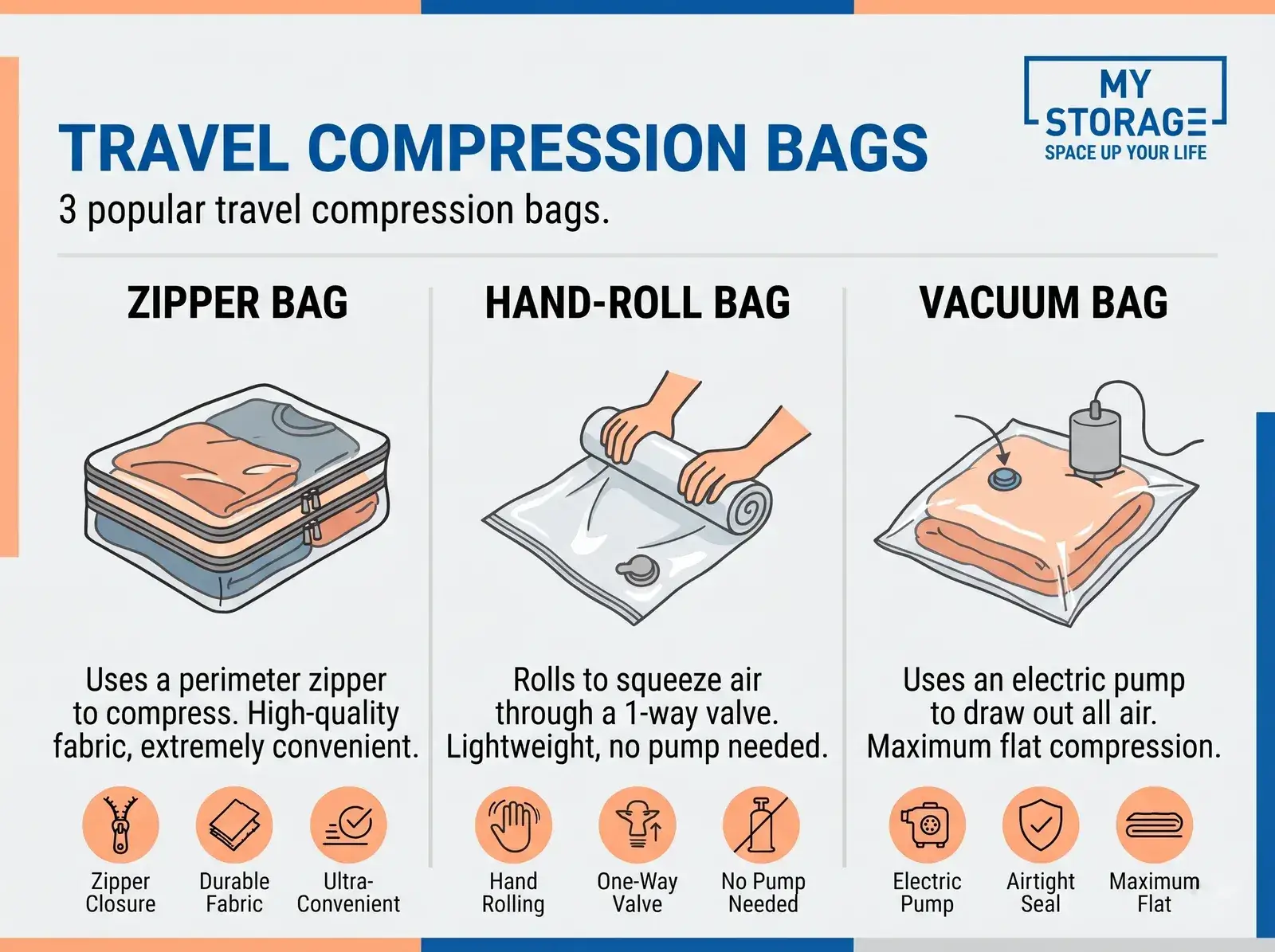
A compression bag (luggage compression bag) is a specialized item used to flatten the air trapped between layers of fabric, reducing the packed volume of clothes inside a suitcase. Depending on how it works, compression bags fall into three main types: double-layer zipper compression bags, roll-up bags that push air out through a one-way valve, and vacuum bags that use a dedicated pump.
3 Popular Types of Compression Bags
Each type of compression bag on the market is designed around its own principle for removing air:
- Zipper Compression Bag: Works with a double-layer zipper system similar to the expansion mechanism of a travel suitcase. You put your clothes inside, zip the bag closed, then pull a second compression zipper around the perimeter to press the fabric down tightly, with no equipment needed.
- Roll-up Compression Bag: Made of flexible plastic with a one-way valve at the bottom. Just put your items in, close the opening with a sliding clip, and roll the bag by hand from the opening to the base to push all the air out.
- Vacuum Storage Bag: Uses a dedicated round valve combined with a manual hand pump or a mini handheld electric vacuum to remove 100% of the air inside, giving the flattest result.
How a Compression Bag Works
Understanding the process helps you work quickly and protect the bag's durability:
- Step 1: Sort clothes of the same thickness and place them in the bag, filling about 80% of its capacity.
- Step 2: Press the sliding clip along the opening 2 to 3 times to make sure both zipper tracks seal completely, with no gaps for air to escape.
- Step 3: Compress by pulling the perimeter zipper, rolling out the air by hand, or plugging the vacuum head into the valve and turning it open.
- Step 4: Lock the protective valve cap firmly on the outside to stop outside air from seeping back in.
How They Differ From Ordinary Zip Bags
Many people confuse ordinary zip bags with purpose-built compression bags:
- Core design purpose: Ordinary plastic zip bags (Ziploc) are only for sorting items, keeping out dust and resisting surface moisture. A compression bag, by contrast, is made of tougher material that withstands mechanical compression in order to reduce the volume it takes up.
- Size reduction: Ordinary zip bags keep the air inside, so they stay puffed up and take lots of room. A compression bag, on the other hand, can flatten a bundle of thin clothes to half its original thickness.
- Seam and zipper durability: The zipper of a compression bag is reinforced against tearing under heavy tension, far better than the thin press-seal edges of food storage zip bags.
2. Pros and Cons of Compression Bags
Compression bags are most useful for bulky winter clothing such as down jackets and woolen scarves, but they easily crease natural fabrics and do not make luggage any lighter. You still need to weigh your suitcase before heading to the airport.
Compression bags offer a clear advantage when packing bulky winter clothes such as down jackets and woolen scarves, and they keep a cabin suitcase tidy. However, their biggest drawbacks are that they crush natural fabrics and create the feeling that the suitcase still has room, leading travelers to overpack and risk exceeding the airline's weight limit.
Advantages When Packing a Suitcase
The practical benefits that a compression bag brings to frequent travelers:
- Frees up to 50% of luggage space: Especially effective for bulky items such as down jackets, winter sweaters, thick scarves and inflatable travel pillows.
- Organizes luggage logically: Separates outfits by day and keeps clean clothes apart from used ones.
- Protects belongings from dust and moisture: A PA/PE plastic shell or tear-resistant parachute fabric keeps clothing from soaking through if the suitcase gets caught in heavy rain on the airport conveyor belt.
- Makes cabin suitcases easier to pack: Lets short-trip business travelers fit a week of clothes into a 20-inch carry-on suitcase without paying extra for checked baggage.
Disadvantages and Risks
The limitations you should know before deciding to use one:
- Clothes easily develop deep creases: Compression over many hours folds natural fibers into creases, so you have to iron the clothes again before wearing them.
- Inconvenient when you need something urgently: If you need a jacket at the bottom bag, you have to open the valve to release the air from the whole bag and then spend time compressing it again from scratch.
- Dependence on equipment for vacuum bags: If you use a type that needs an electric pump, you will run into real trouble on the way back at the hotel or homestay if there is no power outlet or you forgot the pump head.
- Risk of damaging fabric structure: Compressing too tightly for too long can flatten the natural down of a puffer jacket and reduce the warmth it was designed to provide.
Do Compression Bags Reduce Weight?
The most common misunderstanding among passengers is that luggage becomes lighter after using a compression bag:
- The physics does not change: A compression bag only pushes out empty air molecules to shrink the size of the bundle; it does not remove a single gram of fabric mass.
- Risk of exceeding carry-on weight: When they see empty space left after compressing clothes, many people tend to stuff in more items. As a result, a 20-inch cabin suitcase that looks neat can exceed the 7 kg or 12 kg limit of airlines such as Vietnam Airlines or Vietjet Air once it is placed on the airport scale.
3. Should You Use Them When Traveling?
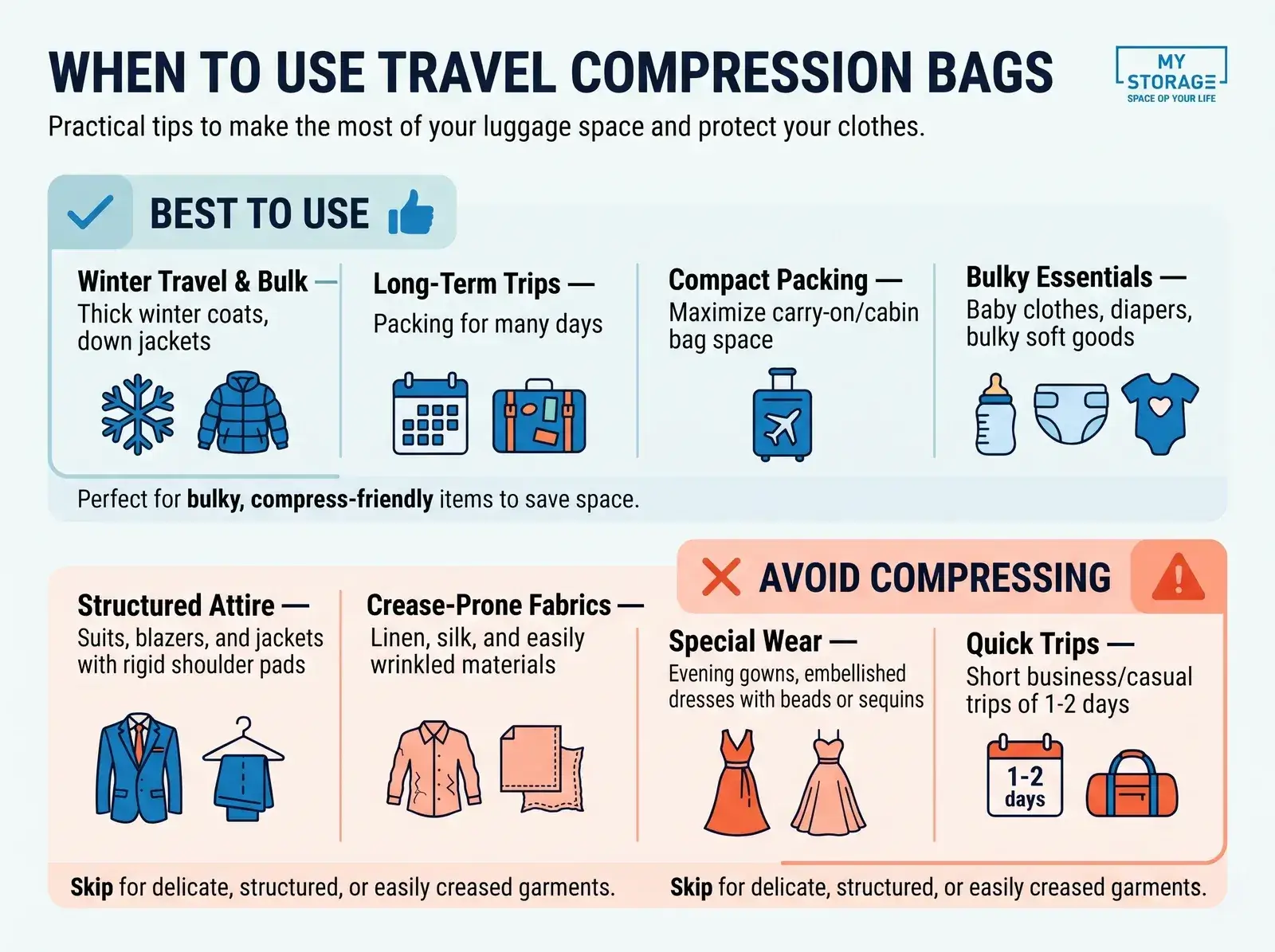
Use compression bags for winter trips, long trips or when you carry only a small carry-on suitcase; for a trip of 1 to 2 days with thin, light clothes you do not need one. Suits, linen, silk and pleated dresses should not be compressed hard.
You should definitely use a compression bag for long winter trips, cross-country journeys or when you only bring a small carry-on suitcase. Conversely, for short trips of 1 to 2 days, where luggage is just light T-shirts or office clothes that need to keep a flat, crisp shape, a compression bag is not necessary at all. For a short trip like that, you can look at a checklist of what to pack for a 3-day trip to bring just enough clothes for a small suitcase.
When to Use One
A compression bag becomes a handy helper in these practical situations:
- Cold-climate or winter travel: Destinations such as Sa Pa, Da Lat in the cold season, Korea, Japan or Europe require thick sweaters, thermal wear and heavy winter coats that take up a lot of volume.
- Long trips of 5 to 10 days or more: A large number of outfits overloads an ordinary suitcase if clothes are packed the traditional flat-folded way. For a long trip, also plan ahead where to store your car and belongings during a long trip.
- Families with young children: Spare clothes, soft diapers and warm blankets for the baby need to be shrunk down as much as possible.
- Backpacking trips: Suits backpackers who need to compress sleepwear and camping sleeping bags into a hiking backpack to reduce bulk while trekking.
When You Don't Need One
You can skip the compression bag to save packing time in these situations:
- A short business trip of 1 to 2 days: With only 1 to 2 outfits, a cabin suitcase has plenty of spare room, so there is no need to compress.
- A summer beach holiday: Summer clothes such as thin cotton T-shirts, swimwear and silk skirts already take up very little volume; simply rolling them tightly by hand is neat enough.
- An itinerary with a different hotel every day: Opening the bag to take out clothes and then struggling to squeeze the air out again each morning is tiring and eats into your rest time. If you have checked out but your flight is still hours away, you can store your suitcase and luggage safely in Ho Chi Minh City and sightsee more lightly.
Clothes You Shouldn't Compress Hard
Some high-end fabrics can be permanently damaged if compressed too hard:
- Suits, blazers and dress trousers: Office clothes with structured padding in the shoulders and canvas interlining will lose their tailored shape beyond repair if folded and compressed.
- Linen, ramie and silk clothing: These natural fibers are extremely sensitive to creases; when compressed tightly they form dense wrinkles that are very hard to iron flat with an ordinary iron.
- Pleated or beaded evening dresses: The pressure can break beads, snap the stitching holding the beadwork or flatten the airy pleats of the skirt.
4. How to Use a Compression Bag Effectively
Roll your clothes, compress them only about 60% to 70%, place heavy bags near the suitcase wheels and hang your clothes up as soon as you check in to keep wrinkles down. Fill the bag only to about 80% of its capacity so the zipper closes easily.
Proper packing technique means sorting clothes by fabric, rolling them tightly by hand instead of folding them flat, and leaving about 10% of space free so the zipper closes easily. Placing bags with heavy items at the bottom of the suitcase near the wheels and getting hangers ready as soon as you check in to a hotel will keep fabric wrinkles to a minimum. If you want to pack the whole suitcase more neatly, also see smart ways to pack clothes for a tidier suitcase.
Step-by-Step Packing Guide
Following these 5 steps optimizes volume and extends the bag's lifespan:
- Step 1 - Sort your clothes: Separate items that tolerate compression well (T-shirts, jeans, underwear, puffer jackets) from wrinkle-prone items that should be packed outside the bag.
- Step 2 - Roll each item: Roll each item tightly by hand instead of folding it flat; this keeps the fabric surface from developing sharp fold creases when compressed.
- Step 3 - Put the clothes in the bag: Line up the rolled clothes neatly side by side and fill the corners at the bottom of the bag; never stuff past the Max line printed on the bag.
- Step 4 - Close the bag carefully: Use the sliding clip to press along the seal from left to right twice, making sure the two rubber tracks close tightly with no air leaking in.
- Step 5 - Compress the air out: For a zipper bag, gently pull the perimeter zipper; for a roll-up bag, kneel on it or use both hands to roll firmly from the top down to push the air out.
Tips to Prevent Wrinkles
Practical little tips that keep clothes fairly smooth after compression:
- Add a layer of thin cloth or soft plastic bag: Place a thin cloth between layers of shirts before rolling to reduce direct friction between folds of fabric.
- Don't squeeze out 100% of the air: Compress clothes only to about 60% to 70% of their fluffiness; keeping a little natural springiness helps the fibers avoid deep deformation.
- Open the bag and hang clothes as soon as you check in: When you arrive at the hotel, open the compression bags right away, shake out each garment and hang it in the wardrobe or in the bathroom so the steam from hot water relaxes the creases naturally.

Arranging Items in the Suitcase
A balanced center of gravity makes the suitcase easy to pull and protects your belongings:
- Put heavy compression bags near the wheels: Bags holding jeans and thick jackets should go in the lower half of the suitcase (near the wheels when it stands upright) to lower the center of gravity so the suitcase doesn't tip over when pulled.
- Leave room for tech items: Place flat compression bags along both sides of the suitcase frame to form a soft cushion protecting the camera, power bank or fragile souvenirs in the middle compartment.
- Keep away from sharp objects: Do not let nail scissors, bottle openers or metal charger plugs rub directly against the surface of a compression bag, as they can puncture it and make it deflate.
5. How to Choose and Buy: Price List
Choose a bag by the compression type that suits your trip, then check the material, zipper, air-release valve and how well it fits inside your suitcase. Zipper bags cut volume by about 30% to 40%, roll-up bags by 40% to 50%, and vacuum bags by up to 60% to 75%.
Choosing the right compression bag should be based on the size of your cabin or checked suitcase compartment, the durability of the double zipper, and how many times it can be reused without the sealing edge tearing. The reference price list and the inspection checklist below form a practical guide to help you pick a quality product at the best cost.
Comparison of the 3 Compression Mechanisms
This detailed comparison helps you pick the compression type that fits your itinerary:
| Comparison Criteria | Zipper Compression Bag | Roll-up Bag (Hand-Rolled) | Vacuum Bag |
|---|---|---|---|
| How it works | Double perimeter zipper presses the fabric | One-way valve at the base releases air as you roll | Round suction valve with a manual pump or machine |
| Extra equipment | None needed | None needed | Needs a hand pump or mini vacuum machine |
| Volume reduction | 30% - 40% of volume | 40% - 50% of volume | Up to 60% - 75% of volume |
| Convenience | Extremely handy, opens and closes quickly | Easy to use, simple hand operation | A bit bulky because you must carry a pump |
| Durability | Very high, hard to tear at the edges | Fairly good, lasts several seasons | Rubber valve can leak if dust gets in |
| Best for | Everyday clothes, thin and light items | Winter clothes, family clothing | Heavy down jackets, thick blankets and pillows |
Criteria for Choosing a Quality Bag
The core technical specs to check carefully before you commit your money:
- Fabric or plastic film: For zipper bags, choose 210D Nylon or waterproof Oxford fabric with high elasticity. For roll-up plastic bags, choose tough PA + PE composite film rather than brittle PET film that cracks easily at the fold.
- Zipper hardware quality: The zipper should come from a reputable brand (such as YKK or SBS) with large, smooth teeth and a sturdy metal slider that can withstand the tension without the teeth slipping.
- A size that fits your suitcase: Measure the interior of your suitcase; a 20-inch suitcase suits a set of size S (about 30 x 20 cm) and M (about 35 x 25 cm), while 24 to 28-inch suitcases should use L (about 40 x 30 cm) and XL.
Checklist for Choosing a Compression Bag
This checklist helps travelers thoroughly check product quality before buying:
| Item to Check | Technical Details to Verify | Standard to Meet |
|---|---|---|
| Bag body material | Nylon Ripstop parachute fabric or tough PA/PE composite plastic | Tough surface, no strong plastic smell |
| Seam quality | Double-stitched folded edges with anti-burst tape | Even stitches, no loose threads |
| Perimeter compression zipper | Large metal zipper, teeth mesh tightly, pulls smoothly without jamming | Holds up well under tension |
| One-way air valve | Soft rubber reed that lets air out only, not in | Air does not leak back in |
| Compatibility | Bag size fits half or a quarter of the suitcase interior | Lies flat without catching on the edges |
| Included equipment | Light mini hand pump or USB Type-C electric vacuum | Pump runs quietly, strong suction |
| Warranty policy | Commitment to replace if the sealing edge cracks or the valve fails within 30 days | A reputable retailer |
Reference Price List for Compression Bags
Below is a reference price list for popular travel compression bags on the Vietnamese market:
| Compression Bag Type | Packaging | Standard Sizes | Reference Price (VND) |
|---|---|---|---|
| Parachute-Fabric Zipper Bag Set (3 pieces) | Set of 3 bags (S, M, L) | 30x20 cm, 35x25 cm, 40x30 cm | 220,000 - 380,000 / set (about US$9 - 15) |
| Premium Zipper Bag Set (6 pieces) | Set of 6 multi-purpose bags | Full set of shirt, trouser and shoe bags | 450,000 - 750,000 / set (about US$17 - 29) |
| PA/PE Roll-up Bag Set (5 pieces) | Pack of 5 roll-up bags with base valve | Size M (40x60 cm) and L (50x70 cm) | 80,000 - 150,000 / pack (about US$3 - 6) |
| Vacuum Bags with Hand Pump (4 pieces) | Set of 4 bags with a manual pump | 60x80 cm, made for winter clothes | 120,000 - 190,000 / set (about US$5 - 7) |
| Vacuum Bags with Mini Electric Pump | Set of 4 bags with a rechargeable pump | Mini vacuum with Type-C charging port | 280,000 - 450,000 / set (about US$11 - 17) |
The prices above are for reference only and may change depending on the manufacturer, the fabric and sewing materials, and the promotions of e-commerce platforms.
Storing and Keeping Your Items
A luggage compression bag is a superb portable solution to the problem of tight space on short trips. However, after the trip ends, you should not keep clothes squeezed in compression bags at home for many months, because the fibers will break down and permanently lose their elasticity. Instead, when you are not travelling, an empty suitcase can become storage, as shown in ways to use a suitcase for storage at home.
If your home is overloaded with bulky suitcases, winter blankets or camping gear that you use only a few times a year, finding a separate storage space outside your home is the best option. The MyStorage self-storage system offers personal storage units with air conditioning that controls humidity and mold 24/7, helping you keep suitcases and seasonal belongings fully protected and completely safe, freeing up roomy living space for the whole family. To find out which unit fits your suitcases and belongings, see the storage unit size guide (1–23 m³) or request a free quote.
6. Frequently Asked Questions
This collection of 15 direct answers covers the most common questions about choosing and using luggage compression bags for travel:
1. What is a compression bag?
A compression bag is a purpose-built bag designed to remove excess air between fabric fibers using a compression zipper, a hand-roll valve or vacuum suction, shrinking a bundle of clothes by 30% to 50% when packed into a travel suitcase.
2. Do compression bags really save space?
Yes. Compression bags are especially effective for clothes with a fluffy, air-filled structure such as down puffer jackets, winter sweaters, felt shawls and travel pillows.
3. Do compression bags reduce luggage weight?
Not at all. A compression bag only reduces the bulk of the volume, not the actual weight of the clothes. You need to weigh your suitcase again before going to the airport to avoid being charged for exceeding the carry-on limit.
4. Can vacuum bags be taken on a plane?
They are allowed on planes as normal, in both carry-on and checked luggage. Airlines only control the suitcase size and the overall weight of the bag according to your ticket rules.
5. Do you need a pump to use a compression bag?
Not required. If you don't want to carry a bulky pump, you can choose a double-layer zipper compression bag or a roll-up plastic bag that pushes air out through a one-way valve at the base, which are light and convenient.
6. Do compression bags ruin the shape of clothes?
They can ruin the shape of suits, blazers with shoulder pads, linen clothing or intricately pleated dresses. These items should never be compressed and should be hung in a flat garment bag instead.
7. Should you compress a down puffer jacket?
Only compress it moderately, about 50% of its volume, and only for a short time while traveling. Squeezing out too much air, or compressing continuously for many months, will break the natural down fibers, leaving the jacket without loft and with less insulation.
8. Can you put damp clothes in a compression bag?
Absolutely not. Putting damp items into the airtight environment of a compression bag lets bacteria and mold break out after just 24 hours, making all the clothes smell unpleasant and yellowing the fabric surface. To limit mold when storing clothes for a long time, see how to protect belongings from humidity and mold in the rainy season.
9. Should you choose a compression bag or a packing cube?
A compression bag is best when you need to shrink bulky winter clothes for a small suitcase. Ordinary packing cubes, meanwhile, suit short trips where you want to keep items neatly sorted without creasing the fabric.
10. How many times can you use a compression bag?
A parachute-fabric zipper compression bag is very durable and can be reused for 3 to 5 years. PA/PE roll-up plastic bags can last 10 to 20 trips if you take care not to let sharp objects rub against and puncture the plastic film.
11. Which compression bag size suits a 20-inch suitcase?
A 20-inch cabin suitcase suits best a set of size S (about 30 x 20 cm) and size M (about 35 x 25 cm). You can fit 2 to 3 bags of these sizes neatly into half of the suitcase without catching on the pull-handle frame.
12. Should you use a compression bag on a short trip?
Not necessary. For a short trip of 1 to 2 days with thin, light summer clothes, an ordinary suitcase has enough room; using a compression bag only costs you extra packing time and risks creasing your clothes. For a short trip, you can look at the list of what to bring on a 3-day trip to pick just enough items.
13. Are compression bags waterproof?
Most compression bags made of PA/PE plastic film or parachute fabric coated with PU waterproof film have good surface water resistance, helping protect the clothes inside if the suitcase happens to get soaked by rain.
14. How long can clothes stay compressed in the bag?
Compress clothes only for the travel period of the trip (from a few days to under 2 weeks). As soon as you get home, open the bag and shake out and air the clothes so the fabric recovers its natural elasticity, and avoid storing them compressed for many months. If you need to store winter clothes for a long time, see how to store clothing and fabric without mold or insects.
15. How can you optimize luggage without compression bags?
You can use the military-style rolling technique (Ranger Rolling), wear your thickest clothes and heaviest shoes on the plane, and use the empty space inside your shoes to tuck in socks and small accessories.
Related articles

Article
Suitcases Aren't Just For Travel: 7 Ways To Use A Suitcase For Storage
A travel suitcase can easily become a versatile storage solution at home when you have no trips planned.
Read article

Article
Weekend Home Cleaning Checklist: 30 Minutes To A Tidier Home 2027
Spending 30 minutes on a weekend tidy-up with a well-structured checklist keeps apartments of 45 to 60 m² orderly without draining the energy you need for rest.
Read article

Article
Is A 45m² Apartment Enough For A Family Of 4? How To Lay It Out Best 2027
A 45 m² apartment can meet the daily needs of a family of four if the space is planned smartly and belongings are kept under strict control.
Read article
