
 Tiếng Việt
 한국어
한국어 日本語
日本語Article· Updated October 21, 2026
Factory Rental Process in Vietnam: From Legal Setup to Operations and Expansion
On this page
Renting a factory in Vietnam involves more than choosing an area and signing a lease. Companies may need investment advice, legal procedures, environmental and fire-safety compliance, recruitment, accounting setup, and fit-out before production can begin. A ready-built factory with supporting services can shorten preparation and let the business focus on operations sooner. The process can be viewed in three stages: a roughly 0–4-month setup period, stable operation, and sustainable expansion.
Demand for this model is growing. According to JLL Vietnam, registered FDI in the first six months of 2026 reached USD 34.7 billion, up 61% year on year, supporting demand for factories and industrial infrastructure in key markets.
At the planning stage, distinguish production floor space from storage space. If raw materials or reserve stock can be kept off-site, business storage may prevent valuable factory area from being used simply to hold goods.
1. Stage 1: Prepare and Bring the Factory Into Operation
The first stage covers defining requirements, completing investment and legal procedures, preparing environmental and fire-safety documents, recruiting staff, and fitting out the premises. It is commonly planned over about 0–4 months, although the actual schedule depends on the project.
Before searching for a site, define the following requirements to avoid costly changes later. For goods that need not sit beside the production line, understanding the different types of rental storage helps estimate ancillary space separately from factory floor area:
- Manufacturing sector
- Required floor area
- Planned production capacity
- Floor loading suitable for machinery and production lines
- Electricity requirements
- Water requirements
- Wastewater treatment plan
- Fire-safety requirements
- Associated warehouse or support area
- Location and logistics connectivity
Some factory landlords offer online search tools, sometimes called Factory Finders, that filter premises by area, floor load and industry. These can help narrow the search at an early stage.
Once the requirements are clear, the company should address the relevant investment and legal procedures:
- Establish a legal entity
- Apply for an Investment Registration Certificate (IRC)
- Apply for an Enterprise Registration Certificate (ERC)
- Amend the IRC or ERC if the project’s scale or business lines change
- Register the project objectives
- Obtain any other permits required for the specific industry
Some legal-service providers quote around 20 working days to process the IRC and ERC once a complete application has been filed. That estimate covers only those two certificates, not the entire factory-rental process, which also involves environmental and fire-safety procedures and handover. As project documents accumulate, a separate document storage plan can make records easier to control and retrieve.
In parallel with investment procedures, review the applicable environmental and fire-safety obligations:
- Environmental impact assessment, if the project is subject to one
- Environmental dossier or permit
- Environmental registration where required
- Fire-prevention and firefighting procedures
- Other compliance requirements specific to the production activity
Before starting operations, the company also needs to prepare its people and financial administration:
- Recruit staff
- Establish an organizational structure
- Complete initial employment procedures
- Set up the accounting system
- Complete tax procedures
- Register for social insurance
- Establish workplace rules
The final setup step is to fit out and formally take possession of the premises:
- Fit out the space for the company’s specific use
- Inspect facilities before acceptance
- Install production machinery and equipment
- Complete the formal handover
- Make the final preparations for production
2. Stage 2: Maintain Stable Operations
Once the factory is operating, the focus shifts from setup to continuity. Electricity, on-site technical support, wastewater treatment, facility management and shared resources can all become important elements of a serviced-factory model. This phase is often described as operational support.
A factory lease does not end, in practical terms, when the tenant receives the keys. That is why some landlords are moving beyond a simple space-rental model toward serviced factories, with support that continues after handover.
Typical operational support may include:
- Power and technical infrastructure: a reliable supply and contingency arrangements to reduce disruption.
- On-site technical support: personnel who can respond to electricity, water and infrastructure issues.
- Wastewater treatment: operation and maintenance of a compliant system, where provided.
- Facility management: maintenance, cleaning and security monitoring of the premises and shared areas.
- Shared resources: facilities or amenities shared among tenants to reduce duplicated investment.
- Business support: administrative, procedural or advisory assistance during long-term operations.
If inventory, reserve materials or infrequently used assets take up production space, a company can move them to MyStorage’s B2B storage service. Separating storage from production helps track inventory and operating costs more clearly.
3. Stage 3: Expand Sustainably
As production stabilizes, the company may need more capacity, stronger environmental, social and governance (ESG) performance, and operating data for its parent company or global management system. A modern factory therefore needs not only to meet today’s production requirements but also to support longer-term expansion. This stage may involve growing within an existing property network, assessing green-building certification, preparing ESG-ready infrastructure and producing data for sustainability reporting.
- Expansion within the same network: the tenant may be able to lease additional space or another factory from the same provider rather than negotiate with an entirely new partner.
- LEED Gold certification: LEED (Leadership in Energy and Environmental Design) is a green-building rating system developed by the U.S. Green Building Council. It considers factors such as energy and water efficiency and indoor environmental quality. Gold is one of its higher certification levels. Learn how LEED relates to other warehouse and building certifications.
- ESG-ready infrastructure: the premises can be designed or upgraded to support reporting and operational requirements that multinational businesses increasingly apply to their supply chains. The same principles are discussed for ESG and CSR in logistics and warehousing.
- Data for the parent company: the management system may provide real-time or periodic operating data for corporate reporting.
Green-building labels should be assessed alongside actual operating data, including energy and water use, working conditions and the ability to measure performance over time. For related transport and distribution, businesses should also consider green logistics practices rather than judging the building alone.
For a long-term plan, use warehouse ISO and green-building certifications as a reference when assessing partners. Check the exact scope of each certificate and evidence at the specific site; do not assume that a claim applies to every location.
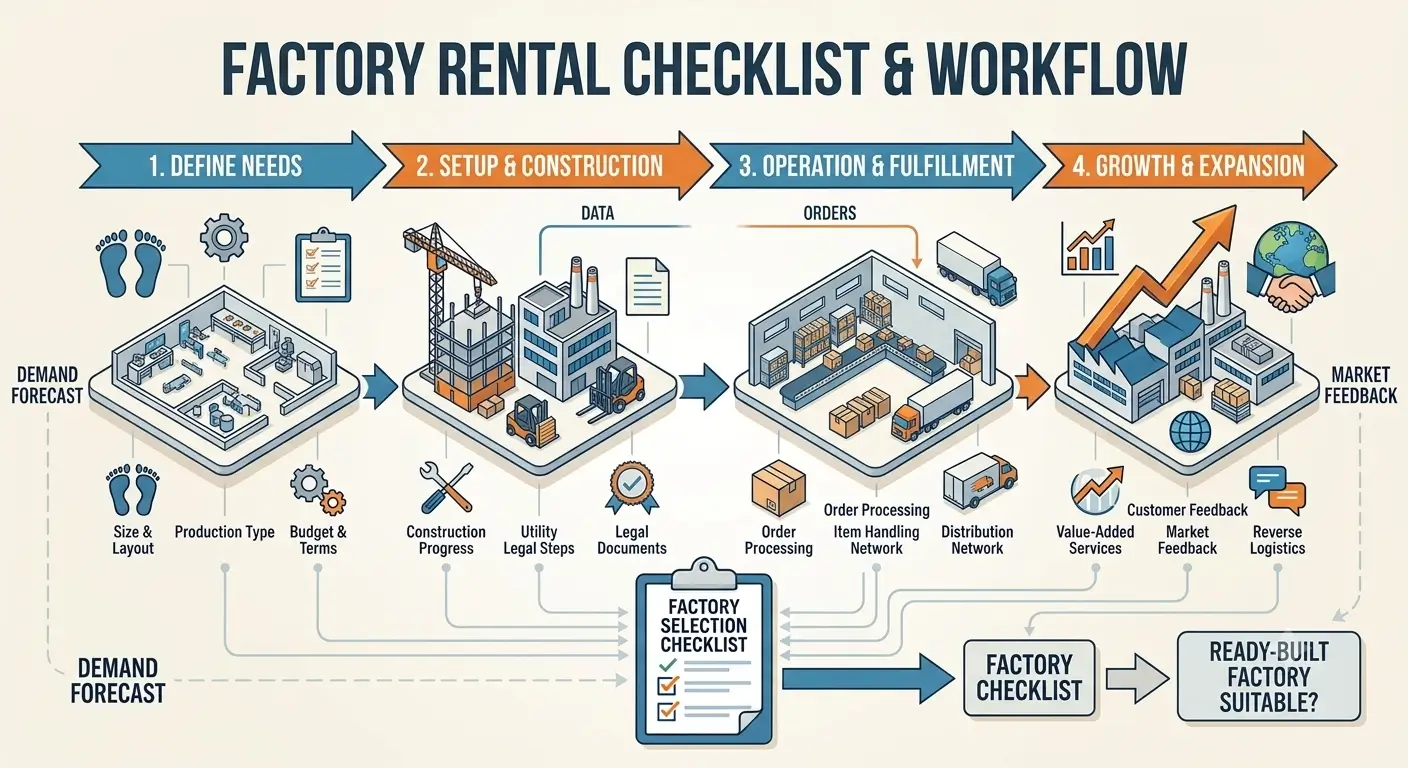
Factory-rental checklist: define requirements, set up the site, operate reliably and plan for expansion.
4. Checklist Before Signing a Factory Lease
Assess five groups of factors together: legal status, physical facilities, production suitability, operating costs and support services. Comparing rent per square metre alone can miss costs and obligations that arise after production begins.
First, review the legal basis of the premises and project:
- The landlord’s right to use or lease the factory
- Lease terms
- IRC and ERC, where applicable
- Activities permitted at the site
- Registered project objectives
- Environmental procedures
- Fire-safety procedures
Next, inspect the technical infrastructure, especially conditions that can affect products and stored goods. For sensitive goods, verify the temperature and humidity control approach in the actual area to be used:
- Actual usable area
- Floor load
- Electrical system
- Water supply
- Wastewater treatment system
- Loading and unloading area
- Building height
- Fire-safety system
Then assess the landlord’s operational support:
- Maintenance
- Facility management
- Security
- Staffing support
- Administrative services
- Technical help when incidents occur
Finally, assess whether the premises can support future growth:
- Can additional area be leased when needed?
- Are other factories available within the provider’s network?
- Can the infrastructure meet future ESG requirements?
- Can the management system provide operating data?
5. Who Is a Ready-Built Factory Suitable For?
A ready-built factory can suit a business that wants to shorten preparation, limit initial property investment and use existing infrastructure. Suitability still depends on the industry, technical specifications, area, capacity and expansion plan. Savills Vietnam reported that in the first half of 2026, ready-built factories accounted for about 56.8% of newly registered manufacturing FDI projects and more than 66% of registered manufacturing FDI capital in Vietnam. That indicates a preference among many foreign investors for existing facilities over developing property from scratch.
This model often suits companies that:
- Need to start production quickly
- Do not want to develop their own real estate
- Are foreign-invested enterprises entering Vietnam
- Are small or midsize and need to manage initial capital
- Need associated legal and operational support
Building a dedicated factory may be more suitable when:
- The design is too specialized for standard premises
- The project is very large
- The production line has exceptional requirements
- The business intends to own industrial property long term
To assess the model realistically, distinguish a production facility from a goods-storage warehouse, estimate ancillary stock and compare factory and warehouse options in Ho Chi Minh City before finalizing the budget.
6. How to Calculate the Total Cost of Renting a Factory
Rent per square metre is only one part of the actual cost. A practical calculation is:
Total cost = Rent + Fit-out + Utilities (electricity and water) + Maintenance + Legal compliance + Management + Potential disruption costs
A lower-rent site that needs extensive fit-out, offers limited support or carries a greater risk of interruption may cost more overall than a higher-rent but more reliable option. If ancillary stock will be stored off-site, compare a separate storage price guide with the cost of using factory floor space for storage.
Reference Rents for Ready-Built Factories in Vietnam
Asking rents vary by region and market conditions. Cushman & Wakefield’s Q2 2026 MarketBeat data reports the following average asking rents for ready-built factories and warehouses in the northern and southern key markets:
|
Region |
Property type |
Reference asking rent |
|---|---|---|
|
North |
Ready-built factory |
About USD 5.0/m²/month |
|
North |
Ready-built warehouse |
About USD 4.9/m²/month |
|
South |
Ready-built factory |
About USD 4.9/m²/month |
|
South |
Ready-built warehouse |
About USD 4.6/m²/month |
These are average asking rents in key markets from Cushman & Wakefield’s Q2 2026 MarketBeat report. They exclude items such as fit-out, operating support, management fees and project-specific incentives. Actual terms vary with location, construction standards, lease length and included services. Request a quotation for the required area, location and production activity rather than treating these averages as a firm offer.
Renting a factory in Vietnam is a process that begins with legal preparation and continues through stable operation and future expansion. It does not end when the lease is signed or the keys are handed over. As FDI grows and ready-built facilities represent a substantial share of new projects, the right property model and suitable long-term support can shorten time to operation and reduce risks throughout the lease.
Frequently Asked Questions About Renting a Factory
1. What Are the Main Steps in Renting a Factory?
Define area and technical needs, survey sites, check legal status, negotiate the lease, complete environmental and fire-safety procedures, accept the premises, install equipment, test operations and plan for expansion.
2. How Long Does It Take to Start Operating?
It depends on the industry, the condition of the premises and the legal dossier. A suitable ready-built factory can shorten preparation, but permits, alterations and inspections still need time.
3. Which Legal Documents Should Be Checked?
Review the landlord’s legal standing and right to lease the premises, permitted activities, the lease, investment and enterprise registrations, and the applicable environmental and fire-safety documents.
4. What Are the Roles of the IRC and ERC?
The IRC records the investment project; the ERC records the establishment of the company. Foreign-invested businesses often need to obtain or amend these before production begins.
5. When Are Environmental and Fire-Safety Procedures Required?
Requirements depend on the industry, project scale, capacity and building. Identify the applicable obligations during site selection so the chosen premises can be operated legally.
6. How Should Factory Location Be Evaluated?
Consider customers and suppliers as well as access to ports, airports and ring roads, vehicle-load limits, permitted truck hours, available labour and logistics services.
7. Which Technical Specifications Matter Most?
Check usable area, floor load, clear height, electrical capacity, water and drainage, wastewater treatment, fire safety, loading areas and vehicle access.
8. Which Businesses Benefit From Ready-Built Factories?
They can work well for businesses seeking a rapid start, lower initial property investment or existing infrastructure. Specialized production lines still require a careful fit-out review.
9. What Should Be Included in Total Rental Cost?
Besides rent, account for fit-out, utilities, management, maintenance, legal compliance, loading labour and losses caused by operational disruption.
10. Should Rent Per Square Metre Decide the Choice?
No. A cheap site that needs major alterations, lacks power or is difficult to access may be more expensive over the lease term.
11. What Support Should a Landlord Provide?
Look for relevant infrastructure maintenance, security, cleaning, electrical and water incident response, shared-area management and a clear contact point for administrative or technical issues.
12. Can a Factory Be Combined With Off-Site Storage?
Yes. Moving reserve stock, files, rarely used equipment or seasonal inventory off-site can free production space and separate manufacturing costs from storage costs.
13. What Should an Expansion Plan Cover?
Clarify additional-area options, renewal conditions, alteration rights, notice periods and relocation arrangements. Electricity, water, road access and loading areas should have room for future capacity.
14. How Does ESG Affect Factory Selection?
Companies and supply chains increasingly look at energy, water, emissions, worker safety and operating data. A site that can measure and improve these indicators supports long-term ESG reporting.
15. What Is the Most Important Pre-Lease Checklist?
Verify legal rights, technical condition, full costs, maintenance responsibilities, handover conditions, alteration rights, termination clauses, expansion options and support commitments in the contract.
Related articles
Article
What Is a WMS? Functions, Benefits and How to Choose a Warehouse Management System
A WMS is warehouse management software that digitises the flow of goods from receiving and location assignment to real-time stock control, picking and dispatch. This guide covers its core…
Read article
Article
Warehouse Storage Pallets: Choosing, Stacking and Optimising Space
A guide to warehouse pallets: comparing wood, plastic and metal, ISO 6780 size standards, the difference between static, dynamic and racking load, brick-bond stacking rules, warehouse…
Read article
Article
Renting Storage by m³ or m²: Which Pricing Method Should You Choose?
Comparing storage rental by m² and by m³ in Ho Chi Minh City: what each unit measures, the formulas with worked examples, the extra fees people miss, when to choose area or volume, a…
Read article
