
 Tiếng Việt
 한국어
 日本語
Article
Wood, Plastic Or Steel Pallets? How To Choose By Goods And Storage Conditions
On this page
Wood, plastic and steel pallets have distinct characteristics in load capacity, durability, hygiene and investment cost. Choosing the right material depends on the nature of the goods, the actual load, the warehouse temperature and the handling method, in order to optimise operating costs and keep the warehouse safe. For pallet size, load and stacking in the warehouse, see the guide to choosing and arranging warehouse pallets.
1. Characteristics Of Wood, Plastic And Steel Pallets
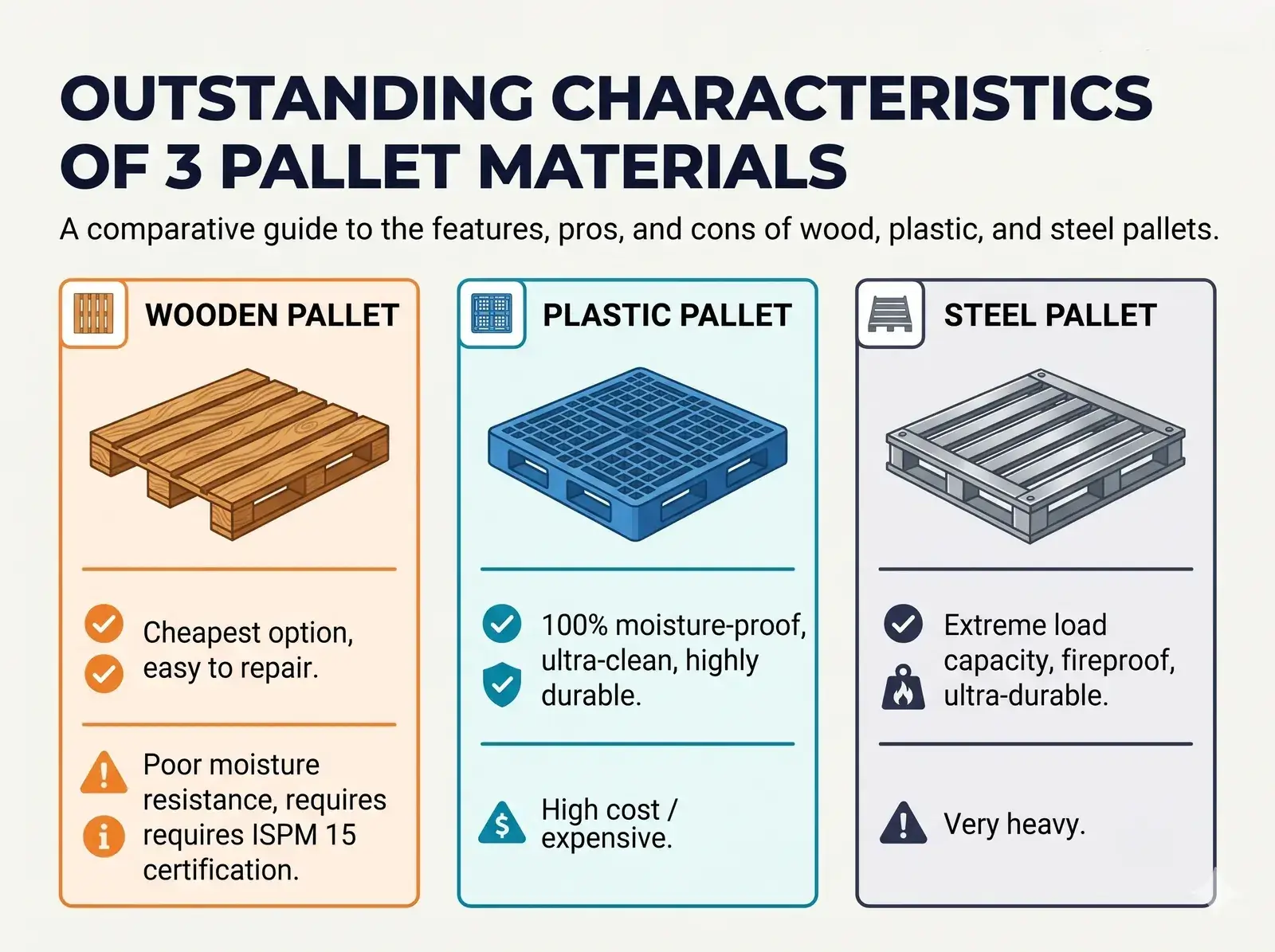
Wood pallets lead on upfront cost and are easy to make to custom sizes; plastic pallets excel at moisture resistance, are easy to clean and are free of termites; steel pallets offer high mechanical strength and carry extremely heavy loads in industrial environments. Each material suits specific warehouse operating conditions.
Pros and cons of wood pallets
Wood pallets are the traditional and most common product in the global supply chain thanks to their simple construction and plentiful raw material:
- Key advantages:
- The lowest upfront cost of the three, saving businesses a significant part of their initial budget.
- Easy to build to non-standard sizes to suit particular loads.
- Flexible repair: only the cracked slats or blocks need replacing, at very low cost.
- High surface friction, so goods slip less while the forklift moves.
- Limitations to note:
- They absorb moisture easily and are attacked by mould and termites when stored in damp, humid conditions.
- Protruding nail heads or sharp splinters can tear packaging or puncture cartons.
- They must be heat treated (HT) to the ISPM 15 standard if used for international export.
Pros and cons of plastic pallets
Plastic pallets moulded from virgin HDPE or PP resin are increasingly widely used for their neat appearance and outstanding cleanliness:
- Key advantages:
- Fully waterproof, immune to termites, no rust and unaffected by most mild chemicals.
- Smooth surface with no splinters or scratches, easy to wash and disinfect with high-pressure water.
- A service life 5 to 10 times longer than wood pallets when used within the permitted load.
- Light and uniform in weight, which reduces vehicle load and lowers injury risk for warehouse staff.
- Limitations to note:
- The initial purchase cost is 2 to 4 times higher than a wood pallet of the same specification.
- Very hard to repair once the structure cracks; they can usually only be sold as scrap to recycle the resin.
- Prone to deforming and becoming brittle if left in strong sunlight or in very high temperatures.
Pros and cons of steel pallets
Metal pallets welded from galvanised box steel or powder-coated steel are the ultimate load-bearing solution for heavy industry:
- Key advantages:
- An extremely sturdy structure, with a static load of up to 5 to 10 tonnes without bending.
- Completely fireproof, meeting the strictest fire-safety standards for industrial warehouses.
- No mould, and able to withstand very strong mechanical impact from forklift tines.
- Lasts for decades if the anti-rust paint is maintained regularly.
- Limitations to note:
- Very heavy (usually 25 kg to 45 kg each), which makes manual handling difficult.
- The highest fabrication cost of the three materials.
- At risk of oxidising and rusting if the protective paint is scratched in chemical or wet environments.
2. Detailed Comparison Of The Three Pallet Types
Evaluating the three pallet types requires analysing static load, dynamic load, racking capacity and total cost of ownership over the product's life together. The table below gives the key technical parameters to help warehouse managers make accurate purchasing decisions that fit their handling equipment.
Comparison table of the 3 pallet materials
A visual breakdown of the technical and operating criteria for wood, plastic and steel pallets:
| Evaluation Criterion | Standard Wood Pallet | HDPE / PP Plastic Pallet | Galvanised Steel Pallet |
|---|---|---|---|
| Initial investment cost | Low (about 120,000 - 250,000 VND, roughly US$5–10) | Medium - High (350,000 - 850,000 VND, roughly US$14–33) | Highest (700,000 - 1,500,000 VND, roughly US$27–58) |
| Self weight | Medium (15 - 22 kg) | Light (7 - 14 kg) | Very heavy (25 - 45 kg) |
| Maximum static load | 1,000 - 3,000 kg | 2,000 - 5,000 kg | 5,000 - 10,000 kg |
| Dynamic load when lifted | 500 - 1,500 kg | 1,000 - 2,000 kg | 2,000 - 3,000 kg |
| Racking load | 300 - 800 kg (needs reinforcing) | 500 - 1,500 kg (steel-core type) | 1,500 - 3,000 kg (very stable) |
| Moisture and mould resistance | Very poor, absorbs water easily | Absolute 100% | Good if the galvanised layer is intact |
| Cleanability | Hard to clean, bacteria build up | Easy to wipe, can be sprayed with chemical cleaners | Easy to clean, avoid standing water |
| Repairability | Very easy, replace slats | Very hard, almost impossible to repair | Weld, touch up the paint on scratched spots |
| Average lifespan | 1 - 2 years (depending on frequency) | 5 - 8 years | Over 10 years |
| Export standard | ISPM 15 certification required | No plant quarantine required | No plant quarantine required |
Core load ratings
When reading a manufacturer's specification sheet under the ISO 8611 standard, businesses must clearly distinguish three types of load:
- Static load: The maximum weight of goods a pallet can bear when set down fixed on a flat floor, with no movement and no vibration.
- Dynamic load: The maximum weight of goods a pallet can safely support when lifted by a forklift or hand pallet truck and moved around the warehouse.
- Racking load: The maximum load when the pallet is placed across two support beams of an industrial racking system (the middle of the pallet underside hangs unsupported with no floor contact).
- Golden safety rule: Never use the static load when lifting goods or placing them on racks; the racking load is always the smallest and most important figure for warehouse safety.
3. How To Choose Pallets By Goods
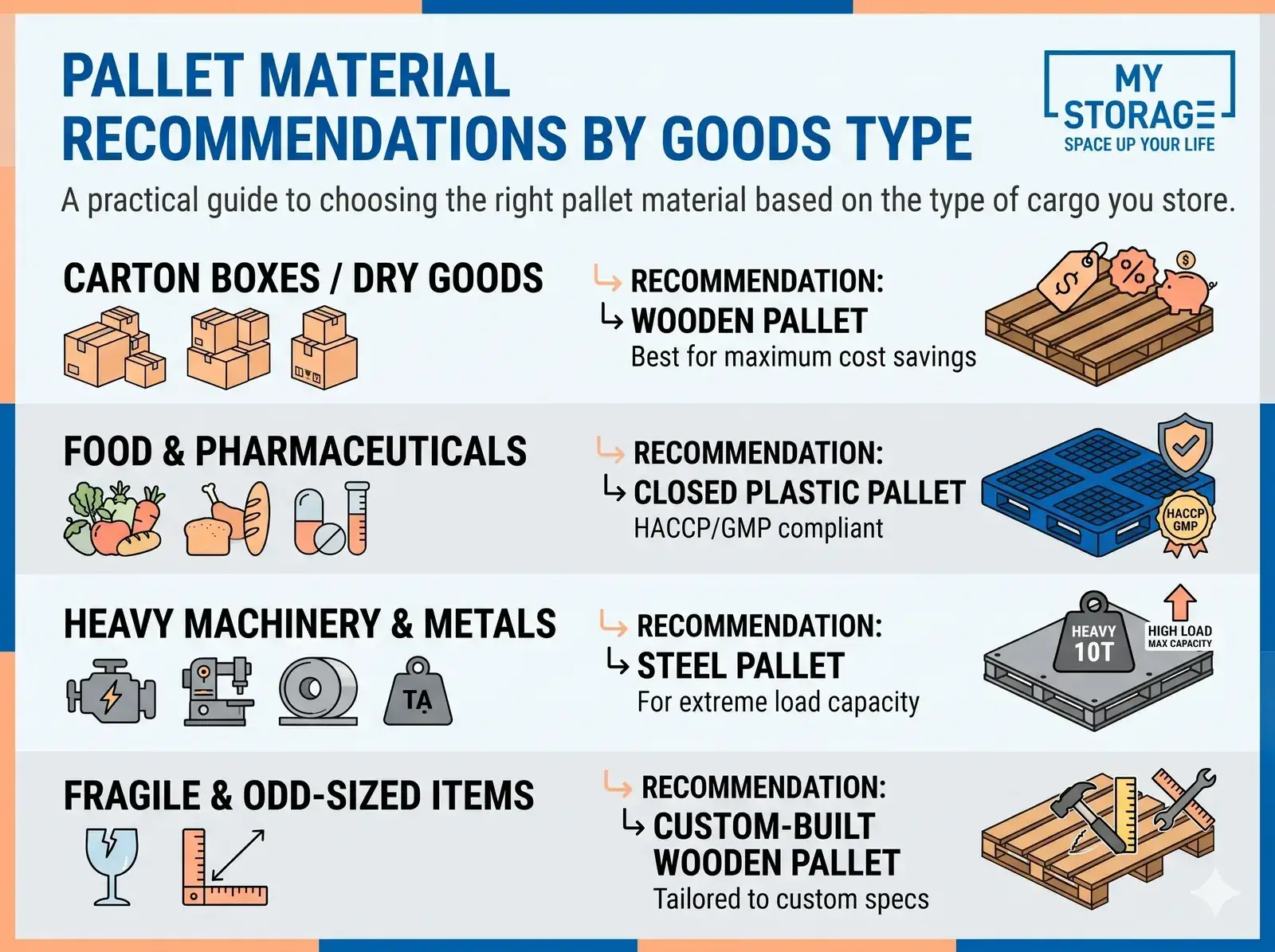
The type of goods directly determines the contact surface and rigidity the pallet needs throughout storage. Ordinary consumer goods favour wood pallets to save cost; food and pharmaceuticals must use antibacterial plastic pallets; while heavy machinery and metal parts need steel pallets for safe load bearing.
Consumer goods and cartons
The most common group in retail stores and e-commerce logistics warehouses:
- Goods characteristics: Goods fully packed in square cardboard boxes, with evenly distributed load and individual weights usually light to medium.
- Suitable material: Acacia or melaleuca wood pallets are the most cost-optimised solution. If the goods move through a clean warehouse environment or are sold out to supermarkets, low-cost plastic mesh-top pallets can be used.
- Handling note: Make sure the pallet surface has no protruding nails that tear the bottom of cartons, and stretch-wrap the load with PE film to secure the packages before lifting.
Food and clean pharmaceuticals
The industry with the strictest hygiene and food-safety requirements under the HACCP and GMP standards:
- Goods characteristics: Food ingredients, fresh milk, confectionery, cosmetics, pharmaceuticals and medical supplies.
- Suitable material: Seamless plastic pallets, moulded from virgin resin with FDA food-contact safety certification, are mandatory.
- Operating benefit: A closed-top design with no gaps completely prevents dust, dirty water and bacteria from settling, and allows regular disinfecting with hot water.
Heavy machinery and equipment
Mechanical manufacturing, building materials and heavy industrial parts:
- Goods characteristics: Electric motors, metal moulds, steel coils and generators, whose mass is extremely concentrated on a few contact points.
- Suitable material: Welded box-frame steel pallets or galvanised steel pallets are the only choice that guarantees the structure will not collapse.
- Operating benefit: The steel structure allows extra lifting lugs, locating locks and tie bars to be added so machines do not shift when cranes load and unload them.
Fragile and odd-sized items
Products sensitive to vibration or with bulky shapes:
- Goods characteristics: Telecom electronics, television screens, ceramics, glass jars or large sheets of glass.
- Suitable material: Order wood pallets made to specific sizes, with side walls or an elastic foam layer on the slats.
- Operating benefit: Easy to screw locating tie bars directly into the pallet's wood body so the load stays completely still during long-distance movement.
4. Choosing Pallets By Warehouse Conditions
Temperature and the design of racking systems in the warehouse directly affect the service life of each pallet material. Dry warehouses suit wood pallets; deep-freeze cold storage requires specialist virgin plastic that resists brittle cracking; while automated heavy-load racking systems usually favour one-piece steel pallets.
Dry and high-humidity warehouses
Air humidity is the number-one destroyer of materials in tropical warehouses:
- Dry, well-ventilated warehouses: All three materials can be used flexibly depending on budget and the type of goods stored. Wood pallets remain the most economical choice if the warehouse has good ventilation.
- High-humidity or damp warehouses: Avoid wood pallets completely, because wood absorbs moisture quickly, grows black mould and rots within a few months. Prefer plastic pallets with runners or hot-dip galvanised steel pallets that resist corrosion.
Cold storage and special environments
Deep-freeze temperatures from -18°C to -25°C demand materials with high molecular stability:
- Effect of low temperatures: Ordinary recycled plastic shrinks and cracks brittlely in the cold; wood pallets freeze and become slippery; ordinary steel can develop condensation that makes the paint flake off.
- The right solution: Use plastic pallets made from 100% virgin HDPE with an anti-freeze additive, able to withstand temperatures from -40°C to +60°C without changing properties.
Selective and drive-in racking
Industrial racking systems require pallets with high rigidity that match the beam dimensions precisely:
- Standard selective racking: Plastic pallets need a 3-skid design or built-in steel reinforcing bars (embedded steel core) to minimise sag under heavy loads.
- Drive-in and radio shuttle racking: Prefer steel pallets or plastic pallets with special guide grooves, so a shuttle robot or forklift can place the pallet deep inside the rack safely.
Handling equipment and export
Compatibility between pallets, forklifts and international maritime regulations determines how smoothly the flow of goods moves:
- Compatibility with a hand pallet truck: Choose a 4-way entry pallet with chamfered bottom boards so the hand truck wheels can slide under easily without jamming.
- Requirements for international export goods: If you choose wood pallets, make sure they are heat treated to the international ISPM 15 standard and carry a clear IPPC certification stamp, to avoid goods being held by the destination country's customs or fined for destruction. Plastic and steel pallets are completely exempt from this quarantine rule.
5. Costs And Pallet Selection Checklist
Pallet investment cost covers not only the initial purchase price but also repair frequency, service life and periodic replacement cost. The 2026 reference price table and the quality inspection checklist below help businesses review every technical requirement before signing a bulk purchase contract.
Reference pallet price table 2026
A summary of reference prices for new pallet lines on the Vietnamese market in 2026:
| Pallet Type | Standard Size (mm) | Actual Dynamic Load | Reference Price (VND/Unit) |
|---|---|---|---|
| Acacia / Melaleuca Wood Pallet (New) | 1,100 x 1,100 x 120 | 1,000 kg | 140,000 - 220,000 (about US$5–9) |
| Export Pine Wood Pallet (ISPM 15) | 1,200 x 1,000 x 140 | 1,200 kg | 220,000 - 320,000 (about US$9–12) |
| One-Piece Plastic Mesh-Top Pallet | 1,100 x 1,100 x 120 | 1,000 kg | 350,000 - 550,000 (about US$14–21) |
| Heavy-Duty Closed-Top Plastic Pallet | 1,200 x 1,000 x 150 | 1,500 kg (steel core) | 650,000 - 950,000 (about US$25–37) |
| Galvanised Anti-Rust Steel Pallet | 1,200 x 1,000 x 150 | 2,500 kg | 750,000 - 1,200,000 (about US$29–47) |
| Powder-Coated Super-Heavy Steel Pallet | 1,300 x 1,100 x 160 | 3,500 kg | 950,000 - 1,600,000 (about US$37–62) |
These prices are reference figures on the Vietnamese market in 2026, exclude VAT and transport costs. Actual unit prices may vary with order quantity, slat thickness and each project's custom fabrication requirements.
Purchase inspection checklist
The checklist below is a practical tool that helps warehouse managers review all 7 key criteria before approving a pallet purchase:
| Review Criterion | Details To Check | Required Standard |
|---|---|---|
| Goods characteristics | Weight, chemical nature, packaging surface in contact | Compatible pallet material |
| Geometric dimensions | Length, width and height compared with the load | A good fit, no excess or shortfall at the edges |
| Load ratings | Determine the static load, dynamic load and racking load | Meets a 20% safety margin |
| Environmental conditions | Humidity, warehouse temperature (ordinary, cool or cold storage) | Material does not deform or rot |
| Handling equipment | Fork width, powered or manual forklift | Four-way entry lets the tines pass freely |
| Legal requirements | ISPM 15 for export wood or HACCP for food | Has a certificate of inspection |
| Whole-life cost | Compare purchase price, maintenance cost, service life and resale value | Optimises the total operating budget |
When should an old pallet be replaced?
Continuing to use degraded pallets risks a very serious rack collapse:
- Wood pallets: Replace immediately when more than two slats are snapped in half, a block is split open and throws the pallet off balance, or the supporting boards are hollowed out by termites.
- Plastic pallets: Retire them when long hairline cracks appear at the main load points, the feet are worn down, or the deck is warped by more than 20 mm.
- Steel pallets: Stop using them when load-bearing welds crack, the box frame is badly dented by fork impact, or the metal is deeply corroded and its load-bearing cross-section is reduced.
Choosing the right pallet material is the foundation that fully protects the value of goods and lifts handling productivity in every supply chain. If your business is looking for a way to optimise warehouse space, study the self-storage model and the flexible storage options at MyStorage to free up business space as efficiently as possible. To find a storage unit that fits your volume of goods, request a free quote.
6. Frequently Asked Questions
A roundup of the 15 most common questions from warehouse managers and businesses weighing up wood, plastic or steel pallets:
1. Are wood or plastic pallets more durable?
Used correctly within the rated load, plastic pallets last 5 to 8 times longer than wood pallets. Plastic pallets are termite-proof, fully water-resistant and have an average lifespan of 5 to 8 years, while wood pallets typically last only 1 to 2 years unless stored in a dry, airy environment.
2. Can plastic pallets carry heavy goods?
Yes. Specialist plastic pallets moulded from virgin HDPE resin bear a static load of up to 5,000 kg and a dynamic load of 2,000 kg. For high-tier racking, manufacturers insert reinforcing steel bars into the plastic core to increase rigidity and prevent sagging.
3. Do steel pallets rust?
Steel pallets can rust if the surface protection flakes off after long contact with high humidity or corrosive chemicals. To solve this thoroughly, businesses usually choose hot-dip galvanising or multi-layer powder coating so that the metal surface stays durable for decades.
4. Can wood pallets be used in cold storage?
Briefly, yes, but long-term use is not recommended. Wood absorbs moisture, and when taken into cold storage the water inside the grain freezes and makes the structure brittle; the moisture released during temperature changes also easily breeds mould that contaminates food.
5. Which plastic pallets meet food-contact standards?
Only pallets made from 100% virgin HDPE or PP with no recycled impurities, a smooth closed surface and food hygiene certification under FDA or HACCP standards qualify for direct or indirect contact with the food chain.
6. What is the ISPM 15 standard for export wood pallets?
ISPM 15 (International Standards for Phytosanitary Measures No. 15) is the international phytosanitary standard for wood packaging material. Export wood pallets must be heat treated to a minimum core temperature of 56°C for 30 minutes, or fumigated with methyl bromide, and stamped with the IPPC mark certifying compliance.
7. Which pallet should high-humidity warehouses prefer?
High-humidity warehouses should prefer plastic pallets with runners or hot-dip galvanised steel pallets. Both materials are completely immune to water vapour, do not mould or rot, and keep the bottoms of the cartons stacked above them completely dry.
8. Can a hand pallet truck be used with every type of pallet?
No. A standard hand pallet truck can only be used with 4-way entry pallets that have no bottom board blocking the entry (or bottom boards with chamfered edges). With a 2-way pallet or a closed-bottom pallet, the small wheels of the hand truck get caught under the bottom board and cannot lift.
9. Which pallet has the lowest lifecycle cost?
Over a full service life of 5 to 7 years, plastic pallets usually have the lowest overall cost. Even though the initial price is twice that of a wood pallet, plastic pallets need no nailing repairs, incur no plant-quarantine costs and can be sold off to recover the value of the recycled resin.
10. Should I buy used pallets?
You can consider buying used pallets to save 40% to 50% of the initial cost if you only need static storage in place. However, before taking delivery you must check carefully whether the pallet has cracked frames, a warped structure or cracked feet, to avoid a rack-collapse accident.
11. What are the common pallet sizes today?
The two most common standard sizes in Vietnam and Asia are 1,100 x 1,100 mm (the square standard often used for intra-Asia exports) and 1,200 x 1,000 mm (the ISO/Euro pallet standard widely used in industrial warehouses and for export to the European and American markets).
12. How do static and dynamic load differ?
Static load is the maximum load a pallet can bear when it sits motionless on a flat factory floor. Dynamic load, by contrast, is the maximum safe weight of goods when the pallet is scooped up by forklift tines and driven over uneven ground.
13. Can loaded pallets be stacked on top of each other?
Yes, you can stack loaded pallets 2 to 3 tiers high (block stacking) if the load underneath has a flat, strong top surface and the pallet is designed with balanced two-sided load bearing. However, you must strictly respect the permitted static load of the pallet at the bottom tier.
14. How often should pallets be inspected and maintained?
Do a quick visual check every time a pallet goes into loading and unloading, and run a periodic whole-warehouse inventory check every 3 to 6 months. Any pallet showing cracks, loose nails or a deformed surface must be tagged and quarantined for repair or disposal immediately.
15. Should I buy pallets by price or by load capacity?
The safety principle requires businesses to put load capacity and the storage environment first. Only after shortlisting pallet models that fully meet the technical requirements should you compare selling prices and suppliers' warranty policies to make the best purchase decision.
Related articles

Article
Do You Need Insurance When Storing Goods In A Warehouse? What To Ask Before You Store
Do you need insurance when storing goods: when to buy it, the 7 questions to review before signing, the three forms of protection and a pre-storage checklist.
Read article

Article
MyStorage Announces Case Study With Investment Fund EMIA: How AI Became A Powerful Member Of The Sales Team
MyStorage and EMIA publish a case study on the STOW AI assistant: 42-second first response, 56% automated replies, 89 hours saved per month and conversion up to about 7%.
Read article
Article
How Many Square Metres Are 5x5 And 10x10 Feet Storage Units? Unit Size Conversion Table
A 5x5 feet storage unit is about 2.32 m² and a 10x10 feet unit about 9.29 m²: conversion formula, size table, real capacity, how to choose and 2027 reference prices.
Read article
