
 Tiếng Việt
 한국어
한국어 日本語
日本語Article· Updated October 26, 2026
Should You Buy or Rent Storage Lockers? Costs and How to Choose
On this page
MyStorage Smart Locker Offer: 11% Off
Any size - Any duration - Ministop D7, D1, D9 and Centre Mall D6
Locker rental from just VND 40,000/hour. Discount applied automatically when you book at booking.mystorage.vn, no code needed · 21/10 - 11/11/26.
Buying lockers suits businesses with long-term needs that want control over their equipment, while renting suits events, short projects, or businesses that need flexibility in quantity and cost. The choice should reflect the length of use, budget, number of lockers, location, and operating requirements.
If you are still weighing up compartment sizes, lock types, or what you can store, understanding how lockers are built and used makes the buying-versus-renting comparison much easier.
Should You Buy or Rent Storage Lockers?
Buying lockers usually makes sense when they will remain in regular use for several years at a fixed location. Renting is often more suitable for time-limited needs, changing quantities, or businesses seeking a smaller initial outlay. For events, conferences, and exhibitions, rental generally offers greater flexibility.
First, consider whether you need a cabinet every day or simply somewhere to keep belongings for a while. If there is no room for another cabinet at home or in the office, renting storage space is another option: it gives your belongings more room without rearranging the space you live or work in.
|
Criteria |
When buying makes sense |
When renting makes sense |
|---|---|---|
|
Length of use |
Long-term use without a specific end date |
Short-term needs or use during a defined period |
|
Location and purpose |
A permanent installation that does not need moving |
Time-limited events, conferences, and exhibitions |
|
Number of users |
A stable user base over time |
Numbers vary with the season or scale of operations |
|
Ownership and operation |
The business owns the asset and manages depreciation and equipment |
The provider owns the equipment and assists with installation and operation as agreed |
|
Initial budget |
A larger initial investment is available |
Lower upfront capital, with costs spread over the rental period |
Is Renting Lockers a Good Choice for Events?
For temporary events, renting is often more practical than buying for the following reasons:
- Attendance can fluctuate, making it difficult to predict exactly how many lockers will be needed.
- Lockers may only be used for a few hours or days, making a new purchase hard to justify.
- There is no need to store or look after the equipment once the event ends.
- The number of lockers can be adjusted to the actual scale of each event.
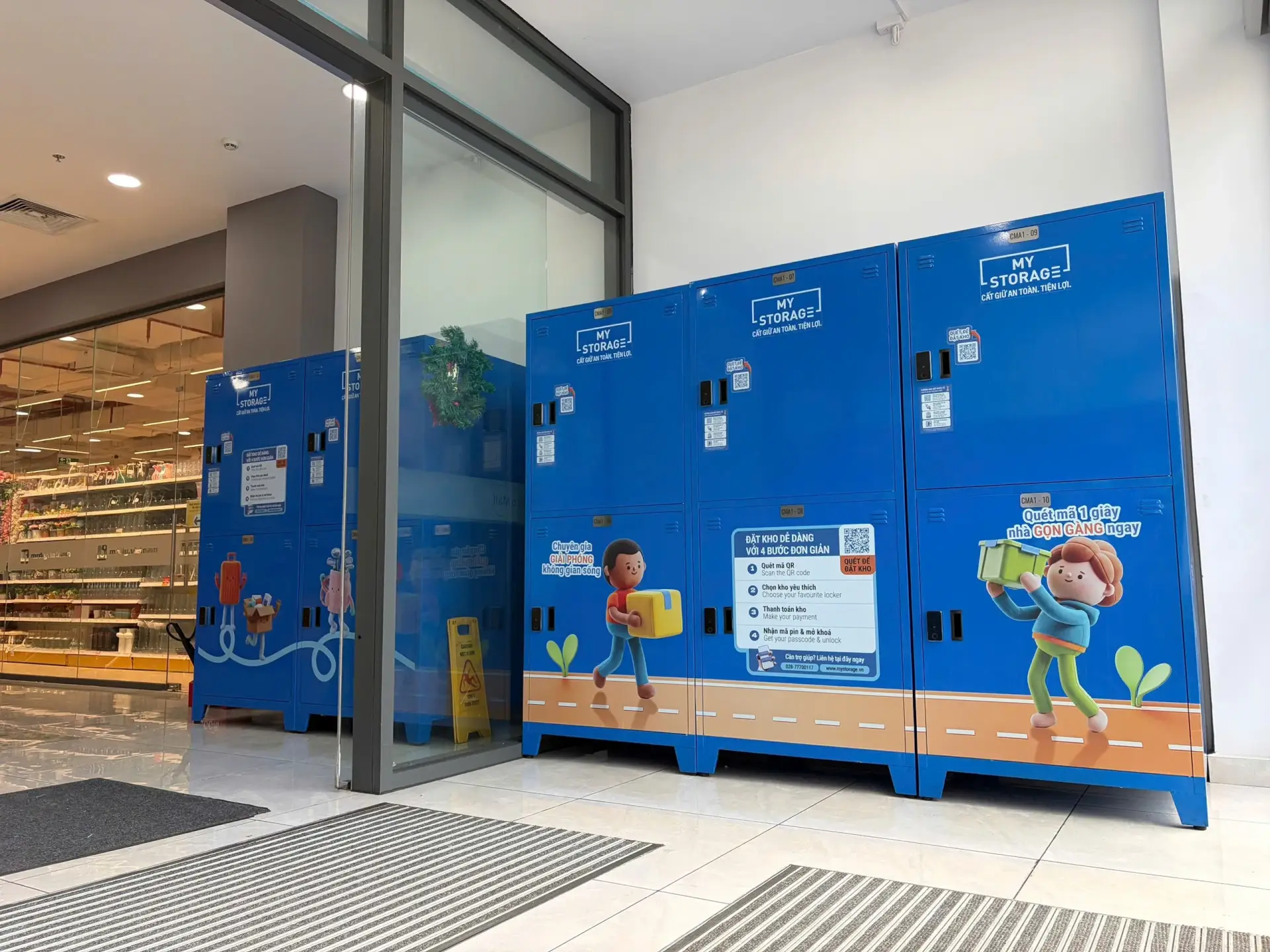
A storage point near the entrance lets guests enjoy the programme without carrying bags and coats throughout. Guests arriving on a flight may also find practical advice on storing luggage safely useful when arranging somewhere to leave their suitcase before travelling from Tan Son Nhat Airport to the venue.
What Costs Are Involved in Buying Lockers?
The cost of buying lockers extends beyond the product price. Delivery, installation, locking systems, maintenance, and replacement parts can all add to the bill. Businesses should therefore calculate the total cost of ownership over the expected life of the equipment, rather than compare purchase prices alone.
The Purchase Price of the Lockers
Locker prices depend on several factors. Before choosing a model, picture the items it will hold and how often they will be taken out and put back. For daily access, compare the convenience of an on-site cabinet with the time spent travelling to off-site space. The main factors affecting locker prices include:
- Number of compartments: more compartments generally increase the price of each cabinet, although they can make better use of floor space.
- Material: powder-coated steel, stainless steel, and composite lockers differ in price and durability, and suit different settings such as offices, factories, or damp areas.
- Size: compartment dimensions affect both the items that fit inside and the floor space needed for installation.
- Design: standard models and custom-built lockers can differ considerably in cost.
Locking-System Costs
The locking system directly affects the initial investment and day-to-day convenience:
- Key locks: usually the lowest-cost option, but keys must be issued and managed manually.
- Combination locks: no physical key is needed, making them useful in shared settings.
- Electronic locks (PIN/QR/RFID): access can be assigned flexibly, making them suitable for public lockers or large shared installations.
- Smart locks: app connectivity and central management typically involve the highest cost, but can support large-scale operation and remote monitoring.
Delivery and Installation Costs
These costs depend on distance, the number of lockers, the installation site, and practical access conditions, such as lifts, narrow passages, or upper floors. Ask the supplier to inspect the site before quoting so that unexpected charges are less likely.
If you are buying lockers while relocating an office, coordinating deliveries can reduce the number of trips. For off-site storage, include the journey as well: choosing a storage area that reduces transport costs can make a real difference to the budget. Check cabinet dimensions and access routes before choosing a delivery truck so that you do not discover on delivery day that the vehicle or cabinet cannot get through.
Maintenance and Repair Costs
Over time, locks, hinges, doors, and electronic components in combination-lock or smart-lock systems may need maintenance. These costs are easily overlooked when comparing purchase prices, yet they can significantly affect the long-term cost of ownership.
What Costs Are Included in Locker Rental?
Rental charges are usually based on the period of use, the number of lockers, and their type. Depending on the supplier, a package may include delivery, installation, dismantling, and technical support. Confirm exactly what the quoted price covers before signing a contract.
It is also important to distinguish renting cabinets for delivery to your venue from renting an existing compartment to leave belongings in. If you only need to put a suitcase away during a trip, a suitable luggage storage service may meet the need without hiring a whole cabinet and arranging transport and installation.
Locker Rental Prices by Duration
Start with how long the lockers will actually be used. A two-day event and a project lasting several months call for different calculations. If you choose an existing compartment, such as one at Centre Mall in District 6, check the rental period and the site's access hours before planning drop-off and collection. Reviewing storage rental prices can help you compare the budget alongside these conditions. Common rental periods include:
- Daily — suitable for short events.
- Weekly — suitable for exhibitions and fairs running over several days.
- Monthly — suitable for projects or medium-term needs.
- For the full event — a package covering the duration of the event.
Additional Rental Costs
Beyond the locker rental fee, allow for packing and moving belongings to the site. During a house move, the load may include tables, chairs, and many boxes, not just suitcases or personal bags. In that situation, storage for household belongings and family luggage needs its own plan rather than trying to fit everything into lockers. The following charges should also be clarified in the quote:
- Transport costs: bringing the lockers to the site and collecting them afterwards.
- Installation and dismantling costs: depending on the quantity and type, these may be charged separately or included in the package.
- Operational support costs: staff guidance, lock troubleshooting, or technical assistance throughout the rental period.
Questions to Ask the Supplier Before Renting
- Does the rental price include delivery and installation?
- Are extra charges payable if the rental period is extended?
- Who is responsible if a locker is damaged during use?
- Is on-site technical support available during the event?
- What are the minimum and maximum rental periods?
Before deciding, explain the number of users, the items to be stored, and the intended duration to the supplier. If your needs extend beyond personal belongings in a single compartment, take a little time to compare storage services. This helps you choose around the actual volume of belongings rather than buying more cabinets and still running out of room.
Comparing the Cost of Buying and Renting Lockers
Buying usually requires a larger initial investment but may be more suitable for prolonged use. Renting reduces upfront capital and makes quantities easier to adjust, although continuous rental over a long period can increase the total cost.
Sometimes a business needs more floor space rather than more cabinets. When boxes start filling office walkways, business storage may be more practical than adding another row of lockers. Compare the options against stock volume and the frequency of incoming and outgoing goods to see which costs are genuinely necessary.
|
Criteria |
Buying lockers |
Renting lockers |
|---|---|---|
|
Initial cost |
Higher |
Lower |
|
Ownership |
Owned by the business |
Owned by the provider |
|
Length of use |
Suitable for long-term use |
Suitable for short- or medium-term use |
|
Flexibility in quantity |
Lower |
High |
|
Installation |
Usually arranged or hired separately |
Support may be included |
|
Maintenance |
The business is responsible |
Depends on the contract |
|
Relocation |
Managed by the business |
May be arranged with the provider |
|
Events |
May not be the most efficient option |
Suitable |
|
Stable ongoing needs |
Suitable |
May be suitable |
|
Capital required |
Higher |
Lower |
Is Renting Lockers Cheaper Than Buying?
Renting is not always cheaper. For short-term use, it often saves upfront capital and ownership-related costs. If lockers will be used continuously for years at one fixed location, buying may offer a lower total cost over the long term.
When Renting Can Be More Cost-Effective
- Events lasting only a few days.
- Short-term projects.
- Seasonal demand rather than year-round use.
- The long-term number of lockers needed is not yet clear.
- A business wants to trial the facility before committing to an investment.
When Buying Can Be More Cost-Effective
- Continuous use over several years.
- A stable number of users with little fluctuation.
- A fixed installation with no need to move the cabinets.
- Frequent, almost daily use.
How to Calculate Total Cost of Ownership (TCO)
For a fair comparison, add up all the payments over the same period. For businesses that move goods regularly, this is also part of logistics and supply chain management: the cabinet price is only one element, while transport, allocating storage space, and retrieving goods all need to be considered. These two formulas provide a starting point:
TCO when buying = Purchase price + delivery + installation + maintenance + repairs + replacement parts
Total rental cost = Rental rate × period of use + additional costs (delivery, installation, operational support)
Comparing these totals over the same expected period helps a business make a decision that fits its budget and operating goals. Actual prices vary by supplier and configuration, so request a detailed quotation before using these formulas.
If you choose off-site space, travel distance is a real cost too. A conveniently located storage facility can save considerable time when you need regular access. Check access hours, collection arrangements and any additional charges before comparing quotes.
Storage conditions must also suit the items; do not assume that every locker meets specific temperature or humidity needs. Compare costs for the same amount of space, rental period and storage conditions. If no one is available to organise drop-off and collection, full-service storage is another option to include in the budget.
Buying or Renting Lockers for Different Needs
Start with the pattern of everyday use. For example, lockers in apartment buildings serve residents over the long term, so stability and ongoing management matter. Offices and factories often have similar needs. For conferences, exhibitions, and short projects, renting is usually easier to adjust when attendance or schedules change.
For an online shop, the amount of stock can grow quickly during peak sales periods. Once locker compartments are no longer enough, e-commerce warehouse rental can provide additional space. If you need to organise stock yourself and manage access, self-storage may suit the way you work.
You do not have to choose one solution for every need. Lockers can hold everyday items while less frequently used belongings are kept elsewhere, leaving the workplace tidier. The combination works best when each item is stored according to how often it is needed and how easily it can be collected.
|
Use case |
Buy |
Rent |
Usual preference |
|---|---|---|---|
|
Apartment buildings |
✓ |
✓ |
Buy |
|
Offices |
✓ |
✓ |
Buy |
|
Factories |
✓ |
✓ |
Buy |
|
Schools |
✓ |
✓ |
Buy |
|
Gyms |
✓ |
✓ |
Buy |
|
✓ |
✓ |
Depends on need |
|
|
Shopping centres |
✓ |
✓ |
Depends on scale |
|
Conferences |
✓ |
Rent |
|
|
Exhibitions |
✓ |
Rent |
|
|
✓ |
Rent |
||
|
Concerts / festivals |
✓ |
Rent |
Frequently Asked Questions
When should a business buy lockers?
Buying makes sense for continuous use over several years, a fixed installation, a stable number of users, and a sufficient initial budget. Ownership gives the business control over equipment, lock configuration, and maintenance schedules.
When should you rent lockers instead of buying?
Renting suits short- or medium-term needs, seasonal changes in quantity, frequently changing locations, or a business that is not ready for a large investment. It also provides a way to trial the arrangement before a long-term rollout.
Are rented lockers suitable for events?
Yes. Conferences, exhibitions, concerts, and sporting events often need lockers for only a few hours or days. Renting allows flexible quantities without having to store the equipment afterwards.
What affects the purchase price of lockers?
The price depends on the number and size of compartments, material, standard or custom design, and lock type. Delivery, installation, and system configuration also need to be accounted for.
What costs arise beyond the purchase price?
A business may also pay for delivery, a site survey, installation, maintenance, repairs, replacement locks and components, and relocation. These are important parts of the total cost of ownership.
How are locker rental prices calculated?
Rental prices usually reflect the number of cabinets or compartments, lock configuration, duration, location, and operational support. Packages may be priced per day, week, month, or for the full event.
Does the rental price include delivery and installation?
This depends on the quotation. Ask the supplier to specify delivery, installation, dismantling, technical staff, and any additional charges in the contract.
What is the minimum rental period?
The minimum depends on the provider and the size of the order. Event packages may be daily, while project rentals may be weekly or monthly.
Is renting always cheaper than buying?
No. Rental is often more economical for short-term use, but continuous use over several years at a fixed site may cost more in rental payments than purchase and maintenance.
How do you calculate the total cost of owning lockers?
Include purchase, delivery, installation, maintenance, repairs, and replacement components over the whole period of use. Compare this figure with the full rental cost for the same period.
Does lock type affect the decision to buy or rent?
Yes. Key and combination locks generally cost less, while PIN, QR, RFID, or smart locks require more investment and technical support. Centralised management and flexible access permissions can strongly influence the choice.
Can lockers be rented in custom sizes or designs?
Customisation depends on the provider, quantity, and preparation time. Bespoke designs usually need earlier booking and may involve additional configuration, manufacturing, or branding costs.
Who is responsible for damage to rented lockers?
The contract should clearly distinguish normal wear, user-caused damage, missing accessories, and technical faults. Both parties should record the condition when the lockers are handed over and returned.
Does the supplier provide technical support at an event?
Some packages can include user guidance, on-site technicians, or remote assistance. Confirm response times, the scope of support, and staffing costs before signing.
What information is needed for a locker quotation?
Provide the number of compartments, desired dimensions, lock type, location, duration, site access conditions, and any transport or operational support requirements. Complete information leads to a more accurate quote and implementation plan.
Related articles
Article
Fix Excel Inventory Formula Errors and Lock Data with Data Validation
How to lock data with Data Validation to stop mistyped SKUs, read the #N/A, #VALUE!, #REF! errors and SUMIFS returning 0, protect sheets from pasted-over formulas, plus tips on barcode…
Read article
Article
What Is Cold Chain Logistics? Process, Standards and Solutions
Cold chain logistics keeps temperature and humidity within a strict range from origin to consumer. This guide covers the standard temperature bands, the four-step process, GDP and HACCP…
Read article
Article
What Is Cycle Counting? How to Run It Without Stopping Sales
Cycle counting means counting part of your stock on a repeating schedule instead of closing the warehouse for a full count. This guide covers ABC classification, how to schedule counts, a…
Read article
