
 Tiếng Việt
 한국어
 日本語
Article
What Is A Fulfillment Warehouse? Functions, Process And Operating Models

On this page
A fulfillment warehouse is a dedicated order-processing centre that handles every logistics step from receiving goods, storage and inventory control to picking, packing, handover to carriers and returns. The model is a strategic link in the e-commerce supply chain, helping multichannel sellers speed up delivery, cut operating costs and improve the customer’s shopping experience. For shops that still pack their own orders, a self-storage service and flexible business storage by industry give you your own storage space without renting a whole warehouse.
1. The Nature Of A Fulfillment Warehouse
A fulfillment warehouse acts as an order completion centre, connecting sales on e-commerce platforms directly to the last-mile delivery network. Unlike a traditional warehouse that simply keeps goods, a fulfillment warehouse runs like a high-speed machine for data and goods flow, making sure every order placed online is processed accurately and packed as fast as possible.
The Fulfillment Warehouse Concept
In logistics, fulfillment means the whole process of completing an order from the moment the buyer presses the order button until the parcel is handed over:
- Fulfillment concept: A chain of steps covering receiving order data, locating the product in the warehouse, picking it from the shelf, packing to shipping standards, attaching the waybill and reconciling cash-on-delivery (COD) payment.
- Nature of a fulfillment warehouse: Not a static long-term store but a dynamic transfer station with very high inventory turnover, focused on handling thousands of small orders a day.
- Multichannel link: A fulfillment warehouse synchronises data in real time with e-commerce platforms such as Shopee, Lazada, TikTok Shop and the business’s own website.
- Core goal: Cut the time from order creation to dispatch to under 2 to 4 hours, minimising cancelled or late orders under marketplace rules.
The model has grown quickly alongside e-logistics and e-commerce storage, where orders are small, come from many selling channels and often have to be delivered the same day.
Main Users
The fulfillment warehouse model is a lifeline for sellers facing the challenge of scaling up their business:
- Marketplace sellers: Shops selling fashion, cosmetics and tech accessories on Shopee, Lazada and TikTok Shop with 100 to thousands of orders a day.
- Multichannel businesses: Brands running physical stores, an online website and several marketplace shops at once that need one central warehouse to pool inventory.
- Importers-exporters and D2C brands: Direct-to-consumer brands that want to optimise the unboxing experience and keep branded packaging consistent.
- Startups and online sellers: Sellers who want to free themselves from manual work such as carrying and packing so they can put 100% of their resources into marketing, livestreaming and product development.
Many shops start by packing orders themselves from a unit used for online-selling storage rental, and only move to fulfillment once orders pass a few dozen a day; categories such as cosmetics storage for online shops also need air conditioning to keep goods in good condition.
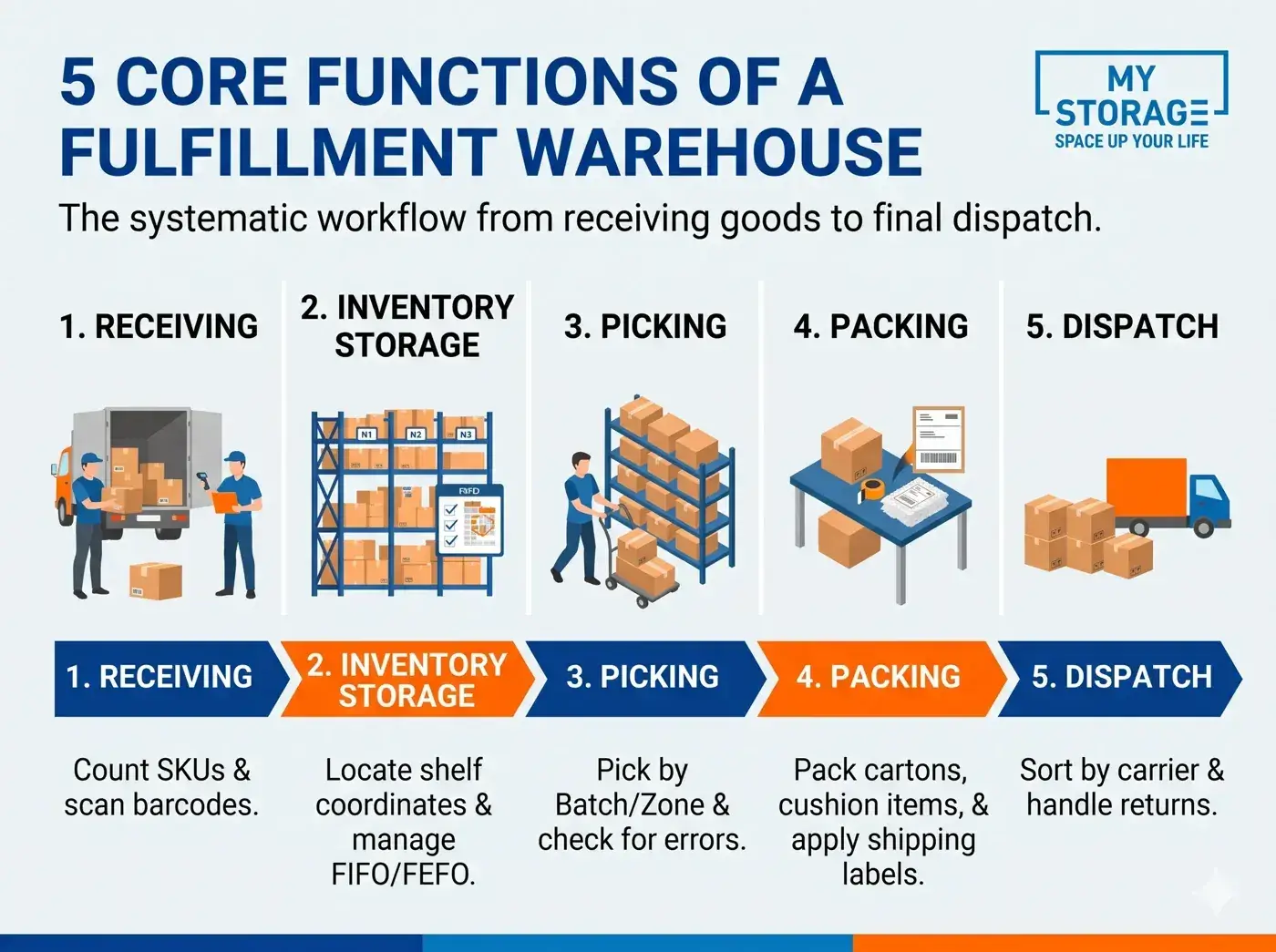
Receiving And Inspecting Inbound Goods
A standard inbound process is the foundation for the accuracy of the entire order-processing chain that follows:
- Receiving goods from suppliers: Delivery trucks are directed to separate docking doors and goods are unloaded onto pallets or dedicated trolleys.
- Counting and reconciling quantities: Warehouse staff check each SKU, number of cartons and number of product units against the delivery note and purchase order (PO).
- Quality and outer packaging inspection: Immediately spot crushed products, torn labels, broken seals or signs of moisture so an exception report can be raised with the carrier.
- Recording data in the system: Scan product barcodes to load the actual received quantity into the warehouse software and switch stock to ready for sale on online shops.
Storage And Inventory
Smart goods placement in a fulfillment warehouse maximises storage space and shortens staff walking distance:
- Zoning by sales velocity: Apply ABC analysis to put fast sellers (group A) on low shelves near the packing tables and slow sellers (group C) on high shelves at the back.
- Location codes with coordinates: Every shelf cell and row gets a unique code (Row - Rack - Level - Bin) so any staff member can find a product within 30 seconds.
- Controlling storage conditions: Keep a cool room temperature and fit humidity control for sensitive categories such as cosmetics, supplements and electronics.
- Managing expiry dates and batches: Apply first-in-first-out (FIFO) or first-expired-first-out (FEFO) to remove the risk of out-of-date stock completely.
Assigning location codes and splitting zones A, B and C is also the principle behind scientific warehouse layout in every kind of warehouse, while goods with expiry dates must leave by FIFO and FEFO in warehouse management.
Picking And Packing Online Orders
Picking and packing are the operating heart of a fulfillment warehouse and directly decide labour productivity:
- Advanced picking methods: Apply piece picking, batch picking of several orders at once or zone picking to optimise walking steps.
- Cross-checking with barcode scanners: Staff scan the product before it goes into the basket; the system gives an audible warning if the colour, size or SKU is wrong.
- Packing standards that protect the product: Use the right-sized carton, add bubble wrap or foam sheets for shock protection and seal with tape so the parcel survives knocks in transit.
- Automatic waybill printing and labelling: The system automatically prints the carrier’s waybill with the packing slip listing the contents and applies it accurately to the parcel.
Handover And Returns
Outbound sorting and reverse logistics keep the order loop closed:
- Sorting lanes by carrier: Packed parcels go through an automatic sorting conveyor or collection trolleys to separate areas for SPX Express, GHTK, GHN, J&T Express or Viettel Post.
- Handover and signed receipt: Scan each parcel for the collecting driver and update the order status to shipped on the e-commerce platform.
- Receiving and processing returns: Inspect parcels returned because the customer refused them or asked for an exchange; check product seals and accessories carefully.
- Restocking or handling faulty goods: Intact items go back into stock for sale; damaged products move to a disposal area or are returned to the seller.
A standard returns handling process in the warehouse gets intact goods back on the shelf within 24 hours instead of waiting in the faulty-goods area.
2. The 7-Step Fulfillment Warehouse Operating Process
A standardised end-to-end fulfillment warehouse process is the guarantee of an order accuracy rate above 99.8%. The whole movement of a product, from arriving at the warehouse to handover to the courier, is digitised and tightly controlled through 7 strict operating steps.
Step 1: Receiving Goods Into The Warehouse
Inbound receiving is organised carefully to prevent inventory data errors right at the warehouse door:
- Booking a delivery slot in advance (ASN): The seller sends an advance shipping notice through the software with the SKU list, expected quantities and the delivery truck’s plate number.
- Checking carton seals: Unloading staff check the manufacturer’s tape and photograph the scene for a report if cartons show signs of being pried open or torn.
- 100% count or sample inspection: Open cartons and count each unit; for large lots of tens of thousands of units, random AQL sampling can be applied.
- Signing the receiving report: Draw up a handover report signed by the delivery representative and the receiving storekeeper, stating the actual quantity received and any discrepancies.
Large lots are usually announced by volume, so knowing how to calculate CBM for stored goods helps the warehouse prepare enough space before the truck arrives.
Step 2: Sorting And Storage
After receiving, products are sorted and routed accurately into specialised storage areas:
- Adding supplementary barcode labels: For products without a standard barcode or with a faded one, the warehouse prints and applies an internal identification barcode.
- Assigning storage locations in the WMS: Staff scan the product and the shelf bin barcode; the software automatically records the link between SKU and storage location.
- Allocating by storage needs: High-value goods go into a locked room with narrow-angle cameras; bulky goods go on high pallet racks; small items go into divided trays.
Step 3: Receiving Orders
The order management system (OMS) automatically collects and processes multichannel orders in real time:
- Automatic API sync with marketplaces: When a customer orders on TikTok Shop, Shopee or the website, the order details are pushed to the fulfillment warehouse management system in under 1 minute.
- Validating the order: The system automatically checks payment status, verifies the delivery address and checks the available stock of the SKUs in the order.
- Automatic order grouping (batching): The software groups orders that share a product or storage area into optimised picking waves to save handling effort.
Step 4: Picking And Checking
Picking is guided directly by smart handheld PDA devices or wireless barcode scanners:
- Issuing an electronic pick list: Warehouse staff receive the picking task on the scanner screen, showing the shortest route through the aisles.
- Confirming location and product: At the right shelf, the staff member scans the shelf barcode and then the product barcode; the scanner shows a green signal and the quantity to pick.
- Gathering at the sorting station: All baskets picked in batches go to the put-to-light sorting station to split products into separate order bins.
Counting the whole warehouse every month interrupts picking, so many fulfillment warehouses use cycle counting in the warehouse to reconcile one group of SKUs every day.
Step 5: Packing And Labelling
Packing keeps goods safe in transit and shows the professionalism of the selling brand:
- Choosing the best packaging materials: Pick a carton that fits the product snugly to reduce dimensional weight and save as much shipping cost as possible.
- Adding gifts and thank-you cards: Include a thank-you card, discount voucher or promotional gift in line with each seller’s marketing campaign.
- Sealing and applying warning labels: Tape the carton edges firmly; apply fragile labels or upright-arrow labels for liquid products.
- Applying the waybill: The thermal-printed waybill is stuck flat on the top of the parcel so the barcode is not creased or torn and the courier’s scanner reads it smoothly.
Step 6: Dispatch And Handover
The final dispatch step makes sure goods leave the warehouse on the schedule promised to the e-commerce platforms:
- Scanning the outbound barcode: Loading staff scan each parcel’s waybill before loading it onto the collection vehicle so the system deducts stock and changes the order status automatically.
- Sorting by carrier hub: Place parcels in steel cages or dedicated sacks for each carrier such as GHTK, GHN, Ninja Van or Viettel Post.
- Handover and electronic signature: Hand all parcels to the collecting truck driver; the driver scans the pickup code and both sides sign the electronic dispatch record.
Step 7: Handling Returns
Professional reverse logistics keeps losses from failed deliveries to a minimum:
- Receiving returned parcels: Collect returned parcels from the courier and scan the waybill so the system records the returned goods as received at the warehouse.
- Opening and assessing condition: Staff inspect the product inside under wide-angle cameras, checking for swapped goods, breakage or intact condition.
- Sorting into 3 streams: Intact goods are sanitised, repacked and returned to stock; lightly faulty goods go back to the shop for repair; badly damaged goods go to the reject area to await disposal.
- Updating reconciliation reports: Report the reason for each return and the actual condition to the seller in the software so they can work with the carrier or reconcile shipping fees.
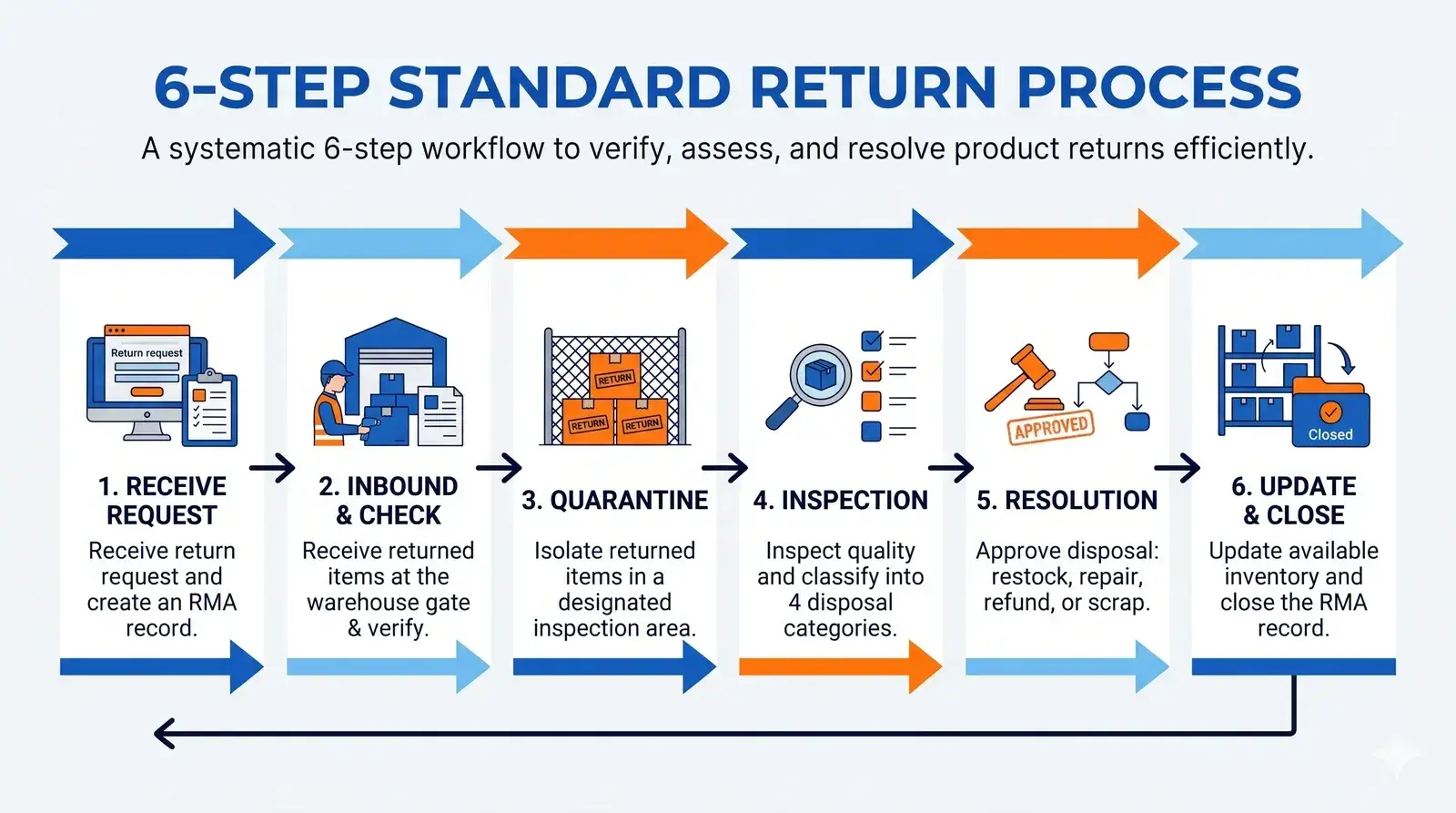
Fulfillment Warehouse Process Control Checklist
This checklist of 7 core steps helps managers control the operating quality of a fulfillment warehouse:
| Step | What To Check | Acceptance Standard |
|---|---|---|
| Receiving | Reconcile SKUs and actual quantity against the PO | 100% match, exception report if any |
| Storage | Check shelf-bin barcode coordinates in the WMS | Scanning a location code returns the right product within 10 seconds |
| Order intake | Sync multichannel orders from the marketplaces | Orders reach the system under 2 minutes after placement |
| Picking | Scan barcodes to check the product before picking | Picking accuracy above 99.8% |
| Packing | Check shock-protection wrapping and carton size | Parcel survives a free fall from 1 metre |
| Dispatch | Scan waybills and sort into the right carrier lane | Handover within the carrier’s pickup window (cut-off time) |
| Returns | Assess product condition and update inventory | Returns handled and sorted within 24 hours |
This control table is condensed from the standard 7-step warehouse operating process, which applies to any warehouse with daily inbound and outbound, not only fulfillment warehouses.
3. Common Fulfillment Warehouse Operating Models
Depending on capital, daily order volume and long-term strategy, a business can choose a self-operated fulfillment model or outsource to a professional service. Understanding the advantages and cost burden of each model helps managers make the most accurate investment decision.
The Self-Operated Fulfillment Model (In-house)
In-house fulfillment requires the business to set up and manage the entire warehouse ecosystem itself:
- Full control for the business: You rent the warehouse space, buy equipment (racking, printers, packing tables), hire storekeepers and install management software yourself.
- Advantage of being in charge: Easily customise packing to your own brand style, check inventory at any time and change promotion policies flexibly.
- A huge fixed-cost burden: You pay fixed monthly rent even in the low season with few orders; staff pay for packers and guards and the initial software investment are very large.
- Difficulty at the peak season: On mega-sale days (11/11, 12/12), orders can jump tenfold, easily overloading a self-run warehouse and causing late deliveries through staff shortages.
Self-operating shops can start with warehouse management in Excel before investing in software, as long as SKU codes and shelf locations are set consistently from the start.
The Third-Party (3PL) Fulfillment Model
3PL fulfillment outsources the whole warehouse operation to a professional logistics company:
- Turning fixed costs into variable costs: The business does not rent a whole large warehouse but pays only for the storage space actually used and the number of orders successfully processed.
- Using modern infrastructure and technology: Benefit from standard warehousing, expensive WMS software and automated processes without any initial capital outlay.
- Preferential shipping rates: Large 3PL providers handle millions of orders a month, so they negotiate deep shipping discounts with carriers, helping shops save on shipping.
- Point to note: A tight service-level agreement (SLA) is needed covering order-processing time and compensation for loss or damage.
3PL providers of warehousing and transport services often bundle fulfillment into one package with transport, bonded warehousing and customs procedures.
The Marketplace Fulfillment Model (FBS, FBL)
Marketplace fulfillment is order completion provided by the e-commerce platforms themselves or their strategic partners:
- Typical programmes: Fulfillment by Shopee (FBS), Fulfillment by Lazada (FBL) or affiliated warehouses designated by the platform.
- An edge in display algorithms: Goods stored in the platform’s warehouse often get priority fast-delivery labels, extra search-ranking points and more shipping vouchers.
- Instant system sync: Orders placed on the platform are processed directly in its warehouse without going through a third party’s intermediary API.
- A flexibility barrier: Storage on the platform is often very expensive for slow-moving stock; inbound inspection is strict and orders from sales channels outside the platform are not supported.
The Omnichannel Fulfillment Model
Omnichannel fulfillment is a unified inventory management solution for brands selling on several platforms at once:
- One single source of inventory: Instead of splitting stock between a store warehouse, a Shopee warehouse and a TikTok warehouse, this model pools all goods in one shared fulfillment centre.
- Smart automatic order allocation: When an order arises from any channel (Facebook, website, TikTok, marketplace), the system deducts from the shared stock and triggers the packing order.
- Optimising capital turnover: It minimises the case where one channel sells out while another sits on unsold stock, helping reduce the working capital tied up in inventory.
- A demanding technology requirement: An omnichannel OMS that connects smoothly and syncs data accurately to the second is a must.
For small shops selling on several marketplaces, managing inventory when selling online from home is a good first step before pooling all goods into one shared warehouse.
Comparing The 4 Fulfillment Warehouse Models
This table compares the 4 most common fulfillment warehouse models on the market today:
| Comparison Criterion | In-house | Third Party (3PL) | Marketplace | Omnichannel |
|---|---|---|---|---|
| Managing party | The business itself | A professional logistics company | The e-commerce platform | The business or a 3PL partner |
| Initial capital | Very high (warehouse, racking, machines) | Low (pay for usage only) | Low (per platform policy) | Medium to high (software systems) |
| Scalability | Slow, limited by floor area | Extremely flexible by season | Flexible within the platform | Very high, adds more sales channels |
| Operating cost | Fixed monthly | Flexible by order volume | High fees for slow-moving stock | Optimised per order |
| Shipping discounts | Poor, because the shop’s volume is small | Very good thanks to pooled volume | Maximum via platform subsidy codes | Optimised per carrier |
| Level of control | 100% direct control | Per SLA commitments | Per the platform’s fixed rules | Centralised control through data |
| Best suited to | Businesses with their own warehouse team | Fast-growing online shops | Sellers exclusive to one platform | Fashion brands, retail chains |
4. Fulfillment Warehouse Compared With Other Warehouse Types
Many businesses confuse a fulfillment warehouse with a traditional warehouse, a general 3PL logistics service, a distribution centre or a self-storage model. Drawing a clear line between how each type really works helps sellers choose the storage solution that fits their operating model.
Versus A Traditional Warehouse
The core difference between the two lies in how goods flow and how fast operations are handled:
- Traditional warehouse: Designed to store large quantities of goods for long periods (several months to years); inbound and outbound move in large units such as trucks, containers or whole pallets.
- Fulfillment warehouse: Optimised for a continuously rotating flow of goods; outbound happens one small unit at a time (a single shirt, lipstick or jar of cream) for the end consumer.
- Use of technology: A traditional warehouse can get by with paper records or a simple Excel file; a fulfillment warehouse must have WMS software and barcode scanners to process thousands of orders a day.
- Share of labour cost: A traditional warehouse needs few staff day to day; a fulfillment warehouse needs a large, shift-flexible team of packers and pickers.
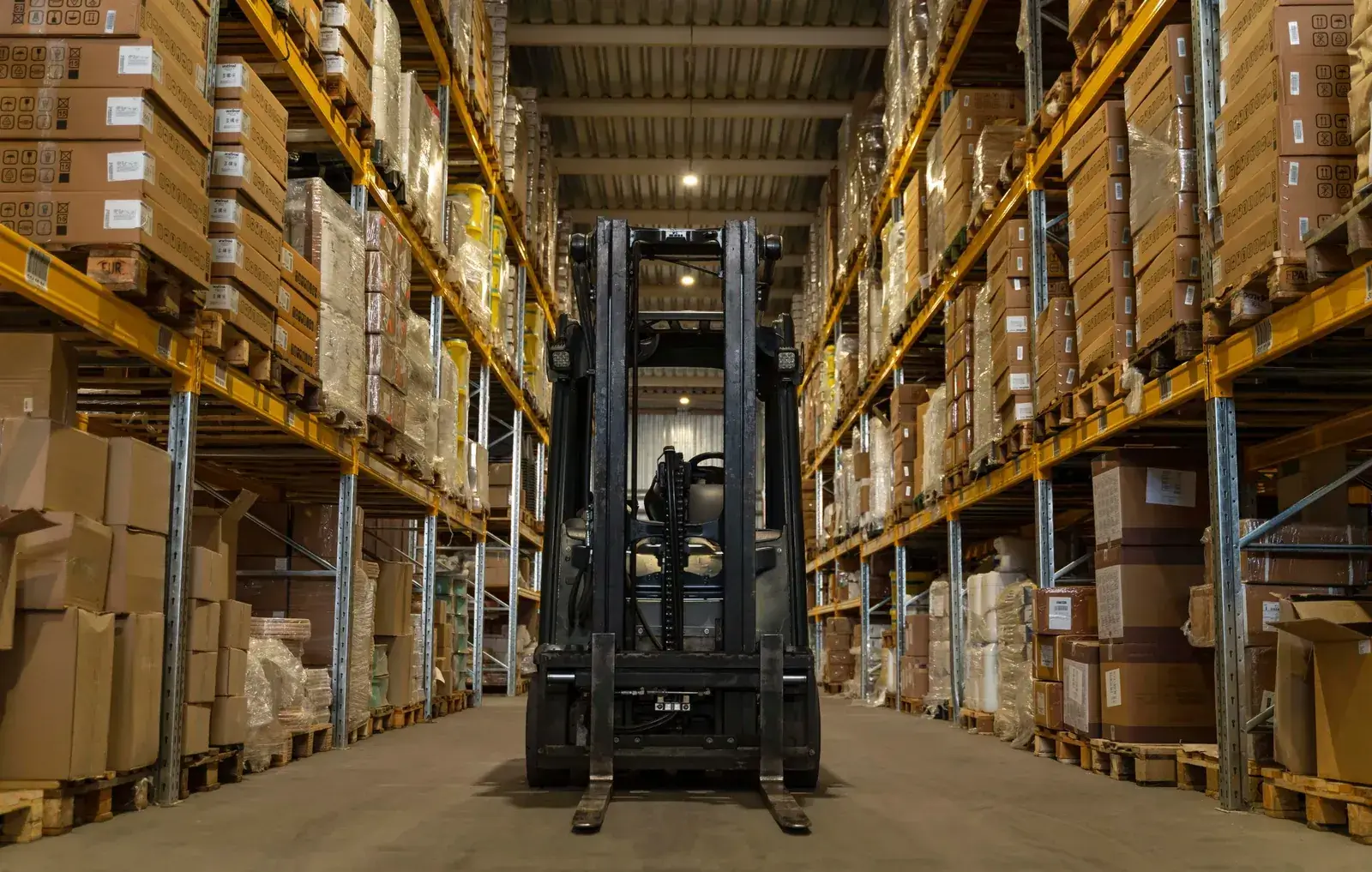
Versus 3PL Services
Fulfillment is a specialised branch within the broad picture of the third-party logistics (3PL) industry:
- What a 3PL service is: A provider of comprehensive logistics solutions covering road transport, sea freight, customs declarations, bonded warehouses, industrial distribution warehouses and supply chain management.
- What a fulfillment warehouse is: A service focused on the final stage of the supply chain, dedicated to processing e-commerce retail orders delivered directly to consumers.
- A two-way relationship: A 3PL logistics company may own several fulfillment centres; however a business that purely offers e-commerce fulfillment does not necessarily provide international transport or customs clearance.
Logistics is itself only part of a bigger picture: logistics and supply chain management differ in scope, while fulfillment takes on the final stage of that chain.
Versus A Distribution Centre
A distribution centre serves large-scale B2B flows, whereas a fulfillment warehouse serves small B2C flows:
- Distribution Center (DC): Receives large quantities of goods from factories, then sorts and routes them into medium lots for supermarkets, agents or chain retail stores.
- Fulfillment warehouse: Receives finished goods and processes tiny individual orders sent directly to each final consumer who ordered online through an app.
- Inbound vehicles: A distribution centre works with large truck fleets of 5 to 15 tonnes; a fulfillment warehouse deals daily with the motorbikes and small vans of express delivery hubs.
Some distribution centres also use cross-docking in the warehouse, moving goods from inbound to outbound trucks within hours without putting them on shelves.
Versus Self-Storage
Self-storage and fulfillment warehouses solve two completely different problems:
- The self-storage model: Provides a separate unit with its own lock; customers bring and store their own goods and manage them themselves, with no picking or packing done for them.
- The fulfillment warehouse model: Does not simply sell warehouse square metres but sells a process service; the operator carries out counting, packing, waybill printing and delivery on the shop owner’s behalf.
- Who uses it: Self-storage suits families storing seasonal belongings, businesses keeping accounting documents or online shops that pack orders on site; fulfillment suits online sellers who want to outsource packing and delivery entirely.
At the 375 Vo Nguyen Giap facility, startups and online sellers can store goods and work at the same time, packing orders right next to their own unit, so self-storage with a packing space suits shops that want to handle orders themselves instead of hiring an outside fulfillment service.
5. Fulfillment Warehouse Technology, Costs And Prices 2027
Running a fulfillment warehouse well takes a tight combination of modern digital platforms and the ability to control operating costs on each order. Knowing the fee structure and the key performance indicators (KPIs) lets businesses judge the financial effectiveness accurately before signing a service contract.
WMS And OMS Systems
The WMS and OMS pair is the brain that runs the whole chain of order processing in a fulfillment warehouse:
- Warehouse management software (WMS): Manages every shelf location in detail, controls stock levels in real time, guides smart picking routes and tracks each employee’s productivity.
- Order management software (OMS): Collects orders automatically from dozens of online sales channels, checks order validity, sends outbound commands to the WMS and updates the tracking code back to the customer.
- Real-time multi-marketplace inventory sync: When a product sells on TikTok Shop, stock on Shopee and the website drops immediately, sharply reducing the risk of marketplace penalties for overselling phantom stock.
When choosing software, compare how well WMS warehouse management systems locate shelf bins, scan codes and connect to marketplaces before signing a contract.
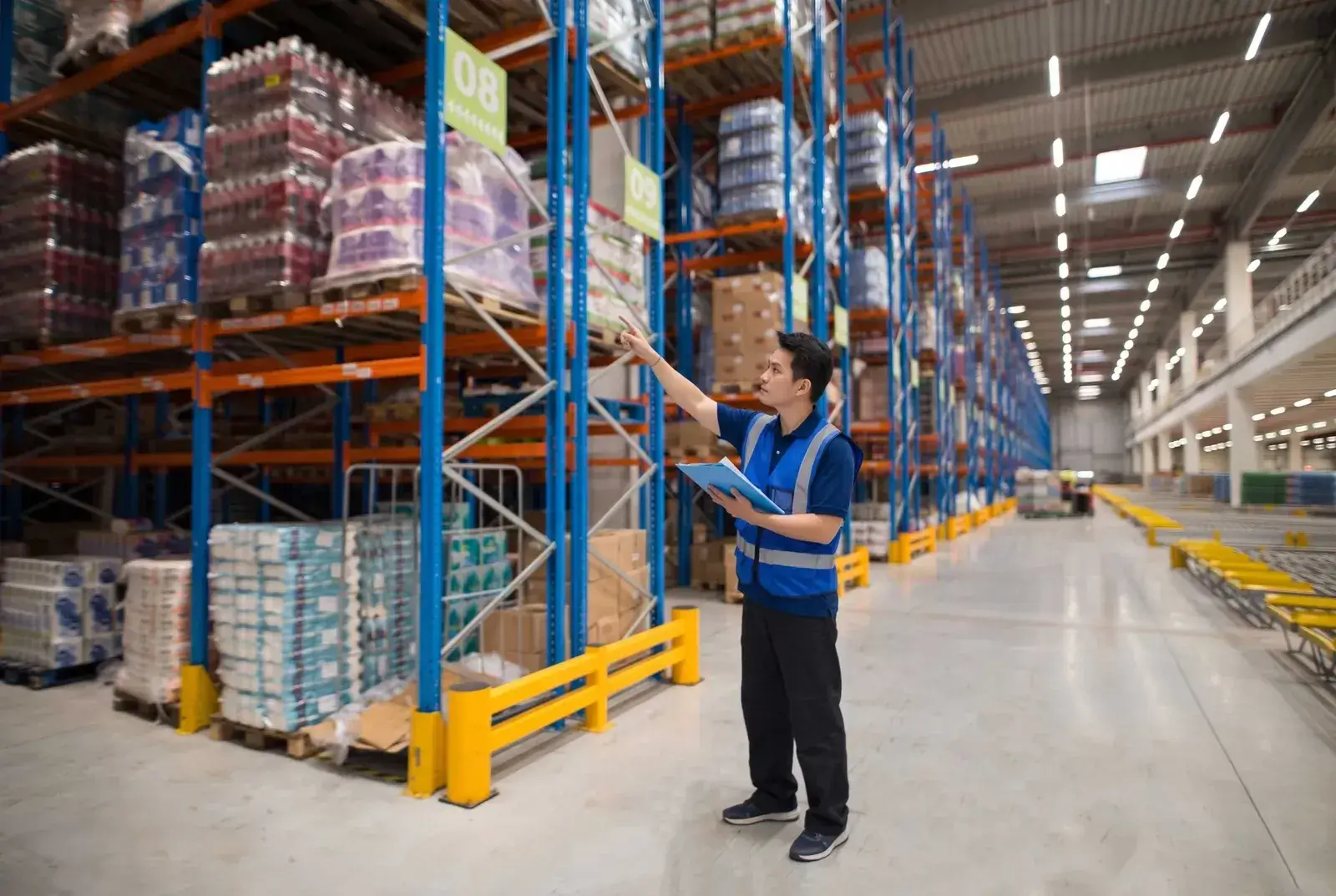
Barcodes And Automation
Automatic recognition technology and mechanisation raise order-processing productivity many times over:
- Barcode and QR code technology: Gives each product and each shelf position a unique identity; scan checks at every touchpoint catch errors right at picking.
- RFID radio-frequency identification: Allows hundreds of items on a pallet to be counted in seconds without scanning each item manually.
- Automatic sorting conveyor (sorter): Automatically scans the waybill on parcels running along the belt and pushes each parcel into the correct chute for each carrier at thousands of parcels an hour.
- Pick-to-light systems: LEDs at the shelf position light up with a display showing the quantity to pick, helping staff pick accurately without looking at a paper list.
KPIs For Evaluating A Fulfillment Warehouse
Sellers need to monitor 6 core performance indicators closely to assess the service quality of the fulfillment provider:
- Order Accuracy Rate: Should reach at least 99.5%; the lower the error rate (wrong item, missing items), the better the shop avoids 1-star reviews.
- Fulfillment Cycle Time: The time from an order reaching the system until the parcel is packed and ready for the courier; under 4 hours is a good standard.
- On-time Shipping Rate: Measures the share of orders handed to the carrier before the platform’s cut-off time so they are not counted as late.
- Inventory Accuracy: The gap between stock shown in the software and the actual goods on the shelf; the industry standard is above 99%.
- Return Rate (warehouse errors): The share of orders returned because of wrong packing, breakage from poor cushioning or a wrongly applied waybill.
- Cost Per Order (CPO): Total fulfillment cost divided by the number of orders processed successfully in the month, to measure economic efficiency.
Fee Components
Fulfillment service costs are made up of several components, itemised by the business’s actual usage:
- Inbound Fee: Charged by the number of cartons, pallets or product units counted and scanned into the system at the start.
- Storage Fee: Charged by the actual volume occupied (m³ or pallets) per day or per month; the faster stock turns, the lower the storage bill.
- Pick & Pack Fee: A per-order handling fee, usually covering the first item picked plus a small surcharge for each extra item in the same order.
- Packaging Material Fee: The cost of cartons, sealing bags, bubble wrap and tape actually used.
- Return Fee: The cost of receiving, opening and inspecting, grading the condition and restocking parcels that failed delivery.
Choosing A Partner
Businesses should weigh 5 key criteria before deciding to sign a fulfillment warehouse contract:
- Warehouse location: Prefer a warehouse near major roads and near the sorting hubs of large express carriers so couriers collect several times a day.
- Infrastructure and fire safety: The warehouse must be raised, free from flooding in the rainy season, have a fire-prevention and firefighting system that passed inspection and clear goods insurance.
- Capacity during mega-sales: The provider must have a plan to add staff and extend overnight shifts during double-day sale spikes and holidays.
- A transparent SLA contract: The contract must clearly state compensation of 100% of the goods’ value in case of loss, damage or shrinkage caused by the warehouse’s fault.
- Smooth software integration: The partner’s software must connect to your online shops through APIs without causing stock mismatches.
Fire safety is a must-have condition: a warehouse that meets warehouse fire-safety standards must have fire alarms, firefighting systems and escape routes as required by regulation.
Self-Storage Price List 2027
For businesses that only need independent goods storage space without packing services, self-storage is the cost-optimal choice in 2027:
| Unit Type | Equivalent Volume / Area | Typical Capacity | Reference Price (per month) |
|---|---|---|---|
| Mini Box | 1 m³ to 3 m³ (about 0.5 - 1.2 m²) | About 8 to 30 medium cartons (suits small online shops storing samples) | 873,000 VND (≈ US$33.91) to 1,563,000 VND (≈ US$60.71) (1 to 3 m³, standard unit) |
| Standard S | 4 m³ to 8 m³ (about 1.5 - 2.5 m²) | About 32 to 80 medium cartons (enough for backup stock for the selling season) | 1,796,000 VND (≈ US$69.76) to 2,886,000 VND (≈ US$112.10) (5 to 7 m³, standard unit) |
| Business M | 9 m³ to 16 m³ (about 3.5 - 5.5 m²) | About 72 to 160 medium cartons (suits a mid-sized distributor) | 3,533,000 VND (≈ US$137.24) to 3,905,000 VND (≈ US$151.69) (from 10 m³, standard unit) |
| 24/7 Air-Conditioning Option | Based on the volume rented | Holds 20°C - 24°C continuously (protects cosmetics and dry food from mould) | About 30% - 40% more than a standard unit |
The prices above are 2027 reference prices for MyStorage self-storage in Ho Chi Minh City, flexible monthly plan, excluding VAT; the 12-month plan is 15% cheaper, and 1 m³ holds about 8 to 10 medium cartons. VND is the billing currency and converted figures move with the exchange rate. Actual cost varies with unit size, location and contract length; the exact price for each size appears as soon as you pick a size in the MyStorage storage price tool. Businesses with more than about 23 m³ of goods should compare the price of a self-storage unit with business storage rental in Ho Chi Minh City priced per m² to choose the cheaper option.
MyStorage Warehouse Solutions
Choosing the right warehousing model is an important lever that frees a business from operating pressure and optimises business costs.
If your business is looking for a provider that completes orders end to end, from picking to packing parcels, fulfillment specialists are the suitable partner. However, if what you actually need is a safe, clean storage space where you can control your own stock, arrange the warehouse yourself or keep backup goods without paying for expensive packing services, a self-storage system is the suitable choice.
The MyStorage self-storage facilities in Ho Chi Minh City provide storage for goods and business assets. With private mini storage units fitted with air conditioning that controls humidity and temperature 24/7, multi-layer security cameras and flexible access, MyStorage helps shop owners protect high-value goods, accounting documents and business equipment. Customers hold their own lock and fully control their storage space, keeping the operating budget transparent and sustainable.
6. Frequently Asked Questions
Here are 15 advanced questions sellers commonly weigh before choosing a model and signing a contract with a fulfillment warehouse:
When should an online shop move from packing its own orders to a fulfillment warehouse?
When packing starts to slow down selling: orders reach about 30 to 50 a day, you miss the platform’s cut-off time, or you spend many hours a day picking goods instead of marketing and product development. If order volume and stock are still small, packing yourself from a small storage unit is usually cheaper and easier to control.
How is cost per order (CPO) calculated and which items should you compare?
CPO is the month’s total fulfillment cost divided by the number of orders processed successfully, covering inbound fees, storage fees by m³ or pallet, pick and pack fees, packaging materials and return handling. When comparing two quotes, put both on the same sample basket of orders (same order count, items per order and return rate) rather than comparing only the per-pick price.
Which hidden fees should you ask about before signing a fulfillment contract?
Ask clearly whether there are storage fees that rise for slow-moving stock, monthly minimum fees, handling fees for inbound lots that differ from the PO, barcode relabelling fees, fees for custom packing such as cards and gifts, fees for orders cancelled after picking and fees for returns that cannot be restocked. Every charge should be listed in the contract’s price schedule.
What terms should an SLA contain to protect the seller?
At a minimum: order-processing time from receipt to ready for handover (a reference of under 4 hours), picking accuracy (99.5% or higher), inventory accuracy (above 99%), the carrier handover cut-off time, the returns processing time (a reference of 24 hours), compensation for loss or damage caused by the warehouse, the right to inspect or audit the warehouse, and the process for recovering all goods when the contract ends.
How do you avoid overselling when selling on several marketplaces at once?
You need an OMS that syncs stock in real time so every order from any channel deducts from one shared stock pool. You should also set a safety stock level for each channel so orders awaiting payment or delayed by a few seconds do not make a marketplace show stock that is not there, and reconcile the software figures with the actual goods on the shelf regularly.
Should you choose marketplace fulfillment (FBS, FBL) or an independent 3PL warehouse?
A marketplace warehouse is convenient because orders sync directly and goods often get priority fast-delivery labels, but it serves only orders on that platform, inbound inspection is strict and storage fees are high for slow-moving stock. An independent 3PL warehouse can handle orders from several channels (marketplaces, website, social media) from one stock pool. If you sell mainly on one marketplace, its fulfillment makes sense; if you sell across channels, choose a 3PL or an omnichannel model.
How does fulfillment differ from 3PL, and does every 3PL company do fulfillment?
3PL is a broad logistics provider covering transport, customs, bonded warehouses, distribution warehouses and supply chain management, while fulfillment is the specialist branch that handles e-commerce orders delivered to consumers. A company in the group of 3PL warehousing services in logistics may own several fulfillment centres, but a business that purely does e-commerce fulfillment does not necessarily provide international transport or customs clearance.
What should you prepare for mega-sales such as 11/11 and 12/12?
Get stock into the warehouse early enough to be counted and shelved before the sale, usually counted in weeks rather than days. Send an advance shipping notice (ASN) and an order forecast so the warehouse can plan staffing, confirm the overtime plan and maximum daily capacity in the contract, settle packaging materials and gifts in advance, and track stock per channel every day throughout the sale.
What conditions do cosmetics and supplements need in a fulfillment warehouse?
Goods with expiry dates must be managed by batch number and dispatched on a first-expired-first-out (FEFO) basis, and the warehouse must control temperature and humidity and avoid sunlight. Ask for regular stock reports by batch and expiry date and warnings when a batch nears its date; expiry-date management when dispatching warehouse stock by FEFO removes the risk of out-of-date stock.
Who pays for returns and how are they handled?
Depending on the contract and the marketplace’s policy, return costs usually include the return shipping fee and the warehouse’s handling fee for receiving, opening, inspecting, sorting and restocking. The standard process splits goods into three streams: intact goods are sanitised, repacked and restocked; lightly faulty goods go back to the shop for repair; badly damaged goods go to the reject area to await disposal, all within about 24 hours and with a report on the reason for the return.
How is cash-on-delivery (COD) reconciled when using a fulfillment warehouse?
COD money is collected from the recipient by the carrier and passed to the seller on the carrier’s reconciliation cycle. The fulfillment warehouse records each parcel handed over with its waybill and delivery status so the shop can match it against the carrier’s statement; ask for daily order reports so lost parcels or shipping fee mismatches are spotted early.
What should warehouse software integrate with to avoid stock mismatches?
You need two-way API connections between the warehouse system and each shop (Shopee, Lazada, TikTok Shop, website): orders pushed in within 1 to 2 minutes, stock deducted immediately and the tracking code sent back. Before signing, run a trial of a few dozen orders to measure stock drift and ask how the provider handles marketplace API outages; comparing the capabilities of different WMS systems for warehouses will help you choose well.
Which KPIs show that a fulfillment warehouse is performing well?
Track six indicators: order accuracy (99.5% or higher), order cycle time (under 4 hours), on-time handover to the carrier’s cut-off, inventory accuracy (above 99%), return rate caused by warehouse errors and cost per order. Write the definition of each indicator into the contract and ask for weekly or monthly reports so comparisons stay consistent.
How are lost or damaged goods compensated?
It depends on the contract: state clearly the compensation level (a reference of 100% of the goods’ value if the warehouse is at fault), how goods are valued (cost or selling price), the maximum per incident and the warehouse’s goods insurance. A signed receiving report, photos of the scene and regular stock counts are important evidence when you need to claim.
When is a self-storage unit and packing your own orders enough?
When orders are still few, stock is from a few cartons to a few dozen cartons, or you want to control inventory and packing yourself. A unit from 1 m³ (holds about 8 to 10 medium cartons) is enough for samples and backup stock; at the 375 Vo Nguyen Giap facility, tenants reach their unit 24/7 and have a workspace to pack orders right next to it. Businesses with several product lines can also look at business storage organised by industry.
Related articles

Article
Popular Decluttering Methods: Should You Choose KonMari, 4 Boxes Or 20/20?
There is no single best decluttering method: KonMari suits a full reset, the 4-box method suits beginners tidying room by room, the 20/20 and 90/90 rules speed up decisions, the 5-minute…
Read article

Article
Storage for Students: Lockers and Monthly Self-Storage Explained
Students storing a backpack or small suitcase for a few days should use a locker; for the summer break, Tet or a room move with many boxes, a monthly self-storage unit from 1 m³ with air…
Read article

Article
Types of Home Storage Cabinets: Uses and How to Choose
Home storage cabinets come in several main types, including wardrobes, multi-purpose cabinets, built-in cabinets, shoe cabinets, kitchen and pantry cabinets, TV and display units…
Read article
