
 Tiếng Việt
 한국어
 日本語
Article
Returned Goods Processing: Inspection, Classification and Restocking
On this page
Returned goods processing follows six steps: recording the RMA request, receiving parcels at the warehouse gate, quarantining the items, inspecting quality, approving a disposal decision and updating available stock. Returned products should only go back into sellable inventory after inspection and approval. This guide covers each step, the four-category grading criteria, an Excel tracking template, and how to free up warehouse space when returns surge.
In e-commerce, return rates can reach double digits and often climb sharply after large promotions or live-stream sales. Without a standard process, the warehouse quickly becomes chaotic, faulty goods may be shipped to the next customer, and revenue leaks away.
1. What Returned Goods Mean for Warehouse Management
Returned goods are products customers send back after receiving them, or products that come back when the carrier fails to deliver. Their condition varies widely, from unopened packaging to damaged or used items, so the business needs an independent check before putting anything back into available stock.
Common Reasons Goods Are Returned
- The customer changes their mind: they no longer need the product, placed a duplicate order, or found a similar product cheaper elsewhere.
- The wrong order was shipped: the picker packed the wrong SKU, size, colour or missed accessories compared with the product description.
- The product has a technical fault: a manufacturing defect, scratches, a feature that does not work, or a clear difference from the advertised images.
- Packaging was damaged in transit: the parcel was crushed, torn, soaked or its seal broke during handling between carrier hubs.
- Delivery failed: the courier could not reach the recipient after three attempts, the recipient refused delivery without a valid reason, or the address was wrong.
Risks of Handling Returns Poorly
- Faulty goods sold to new customers: opened or incomplete products go back on the shelf, leading to complaints and damage to the brand's reputation.
- Stock data drifts: returns are not recorded, or are recorded hastily, so the books no longer match the shelves.
- Holding costs and stuck capital: goods left for weeks gather dust, deteriorate, lose value and take up floor space.
- No way to assign responsibility: the damage cannot be traced to the manufacturer, the carrier or the customer, so the business absorbs the whole loss.
Returned Goods Versus Regular Stock
Returned goods are not automatically saleable. The two groups differ in nature and in how they are managed:
- Available inventory: brand-new products in original packaging, that have passed incoming quality checks, have a fixed shelf location and are ready to sell.
- Returned goods (RMA / Returned Goods): items awaiting verification. When they arrive from the courier, they must be quarantined and kept out of sellable stock until a formal inspection report is issued.
2. The Standard 6-Step Returned Goods Process
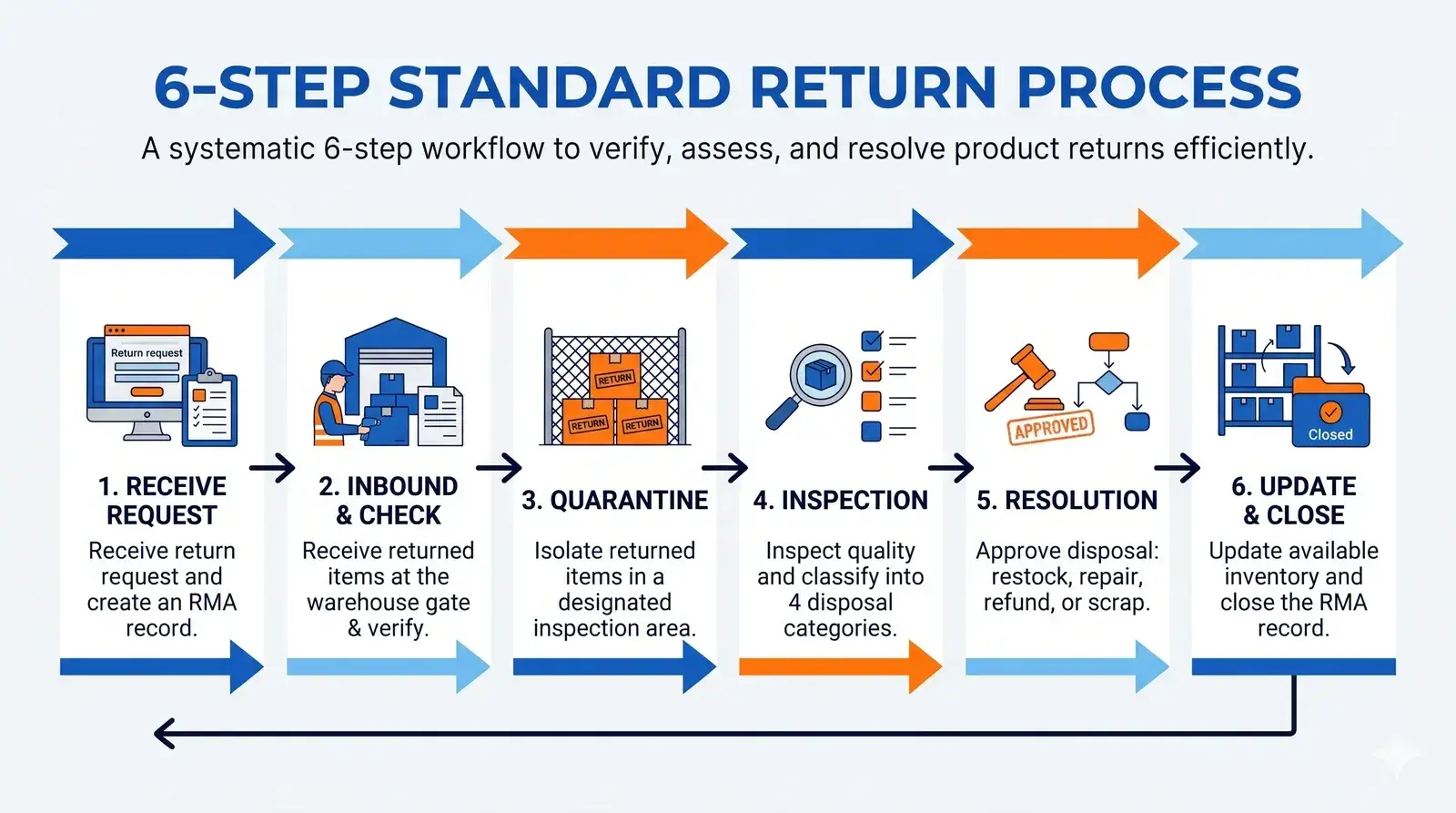
The process runs in six sequential steps: recording the request, receiving the goods physically, quarantining them, inspecting and classifying them, approving a decision, and updating stock records. Following all six steps keeps every return traceable, handled consistently and protected against loss.
- Record the request and create an RMA file
- Receive the parcel and check it against the RMA at the gate
- Quarantine the returned items in an inspection area
- Inspect quality and grade the item into one of four categories
- Approve the disposal decision
- Update available stock and close the RMA file
Step 1: Record the Request and Create an RMA File
The process starts when a return notice arrives from a customer or from the carrier's app. The customer service or warehouse coordinator should:
- Collect the details: original order number, SKU, quantity, buyer name, carrier and the reason for the return.
- Check the return policy: confirm the order is within the return window (for example 7 days) and within the warranty scope.
- Create an RMA (Return Merchandise Authorization) number: each case gets a unique identifier, for example
RMA-2026-0089, linking all data from receipt to closure. - Assign responsibility: record the expected status and name the person who will receive the parcel at the warehouse gate.
Step 2: Receive the Goods and Reconcile Them
When the courier hands over the returned parcels at the warehouse gate, the receiving staff member must first check the outside of each package:
- Check the seal: look for cuts, extra tape, heavy dents or signs of moisture.
- Match the waybill and quantity: compare the tracking number on the parcel with the RMA record, and count the parcels against the courier's handover note.
- Record a joint inspection if something is wrong: if a parcel is empty inside, weighs wrong or contains the wrong product, film the unboxing and ask the courier to sign the irregularity report on the spot.
Step 3: Quarantine the Returns Before Inspection
Returned parcels must never go to the area holding new stock. They should move straight into a dedicated quarantine zone:
- Physical separation: set up a clearly signed zone, kept apart from the picking aisles so nobody picks an unchecked item by mistake.
- Status labels: attach a yellow warning tag or the RMA slip to each parcel, showing the receipt date and the inspector's name.
- Lock the stock records: do not count these items in the available-stock column of the spreadsheet or in the warehouse management system (WMS).
- Set a time limit: target completing the inspection within 24 to 48 hours of receipt to avoid backlogs.
Step 4: Inspect Quality and Grade the Items
A quality inspector opens each parcel and assesses the item against the defined technical criteria:
- Appearance and completeness: compare the product with the original SKU, check the labels and tags, and count the accessories (charging cables, screws, manuals) and any free gifts.
- Function test: for electronics, household appliances or machinery, power on and test the basic functions, connectivity and battery life.
- Hygiene and safety: for apparel, look for stains, unusual odours or frayed threads; for cosmetics, check the shrink film over the cap.
- Inspection record: photograph the condition, list each defect and file the report in the RMA record.

Step 5: Decide How to Handle the Item
Based on the inspection result, an authorised person makes one of four decisions:
- Fit for resale: reseal the item with a new security sticker and process the restock.
- Minor packaging damage: the packing team replaces the carton and re-wraps the item in protective film before re-grading. See packing materials for replacement boxes and wrap.
- Technical fault under warranty: send the item to the technical team for repair, or pack it and return it to the supplier's factory.
- Total loss: record a write-off, sell the item as scrap, or claim compensation from the carrier if the damage happened during delivery.
Step 6: Update Stock and Close the File
The final step brings the numbers back into balance and closes the record:
- Restock available inventory: for items that pass, the warehouse clerk raises a return receipt and records the correct SKU and the new shelf location.
- Financial adjustments: work with accounting to refund the buyer, offset the carrier's balance, or book the loss.
- Sync sales channels: update the available quantity on each online store so the item can be sold again.
- Close the RMA file: store the photos, inspection record and approval signature for periodic reconciliation.
3. Criteria for Grading Returned Goods
Grading must rest on clear, consistent technical criteria, so that a staff member's personal judgement does not decide the outcome. Each product category needs its own set of checks to reach the right decision and protect both the customer and the budget.
Four Common Return Groups
| Group | Visual and functional criteria | Standard action |
|---|---|---|
| Group 1: Intact, fit for sale | Brand new, correct SKU, original tags, undamaged box, all accessories and gifts included. | Restock straight into available inventory. |
| Group 2: Light packaging damage | The product inside is perfect and works, but the outer box is torn at the corner, dirty or lightly dented. | Replace the box, reseal, clean, then restock for sale. |
| Group 3: Technical fault or missing accessories | Does not power on, flickers, is missing a charger or manual, or the customer has already used it. | Move to repair, add the missing accessories, or sell as clearance (outlet) stock. |
| Group 4: Severe damage or counterfeit | Smashed beyond repair, the contents swapped for worthless objects, cosmetics contaminated. | Open a compensation claim, return to the supplier, or dispose of the item. |
Inspection Criteria by Product Category
Each category needs its own control points. Warehouse staff should know the core checks for each:
Fashion and apparel
- Check the fabric label at the collar and the hang tag, and confirm whether the tag has been cut off.
- Inspect sensitive areas such as the underarms and collar for makeup marks, sweat odour, perfume or stains.
- Check seams, buttons, zips and the original shape of the garment.
Electronics and accessories
- The serial number or IMEI on the device must match the box and the electronic warranty card.
- Look for impact marks, screen scratches, cracked plastic or signs that screws were opened without authorisation.
- Test the charger, touch response, ports, speakers and camera.
Cosmetics and beauty products
- Check the aluminium seal under the jar lid or the shrink film around the box.
- Check the expiry date, batch number, and any colour change, odour change or separation in the liquid.
- Safety rule: any product applied directly to the skin that has been opened or has lost its protective seal must never be resold to a new customer, to avoid legal and health risks.
Fast-moving consumer goods and household items
- Check the packaging and the net weight of the product.
- Make sure plastic and stainless steel fittings have not cracked or warped under pressure during transit.
Seven Standard Statuses for an RMA File
The tracking system should use one shared set of seven statuses, so that Customer Care, Warehouse Operations and Accounting can follow progress together. Statuses 4, 5 and 6 are the three branches after QC, and every branch ends at status 7.
- AWAITING RECEIPT: the carrier is moving the parcel back to the warehouse.
- RECEIVED - AWAITING INSPECTION: the parcel is at the warehouse gate, the waybill is logged and the item is in quarantine.
- UNDER VERIFICATION: a technical specialist is inspecting the item in depth or contacting the customer to clarify the fault.
- FIT FOR RESALE: the product meets the standard, has been resealed and is ready to return to the shelf.
- AWAITING REPACKING / REPAIR: the box is being replaced or the item is with the workshop for a minor fix.
- AWAITING SUPPLIER RETURN / DISPOSAL: the item cannot be sold and is waiting for a return note or waste handling.
- COMPLETED: stock records and the financial refund or offset have been closed.
4. Excel Template for Returns Tracking and Stock Reconciliation
A returns tracking workbook in Excel or Google Sheets lets small and mid-sized online shops manage returned goods without paying for software. The file should be designed so that returned items are never added to available stock until a formal approval is recorded.
Required Columns
To follow one return from the moment it arrives to the moment the file closes, the workbook needs at least 10 columns:
| Column name | Data format | Management purpose |
|---|---|---|
| RMA ID | Text, for example RMA-001 | Unique key for each return case. |
| Date received | Date (dd/mm/yyyy) | Tracks progress and the SLA deadline. |
| Original order / waybill | Text | Cross-checks against the sales system or the carrier app. |
| SKU | Drop-down list | Identifies exactly which product came back. |
| Quantity received | Whole number | Records the count made at the warehouse gate. |
| Return reason | Drop-down list | Classifies the cause: wrong item shipped, technical fault, customer changed mind. |
| Inspection result | Free text | Notes on box condition, accessories and scratches. |
| Disposition | Drop-down list | One of four groups: resell, repack, repair, dispose. |
| Stock status | Drop-down list | Shows either quarantined (awaiting approval) or added to available stock. |
| Approver and closing date | Text and date | Assigns personal responsibility and records when the file was closed. |
Formulas and Automation in Excel
To calculate figures automatically and spot backlogs, these are the useful functions:
- SUMIFS to total approved returns by SKU: adds up the returned quantity that has been approved and restocked in a given period.
=SUMIFS(Table_HangHoan[Số Lượng], Table_HangHoan[Mã SKU], A2, Table_HangHoan[Trạng Thái Tồn Kho], "Đã nhập tồn khả dụng")- COUNTIF to count stuck cases: shows how many return files are overdue in quarantine.
=COUNTIF(Table_HangHoan[Trạng Thái Tồn Kho], "Cách ly chờ duyệt")- XLOOKUP for product names: fills in the product name from the master catalogue when a SKU is selected.
=XLOOKUP(D2, DM_HangHoa!$A:$A, DM_HangHoa!$B:$B, "Không tìm thấy SKU", 0)- Data Validation for status columns: locks the return reason, disposition and stock status columns to fixed drop-down lists, so typing errors are blocked. Step-by-step instructions and how to read formula errors are in the guide fixing Excel inventory formula errors.
- Conditional formatting for overdue returns: turns a row red when it was received more than 48 hours ago and is still marked as quarantined.
=AND(I2="Cách ly chờ duyệt", (TODAY()-B2)>2)How the Returns File Links to Stock
The same SKU gives different results in the summary table depending on the file's status:
| File status | Effect on stock |
|---|---|
| Quarantined, awaiting approval | Not counted as sellable stock |
| Approved and added to available stock | Automatically counted in the summary table |
The stock summary formula: Available stock = Opening stock + New receipts + Approved returns - Units sold.
Weekly Reconciliation of Returns Against Stock and Orders
Reconciliation should run every week in six steps:
- Review failed deliveries: pull a report from the delivery partners (GHN, Viettel Post, SPX, GHTK) and filter for waybills in return status.
- Match against physical receipts: compare the list with the parcels in quarantine, and identify any parcels that were delayed or lost so you can claim compensation.
- Check the disposition records: make sure every opened parcel has a QC inspection form signed by a QC staff member.
- Update the stock workbook: enter only items with a signed, approved inspection, as an inbound line in your Excel inventory workbook.
- Run cycle counts: count the quarantine area on a regular schedule, following the cycle counting process, to catch discrepancies early.
- Archive the records digitally: scan the inspection reports, carrier deduction invoices and evidence photos into a shared folder for audit trails.
5. Speeding Up Returns Handling and Freeing Up Warehouse Space
Shortening the handling time means high-value stock goes back on the shelf sooner, and floor space is freed up for the next inbound shipment.
KPIs to Track
- Average turnaround time: from the moment the parcel reaches the gate to the final disposition decision. Target: under 24 working hours.
- On-time processing rate: the share of RMA files closed within the agreed deadline, out of all files received.
- Restock rate: the quantity returned to available stock, compared with the total quantity received, showing how well goods are protected in transit.
- Backlog rate: parcels still waiting for inspection at the end of a week or month, compared with the handling capacity.
- Return reasons breakdown: which causes dominate, such as packing mistakes, product photos that do not match the item, or damage by the carrier.
Ways to Stop Returns From Piling Up
- Prioritise by value: inspect high-value items, fast sellers and products with short shelf life first, so they can go back on sale quickly.
- Standardise the checklist: place a yes-or-no inspection checklist at the workstation, so staff can decide each product in about two to three minutes.
- Clear write-offs weekly: schedule disposal or supplier returns for every Friday afternoon, so damaged goods do not sit into the next week.
- Feed return data back to sales: share the return-reason report with the advisory and marketing teams, so product descriptions can be corrected and size or material misunderstandings are not repeated.
When Does a Business Need More Storage Space?
After a large promotion or during the year-end peak, a sudden surge of returns can paralyse a normal warehouse. Look for more space when these signs appear:
- Aisles between racks are blocked by sacks of returned goods, which is unsafe for staff and slows order picking.
- New stock and returns awaiting inspection share the same area, so workers may pick a used item for a new order.
- Bulky returns pile up and need temporary space for a few weeks while the carrier collects them or a disposal date is set.
For how to organise stock during live-stream sales, read the guide on storing live-stream inventory.
Not sure how many cubic metres the returns need? Photograph the parcels and let MyStorage's AI Size Estimator estimate it for you:
Self-Storage as a Buffer for Online Sellers
To cover a temporary shortage of space without signing a long-term warehouse lease, MyStorage offers self-storage in Ho Chi Minh City for online sellers:
- Air-conditioned units running 24/7: stable temperature and humidity protect cosmetics, fashion accessories, supplements and electronics while they wait for sorting. Learn more about air-conditioned storage.
- Flexible sizes from 1 m³ to 23 m³: a buffer for spare stock, bulky returns or goods waiting for clearance. See the mini storage size guide to pick the right volume.
- Closed-loop security: cameras, a separate lock on each unit and security staff on duty.
- Monthly contracts: expand during peak season and scale down when demand falls.

Price Reference for Returns and Storage Solutions
Managing returns cost and buffer storage directly affects a seller's margin. The table below shows reference prices for covering spreadsheet tools, software and MyStorage buffer storage, for 2027:
| Solution group | Scale | Estimated cost (VND) | Type of investment |
|---|---|---|---|
| Self-built Excel returns tracker | Under 30 returns per day | 0 | Free |
| Advanced Excel file with VBA | Under 100 returns per day | 300,000 – 800,000 | One-off licence |
| Returns module on a cloud WMS | 100 to 1,000 returns per day | 400,000 – 1,500,000 per month | Periodic subscription |
| Enterprise WMS or ERP | Large retail chains | 5,000,000 – 20,000,000+ per month | Subscription or large package |
| MyStorage self-storage, 1 m³ (standard) | About 8 to 10 medium cartons | 873,000 – 965,000 per month | Flexible monthly rental |
| MyStorage self-storage, 1 m³ (air-conditioned) | Heat-sensitive goods | 1,136,000 – 1,256,000 per month | Flexible monthly rental |
| MyStorage self-storage, 3 m³ (air-conditioned) | Bulky returns or heat-sensitive goods | 1,869,000 – 2,065,000 per month | Flexible monthly rental |
| MyStorage self-storage, 5 m³ (standard) | A motorbike with boxes, or a peak-season buffer | 1,796,000 – 1,984,000 per month | Flexible monthly rental |
| MyStorage self-storage, 7 m³ (standard) | The contents of a bedroom | 2,612,000 – 2,886,000 per month | Flexible monthly rental |
MyStorage prices are flexible monthly rates, excluding VAT, for 2027, and may vary about 5% from the actual price. The 12-month plan is 15% cheaper. Software prices are general market references and vary by supplier. For prices by district, see personal storage price list in Ho Chi Minh City. To compare pricing by cubic metre and by square metre, see renting storage by m³ or m².
Choose the rental type, size and temperature to see today's MyStorage price and book with an offer:
Complete Your Supply Chain With a Professional Returns Process
A tight returns process, from receipt and quarantine through inspection to stock updates, protects both brand reputation and cash flow. When grading standards are applied strictly, the tracking file is kept up to date, and stuck stock is cleared quickly, reverse logistics turns from a cost centre into a service advantage.
If the volume of returns rises after a a major sale event, or you need an air-conditioned area to grade high-value products, contact MyStorage. Our team will recommend a flexible buffer solution that fits your space and budget. You can also see the MyStorage facility locations to choose the closest one.
Frequently Asked Questions About Returned Goods Processing
Can returned goods be restocked and sold immediately?
No. Returned items must be physically quarantined and pass a quality check, confirming they are intact and complete with all accessories, before they move into available stock.
What are the standard steps for processing returned goods?
Six steps in sequence: record the request and create an RMA number, receive the parcel at the gate, quarantine it, inspect and grade it, approve the disposition, then update stock and close the file.
How do you tell a return that can be resold from a defective one?
A resaleable item is brand new, has intact tags and packaging, includes all accessories and works perfectly. If the packaging is torn, the product is scratched or the function fails, it belongs in the repair or disposal group.
Should a returned product with a technical fault be repaired or sent back to the supplier?
If the product is still under the manufacturer's warranty, the best option is usually to return it to the supplier and offset the amount against the account. For minor faults that are easy to fix, the business can repair the item itself and sell it as clearance stock.
What is the purpose of the RMA number in a returns process?
The RMA number is the unique identifier for each return case. It links the original order, the inspection record, the photos and the financial decision, which prevents files from being lost or duplicated.
Which columns should a returns tracking spreadsheet contain?
At least 10 columns: RMA ID, date received, original order number, SKU, quantity received, return reason, inspection result, disposition, stock status and approver.
How do you stop returns from distorting available stock figures?
Write the formula so that returned items only count toward sellable stock once the file status changes to added to available stock. Never add them automatically when the parcel is first received.
Can cosmetics with a broken seal be repacked and sold again?
No. Cosmetics whose seal has been broken risk contamination, oxidation and loss of safety. Convert them into tester units where appropriate, or record a disposal. Cosmetics storage guidance is in the post cosmetic storage for online shops.
How should an online shop handle a sudden spike in returns after a livestream?
Set up a dedicated returns inspection table at the warehouse gate, prioritise high-value and fast-selling items, and rent short-term buffer storage for bulky parcels waiting to be processed.
Who is responsible for inspecting returned goods?
The quality control (QC) team, or a technically trained warehouse clerk, checks appearance and function. The warehouse manager or business owner signs off on whether an item is restocked or cleared.
What should be done if a returned parcel has been swapped for stones or water bottles?
Keep the parcel exactly as received, film the unboxing close up with the courier present, record a joint inspection report signed by both parties, and file a compensation claim with the carrier.
How long should it take to process one returned parcel (SLA)?
Aim for 24 to 48 working hours from physical receipt at the warehouse. Longer processing ties up floor space and delays refunds to buyers.
What is the difference between reverse logistics and forward logistics?
Forward logistics moves new products from the manufacturer through distribution warehouses to the final consumer. Reverse logistics runs in the opposite direction, from the customer back to the seller, for warranty, repair, exchange, return or disposal.
Can a barcode scanner be connected to an Excel returns file?
Yes. A USB barcode scanner works like a keyboard, so scanning the carrier label or the SKU on the box types the code into the selected cell, which speeds up counting considerably.
What does short-term storage to clear returns cost in Ho Chi Minh City?
A standard 1 m³ self-storage unit from MyStorage costs about 873,000 to 965,000 VND per month, holding about 8 to 10 medium cartons. An air-conditioned 1 m³ unit costs about 1,136,000 to 1,256,000 VND. Rentals are monthly and can be expanded or reduced with the season. You can check prices for your size with the price tool.
Related articles
Article
Fix Excel Inventory Formula Errors and Lock Data with Data Validation
How to lock data with Data Validation to stop mistyped SKUs, read the #N/A, #VALUE!, #REF! errors and SUMIFS returning 0, protect sheets from pasted-over formulas, plus tips on barcode…
Read article
Article
What Is Cold Chain Logistics? Process, Standards and Solutions
Cold chain logistics keeps temperature and humidity within a strict range from origin to consumer. This guide covers the standard temperature bands, the four-step process, GDP and HACCP…
Read article
Article
What Is Cycle Counting? How to Run It Without Stopping Sales
Cycle counting means counting part of your stock on a repeating schedule instead of closing the warehouse for a full count. This guide covers ABC classification, how to schedule counts, a…
Read article
