
 Tiếng Việt
 한국어
한국어 日本語
日本語Article
How to Manage Inventory for a Home-Based Online Shop

Running an online shop from home is a popular way to start a business: it keeps premises costs to a minimum and the operation stays flexible. But as daily orders grow and the product range widens, sellers often end up overloaded, handling everything from restocking to packing and dispatch.
Without a clear inventory process, a shop quickly runs into serious problems: overselling, lost stock, capital tied up in goods, or hours wasted hunting for a single item to send a customer. Setting up a sound stock-control method early keeps an online shop running smoothly, protects cash flow and leaves it ready to scale.
1. Why Manage Inventory at Home?
Inventory management lets an online shop know exactly how much of each item it holds in real time, avoids overselling and the cancellations that follow, and makes restocking planned rather than reactive. For a home-based operation, good stock control also frees up living space, shortens packing time and stops capital being buried in slow-moving products.
Common problems when storing stock at home
When living space becomes an improvised stockroom, shop owners tend to run into the same operational difficulties:
- No clear count by variant: Without detailed classification, the seller cannot say exactly how many of each colour and size remain, and ends up accepting orders beyond actual stock.
- Stock figures drift between sales channels: Selling on Shopee, TikTok Shop and Facebook at once without instant syncing easily leads to phantom orders or short deliveries.
- Product lines fall out of step: Best-sellers run out suddenly and cost the shop revenue, while outdated, slow-moving products keep taking up storage space.
- Time lost looking for stock: Products scattered across the living room, under the bed or in a stairwell corner make picking and packing messy and slow.
What good stock control gives you
Bringing order to a home stockroom pays off in practical ways:
- Fewer mistakes when fulfilling orders: Tight stock control means packing the right model and the right variant, and cuts cancellations due to stock-outs to a minimum.
- Working capital freed up: Knowing how fast each SKU sells lets the seller cut long-held stock, recover cash quickly and reinvest in higher-margin products.
- Restocking planned in advance: Accurate stock data is the basis for ordering ahead of major sales events, so supply never breaks.
- Living space optimised, room to grow: Neatly arranged goods keep the home airy, and lay solid groundwork for when the shop needs storage space outside the house.
2. The Home Inventory Management Process
To manage a stockroom at home effectively, a shop owner needs to standardise product codes, build a sheet that tracks inbound and outbound movements, record transactions as they happen, and reconcile the figures periodically. Every item should have a fixed storage location so picking is fast and accurate, with as little packing confusion as possible.
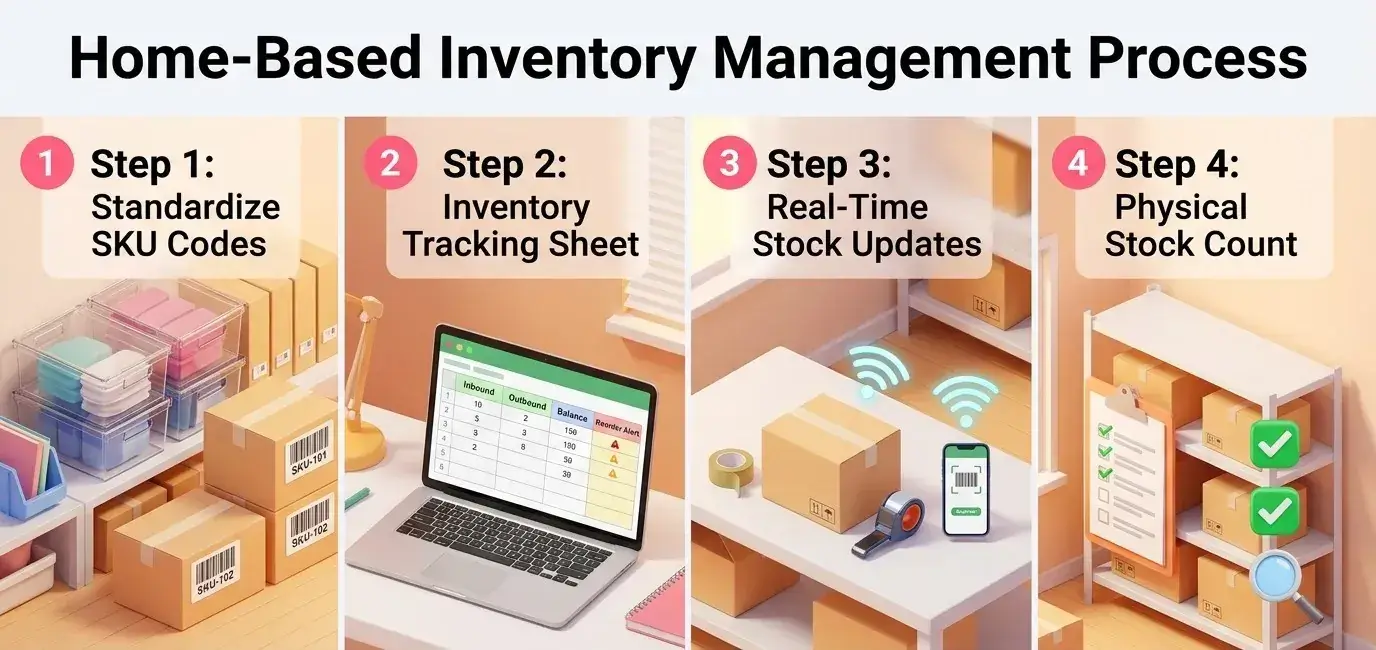
Step 1: Standardise product SKU codes
The stock keeping unit (SKU) is the foundation that tells every product and every detailed variant apart in your stockroom:
- How to structure an SKU sensibly: The code should carry abbreviated information such as product type, style code, colour and size (for example SM-TR-TR-M for a men's shirt, plain cut, white, size M).
- Avoid duplicates and confusion: Every colour or size variant must have its own unique SKU; never share one code across different items.
- Keep naming consistent: Name products in your management system exactly as they appear on the marketplace listing, so whoever is packing can identify them easily.
Step 2: Build an inbound-outbound-balance sheet
The tracking sheet records the full movement history of each SKU, from the day it arrives to the day it ships:
- The core columns: A standard tracking sheet needs columns for SKU, Product name, Storage location, Opening balance, Quantity in, Quantity out, Returns and Closing balance.
- Set a minimum stock level: Set a safety stock level for each product; when the actual quantity hits that threshold, the system prompts the owner to reorder.
- Start with free tools: Below 50 orders a day, Google Sheets or Excel is perfectly workable and keeps initial costs down.
Step 3: Update stock movements in real time
Stock data is only worth having when it is recorded continuously and matches every transaction during the day:
- Record goods the moment they arrive: Count the quantity and check the condition carefully before entering the figures, so they can be reconciled against the supplier's invoice.
- Deduct stock as soon as the waybill is created: Reduce the quantity as soon as an order is confirmed and packed; do not leave the figures to pile up until the weekend.
- A zone and a column for returns: Goods cancelled in transit or returned by customers need a quality check before they go back into sellable stock.
Step 4: Count and reconcile against the shelves
A regular physical count is the only way to catch discrepancies between the books and the actual goods early:
- Cycle count by SKU group: Rather than halting everything for a single full count, split the catalogue and check 5 to 10 SKUs a day.
- Find the cause of any shrinkage: When a discrepancy appears, review the packing camera, the order history, or check whether the item was put in the wrong place, before adjusting the figures.
- Count high-value items more often: Expensive, small items that are easy to misplace should be counted weekly to keep your assets safe.
E-commerce industry data:
According to Vietnamese e-commerce market reporting from the data platform Metric, the average return rate on online marketplaces runs from 8% to 12%, and in fashion it has reached 15% at times. Without close tracking of returns, an online shop can lose 5% to 7% of its inventory value with no clear explanation.
3. How to Organise a Home Stockroom Properly
Floor space at home is usually limited, so a well-planned storage layout determines both packing productivity and how well product quality is preserved. Drawing clear boundaries between functional zones, using the height of the room and placing best-sellers within easy reach frees up walkways and keeps the house in order.
Zone your storage by product group
An orderly storage layout makes the home operation feel professional and reduces collisions:
- Sellable stock zone: On multi-tier racking, divided by product group, or with a dedicated shelf level per SKU.
- Faulty goods and returns zone: Set aside a separate corner for returned parcels or products with technical faults, so they are never repacked for a new customer by mistake.
- Packing and supplies zone: Keep cardboard boxes, bubble wrap and tape and the label printer tidy on their own workbench so the work moves quickly.
- Keep walkways clear: Never stack goods across a fire exit, a doorway or the family's shared living areas.
Apply FIFO and FEFO
Managing the flow in and out properly minimises the risk of goods degrading or expiring:
- FIFO (first in, first out): Goods received earlier sit at the front so they go out first. This suits fashion, accessories and household goods, where old stock goes out of style.
- FEFO (first expired, first out): Items with an expiry date, such as cosmetics, dry food or supplements, need their dates checked on arrival; the batch with the shorter shelf life goes in the most accessible spot.
Label locations so picking is fast
A location system means anyone in the household can help pick an order correctly:
- Name locations as coordinates: Give each rack and shelf level a name (for example R1-L2 for Rack 1, Level 2) and label it clearly and largely at the end of the rack.
- Write the coordinates into your stock sheet: Record each SKU's storage location in the tracking sheet so the picker does not have to hunt for it.
- Give best-sellers the prime spots: The SKUs that make up 80% of daily orders (group A under the A, B, C stock classification) belong on shelf levels at eye height, closest to the packing bench.
Deal with slow-moving and ageing stock
Stock that sits for a long time is the main reason living space disappears and capital stagnates:
- Filter for stock older than 60 to 90 days: Review products with slow turnover, or with no orders at all for more than two months.
- Plan how to clear it: Run buy-one-get-one promotions, bundle items with best-sellers, or sell them off to recover the original cost.
- Stop buying on instinct: Do not bring in more similar variants while the old stock is still unresolved.
4. Spreadsheet or Inventory Software?
Excel or Google Sheets is an excellent starting point for an online shop with few products, a light workflow and a small initial budget. Once the business grows to thousands of orders a month and sells across several channels, moving to dedicated inventory software becomes necessary to automate the data and avoid manual errors.
When is a spreadsheet enough?
Spreadsheet management works best under simple operating conditions:
- The shop has fewer than 50 SKUs and a catalogue without complex variants.
- Fewer than 30 orders a day, so the seller has time to record them manually after each selling session.
- Only one or two people handle the stock and the orders, with no need for complex permissions.
- Sales come mainly through a single channel, with no need for automatic stock syncing.
When should you move to software?
It is worth investing in professional inventory software once you notice these signs:
- Selling across several channels at once: Shopee, TikTok Shop, Lazada and social media simultaneously, where stock has to be deducted automatically across every channel as orders come in.
- Stock discrepancies rising: The system frequently shows stock available when the shelf is empty, driving up cancellations and operational penalties from the marketplace.
- Hiring staff: You need detailed permissions for packing staff and chat agents without exposing cost prices or sensitive financial data.
How to choose the right tool
To pick an inventory tool that fits and stays within budget, assess it against these criteria:
- Marketplace integrations: Favour software that syncs stock both ways, quickly, with Shopee, TikTok Shop and the common delivery partners.
- A clear, easy interface: Simple to operate, with a mobile app so the owner can check stock anywhere.
- Sensible licence cost: Weigh monthly against annual plans, and keep the software cost under 2% to 3% of the shop's monthly revenue.
5. When Should a Shop Rent Storage Outside?
Storing stock at home is only a temporary answer in the early days, while volumes are modest. Once the business takes off, goods start taking over the whole living space and getting in the way of family life, weighing up renting storage instead of keeping stock at home becomes the turning point towards a professional operation.
Signs your home stockroom is overloaded
It is time to seriously consider moving stock out when any of the following appears:
- Boxes and packing supplies fill the living room, the bedroom or the hallway, leaving the home stuffy and unsafe in a fire.
- Finding products and packing them takes several times longer because goods are stacked at random.
- There is no longer safe space to take in a large consignment at a good manufacturer discount.
- Goods are easily damaged or go mouldy because home conditions cannot hold the right temperature and humidity, particularly cosmetics and electronics.
Home storage versus renting outside
The table below compares the core operational aspects of the two options:
| Criteria | Storing at home | Renting external self-storage |
|---|---|---|
| Monthly premises cost | No separate rental cost. | A recurring monthly fee based on the space used. |
| Living space | Severely reduced; a common source of family tension. | Fully freed up, giving the home back its comfort. |
| Storage conditions | Hard to control temperature; mould is likely in the rainy season. | Air conditioning holding temperature and humidity below 25°C. |
| Security and fire safety | High risk of electrical fire; you carry the responsibility. | CCTV 24/7, your own lock code, approved fire-safety systems. |
| Room to expand | Limited by the actual size of the house. | Highly flexible: scale up or down with the season. |
Choosing the right storage model
Depending on your budget and the way you operate, an online shop can choose between these models:
- The self-storage model: The best fit for small and medium online shops that want private space with air conditioning, and the freedom to organise, pack and collect stock whenever they like.
- The fulfilment model: Suits businesses with strong cash flow that want to outsource logistics to a 3PL across the whole chain, from storage and picking to packing and handover to the courier.
- The traditional warehouse rental model: Suits distributors handling bulky goods and large pallet volumes, but it requires a long lease of several years.
MyStorage: smart self-storage for online shops
For online sellers in Ho Chi Minh City who want professional storage space without the cost pressure of a large industrial warehouse, MyStorage is the strongest option:
MyStorage self-storage offers a range of separate storage spaces, from mini units of a few cubic metres to rooms of 10m² to 50m², at conveniently connected locations across Ho Chi Minh City.

- Close climate control: Our air-conditioned storage areas hold temperature below 25°C with steady humidity, keeping cosmetics, fashion accessories, dry food and luxury goods in full condition.
- Multi-layer security and privacy: Each customer has their own lock code and key card, with CCTV and access control covering the site 24/7 and an approved automatic fire alarm system.
- Flexible rental terms: Shop owners can rent month by month, upgrade to a larger room for the year-end shopping peak and scale back when the sale season ends.
- Facilities that help you pack: The site has workbench space, high-speed Wi-Fi, trolleys and a goods lift, so sorting and packing are straightforward.
Not sure how many cubic metres your shop needs? Photograph your stock and let MyStorage's AI Size Estimator work it out:
A note on scope of service:
MyStorage self-storage is about providing safe, standard-compliant, independent storage space. The model does not include order picking, automated packing or dispatch to marketplaces by default, unless the customer signs up for the relevant support packages.
Reference Storage Rental Prices
Below are reference price ranges for the storage options online shops in Ho Chi Minh City use most:
| Type of storage | Size | Reference price | Best suited to |
|---|---|---|---|
| Mini unit (locker / cube) | From 1 – 4 m³ | VND 600,000 – 1,200,000 / month | Samples, small accessories, accounting records. |
| Small air-conditioned self-storage room | From 6 – 12 m² | VND 2,800,000 – 5,500,000 / month | Fashion, cosmetics and dry food shops that need a cool environment. |
| Standard self-storage room | From 15 – 30 m² | VND 6,500,000 – 11,500,000 / month | Small businesses and multi-channel shops with steady order volumes. |
| Full-service storage by the box | Priced per carton | VND 35,000 – 60,000 / box / month | Collection from your door, centralised storage; good for long-term stock. |
Please note: the prices above are indicative for the Ho Chi Minh City market in late 2026. Actual costs vary with the location of the facility, the contract term and any additional services you choose.
Pick a storage type, size and temperature option to see today's MyStorage price instantly and book with an offer:
Optimise Your Stock to Grow Revenue
Effective inventory management is not simply counting goods every day; it is the core strategy that saves a home-based online shop time, optimises its cash flow and builds its reputation with customers. By standardising SKUs, updating movements consistently and keeping the space tidy, you build a solid operating foundation for the long run.
Once your stock outgrows the house, do not hesitate to look for professional storage for an online shop outside the home, to free up your living space and raise order-processing throughput.
If you are looking for secure self-storage with proper air conditioning and flexible terms in Ho Chi Minh City, talk to the MyStorage advisory team for advice on the unit size that best fits your business.
This article was written by the MyStorage team, drawing on our experience running storage services in Ho Chi Minh City; last updated October 2026. The prices and figures given here are indicative at the time of writing.
Frequently Asked Questions
What is an SKU, and why does a home-based online shop need one?
An SKU is a product identifier you define for internal management. It distinguishes each style, colour and size clearly, reduces picking and packing mistakes, and makes reconciling stock across marketplaces accurate.
How often should I count stock at home?
For a small shop, cycle count daily or weekly through small groups of 5 to 10 fast-moving SKUs. For the whole stockroom, run a full count once a month so discrepancies are corrected promptly.
Should I use inventory software as soon as I open the shop?
If you are starting out with fewer than 30 orders a day and a small catalogue, Google Sheets is economical and entirely sufficient. Invest in software only when you start selling across several marketplaces, or when order volume grows beyond manual control.
How do I reduce losses on returned goods when selling online?
Set up a dedicated receiving area for returns, film the unboxing so you can reconcile with the marketplace, and clearly separate intact goods to put back into stock from damaged goods for a timely compensation claim.
What is the difference between FIFO and FEFO?
FIFO means first in, first out, which suits fashion and household goods so stock does not go out of style; FEFO means first expired, first out, applied to cosmetics, pharmaceuticals or food so customers always receive the freshest dates.
How do I work out safety stock for an online shop?
Safety stock is based on average daily sales multiplied by supplier lead time, plus a buffer for peak days. When the actual quantity reaches that threshold, place a new order straight away.
How do I deal with products going mouldy at home during the rainy season?
Keep goods on pallets or racking at least 15cm off the floor, away from damp walls, put a dedicated desiccant pack in each box, and keep the room closed or run a dehumidifier when humidity goes above 80%. See also how to protect belongings from damp and mould in the rainy season.
How do I sync stock when selling on TikTok Shop and Shopee at once?
Use multi-channel sales software with direct marketplace integrations; when an order comes in on Shopee, the system reduces available stock on TikTok Shop within seconds to prevent overselling.
Do free gifts and packing supplies need their own SKUs?
They very much do. Cartons, bubble wrap, tape and free gifts all form part of your cost of goods and need their own SKUs so you can track quantities, and never suddenly run out of boxes and miss a dispatch deadline.
What is the difference between physical stock and available stock?
Physical stock is the total quantity actually in the house; available stock is what is left to sell after deducting items already ordered but still waiting to be packed or collected by the courier.
Should an online shop clear old stock at a loss?
It is worth clearing stock to recover cash if a product has sat for three to six months without a single order. Selling at break-even or a small loss frees up space in the house and brings immediate cash to reinvest in what is selling.
Is self-storage more expensive than renting a whole house as a stockroom?
Self-storage is charged flexibly on the volume you actually use (from a few cubic metres) and comes with air conditioning, security and approved fire safety. Renting a whole house means paying for all of it whether you use it or not, a long-term deposit, and your own electricity, water, security and air conditioning. See also warehouse rental costs in Ho Chi Minh City by district.
Are goods stored at MyStorage self-storage secure?
MyStorage has access control by personal lock code, CCTV covering every corridor 24/7, security staff on site and an automatic fire-fighting system approved by the authorities.
When can I visit MyStorage to pack and collect stock?
Self-storage customers at MyStorage have independent access to their unit during standard operating hours, or 24/7 by service agreement, so they can organise, pack and hand goods to the courier freely.
Can I bring racking and a packing bench into a MyStorage unit?
Customers are free to design the inside of their private room at MyStorage, including installing steel racking, setting up a desk and chair, a label printer, and arranging stock to suit their own workflow.
Related articles
Article
Logistics and Industrial Real Estate: How They Connect, Market Trends and Opportunities
How logistics and industrial real estate depend on each other: types of premises, how location and warehouse design drive cost, Vietnam market trends, and choosing the right space.
Read article

Article
Where to Store Your Vehicle and Belongings During a Long Trip
How to sort your belongings, prepare a motorbike or car, and choose where to store everything during a long trip: keep it at home, leave it with family, or rent self-storage.
Read article

Article
Where to Store Livestream Products When Home Space Is Limited?
Learn how online sellers can store livestream inventory when home space is limited: organize samples and stock, manage orders, compare home storage with renting a private unit, review…
Read article
