
 Tiếng Việt
 한국어
한국어 日本語
日本語Article
IoT in Warehouse Management: Temperature, Humidity & Security
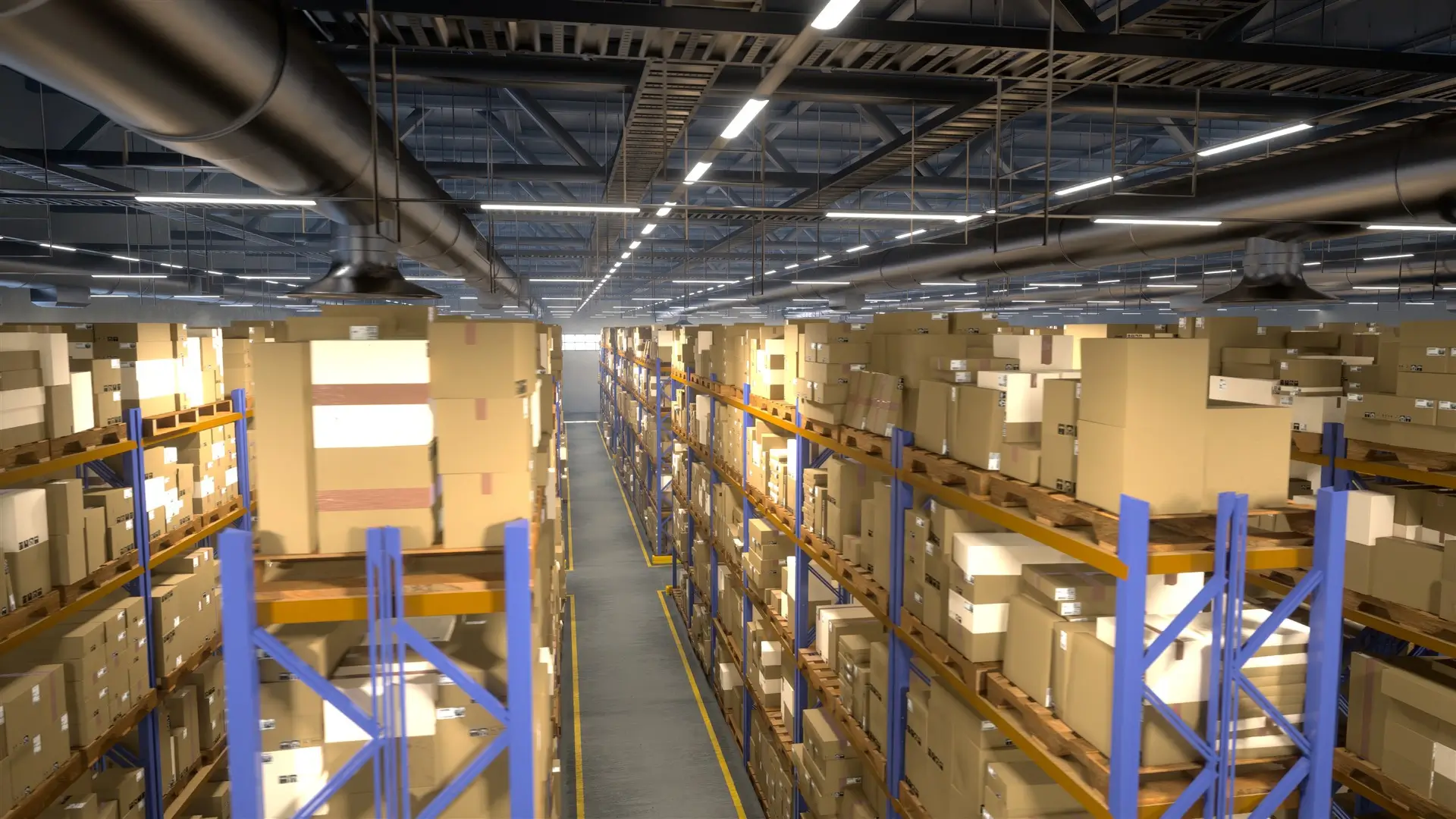
The Internet of Things (IoT) in warehouse management is a solution that uses a network of smart devices, including environmental sensors, wireless chip readers and video surveillance systems, to collect operational data continuously. Instead of relying on staff to inspect every corner of the warehouse manually with a notebook, IoT systems automatically digitize changes in temperature, humidity and access activity in real time.
By transmitting data instantly to a central management dashboard, businesses can detect risks of damage to goods early, prevent security incidents promptly and shift warehouse management from reactive responses to proactive control of operational quality.
What Is IoT in Warehouse Management, and How Does It Work?
Essentially, IoT acts as a digital nervous system covering the entire warehouse facility, connecting the physical space with modern supply chain management software systems.
Core components of a warehouse IoT system
A complete IoT ecosystem relies on the coordinated operation of five technology layers, from on-site data collection hardware to cloud-based analytics software.
The main components include:
- On-site measurement sensors: These include probes for air temperature and relative humidity, water-leak sensors, smoke detectors and infrared motion sensors.
- Asset identification and location devices: These use radio-frequency identification (RFID), two-dimensional barcodes and Bluetooth Low Energy location tags attached directly to pallets or boxes.
- Transmission infrastructure and intermediary gateways: Sensor data is collected by gateways using long-range wireless protocols such as LoRaWAN, industrial Wi-Fi networks or cellular connections.
- Central data-processing software platform: A visual cloud-based dashboard lets managers monitor changes in each zone and configure automatic alert scenarios.
- Integration with business software: Seamless connectivity with a warehouse management system (WMS), an enterprise resource planning (ERP) system and the building's access-control system.
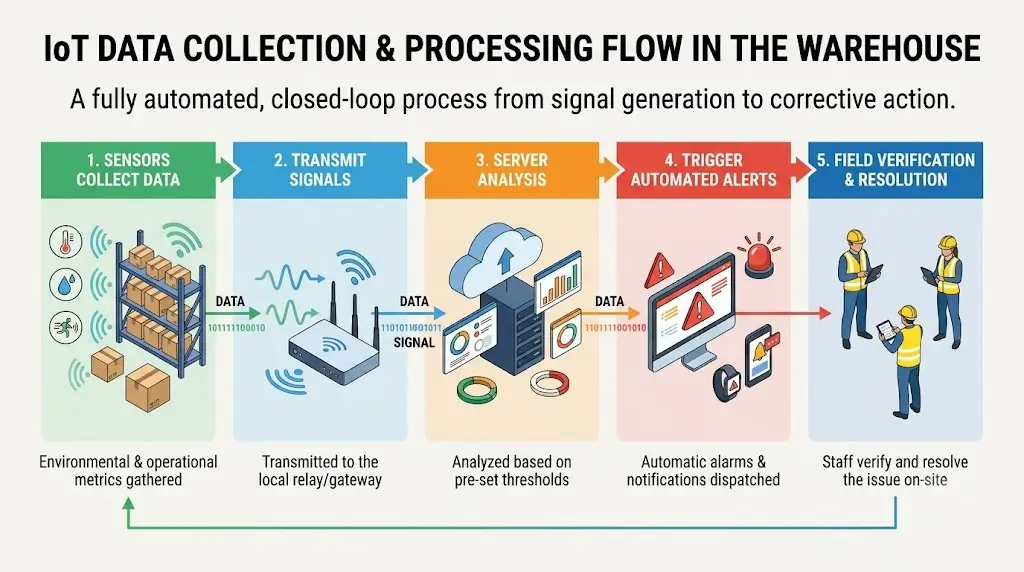
IoT data collection and processing flow in the warehouse
The data process inside a smart warehouse is fully automated and closed-loop, from the initial signal through to corrective action by staff.
The data flow is standardized through the following steps:
Sensors collect readings → Signals are transmitted to the gateway → The server analyzes data against preset thresholds → Automatic alerts are triggered → Staff verify and resolve the issue on site
When environmental readings such as temperature exceed safe limits, the system not only sends urgent text messages or mobile-app notifications to the warehouse supervisor, but can also automatically activate dehumidifiers or adjust ventilation and cooling capacity to restore the microclimate.
Differences and connections between IoT and WMS software
Many managers confuse the scope of IoT systems with that of warehouse management software, leading to fragmented investments that fail to deliver their combined potential.
The detailed comparison below clarifies how the two technology platforms complement each other:
|
Comparison criterion |
IoT sensors and devices |
Warehouse management system (WMS) |
|---|---|---|
|
Management focus |
Physical environment, equipment condition and facility security |
Inventory, storage locations and inbound/outbound processes |
|
Input data source |
Automatic measurements from sensor probes |
Shipping-label scans and staff data-entry operations |
|
Core task |
Monitor storage conditions and detect risks immediately |
Optimize picking routes and inventory accuracy |
|
How they work together |
Provide actual environmental data |
Receive IoT data to block overheated batches |
How Do Temperature and Humidity Sensors Control Storage Conditions?
Excessive temperature and humidity are two leading causes of deterioration in goods, degradation of raw materials and substantial financial losses for sellers.
Continuous temperature monitoring by zone and time
Different areas within a warehouse often have distinct temperature layers; areas near the metal roof are usually much hotter than ground level, while enclosed corners often lack circulating airflow.
Smart temperature sensors offer advanced monitoring capabilities:
- Continuous 24/7 measurements at intervals of one to five minutes create a detailed temperature map of the entire warehouse at each rack level.
- Prompt detection of refrigeration-compressor or industrial ventilation-fan failures before the storage compartment exceeds dangerous temperatures.
- Retention of complete temperature-history logs for legal verification and to demonstrate cold-chain compliance for pharmaceuticals, cosmetics and fresh food.
Humidity sensors help prevent mold and water-leak damage
Vietnam's tropical monsoon climate, with humidity frequently exceeding 80% during the rainy season, is a constant threat to many product categories.
Applications of humidity and water-leak sensors:
- Measure relative humidity around racks holding paper and cardboard goods, stored documents, wood products and textiles, preventing mold growth before it begins.
- Place water-leak probes directly on the floor at high-risk points such as receiving and dispatch doors, the bases of utility shafts and along roof rainwater drainage pipes.
- Trigger alarms as soon as water spreads across the warehouse floor, enabling staff to move goods to higher positions before it penetrates cardboard packaging.
Automatic alerts and incident response when thresholds are exceeded
A professional IoT system never leaves data sitting idle on a screen; it establishes proactive responses for different risk levels.
The intelligent alert process includes:
- Level 1 alert (just beyond the safe threshold): The system sends a push notification to the on-duty technician's app to inspect the air-conditioning system.
- Level 2 alert (dangerous threshold exceeded for more than 15 minutes): The system automatically calls or sends urgent messages to the warehouse director and facility safety officer.
- Digital incident-response records: Record when the incident occurred, the time needed to restore safe conditions and notes on its cause to support preventive maintenance.
The following table illustrates environmental monitoring standards for several common categories of goods:
|
Stored goods category |
Environmental readings to monitor |
Recommended control range |
Main preservation objective |
|---|---|---|---|
|
Documents, books and paper packaging |
Relative humidity and room temperature |
Humidity 50%–60%, temperature below 28°C |
Prevent mold, yellowing and insect damage |
|
Electronic components, chips and circuit boards |
Relative humidity and static electricity |
Humidity 30%–50%, temperature 20°C–25°C |
Prevent corrosion of solder joints and short circuits |
|
Pharmaceuticals, vaccines and health-protection foods |
Cold-room or cool-room temperature |
Cool storage 15°C–25°C, cold storage 2°C–8°C |
Meet Ministry of Health GSP standards and preserve medicinal properties |
|
Premium wooden furniture and handicrafts |
Equilibrium wood moisture and temperature |
Humidity 45%–60%, stable temperature |
Prevent warping, cracking and peeling paint |
Important note: Businesses should not apply the same temperature and humidity level to every type of goods. IoT alert thresholds must be based on manufacturers' technical instructions and relevant specialist inspection standards.
How Does IoT Support Warehouse Security and Incident Detection?
In addition to controlling air quality, IoT creates a multilayer protection network that helps prevent inventory losses and improves fire and explosion safety.
Motion sensors and door-status monitoring in restricted areas
Areas containing high-value goods, such as precious-metal storage, technology-equipment storage or server rooms, always require strict security procedures.
Security sensors provide robust layers of protection:
- Magnetic door sensors: Detect and immediately alert staff if a storage-compartment door opens outside authorized working hours or is forced open.
- Passive infrared motion sensors: Scan internal aisles at night and detect unauthorized entry even when all lighting is switched off.
- Emergency-exit and receiving/dispatch door monitoring: Alert staff when loading-bay doors remain ajar too long, allowing cooled air to escape outside.
Combining IoT with surveillance cameras, access cards and RFID identification
The real strength of modern security lies in connecting actual video footage with electronic identification data.
Discussing this integration trend in Automation Today magazine, an industrial security solutions expert explains:
"A standalone camera merely records what happened so it can be reviewed after goods go missing. But when a camera is synchronized with an IoT sensor network and card-based door access control, the system becomes an intelligent guard: as soon as unusual movement occurs at the warehouse door, the camera automatically turns toward that location, zooms in on the person's face or vehicle license plate and sends the images straight to the manager's phone."
Interconnected devices provide complete transparency:
- Security cameras automatically mark footage when a door sensor records an opening event, allowing investigation data to be retrieved within seconds rather than searching through dozens of hours of recordings.
- Card readers accurately identify the employee opening the door and check access permissions for each shift to eliminate the risk of internal fraud.
- RFID readers at receiving and dispatch doors automatically count boxes passing through and immediately raise an alert if an item has no outbound order in the WMS.
Early warning of environmental risks and fire hazards
Warehouses hold large quantities of flammable materials such as wooden pallets, cardboard boxes and plastic wrapping, making early detection of fire sources essential.
Supplementary safety-sensor solutions include:
- Photoelectric smoke detectors: Detect airborne smoke particles during the smoldering stage before flames develop into a major fire.
- Carbon monoxide and rate-of-rise heat sensors: Identify sudden changes in air composition and localized heat near main electrical distribution panels.
- Note on legal requirements: The IoT environmental-sensor network must be understood as a supplementary early-warning system. It does not replace the dedicated fire-prevention and firefighting system that has undergone the legally required police design appraisal and acceptance inspection.
An illustrative coordinated response to a security incident
A practical example demonstrates the advantages of an integrated system: at 2 a.m. on Sunday, the door to a component-storage unit unexpectedly opens. Its magnetic sensor sends a signal to the cloud server within one millisecond. The system checks the schedule and finds no approved work order for that time.
Immediately, the on-site alarm sounds, the nearest camera turns toward the door to photograph the intruder's face, and a red-alert message is sent to the security team leader and business owner. The entire response takes less than 15 seconds, allowing on-site security personnel to intervene before goods are moved.
Benefits, Costs and Implementation of IoT in Warehouse Management
IoT is no longer an expensive playground reserved for multinational corporations. It has become a practical cost-optimization tool for any business needing proper storage conditions.
Quantifiable operational performance indicators
A market analysis report from technology research firm Gartner indicates that using IoT in supply chains and warehousing helps businesses reduce environmentally caused damage to goods by up to 30% and cut mechanical-equipment idle time by 20%.
Core key performance indicators (KPIs) include:
- Time to detect environmental incidents: Reduced from several hours, while waiting for staff inspection rounds, to under 30 seconds after temperature or humidity exceeds the permitted threshold.
- Share of stored goods meeting quality standards: Raise the proportion of batches retaining their quality to 99.8%, completely eliminating partners' compensation claims for mold damage.
- Labor costs for manual recordkeeping: Save warehouse supervisors hundreds of working hours each month otherwise spent walking around with thermometers and writing readings in logbooks.
Cost components of an IoT system investment
The budget for a warehouse IoT project depends on floor area, sensor density and the complexity of connected software.
A typical investment cost structure includes:
- Initial hardware procurement: The cost of wireless temperature/humidity sensors, door sensors, location tags and network gateways.
- Survey and installation costs: Labor for mapping radio coverage in the warehouse, wiring gateway power supplies and testing sensor coverage.
- Cloud management software licensing fees: Usually paid monthly or annually according to the number of sensor devices connected to the system.
- Periodic device calibration costs: Measuring and recalibrating temperature and humidity sensor accuracy after every 12 months of use in accordance with measurement-quality standards.
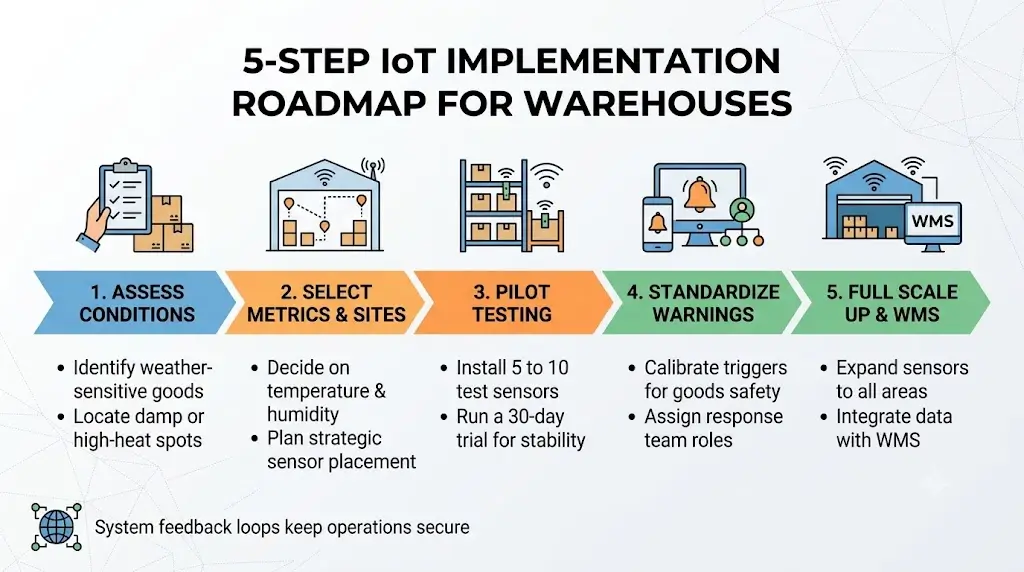
A five-step roadmap for deploying warehouse IoT
To ensure project success and avoid wasting the budget, businesses should follow a standardized step-by-step roadmap:
Assess existing conditions and risks → Select priority measurements → Run a small-scale pilot → Standardize response procedures → Expand across the facility and integrate with WMS
- Step 1: Assess existing conditions and risks: Identify the goods most sensitive to weather and the dead spots where moisture or heat may accumulate.
- Step 2: Select measurements and strategic installation locations: Decide whether to monitor temperature, humidity or door security; map sensor positions on the highest-risk racks.
- Step 3: Run a pilot in one zone: Install five to ten sensors in a sample storage unit for 30 days to assess signal-transmission stability.
- Step 4: Standardize alert thresholds and recipient permissions: Set temperature and humidity thresholds precisely according to product standards and assign responsibilities for responding to alarms.
- Step 5: Evaluate results and expand throughout the facility: Review the savings achieved, install sensors across the full warehouse area and connect data to the WMS.
Criteria for selecting IoT hardware and software solutions
Businesses should carefully consider the following five technical criteria before choosing a provider:
- Sensor accuracy and battery life: Temperature sensors should have an error below 0.5°C and batteries lasting at least two to three years of continuous operation without replacement.
- Wireless connection stability: Prioritize specialized protocols such as LoRaWAN, which can penetrate dense steel racking much better than ordinary Wi-Fi.
- Intelligent disconnection alerts: The system must automatically detect and report any sensor that unexpectedly loses power or stops transmitting to the server.
- Report exports for quality inspections: The software must easily export historical temperature and humidity charts in standard file formats for regulators or partner auditors.
- Warranty and on-site technical support: The provider must have engineers available to replace faulty components within 24 hours.
Indicative Costs of IoT Devices and Smart Storage Solutions in Ho Chi Minh City
Businesses can choose between two approaches: purchasing equipment for their own warehouse, or renting serviced storage units with smart sensors already integrated.
The following table provides indicative market costs updated for late 2026:
|
Equipment or service |
Billing basis |
Estimated indicative price (VND) |
Technical notes |
|---|---|---|---|
|
Industrial temperature and humidity sensor |
Per device |
650,000–1,800,000 / device |
Wireless sensor, two-to-three-year battery life, on-device display |
|
Central network gateway |
Per unit |
4,500,000–9,500,000 / unit |
One gateway can provide coverage for 30–50 sensors |
|
Cloud monitoring software subscription |
Per month / device |
35,000–70,000 / sensor / month |
Includes historical data storage, heat maps and alert messages |
|
Magnetic door and motion sensor |
Per device |
450,000–950,000 / device |
Sends an alert when a door opens outside authorized hours |
|
MyStorage smart self-storage rental |
Per month / storage unit |
From 900,000 / month |
Private storage unit with integrated temperature/humidity control and 24/7 security |
Important note: The equipment prices above are common market estimates for preliminary budgeting. Actual costs may vary according to whether the equipment brand is European, Japanese or domestic, as well as the structural conditions of the individual warehouse building.
Applying IoT to warehouse management is not simply about adding expensive gadgets. It is a strategic step toward a transparent, reliable supply chain that remains resilient through changing weather conditions. When every package is protected in an environment monitored every second, businesses can confidently deliver products of the highest quality to consumers.
If you are looking for an absolutely safe goods-storage solution without spending hundreds of millions of dong on a complex sensor installation, MyStorage's smart self-storage system in Ho Chi Minh City is an ideal choice. With every facility equipped with internationally standardized air conditioning and humidity control, 24/7 security cameras and storage units in a range of sizes from a few square meters to several dozen, MyStorage provides proper preservation conditions so you can focus confidently on growing your business.
Frequently Asked Questions About IoT in Warehouse Management
Below are detailed answers to the most common questions warehouse managers ask when exploring and adopting IoT monitoring technology.
1. Should a small warehouse invest in IoT sensors?
If you store ordinary goods that are not temperature-sensitive, it may not be necessary. However, if you sell cosmetics, health supplements, important documents or electronics, a few basic temperature and humidity sensors represent a small investment that can prevent tens of millions of dong in mold-related losses.
2. Can dense steel racks obstruct wireless sensor signals?
Ordinary Wi-Fi or Bluetooth signals are significantly weakened when passing through steel racks. Professional warehouse solutions therefore use low-frequency radio technologies such as LoRaWAN, with longer wavelengths, excellent obstacle penetration and ranges of hundreds of meters inside warehouse buildings.
3. How long do temperature and humidity sensor batteries last?
Energy-efficient data transmission means industrial temperature and humidity sensors consume power only when sending periodic data packets, allowing their batteries to operate continuously for two to five years before replacement.
4. Can an IoT system keep working during a power or internet outage?
Yes. Dedicated gateways are equipped with rechargeable backup batteries and internal buffer memory. When the internet connection fails, the gateway continues collecting sensor data and temporarily stores it on a memory card. Once connectivity returns, it automatically uploads the missing data to the cloud server without losing measurement logs.
5. Can IoT temperature and humidity sensors replace GSP pharmacy documentation inspections?
IoT systems provide highly accurate automatic measurement logs for internal monitoring. However, to meet health-authority inspection requirements for Good Storage Practice (GSP) certification, all measuring devices must carry valid periodic calibration certification from state-designated measurement-quality centers.
6. How many temperature and humidity sensors does a 1,000 m² warehouse need?
The number depends on ceiling height and the uniformity of ventilation. Typically, a 1,000 m² warehouse storing standard goods requires four to eight sensors distributed near receiving/dispatch doors, in the center, beside sun-facing walls and on upper rack levels.
7. Can businesses buy and install sensors themselves, or must they hire professionals?
Modern wireless smart-sensor solutions are simple to install on a plug-and-play basis. Businesses only need to scan the device code in a phone app and attach the sensor to a rack with suitable mounting tape, without drilling walls or running complicated electrical wiring.
8. How does MyStorage control temperature and humidity in Ho Chi Minh City?
All MyStorage warehouses in Ho Chi Minh City operate industrial air conditioning and dedicated dehumidifiers continuously, 24/7, keeping temperatures cool below 25°C and relative humidity strictly below 60% to maximize protection for customers' goods and documents.
9. Do IoT sensors automatically adjust warehouse temperature and humidity?
Sensors mainly measure and transmit data; not every device can independently control an air conditioner or dehumidifier. Automatic adjustment is possible only with compatible controllers, tested operating scenarios and verified safety limits. If standalone sensors are installed, someone must be assigned to receive alerts and respond at the warehouse.
10. What should IoT alert thresholds be based on?
They should reflect each product's storage requirements, the manufacturer's instructions and actual operating conditions. Distinguish early-warning thresholds from emergency-action thresholds, and test alert delays to limit notifications caused by brief fluctuations when doors open. Do not use one temperature or humidity level for every product category.
11. Where should sensors be placed to reflect actual warehouse conditions?
Survey the warehouse before selecting sensor locations and quantities. When designing the warehouse layout, identify areas prone to heat or moisture accumulation, locations near doors and different rack levels; avoid measuring only at one convenient point. Do not place a probe directly in a cold-air stream if the aim is to monitor the conditions goods actually experience. Reassess measurement locations after rearranging racks or changing ventilation.
12. What data is needed to integrate IoT with WMS?
Businesses need consistent sensor identifiers, measurement locations or zones, units, timestamps and a method of associating readings with storage locations or batches. They should also check the data-exchange methods supported by both systems. Pilot the integration in a small area, reconcile the data and define who may handle alerts before expanding; do not assume every sensor connects directly to every WMS.
13. How long should temperature and humidity logs be retained?
Retention should depend on product requirements, customer contracts, traceability needs and applicable industry regulations, rather than one fixed period for all warehouses. When selecting a solution, check data export, backup, time synchronization and access to historical data after cancelling the subscription. Logs should record both alerts and corrective actions to support incident reviews.
14. How should warehouse IoT permissions and data be protected?
Separate permissions for viewing data, changing alert thresholds and managing devices according to job roles. Use individual accounts, limit unnecessary privileges, change default credentials and update software following the provider's guidance. Record configuration changes, protect data in transit and at rest, and revoke access when employees or contractors no longer manage the system.
15. For environmental control, should you choose self-storage, valet storage or auto lockers?
Self-storage provides a private unit for each customer, with AC and temperature control. Valet storage is shared storage with an all-inclusive pickup-and-delivery service, billed by the volume used; AC availability and temperature/humidity control depend on the package. Auto lockers are centrally located and offer flexible hourly rental; do not assume they provide the same preservation conditions as self-storage. For sensitive goods, confirm the storage requirements, consider suitable cool storage with temperature and humidity control, and ask what monitoring data the selected package can provide.
Related articles

Article
Rent a Ready-Built Warehouse or Build Your Own? Comparing Costs and Timelines
When expanding storage and distribution capacity, business leaders often face a critical strategic decision: should they rent a ready-built warehouse or invest their own capital in building…
Read article

Article
Can You Use an Apartment as a Warehouse or Office? Space Solutions for Online Shops and Small Businesses
Is it legal to rent an apartment as a warehouse or office? Explore the rules, risks, and suitable storage solutions for online shops and small businesses.
Read article

Article
Combining Storage Rental and Livestreaming for Online Shops: An Efficient Operating Model
Combining storage rental with a livestreaming space is a modern operating solution that allows online sellers to integrate product storage, sample preparation, live sales sessions, and…
Read article
